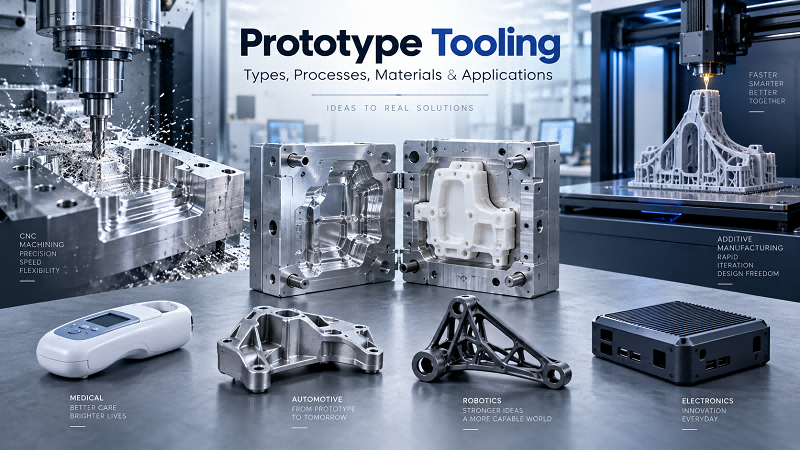
Rapid molds, by integrating technologies such as CNC machining, additive manufacturing, casting, and rapid injection molding, enable manufacturers to produce molds, dies, fixtures, and other tools within shorter delivery times.
The speed and flexibility of this technology are particularly valuable in the processes of prototype design, product verification, bridge production, and small-batch production.
This guide explains what a rapid mold is, how the rapid mold machine works, and the main mold types, materials, design requirements, costs, and other content involved in modern rapid mold manufacturing.
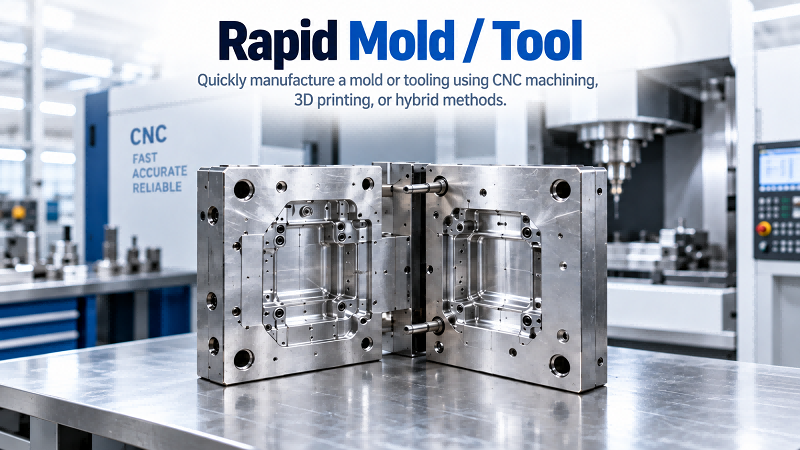
What Is Rapid Tooling?
Rapid prototyping is a manufacturing method that can create molds, patterns, fixtures, and production tools more quickly, usually combined with CNC machining, 3D printing, casting, or other rapid manufacturing technologies.
It is used to produce prototype molds and small-batch molds for processes such as injection molding, thermoforming, die casting, silicone molding, and composite material manufacturing.
Rapid molds focus on shorter delivery times, lower initial investment, and durability for sufficient prototype or bridge production quantities.
Therefore, rapid molds fill the manufacturing gap between rapid prototyping and full-scale production, allowing companies to verify designs, materials, assembly performance, surface quality, and manufacturing feasibility before investing in expensive production molds.
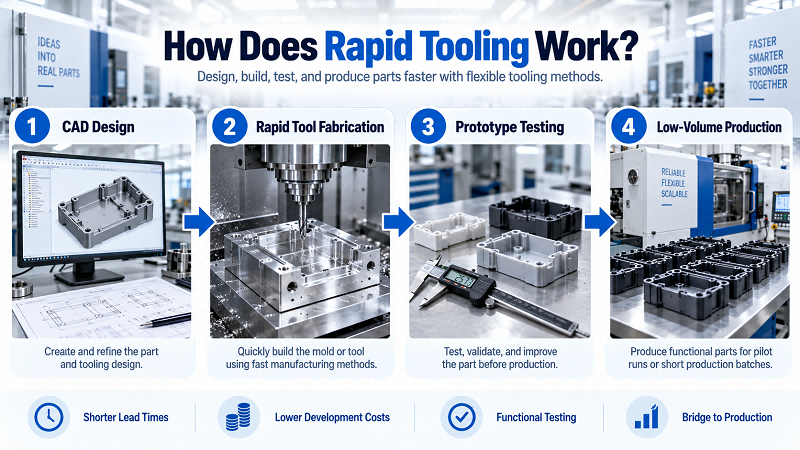
How Does Rapid Tooling Work?
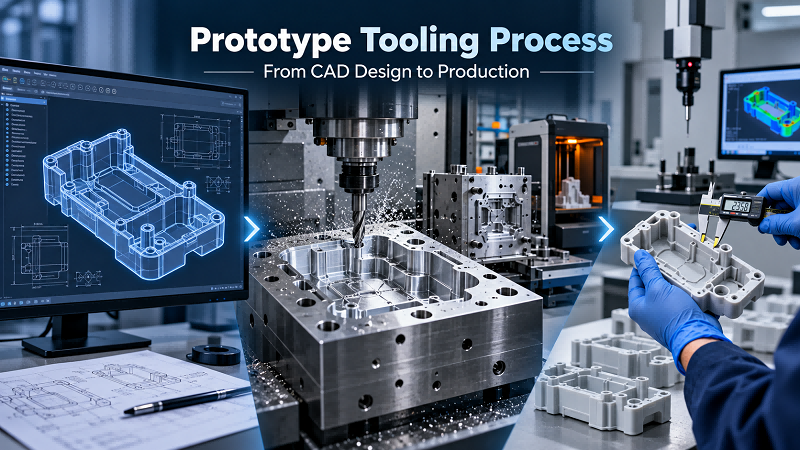
Rapid manufacturing starts with a finished 3D CAD model of the part. Engineers then run a manufacturability check. They identify parting lines, draft angles, wall thicknesses, undercuts, gate positions, cooling needs, and proper mold materials.
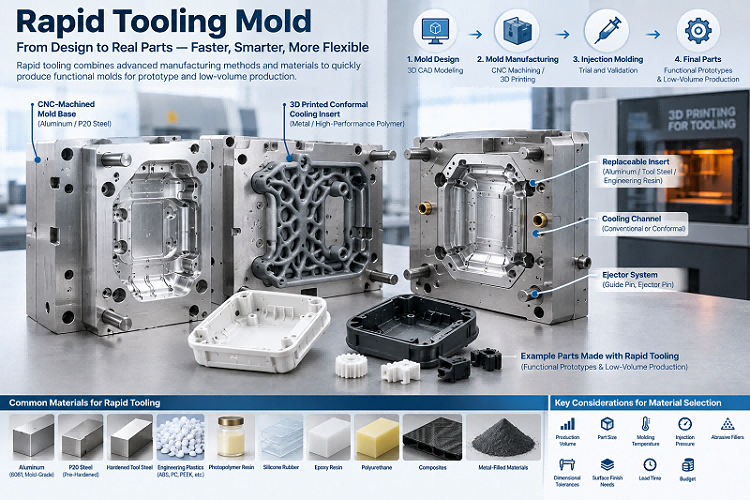
Next, engineers design the mold and choose production methods. Common choices include CNC machining for aluminum inserts, low-carbon steel machining, 3D-printed mold parts, mold casting, or a mix of additive and subtractive processes.
After machining or 3D printing, workers polish, heat-treat, and coat the mold. They assemble the mold, check its dimensions, and make test samples. The mold can only produce real parts after passing all checks.
Digital manufacturing cuts many traditional tooling steps. It also lets users change designs quickly. For this reason, rapid tooling works well for products still under development for engineering validation.
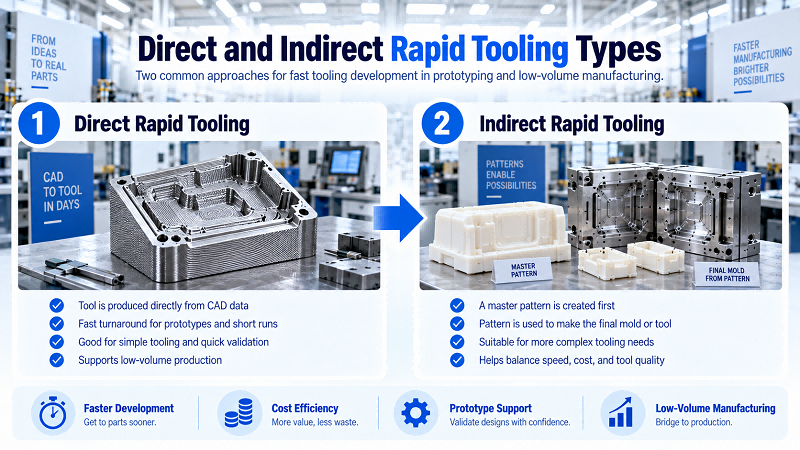
What Are the Rapid Tooling Types?
Rapid tooling falls into two main types: direct and indirect. Direct rapid tooling uses CNC machining, metal additive manufacturing, or polymer 3D printing. These methods make molds, inserts, and tool parts straight from CAD files. They remove extra production steps.
Indirect rapid tooling works differently. Engineers first build a master model or pattern. They then make the final mold through replication methods. Common options include silicone casting, epoxy molding, investment casting, and spray metal molding.
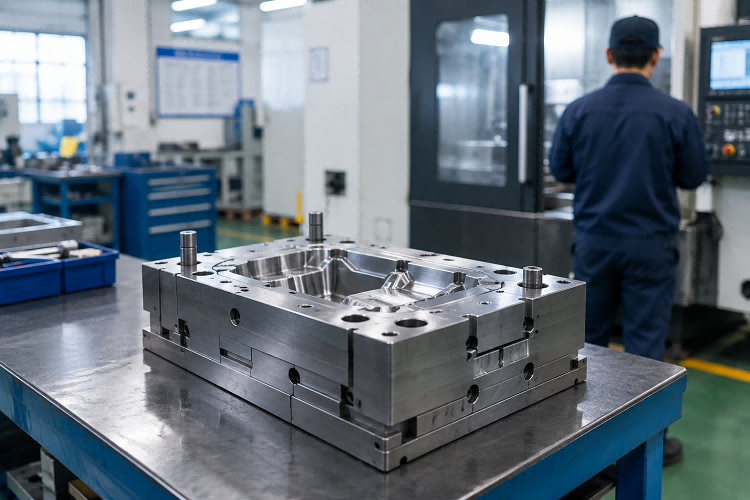
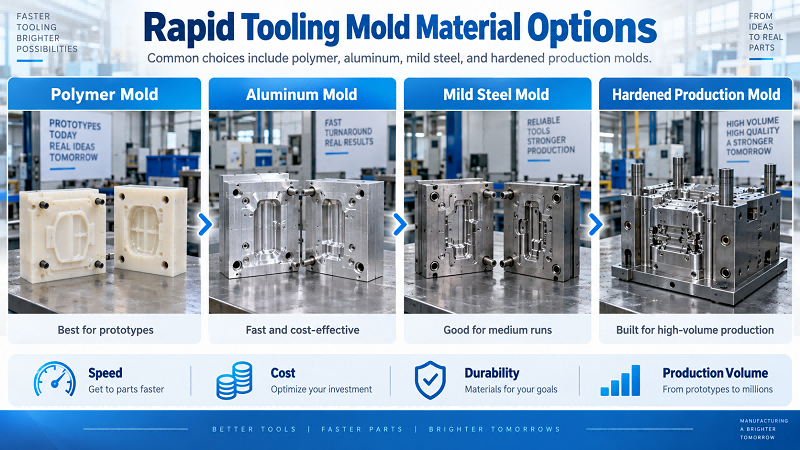
Aluminum and mild steel injection molds are the most common choices. Teams use them for engineering prototypes and small-batch runs. These molds have better durability, dimensional accuracy, and material compatibility than most temporary plastic tools. They also take less time to build than traditional hardened steel production molds.
Considerations for Making Prototyping Molds
When you build prototype molds, first find out how many parts you need. The expected production quantity heavily affects your mold choice: polymer, aluminum, mild steel, or hardened production molds.
Engineers also check other key factors. These factors include the molding material, mold temperature, injection pressure, part complexity, dimensional tolerances, surface finish, undercuts, inserts, and required tool life. Engineers also confirm whether the prototype must match real production conditions.
Keep mold designs simple. The mold still needs to recreate all critical product features.
Teams also need to pick which features matter most for validation. This practice lets engineers focus work on functional sizes, assembly joints, sealing faces, cosmetic surfaces, and other features that directly affect product performance.
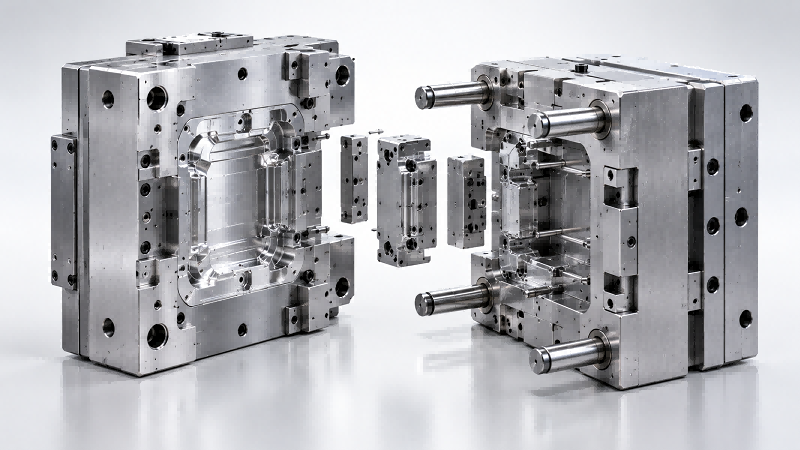
Advantages of Rapid Tooling in Manufacturing
Rapid tooling cuts product development time. Teams can build molds and fixtures in days or weeks.
Rapid tooling also reduces initial costs. Companies can make dozens, hundreds, or even thousands of parts that match production quality before mass manufacturing. These parts support design checks, certification, market trials, pilot production, and early customer shipments.
Design flexibility is another key benefit. If engineers find problems with dimensions, function, or assembly during testing, they can change CAD files and mold inserts. They do not need to replace an entire expensive production mold.
Most importantly, rapid injection molding uses real engineering plastics to make prototypes. Common materials include ABS, PC, POM, PA, PP, PEEK, and glass-filled polymers. These prototypes give engineers reliable performance data. The data reflects the final product much better than parts made only by 3D printing.
Applications of Rapid Tooling
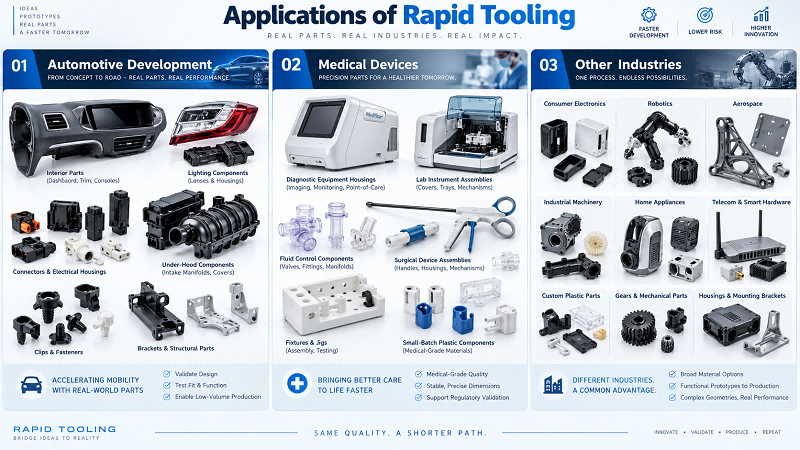
Rapid tooling sees heavy use in automotive development. Engineers make prototype interior parts, connectors, housings, clips, brackets, lighting pieces, and under-hood components. They test these parts with real production materials before vehicle validation.
Medical device makers use rapid tooling too. They build diagnostic equipment housings, lab instrument assemblies, fluid control parts, surgical device assemblies, fixtures, and small batches of plastic components. These parts need stable dimensions, compatible materials, and controlled manufacturing processes.
Many other industries also adopt rapid tooling. These industries include consumer electronics, robotics, aerospace, industrial machinery, home appliances, telecom, and smart hardware. Manufacturers produce housings, structural pieces, functional prototypes, gears, connectors, mounting brackets, and custom plastic parts.
What Are Some Advanced Techniques Used in Rapid Tooling?
Advanced rapid tooling often combines additive and subtractive manufacturing. Teams 3D print complex mold inserts near their final shape. Then they use CNC machining on critical sealing surfaces, parting lines, holes, and precision features. This machine delivers tighter tolerances.
Metal additive methods like selective laser melting and direct metal laser sintering make conformal cooling channels. These channels follow the shape of molded parts. They can balance temperature better and cut cycle times for certain applications.
Other available technologies include high-speed machining, 5-axis CNC machining, laser texturing, vacuum casting masters, metal-filled epoxy molds, hybrid mold inserts, swappable inserts, and modular mold bases. Manufacturers also apply advanced surface coatings. These coatings improve wear resistance or part release.
Engineers also use digital simulation in mold development. They study mold filling, cooling, warpage, shrinkage, gate positions, and possible defects. They run all these checks before building the physical mold.
What Are the Machines and Equipment Required for Rapid Tooling?
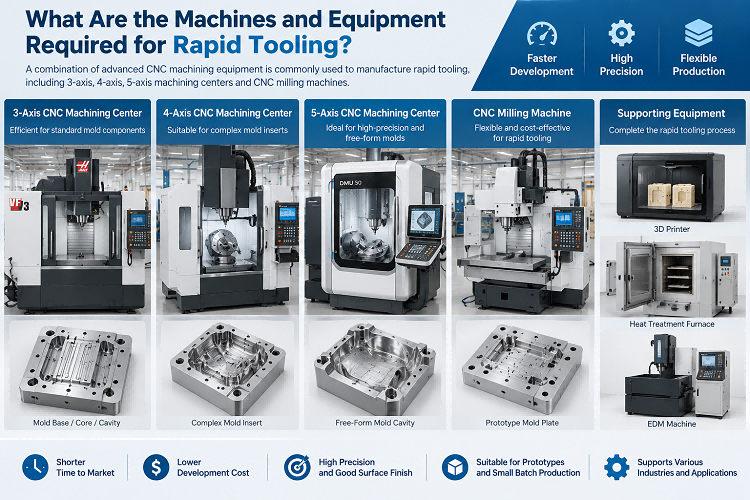
CNC milling machines are key equipment for rapid manufacturing. They cut materials like aluminum, tool steel, copper, graphite, engineering plastics, and mold inserts. They provide precise dimensions and good surface quality.
Manufacturers may also use other machines for different projects. These include CNC lathes, EDM machines, wire EDM, surface grinders, laser cutters, CMMs, injection molding machines, vacuum casting systems, industrial 3D printers, polishing tools, and heat treatment equipment.
3-axis machining works well for most simple mold plates and cavities. 4-axis and 5-axis CNC machines simplify complex shapes, deep cavities, angled features, and multi-sided mold parts. They need fewer setups.
Inspection tools are also important. CMMs, optical measuring systems, height gauges, micrometers, and surface roughness testers check mold sizes before trial runs. This step reduces expensive mold changes later.
What Are the Main Rapid Tooling Parameters?
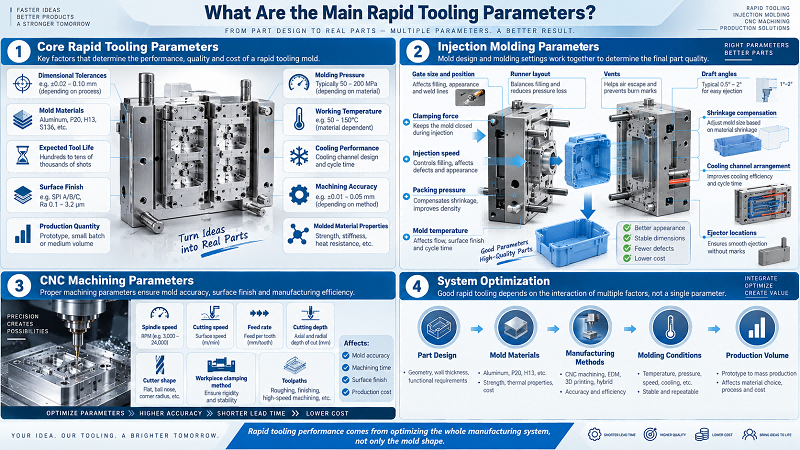
Teams track many core parameters for rapid tooling. These items include dimensional tolerances, mold materials, expected tool life, surface finish, production quantity, molding pressure, working temperature, cooling performance, machining accuracy, and the properties of the molded material.
In injection molding work, engineers check extra settings. They review gate size and position, runner layout, vents, draft angles, shrinkage compensation, cooling channel arrangement, ejector locations, clamping force, injection speed, packing pressure, and mold temperature. Every setting impacts the final part quality.
CNC machining settings also matter. Spindle speed, cutting speed, feed rate, cutting depth, cutter shape, workpiece clamping method, and toolpaths all change mold accuracy, machining time, surface finish, and production cost.
So, good rapid tooling needs optimization across the whole manufacturing system. Teams cannot only focus on mold shape. Mold performance comes from the interaction between part design, mold materials, manufacturing methods, molding conditions, and production volume.
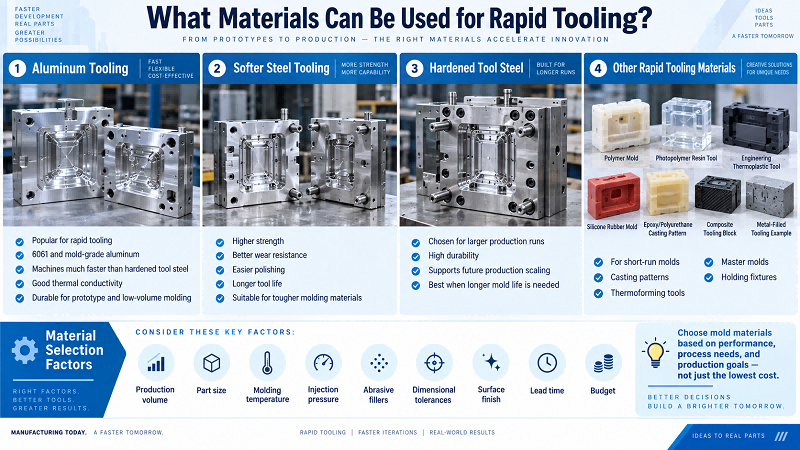
What Materials Can Be Used for Rapid Tooling?
Aluminum is a popular material for rapid tooling. Alloys such as 6061 and special mold-grade aluminum machine much faster than hardened tool steel. They deliver good thermal conductivity and enough durability for most prototype and low-volume molding jobs.
Teams pick softer steels like P20 when they need higher strength, better wear resistance, easier polishing, longer tool life or compatibility with tougher molding materials. Engineers choose hardened tool steels if rapid tooling will support larger production runs later.
Manufacturers also use polymers, photopolymer resins, engineering thermoplastics, silicone rubber, epoxy resins, polyurethanes, composites and metal-filled tooling materials. These materials make short-run molds, casting patterns, thermoforming tools, master molds, and holding fixtures.
Material selection must consider production volume, part size, molding temperature, injection pressure, abrasive fillers, dimensional tolerances, surface finish needs, lead time, and budget. Teams should not just pick the lowest-cost mold material.
Is Rapid Tooling Expensive?
Companies often choose rapid tooling for prototypes, bridge tooling, or low-to-medium production runs. Rapid tooling usually costs less than traditional production tooling. It uses easier-to-machine materials and simpler mold designs.
Many factors change the final cost. These factors include mold size, cavity count, part complexity, tolerances, surface finish, mold material, slides, lifters, inserts, cooling systems, molding material, tool life, and production quantity.
A simple single-cavity aluminum prototype mold stays affordable. But a complex multi-cavity mold needs multiple slides, precision inserts, tight tolerances, and polished surfaces. This kind of mold still costs a lot.
So teams should not just compare rapid tooling against low-cost tooling. They need to evaluate total development cost and business risks. They weigh rapid product validation against the higher investment needed for high-volume production molds.
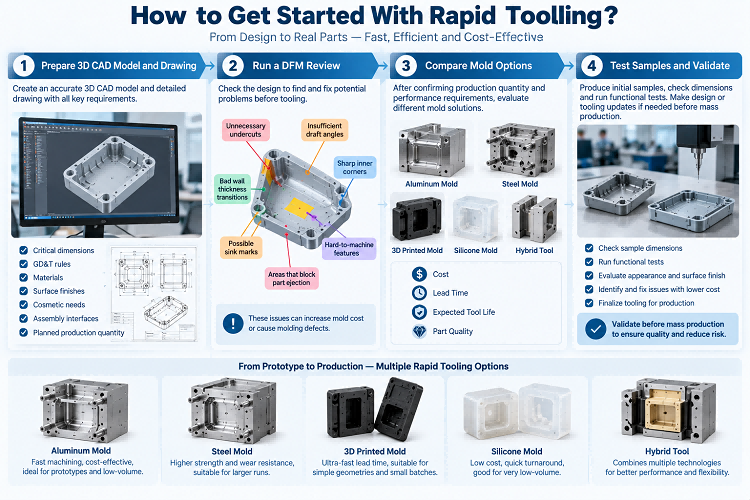
How to Get Started With Rapid Tooling?
Teams first prepare an accurate 3D CAD model and drawing. The document lists critical dimensions, GD&T rules, materials, surface finishes, cosmetic needs, assembly interfaces, and planned production quantity.
Then the manufacturer runs a DFM review. This check finds design problems. Common issues include unnecessary undercuts, insufficient draft angles, bad wall thickness transitions, hard-to-machine features, sharp inner corners, possible sink marks, and areas that block part ejection. These problems raise mold cost or create molding defects.
After teams confirm production quantity and performance requirements, engineers compare different mold choices. The options include aluminum molds, steel molds, 3D printed molds, silicone molds, and hybrid tools. They judge each option by cost, lead time, expected tool life, and part quality.
Before mass production, workers test the first samples. They check sample dimensions and run functional tests. Teams can update the rapid tooling with lower cost if they find issues at this stage.
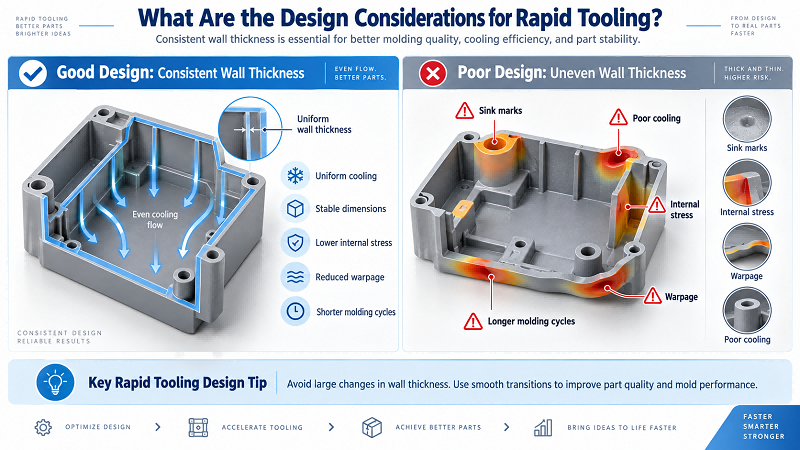
What Are the Design Considerations for Rapid Tooling?
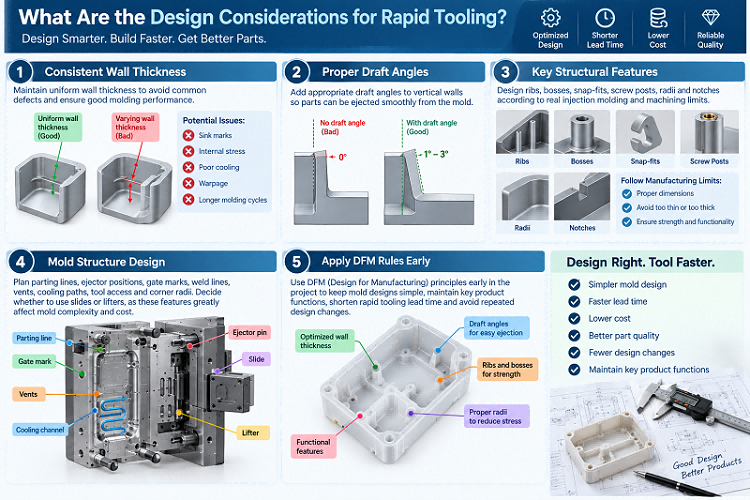
Good rapid mold design starts with consistent wall thickness. Big changes in wall thickness create sink marks, internal stress, poor cooling, warpage and longer molding cycles.
Designers add proper draft angles to vertical walls. These angles let parts separate from the mold smoothly. Engineers also design ribs, bosses, snap-fits, screw posts, radii, and notches. They follow real injection molding and machining limits.
Engineers carefully plan parting lines, ejector positions, gate marks, weld lines, vents, cooling paths, tool access, and corner radii. They also decide whether to use slides or lifters. These features greatly change mold complexity and cost.
Teams apply DFM rules early in the project. This practice keeps mold designs simple and keeps key product functions intact. It cuts rapid tooling lead time and prevents repeated design changes.
What Is the Environmental Impact of Rapid Tooling?
Good rapid mold design starts with consistent wall thickness. Big changes in wall thickness create sink marks, internal stress, poor cooling, warpage, and longer molding cycles.
Designers add proper draft angles to vertical walls. These angles let parts separate from the mold smoothly. Engineers also design ribs, bosses, snap-fits, screw posts, radii, and notches. They follow real injection molding and machining limits.
Engineers carefully plan parting lines, ejector positions, gate marks, weld lines, vents, cooling paths, tool access, and corner radii. They also decide whether to use slides or lifters. These features greatly change mold complexity and cost.
Teams apply DFM rules early in the project. This practice keeps mold designs simple and keeps key product functions intact. It cuts rapid tooling lead time and prevents repeated design changes.
What Are Some Common Problems and Defects With Rapid Tooling?
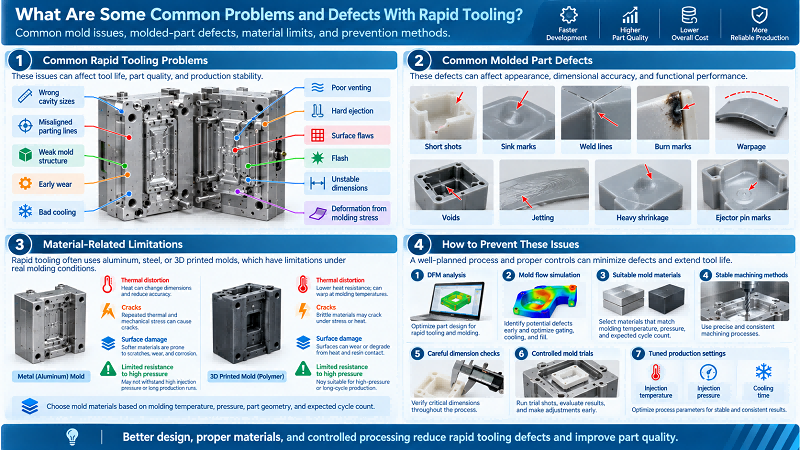
Rapid tooling has several common problems. They include wrong cavity sizes, misaligned parting lines, weak mold structure, early wear, bad cooling, poor venting, hard ejection, surface flaws, flash, unstable dimensions, and deformation from molding stress.
Poorly optimized mold design and process settings create defects on molded parts. These defects include short shots, sink marks, weld lines, burn marks, warpage, voids, jetting, heavy shrinkage, and ejector pin marks.
Polymer and 3D-printed molds can develop thermal distortion, cracks, and surface damage. They also cannot withstand high pressure. Engineers must pick mold materials based on molding temperature, pressure, part shape, and expected cycle count.
Teams can prevent most of these issues. They use DFM analysis, mold flow simulation, suitable mold materials, stable machining methods, careful dimension checks, controlled mold trials, and tuned production settings such as injection temperature, pressure, and cooling time.
How Does Rapid Tooling Compare With Traditional Tooling?
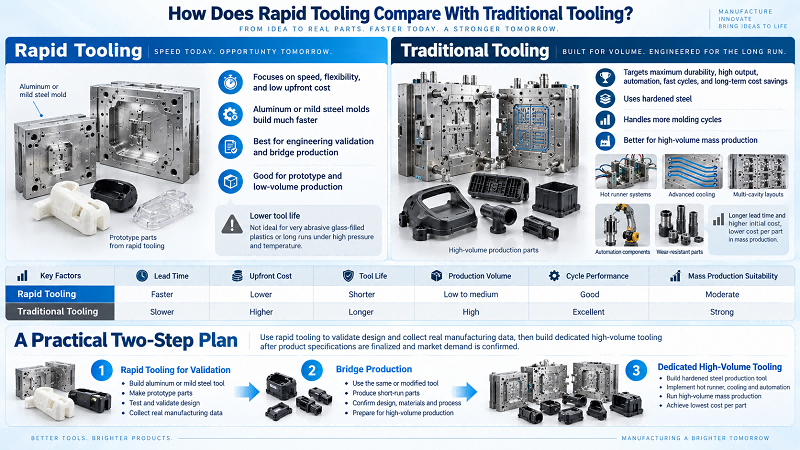
Rapid tooling focuses on speed, flexibility, and low upfront cost. Traditional tooling targets maximum durability, high output, automation, fast cycles, and long-term cost savings.
Aluminum or mild steel rapid molds build much faster than hardened production molds. But they cannot handle as many molding cycles. This limitation is obvious when teams mold abrasive glass-filled plastics or run under high pressure and temperature.
Traditional production molds use hardened steel. They may include hot runner systems, advanced cooling, multi-cavity layouts, automation parts, and wear-resistant components. These features extend lead time and raise initial cost, but they reduce each part’s cost in mass production.
So many new product teams use a two-step plan. They use rapid tooling for engineering validation and bridge production. Real manufacturing data helps them fix the design. Then they build dedicated high-volume tooling after finalizing product specs and confirming market demand.

Why choose NOBLE as your Rapid Tooling Manufacturer
NOBLE is a Sino-British joint venture awarded by the government as a “National High-tech Enterprise”. We have two major business directions: “Smart Manufacturing” and “Care Products”. The “Smart Manufacturing” business specializes in providing customers with project-supporting services, including parts machining and manufacturing.
More than 10 years of professional manufacturing and rapid prototyping experience. Our efficient team provides strong support for your new projects to 100% realize your requirements; Standardized management brings strict quality control of parts & products; a reasonable workflow achieves lower costs with the same quality.
After years of hard work and development, NOBLE has gradually transformed from a precision parts machining and manufacturing enterprise with complete industrial chain supporting service capabilities to a service-oriented enterprise that provides full support for customers’ entire projects.
NOBLE is your trusted one-stop custom manufacturing solution, from prototype design to manufacturing, through huge manufacturing resources, suitable technology, streamlined process, expert guidance, and a perfect quality inspection process to turn your ideas into reality.
NOBLE has the following qualification certificates:
ISO 9001: 2015 – Robust quality management for general manufacturing. Consistent processes. Documented control. Traceable inspection.
ISO 13485: 2016 – Stricter quality standards for medical device parts. Rigorous process validation. Full traceability. Required for implantable and surgical parts.
Conclusion
Rapid tooling creates a practical link between early prototyping and mass production. Companies can make functional parts with real materials and standard production processes. They do not need to buy expensive long-life molds right away.
Technologies like CNC machining, rapid injection molding, additive manufacturing, EDM, and casting support different tooling choices. Engineers pick the best solution based on part quantity, complexity, tolerances, material properties, lead time, and budget.
Teams gain the most value when they pair rapid tooling with solid DFM checks, proper material selection, precise mold fabrication, dimensional inspection, and controlled production tests. They find possible defects when design changes still cost little.
Manufacturers in automotive, medical, robotics, electronics, aerospace, consumer goods, and industrial equipment benefit from a well-planned rapid tooling strategy. This strategy shortens product development timelines, cuts financial risk, strengthens design validation, and creates a smoother shift from prototyping to mass production.
FAQs
1. Can rapid tooling produce cosmetic-grade visible parts for consumer products?
A: Yes. Proper polishing and surface coatings help rapid molds deliver acceptable cosmetic surfaces for visible consumer-grade components.
2. What is the typical turnaround difference between rapid tooling and traditional tooling?
Rapid tooling usually takes days to weeks, while traditional hardened-steel tooling often needs several weeks or months.
3. Can rapid tooling support overmolding or insert-molding applications?
It can, but it requires custom inserts and careful DFM checks to avoid mold damage during production.
4. Will rapid tooling molds be modified directly after finding part defects in trial runs?
Teams modify mold inserts preferentially. They avoid reworking the whole mold to save time and cost.
5. What main risks exist when using 3D- printed polymer rapid molds?
They suffer heat-related deformation. Users must limit cycle counts and avoid high-temperature abrasive plastics