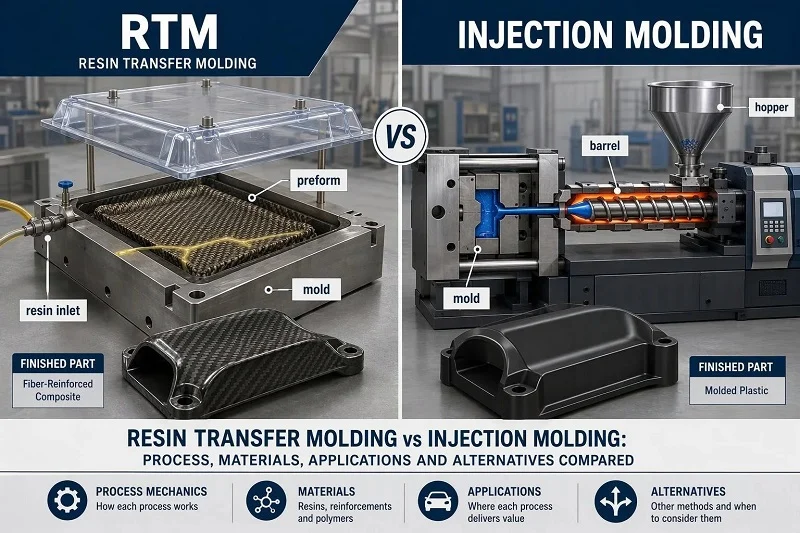
The choice between resin transfer molding and injection molding usually begins as a materials question: does the part need continuous fiber reinforcement inside a thermoset matrix, or can it be molded from a thermoplastic or thermoset compound? That answer narrows the field faster than any comparison of machine specifications, because the two processes consume different material forms and therefore produce parts with different structural behavior.
This article compares resin transfer molding and injection molding across process mechanics, materials, design rules, tooling and cost, production volume, applications, and adjacent manufacturing routes. A side-by-side matrix comes first for readers who are close to a decision, followed by criteria-led sections that explain the reasoning behind each row, then use-case guidance and a verdict. Neither process is universally better; each fits a different kind of part, and the useful question is which one fits yours.
Resin Transfer Molding vs Injection Molding at a Glance
| Dimension | Resin transfer molding | Injection molding |
| Material system | Liquid thermoset resin injected into a dry fiber preform | Pre-compounded thermoplastic pellets or granular thermoset molding compound |
| Typical part size | Large to very large composite structures; small parts also possible | Small to medium precision parts; large parts possible with large presses |
| Fiber content and control | Continuous fiber preforms, with fiber volume fractions reported up to about 65%; orientation set during preforming | Short or long fibers in compound form; orientation influenced by flow and gate location |
| Tooling type and relative cost | Matched molds; low injection pressure permits lower-cost composite or “soft” tooling at low-to-medium volumes | Usually hardened steel; high upfront cost justified by high shot counts |
| Cycle time | Minutes to tens of minutes, set largely by cure chemistry; high-pressure variants can reach about two minutes for automotive-scale parts | Typically seconds to a few minutes; cooling often dominates |
| Typical volumes | Low to medium, with automation supporting intermediate volumes | Medium to very high |
| Surface finish | Good finish on both faces from the closed mold | Good finish from the cavity; texture and molded-in color available |
| Design freedom | Ribs, cores and inserts; large complex shapes | Extensive undercuts, thin walls, inserts and side actions at added tooling cost |
| Best-fit use cases | Structural and semi-structural fiber-reinforced composite parts | High-volume precision plastic parts, housings, packaging and overmolded electronics |
Read the table as a fit map rather than a scorecard. The two columns describe different material families, so a cell that looks like an advantage in one row is usually a consequence of the material choice rather than a process victory. Where a row matters most for your part, the sections that follow explain the mechanism behind it.
Evaluation Criteria: How to Choose Between Resin Transfer Molding and Injection Molding

Seven criteria organize the rest of this comparison: part size and geometry, fiber content and structural performance, production volume and cycle time, tooling investment, material family and service environment, surface finish and tolerance, and secondary operations. They are listed in roughly the order that eliminates options fastest, but they interact, and a single part rarely wins on all of them.
A large structural panel with continuous fibers will usually be decided by size and fiber content before cost is even modeled. A small housing produced in millions of units will be decided by volume and cycle time. A part that must resist hot coolant and also carry load may sit between the two routes, and the honest answer there is to compare a composite design against a thermoset compound design rather than assume one process can substitute for the other.
Process Mechanics Compared
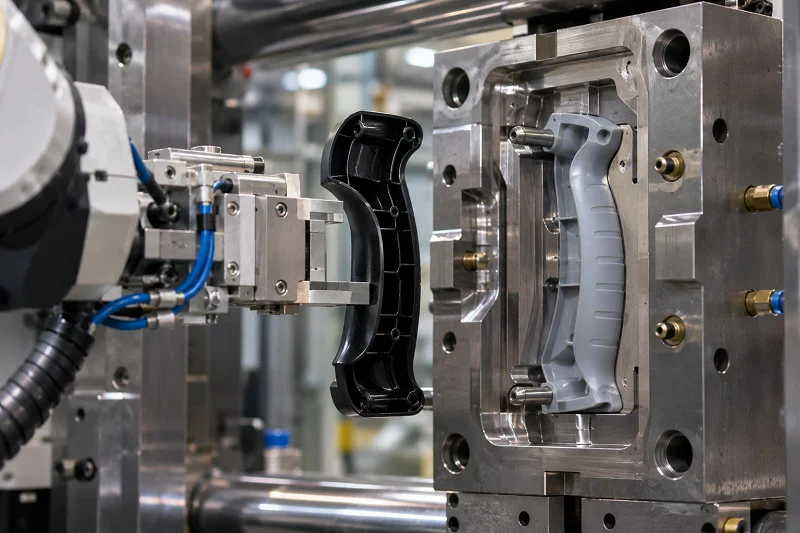
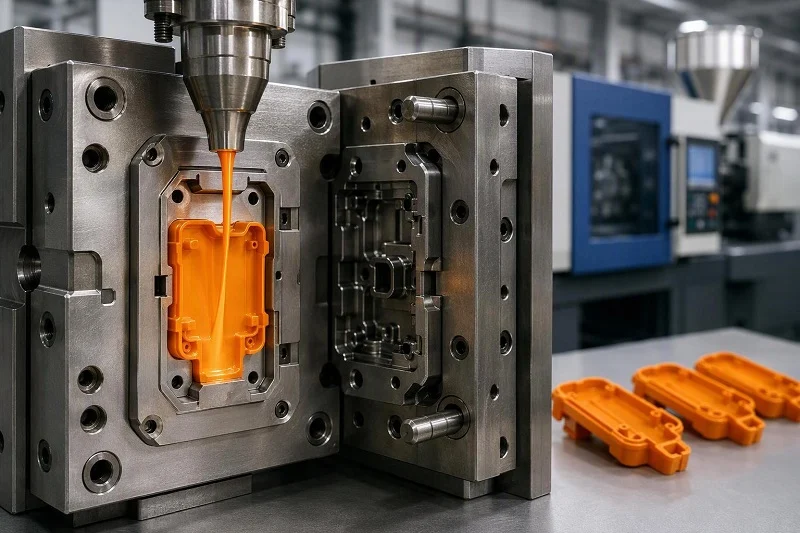
The two process families diverge at the mold. Resin transfer molding builds a part around a dry fiber preform placed in a closed mold, then saturates that preform with liquid resin. Injection molding fills a closed mold with a compound that has already been melted or softened in the machine. Everything downstream — fill pressure, cycle structure, defect modes, tooling — follows from that difference.
The Resin Transfer Molding Sequence
The sequence begins with preform construction: dry reinforcement is cut, layered and shaped, then placed in the mold cavity, which sets part thickness. The mold closes and preheats, and resin is injected at a controlled flow rate and pressure to impregnate the preform. Inlet ports are then closed and the part packs and cures while the heated mold drives polymerization, followed by cool-down and ejection.
One detail shapes the whole process: the resin reaction in resin transfer molding is thermally activated by heat from the mold wall and the preform, rather than by mixing reactants as in reaction injection molding. That reaction is typically much slower, which allows a longer fill time at lower injection pressure. Fill time is optimized to saturate the preform without dry spots or premature gelation, and flow simulation is commonly used to predict fill patterns before tooling is committed.
The Injection Molding Sequence
Compound is fed into the machine and plasticized by the reciprocating screw, with shear from screw rotation supplying most of the melting heat and heater bands supplying the rest. The screw then pushes the melt forward to fill the mold at a controlled flow rate. Packing follows under pressure to compress the polymer and force additional material in as shrinkage occurs — from 5 to 25 percent more material can be added during this stage — and the gate should freeze during packing so material cannot exit the mold. The mold is then held shut while the part cools enough to eject, after which it opens, the part is ejected, and the cycle resets.
Where the Cycle Time Goes
An injection molding cycle divides into fill, packing, cooling and mold-open time. Cooling is normally the longest stage and can account for up to 80 percent of total cycle time, which is why wall thickness drives cost so strongly. Resin transfer molding has analogous stages — preheating and filling, packing and curing, cool-down — but cure chemistry, not just cooling, sets the floor, and the thermal cycle at the closed-mold stage has a direct effect on part cost.
Speed therefore depends on the variant. High-pressure resin transfer molding can reach cycle times as short as about two minutes for automotive-scale parts, while standard resin transfer molding is generally treated as an intermediate-volume process. Injection molding remains the faster route per part in most high-volume work, but that is a statement about mechanics and volume, not a universal verdict.
Materials Compared
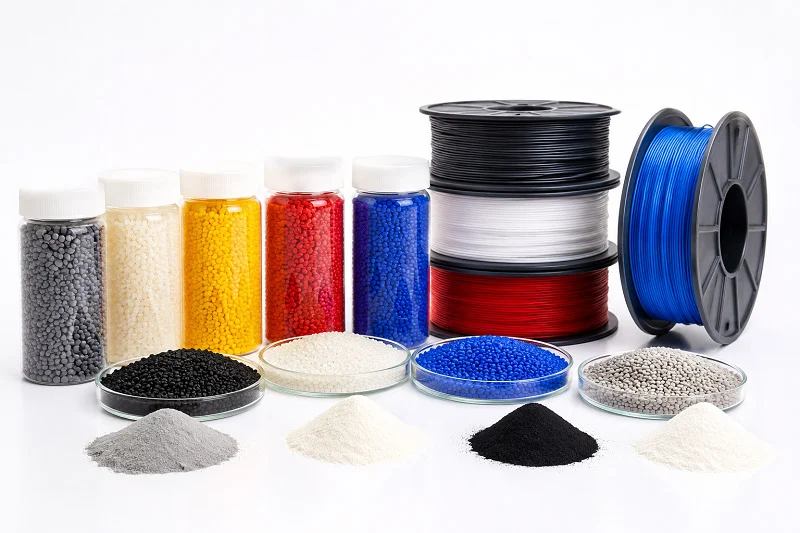
The material comparison starts with form. Resin transfer molding consumes a liquid thermoset resin plus a dry reinforcement, while injection molding consumes a pre-compounded pellet or granule. That single difference drives most of the downstream property and design differences between the two routes.
Resins and Reinforcements in Resin Transfer Molding
On the resin side, thermoset systems such as polyester, vinyl ester and epoxy are selected for viscosity, pot life and cure profile. Epoxy is the usual choice for high-performance aerospace and automotive work, vinyl ester is common in marine and industrial parts for moisture and chemical resistance, and polyester is the economical option for less demanding applications. On the reinforcement side, glass, carbon and other fiber preforms are laid up with orientation and layering chosen to build strength and stiffness that metal cannot match at the same weight.
Fiber volume fraction and preform permeability govern how the resin fills, and voids are the main quality risk — caused by inadequate venting, resin gelation trapping air, or high viscosity preventing complete wet-out. Because the resin is formulated for the process rather than bought off the shelf, resin transfer molding allows tailored formulations matched to the part.
Thermoplastic and Thermoset Compounds in Injection Molding
Injection molding consumes thermoplastic pellets across commodity and engineering grades, and separately, granular thermoset molding compounds such as phenolic and epoxy systems. The two streams behave differently and should not be blended into one claim.
Thermoset molding compounds can carry filler and fiber fractions of roughly 40 to 80 wt.%, offer high thermomechanical performance with glass transition temperatures around 250 °C after post-curing, and resist automotive fluids such as water-glycol coolant and oils. Their low mold-filling pressure, around 10 bar, also allows sensitive electronic components to be overmolded gently. Thermoplastic compounds, by contrast, remelt and can be reground, and their fiber content is limited by what the compounding and molding steps can carry without excessive fiber breakage.
Property Trade-Offs That Follow From the Material System
Continuous-fiber composites deliver high strength-to-weight, but the property is directional: composite materials are anisotropic, responding stiffly when load aligns with the fibers and more compliant when load runs transverse to them. Short-fiber injection molding compounds show a milder version of the same effect, and gate location controls fiber orientation, weld-line formation and warpage. Unfilled compounds avoid anisotropy but give up stiffness.
Temperature and chemical resistance, dimensional stability, surface finish and recyclability all shift with the matrix. A thermoset composite part and a molded thermoplastic part are not interchangeable, so “which material is better” only has an answer once the service environment and structural requirement are fixed.
Design and Tooling Considerations

Tooling investment and design rules differ sharply between the two routes. In resin transfer molding, tooling cost scales mainly with part size and geometry, and low injection pressure opens the door to lower-cost tooling. In injection molding, tooling is a large fixed cost whose justification rests on shot count. Design decisions made early lock in cycle time and defect risk in both processes, which is why the rules below are worth applying before a mold is cut.
Design Considerations for Resin Transfer Molding
Wall thickness is the first control: consistent sections between about 1.2 mm and 3 mm reduce warpage and non-uniform fill, and gradual transitions between differing sections limit stress concentration and fill imbalance. Ribs should not exceed about two-thirds of the adjacent wall thickness to prevent sink marks and fill imbalance, and internal corner radii should be at least 50 percent of the adjacent wall thickness to promote resin flow and reduce stress concentration. Venting and injection-port placement must be planned for complete saturation.
The process accommodates ribs, cores and inserts, and because injection pressures are low, composite or “soft” tooling can replace steel or nickel at low-to-medium volumes. The trade-off is that precise tools take longer to make, and the tooling investment rises with part size.
Design Considerations for Injection Molding
The counterpart rules center on uniform wall thickness, typically between about 1 mm and 3 mm, with thicker sections hollowed out and stiffened by ribs rather than left solid. Draft angles are needed for ejection and should increase for tall or textured parts. Gate location determines fill balance, weld-line position and fiber orientation in filled compounds, and the vestige it leaves must be planned for, often hidden on the non-cosmetic face. Shrinkage allowance is built into the cavity, and the whole design must account for packing and cooling behavior.
Tooling is typically hardened steel, with softer aluminum molds used for more moderate runs because they wear faster. The high upfront cost is justified by high shot counts, and design changes after the mold is made are expensive, so the design freeze carries real weight.
Tooling, Cost and Volume: Where the Crossover Sits
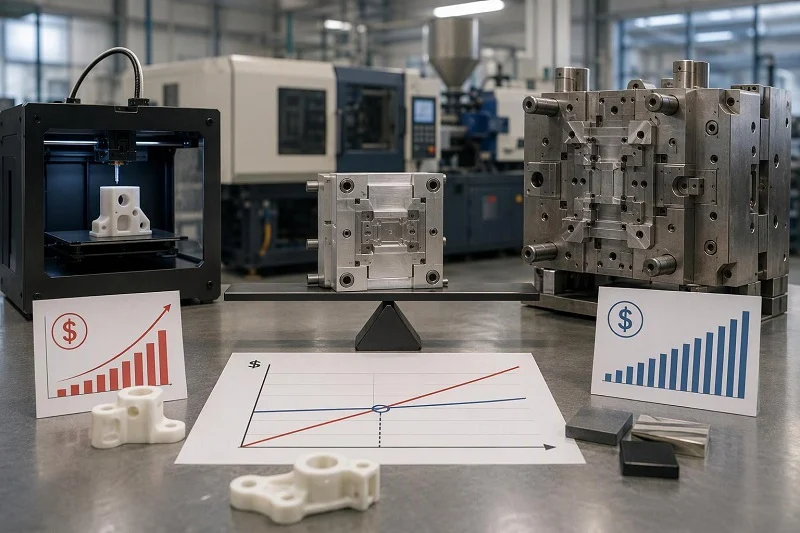
Cost comparisons between resin transfer molding and injection molding rarely reduce to a single break-even number, because the two processes carry their fixed costs in different places. In resin transfer molding, tooling investment scales mainly with part size and geometry: the larger the tool, the higher the investment. But because the process runs at low reaction temperatures and injection pressures, composite or “soft” tools can replace high-cost steel or nickel, which keeps up-front spending modest at the low-to-medium volumes typical of the process.
Injection molding inverts this structure. A hardened steel mold is a large fixed cost that only makes sense when it is amortized across many shots, and the per-part price then falls as volume rises. Tooling cost is built from the mold base, cavity and core manufacture, design and engineering, hot runner systems and side actions, and its per-part impact decreases with production volume — while the design decisions made at that stage lock in much larger processing costs later. Cavity life also enters the calculation: steel production molds typically run on the order of one million cycles per cavity with unfilled resins and about 300,000 with glass-filled resins, whereas aluminum molds produce only about 10,000 parts per cavity.
The crossover therefore sits where the amortized tooling burden of injection molding drops below the higher per-part cost of a slower composite cycle. At low volumes, resin transfer molding’s cheaper tooling can win; at high volumes, injection molding’s short cycles and automation tend to drive unit cost down. Where exactly that point falls is part-specific and depends on size, material and secondary operations, so it is worth modeling both routes for the actual geometry rather than assuming a threshold.
Resin Transfer Molding Variants and How They Compare
Resin transfer molding belongs to the broader family of liquid composite molding processes, which includes vacuum-assisted variants, high-pressure variants and light RTM. All share the same principle — injecting liquid resin into a closed mold containing dry fiber reinforcement — but they differ in tooling rigidity, injection pressure and achievable part quality. Choosing among them is largely a question of how much capital investment the volume can justify.
Light RTM uses lower-cost, lower-pressure tooling suited to modest volumes where a good finish on both faces matters more than cycle speed. Vacuum-assisted resin transfer molding draws resin into the laminate with vacuum pressure rather than positive injection pressure; it is a closed-mold process that uses only atmospheric pressure to push resin into the cavity, and it suits large structures, though typically only one side receives a good surface finish.
High-pressure RTM injects resin at roughly 30–120 bar through a high-pressure mixing head that combines resin and hardener at the injection point. That pressure drives very rapid mold fill, enabling cycle times as short as about two minutes for automotive-scale parts, and it is used extensively for structural carbon fiber components where cycle time, fiber volume fraction and low void content must be optimized together. The trade-off is high tooling and equipment cost, justified only by the very high production volumes typical of automotive programs. In practice, parts are produced in roughly three to seven minutes, a function of size and complexity, and mold pressures can reach 110 bar when fiber content is very high.
How Resin Transfer Molding and Injection Molding Compare With Other Processes
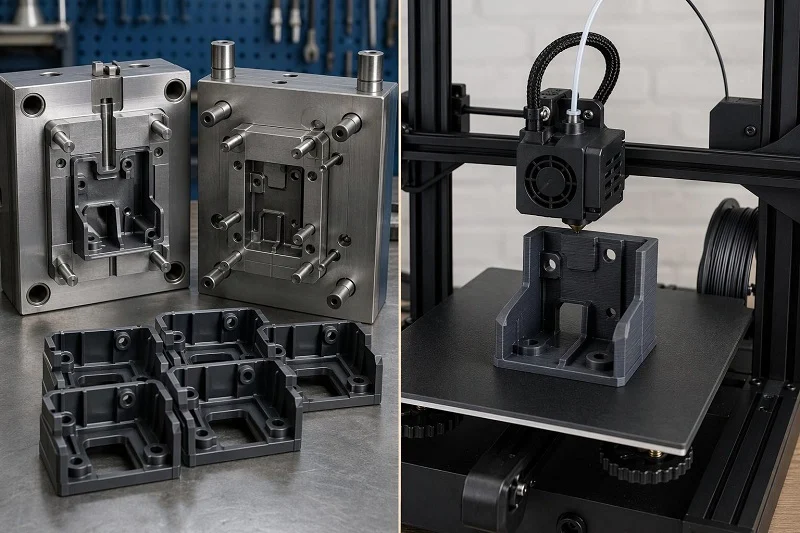
Both processes sit inside a wider field of manufacturing routes, and ruling the alternatives in or out is often faster than comparing the two head to head. The relevant question is usually which process family the part’s material and geometry already point toward.
Hand layup is the simplest composite method: fibers are layered onto a one-sided mold and resin is poured and rolled out by hand. It is typically used for low-volume production of larger structures such as wind turbine components, so it competes with resin transfer molding only where surface finish on both faces and repeatability are not critical.
Compression molding is the most common option for high-volume composite parts, using matched metal dies in a hydraulic press to cure a charge of matrix and reinforcement quickly. It is a high-volume, high-pressure method that suits production quantities above roughly 10,000 parts, where its durable tooling pays for itself; below that, resin transfer molding’s lower tooling cost is usually the better fit.
Thermoforming shapes thermoplastic sheet against a mold and suits thin-walled enclosures and trays where a sheet material is acceptable; it does not deliver the fiber architecture or dimensional control of a molded engineering part. Rotational molding makes hollow, seamless parts such as tanks and containers, a geometry that neither resin transfer molding nor injection molding targets directly.
Die casting produces metal parts by injecting molten alloy into a steel die. It becomes attractive when metal properties — strength, thermal conductivity or EMI shielding — are required, and its economics versus injection molding shift with volume: at high volumes above roughly 500,000 units, die casting’s fast cycle can produce a lower unit cost, though aluminum dies must be replaced along the way.
3D printing builds geometry without tooling, which makes it the natural route for prototypes and low-volume parts where a mold cannot be justified. It rarely competes at production volumes, but it is often the sensible step before committing to either molding process.
Applications: Where Each Process Fits

Application fit follows from the same three variables that run through this comparison: the material system, the part size and the production volume. The sections below show where each process is conventionally found.
Resin Transfer Molding Applications
Resin transfer molding is used for chairs, automobile parts and aircraft components, and it interests the aerospace industry because it promises cost savings and performance improvements over traditional methods. It also handles large, complex shapes with ribs, cores and inserts. It can be automated in preforming, reinforcement loading, demolding and trimming — which is why it is generally considered an intermediate-volume molding process.
Injection Molding Applications
Injection molding is widely used for both consumer products and engineering applications, and almost every plastic item in daily use is produced this way. Typical work includes packaging, industrial and engineering components, medical device housings and high-volume precision parts. Granular thermoset compounds extend the reach to electronics, where low mold-filling pressure of around 10 bar allows sensitive components to be overmolded.
Who Should Choose between Resin Transfer Molding vs Injection Molding
The self-selection rule is straightforward once the criteria are ordered. Choose resin transfer molding for large, complex, fiber-reinforced structural parts at low-to-medium volumes, where tooling budget and strength-to-weight matter more than cycle time. A representative case is a structural body panel or a large molded shell with integrated ribs and inserts, produced in the hundreds or low thousands per year: a soft composite tool keeps the up-front investment low, and the continuous fiber preform supplies the stiffness the part needs.
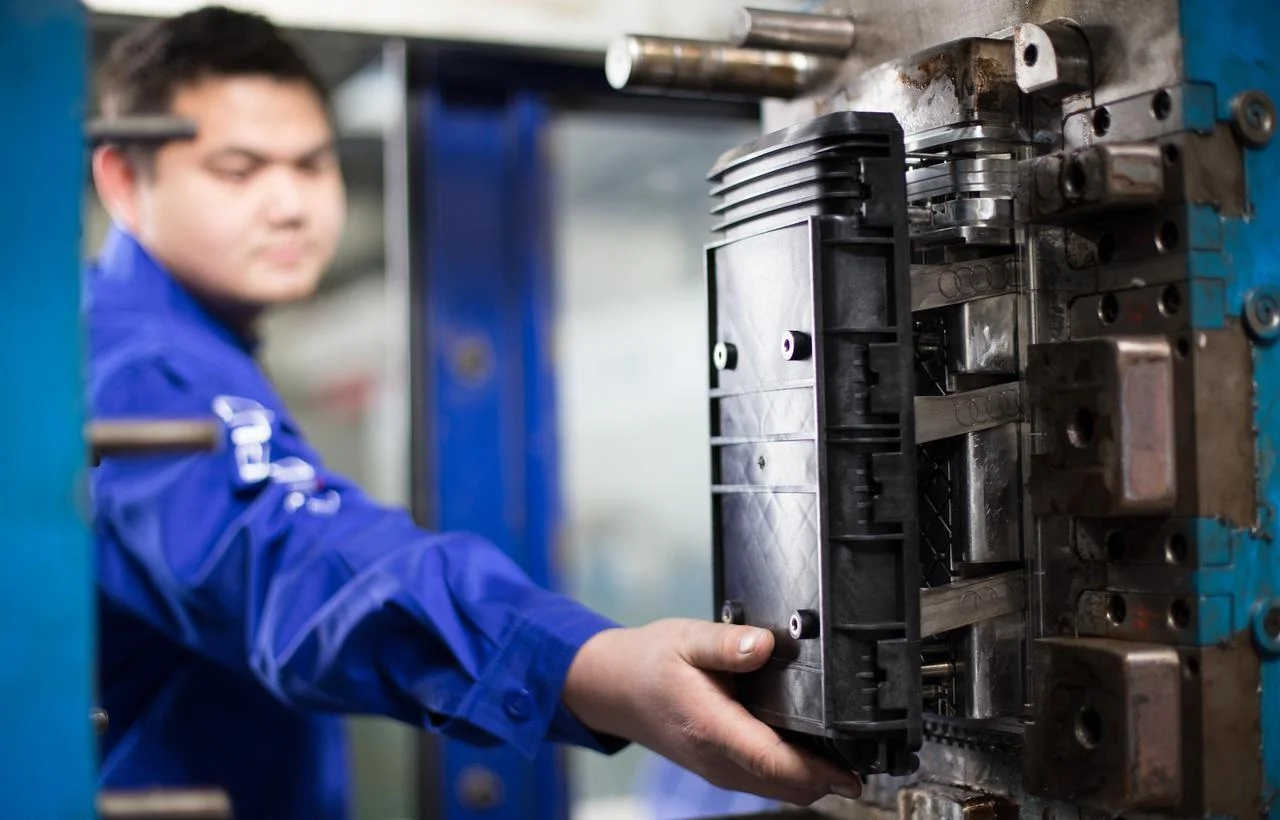
Choose injection molding for high-volume, precision plastic parts where short cycles, repeatability and per-part cost dominate. That includes thermoset compound parts that must resist heat and automotive fluids, such as water-glycol coolant and oils, where a phenolic or epoxy molding compound with a glass transition temperature around 250 °C after post-curing is the appropriate material. A representative case is a precision housing or connector produced in the hundreds of thousands per year, where a steel mold amortized over that volume delivers a low unit cost.
Some cases genuinely depend on part size, volume and service environment rather than on process preference. A medium-volume part with moderate structural demands may be viable either way, and the deciding factor becomes the cost of secondary operations, the tolerance requirement or the surface finish specification. In those situations, quoting both routes against the actual geometry is more reliable than applying a general rule.
Choosing NOBLE to Support Your Injection Molding Project

NOBLE is a China-based custom manufacturing partner for injection molding projects. As a Sino-British joint venture recognized by the government as a “National High-tech Enterprise,” NOBLE brings over 10 years of experience providing one-stop custom manufacturing from prototyping to production.
Several capabilities are relevant to injection molding projects. In its general machining and manufacturing work, NOBLE can finish parts rapidly within 7–10 days with the support of comprehensive CNC software and experienced engineers. A quick and professional quote can be offered within 24 hours after you submit an RFQ with the information needed. In-house capabilities span design, prototypes and mass production, so the same partner carries a project from concept through to end-use parts. A full set of inspection equipment and an overall quality control system support dimensional accuracy in prototypes and components alike, and the team works across a range of metal and plastic materials.
NOBLE holds ISO 9001:2015 and ISO 13485:2016 certification. The service scope runs from design to assembly — not production alone — which means tooling, molding, secondary operations and final assembly can be coordinated through one supplier rather than split across several. For teams moving an injection molding project from prototype to batch production, that continuity reduces the handoffs where tolerance and schedule problems usually appear.
FAQs about Resin Transfer Molding vs Injection Molding
What is the core difference between resin transfer molding and injection molding?
Resin transfer molding injects liquid thermoset resin into a closed mold containing a dry fiber preform, building a fiber-reinforced composite part. Injection molding fills a closed mold with a molten or softened pre-compounded material, typically a thermoplastic pellet or a granular thermoset compound. The material form, not the mold, is the fundamental difference.
Can resin transfer molding replace injection molding for a given part?
Generally not directly. A continuous-fiber thermoset composite part and a molded thermoplastic part are not interchangeable, because they differ in fiber architecture, anisotropy, surface finish and recyclability. Substitution is only realistic when the design is re-engineered around the new material system.
Which process suits large parts?
Resin transfer molding is the stronger fit for large, complex shapes with ribs, cores and inserts, and low injection pressures allow lower-cost tooling at those sizes. Injection molding can produce large parts, but mold cost and clamping requirements rise steeply with size.
Which process suits high volumes?
Injection molding, where short cycles and automation drive unit cost down as volume rises. High-pressure RTM can also reach high volumes for automotive structural parts, but only with substantial tooling and equipment investment.
Can injection molding process fiber-reinforced or thermoset materials?
Yes. Thermoplastic compounds are available with glass or carbon fiber reinforcement, and granular thermoset molding compounds can carry filler and fiber fractions of roughly 40–80 wt.%. Both streams behave differently from continuous-fiber preforms, so the reinforcement form should be matched to the load path.
What drives cost in each process?
In resin transfer molding, tooling cost scales mainly with part size and geometry, and cycle time is set by cure chemistry. In injection molding, tooling is a large fixed cost amortized over volume, while cooling dominates cycle time and therefore machine-hour cost.
How are prototype quantities typically handled?
Prototypes are usually made without production tooling — by 3D printing, CNC machining or a temporary mold — so the design can be validated before committing to a steel mold or a composite tool. Production tooling is ordered once the geometry and material are settled.