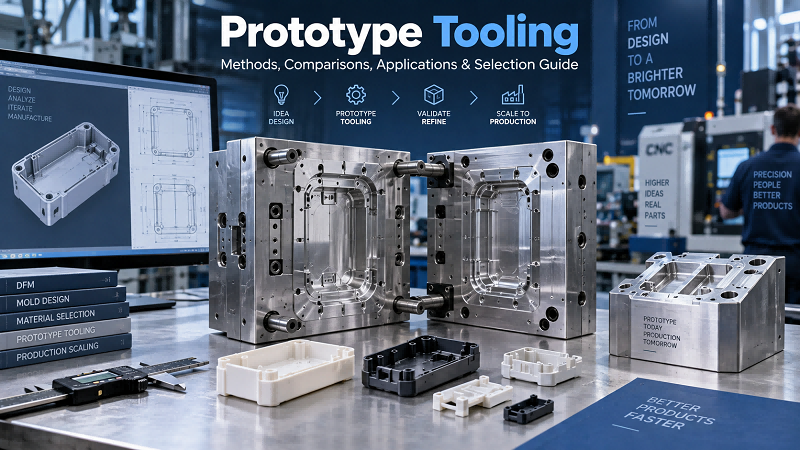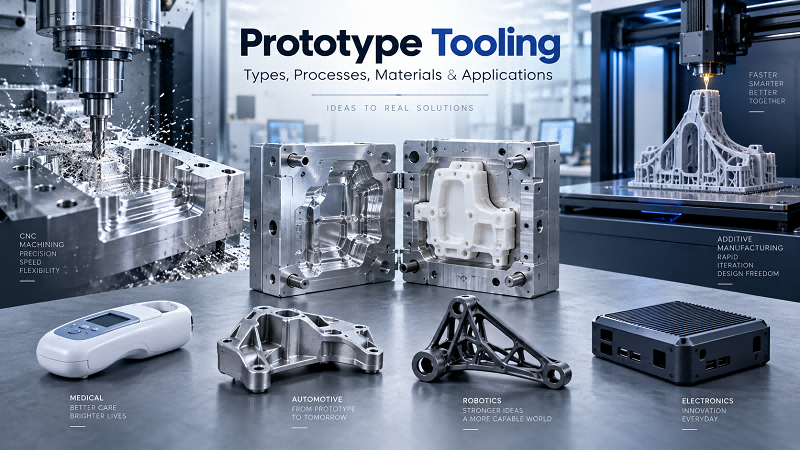
Prototype molds are an important stage between product design and mass manufacturing.
By integrating other rapid manufacturing technologies such as CNC machining, additive manufacturing, and casting, prototype molds can help companies shorten the development cycle and verify designs more effectively.
For manufacturers developing automotive, aerospace, medical, robotics, electronic, and industrial products, prototyping tools can reduce technical uncertainties before production begins.
It offers a practical method to evaluate the geometry, material, manufacturability, assembly, and final product performance of parts, while maintaining the flexibility of development.
What Is Prototype Tooling?
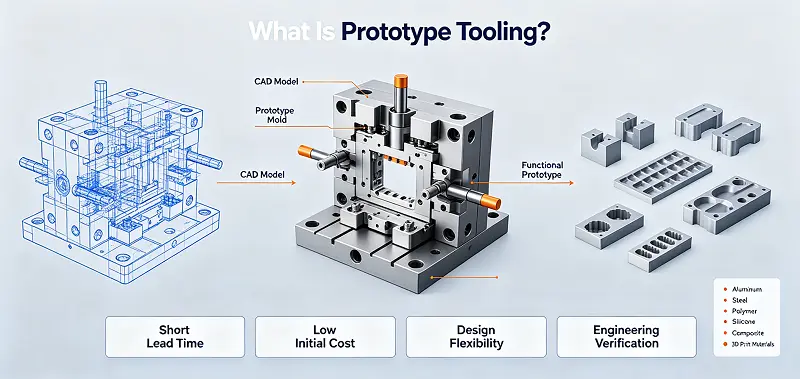
A prototype mold refers to a manufacturing mold, die, fixture, or production tool used for manufacturing a limited number of prototypes or pre-production parts.
Prototype tools emphasize shorter delivery times, lower initial costs, and design flexibility.
They are usually used in product development, engineering verification, functional testing, and small-batch production.
Depending on the required quantity, tolerance, material, and surface finish, prototype tools can be made of aluminum, steel, polymer, silicone resin, composite materials, or 3d printing materials.
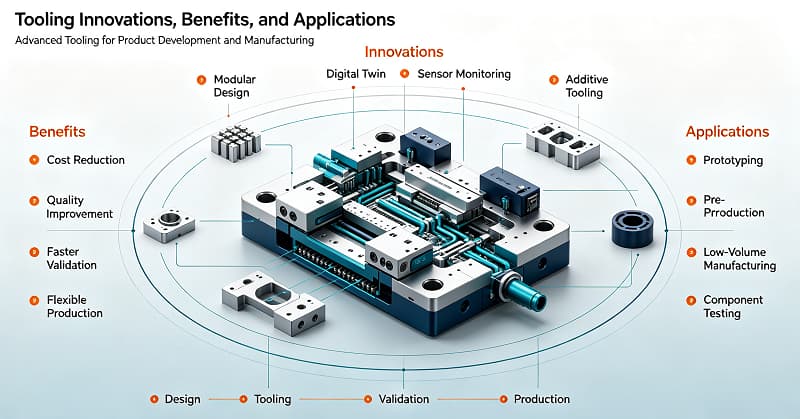
Tooling Innovations, Benefits, and Applications
Modern prototype molds have developed rapidly due to the advancements in CNC machining, additive manufacturing, CAD/CAM software, simulation, and digital inspection.
These innovations make prototyping tools very useful for design verification, functional prototyping, bridging production, market testing, and small-batch production.
It also offers the engineering team more opportunities to modify the design before investing in expensive production tools.
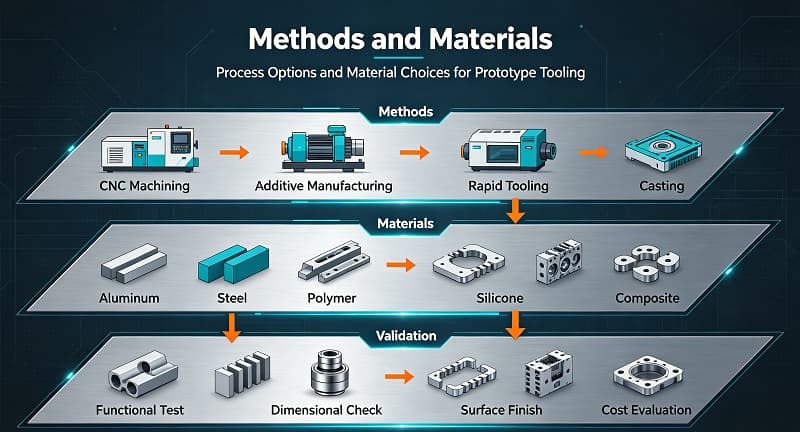
Methods and Materials
Prototype molds can be produced by CNC machining, 3D printing, silicone molding, casting, thermoforming, injection molding, and composite mold methods.
The most suitable process depends on the geometry, quantity, tolerance, mold life, material, and project schedule of the parts.
Commonly used mold materials include aluminum alloy, pre-hardened steel, tool steel, engineering plastics, silicone, epoxy resin, polyurethane and composite materials.
Aluminum is particularly popular for prototype molds because it combines good machinability, thermal conductivity, dimensional stability, and relatively short machining time.
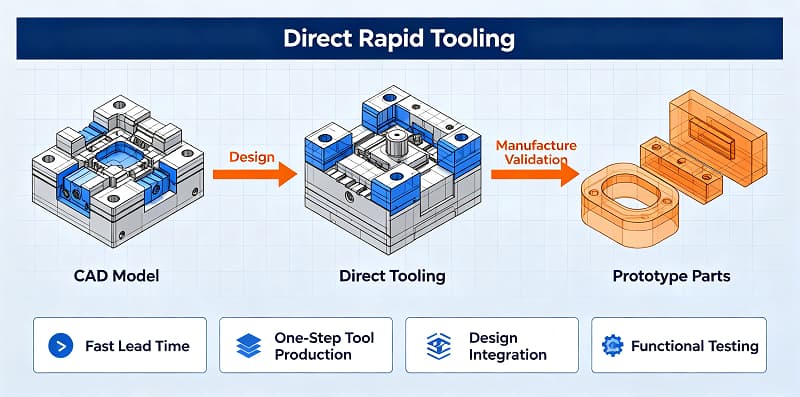
Direct Rapid Tooling
Direct rapid mold production: Molds or mold components are produced directly from CAD data.
Technologies such as CNC machining and additive manufacturing are often employed because they can quickly transform digital models into usable tools.
Direct machining is particularly useful when the delivery time is short, and design changes are frequent.
It can also reduce the number of manufacturing steps required during the early product development period.
Types of Direct Prototype Tooling
Direct prototyping tools include 3D-printed molds made of metal or polymer materials and soft prototyping tools made from aluminum or pre-hardened steel.
3d printing tools can be used for complex geometries and rapid design verification, while mechanically processed aluminum tools can offer better precision and durability.
When the prototype mold must withstand high forming pressure or a large production cycle, pre-hardened steel can be selected.
The correct choice depends on the expected tool life, part material, production quantity, and size requirements.
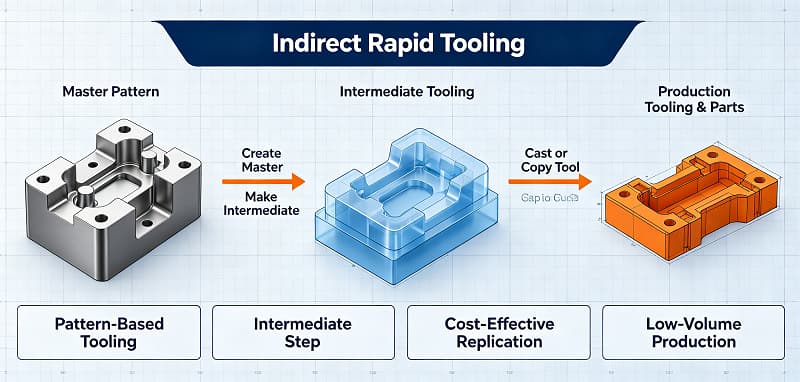
Indirect Rapid Tooling
Indirect rapid molds use the master model or pattern to create the final mold.
This process first creates a reference component and then replicates it through molding, casting, or forming.
This method is economical when you need several molds or small batches of parts.
It is also useful when the mold geometry can be effectively replicated from a high-quality master model.
Types of Indirect Prototype Tooling
Silicone resin molds are widely used for small-batch casting of polyurethane and similar materials.
Thermoforming molds are typically used for thin plastic casings, covers, packaging, and shell prototypes.
Compound molds offer another lightweight tool option for certain forming and low-pressure manufacturing applications.
Each indirect machining method offers a different balance among cost, precision, material compatibility, and tool life.
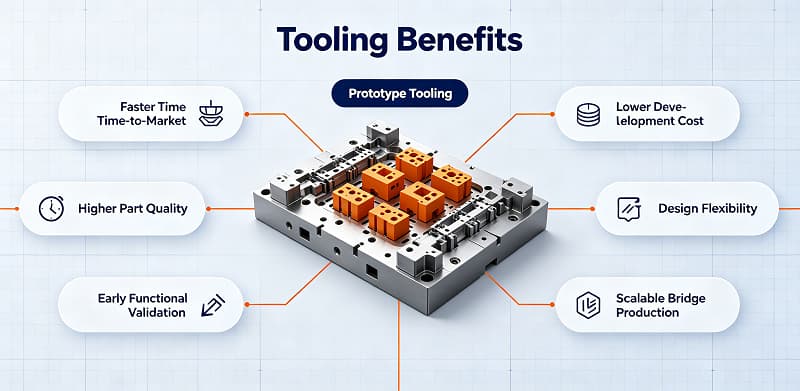
Tooling Benefits
Prototype tools can help engineering teams evaluate actual formed or formed components, while reducing the financial risks associated with complete production tools.
Fast Turnaround Times
Prototype tools usually have simplified structures and faster manufacturing processes.
Compared with traditional hardened production molds, aluminum molds, CNC machining, and rapid mold manufacturing technology can significantly shorten the mold delivery time.
Cost-Effectiveness for Low-Volume Production
For small-batch manufacturing, prototype tools can offer a better cost balance than immediately investing in large-batch production tools.
The initial mold cost was relatively low, yet manufacturers could still produce representative molded parts.
Enables Testing and Validation of Designs
Prototype tools enable engineers to evaluate dimensions, assembly conditions, material behavior, and functional performance using components similar to those in production.
Therefore, problems can be identified before the expensive mass production tools are completed.
Supports Iterative Development
Product design often changes after testing.
Prototype molds make these adjustments easier because the mold structure can usually be modified more quickly and economically than hardened production molds.
Rapid Creation of Molds
Modern numerical control equipment, CAD/CAM software, and additive manufacturing technology enable the rapid production of mold components from digital models. This helps to reduce the time between design approval and physical component testing.
Lower Mold Costs and Faster Lead Times
Simplified mold structures and easy-to-process materials can reduce mold costs and manufacturing time. This makes prototyping tools particularly attractive for new products, custom components, and uncertain production volumes.
Steps to Producing Prototype Tooling
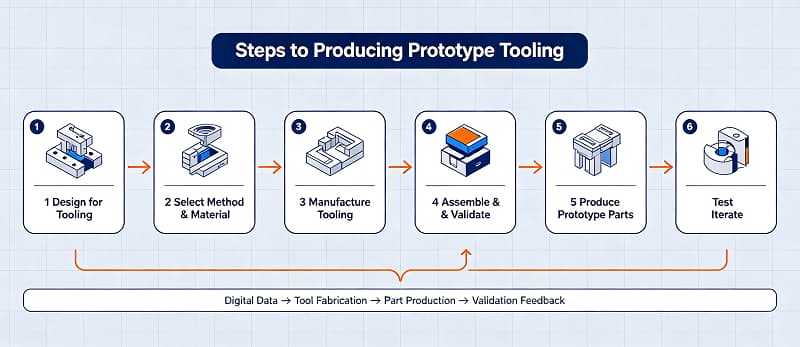
A successful prototype tool project usually follows a structured engineering workflow.
Design review, material selection, mold production, testing, and optimization will all affect the quality of the final prototype parts.
Initial Design and CAD Models
The process begins with accurate 3D CAD models and clear engineering requirements. Critical dimensions, tolerances, wall thickness, draft angles, ribs, bosses, undercuts, and assembly features should be reviewed before tooling begins.
Selecting the Right Technology and Materials
Engineers select tooling technology according to quantity, part material, dimensional accuracy, tooling life, and project budget. Aluminum, steel, silicone, resin, and composite tooling each have different advantages.
Mold Creation and Prototype Tooling Production
After the design is approved, the tooling is manufactured using CNC machining, additive manufacturing, casting, or other suitable processes. Machining accuracy and surface finishing directly influence molded part quality.
Testing, Validation, and Refinement
Initial samples are inspected for dimensions, appearance, fit, and functional performance. Engineering feedback can then be used to adjust the part design, mold structure, machining parameters, or material selection.
Towards Mass Production
Once prototype parts meet performance and quality requirements, the project can move toward bridge production or full-scale manufacturing. Lessons learned during prototype tooling can also improve the design of final production molds.
Applications Across Industries
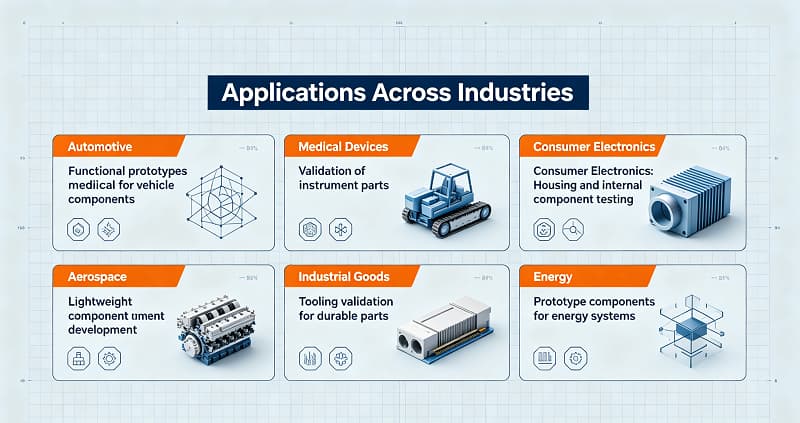
Prototype tooling supports product development across industries where testing and manufacturing validation are critical. It is particularly useful for complex components that must meet demanding functional, dimensional, or regulatory requirements.
Aerospace Industry
Aerospace manufacturers use prototype tooling for structural parts, housings, ducts, fixtures, interior components, and engineering test parts. Low production volumes and strict dimensional requirements make rapid tooling valuable during development.
Automotive Industry
Automotive applications include interior components, brackets, housings, covers, connectors, functional plastic parts, and under-hood components. Prototype tooling allows manufacturers to test new designs before launching high-volume molds.
Medical Industry
Medical product developers use prototype tooling for device housings, instrument components, laboratory equipment, diagnostic devices, and other precision parts. Prototype production can support design verification, assembly testing, ergonomics, and material evaluation.
Choosing the Right Prototype Tooling Partner
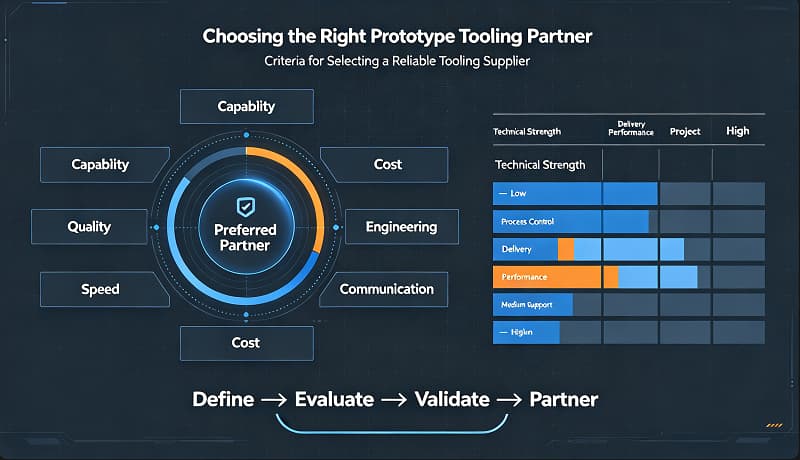
The tooling supplier has a direct impact on lead time, dimensional accuracy, cost, and final prototype quality. Companies should evaluate both manufacturing capability and engineering support before selecting a supplier.
Expertise
An experienced prototype tooling manufacturer should understand mold design, CNC machining, injection molding, materials, tolerances, and design for manufacturability. Strong engineering knowledge helps identify potential problems before tooling production begins.
State-of-the-Art Technology
Modern 3-axis, 4-axis, and 5-axis CNC machines, EDM equipment, inspection systems, and digital manufacturing software improve tooling accuracy and efficiency. Advanced equipment is especially important for complex geometries and tight-tolerance components.
Rapid Turnaround Times
Lead time is often one of the main reasons companies choose prototype tooling. A capable supplier should have efficient quoting, engineering review, machining, inspection, and production workflows to keep development moving quickly.
Comprehensive Support and Flexibility
Prototype development frequently involves design changes and engineering adjustments. Suppliers that provide DFM feedback, material recommendations, tooling modifications, inspection, finishing, and low-volume production can simplify the entire development process.
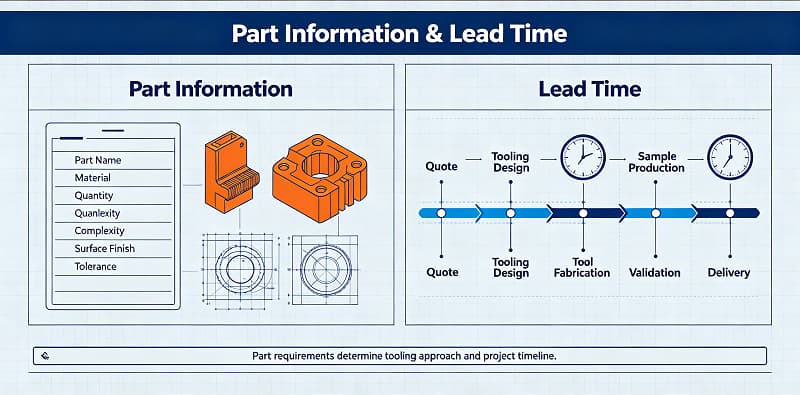
Part Information & Lead Time
The delivery time of the prototype mold depends on the part size, geometry, mold complexity, number of cavities, material, surface finish, and tolerance requirements.
The maximum size of the formed part and the maximum volume of the part are also determined by the mold equipment and the capacity of the forming machine.
Tolerances should be defined based on the functional requirements of the components. Providing complete CAD drawings and production requirements helps manufacturers estimate mold costs and delivery times more accurately.
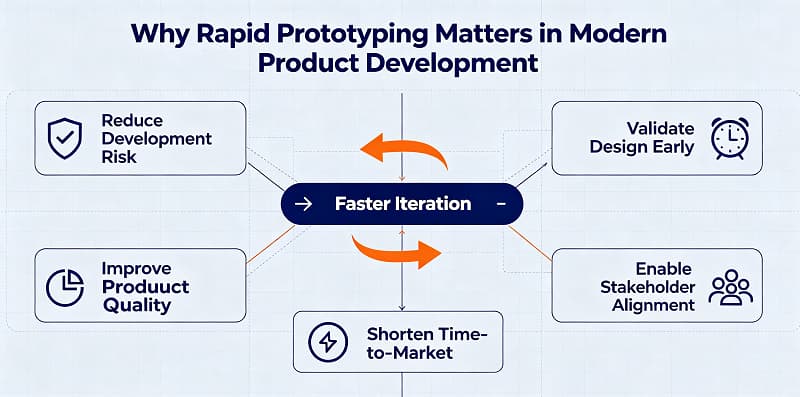
Why Rapid Prototyping Matters in Modern Product Development
Rapid prototyping allows engineering teams to turn digital designs into physical components before mass production. It supports faster decision-making and gives designers valuable feedback about manufacturability, assembly, appearance, and functionality.
Faster Design Iteration
Rapid prototypes can be manufactured soon after a CAD model is completed. Engineers can test the part, identify problems, modify the design, and produce another version without waiting for production tooling.
Cost-Effective Development
Early prototypes help identify engineering problems while design changes are still relatively inexpensive. Correcting problems before production tooling can prevent costly mold modifications and production delays.
Early Functional Testing
Physical prototypes allow teams to test fit, motion, strength, assembly, interfaces, and user interaction. Functional testing is especially important when multiple components must work together within a mechanical system.
Reduced Product Development Risk
Testing design assumptions before production reduces uncertainty. Prototype evaluation can reveal dimensional conflicts, material problems, manufacturing limitations, and assembly issues that may not be obvious from digital models alone.
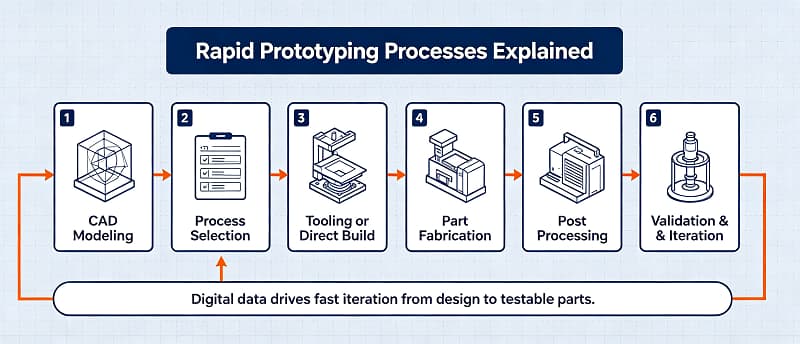
Rapid Prototyping Processes Explained
Several manufacturing processes can support prototype development. Each technology has different advantages in terms of materials, precision, geometry, cost, and output.
3D Printing (SLA, SLS, MJF, FDM)
SLA provides detailed resin prototypes, while SLS and MJF are commonly used for durable polymer parts. FDM offers an economical solution for concept models, fixtures, and larger prototypes where an extremely fine surface finish is not required.
CNC Machining (Prototype Machining)
Prototype CNC machining creates parts directly from solid metal or plastic stock. It offers high dimensional accuracy, good surface quality, and access to engineering materials similar to those used in final production.
Sheet Metal Prototyping
Sheet metal prototyping uses laser cutting, bending, punching, welding, and finishing to manufacture brackets, covers, chassis, panels, and enclosures. It is commonly used in electronics, automotive equipment, robotics, and industrial systems.
Urethane Casting
Urethane casting uses silicone molds to reproduce parts from a master pattern. It is suitable for producing small batches of plastic-like components with different colors, textures, and material properties.
Rapid Injection Molding
Rapid injection molding uses simplified molds to produce low-volume injection-molded parts quickly. It is useful when engineers need prototypes manufactured from actual thermoplastic materials and production-like processes.
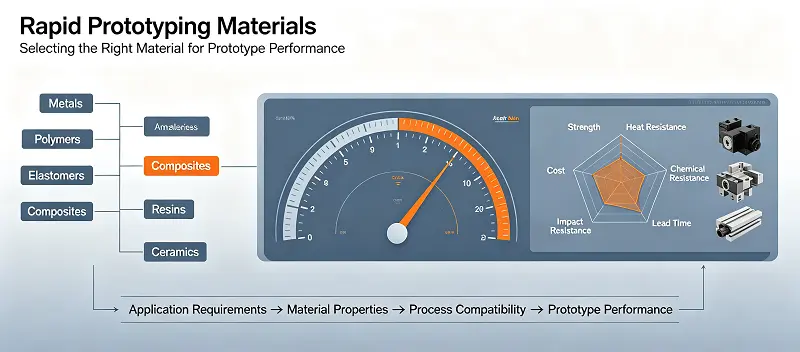
Rapid Prototyping Materials
Rapid prototyping materials include engineering plastics, aluminum alloys, stainless steel, carbon steel, titanium, resins, nylon, elastomers, polyurethanes, and composite materials.
For the prototype tools themselves, aluminium, pre-hardened steel, silicone, resin, and composite materials are common.
The reasonable combination of prototype materials and mold materials can improve the testing accuracy while controlling the engineering cost.
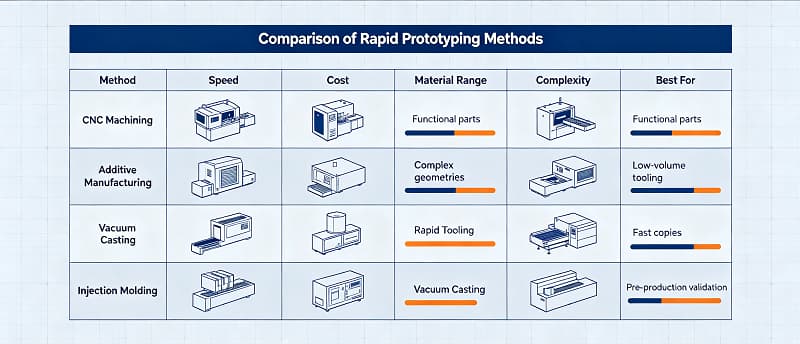
Comparison of Rapid Prototyping Methods
Different prototyping processes serve different engineering requirements.
3D printing offers excellent design freedom, CNC machining provides powerful precision and production-grade materials, while polyurethane casting and rapid injection molding are more suitable for repetitive parts.
For thin metal structures, sheet metal prototypes are the preferred choice, and when a company needs molded or formed parts to simulate the final product, prototype tools become very valuable.
Therefore, process selection should be based on quantity, geometry, material, tolerance, finishing, and testing targets.
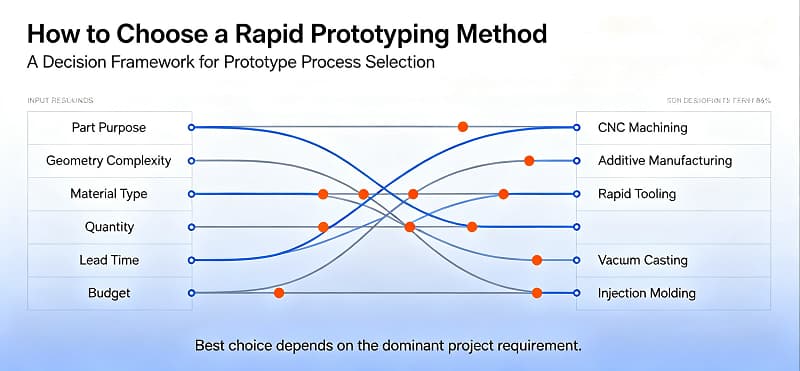
How to Choose a Rapid Prototyping Method
Choosing the right method requires balancing technical performance, budget, quantity, and project schedule. Before choosing a manufacturing process, engineers should first determine what information the prototype must provide.
Decision Tree (For Selecting a Prototyping Process)
If only the appearance and basic geometric shapes are needed, 3D printing is sufficient. Functional metal parts are more suitable for CNC machining, while repetitive plastic prototypes are suitable for polyurethane casting or rapid injection molding.
Use Online Quoting and DFM Feedback Early
Early quotations provide information on manufacturing costs, material availability, and expected delivery times. DFM can identify difficult features, cuts, thin walls, or machining limitations before manufacturing begins.
Precision CNC Machining Service
Precision CNC machining adaptation requires strict tolerances, complex interfaces, precise installation surfaces, and prototypes of production-grade metals. It can also manufacture tool blades, mold parts, fixtures, and other precision mold parts.
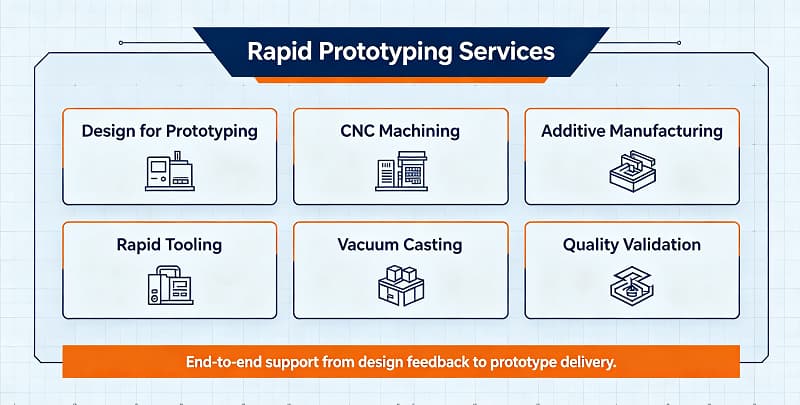
Rapid Prototyping Services
Rapid prototyping services typically integrate multiple manufacturing processes.
Suppliers can provide various processes such as CNC machining, 3D printing, and sheet metal manufacturing in the same development project.
Material Applications
Select different materials based on mechanical, thermal, chemical, optical, and appearance requirements.
Metals are typically used for structures and precision components, while polymers and resins are often employed for casings, covers, functional prototypes, and appearance models.
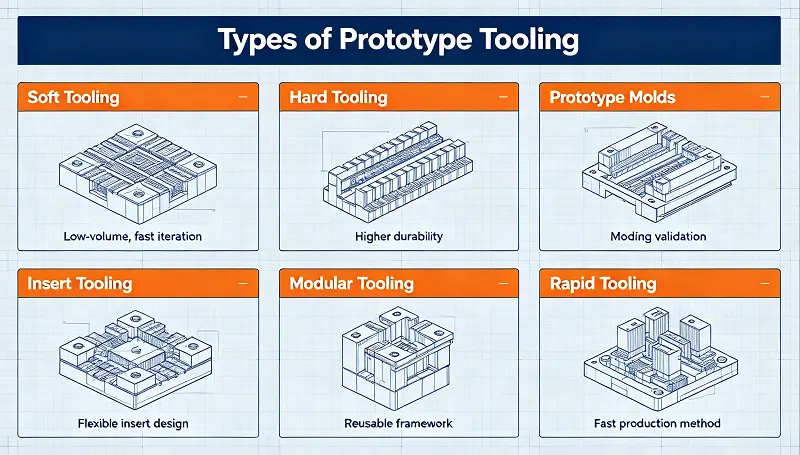
Types of Prototype Tooling
Prototype molds can be classified into several types based on materials, durability, production quantity, and manufacturing methods. Understanding these categories helps companies match their tool investments with expected production demands.
Soft Tooling
Soft molds typically use aluminium, silicone, resin, or other relatively easy-to-manufacture materials. It applies to prototypes, tests, short-term production runs, and projects that may still require tool changes.
Hard Tooling
Hard tooling generally uses stronger steel materials and is designed for longer production life. Manufacturing takes longer and costs more, but the tooling can withstand higher production volumes and more demanding machining conditions.
Bridge Tooling
Bridge tooling provides temporary production capacity between prototype development and final mass-production tooling. It is useful when companies need market-ready parts while permanent tooling is still being manufactured.
Printed Injection Molds
Additive manufacturing can create injection mold inserts for small quantities and rapid testing. Printed molds are best suited to controlled production conditions because their temperature resistance, pressure resistance, and tool life may be lower than machined metal molds.
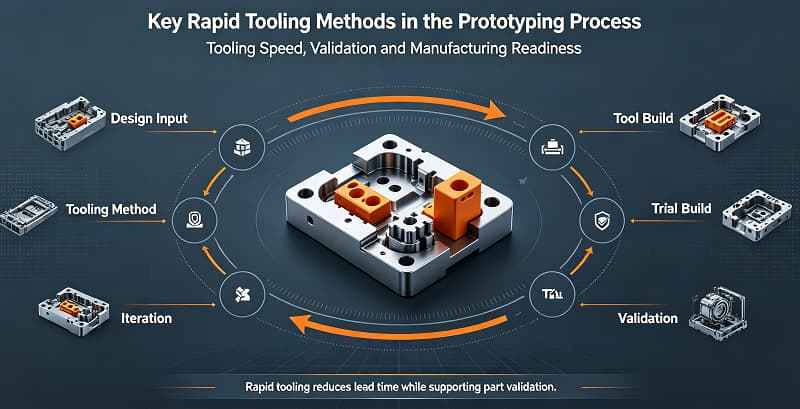
Key Rapid Tooling Methods in the Prototyping Process
Rapid molds can employ a variety of forming, machining, shaping, and additive manufacturing technologies. The best approach depends on the material, geometry, output, and required performance of the final part.
Injection Molding
Injection molding with prototype tools produces plastic parts that closely represent future production components. Engineers can evaluate shrinkage, filling, assembly, surface appearance, and functional behavior before investing in high-volume tooling.
Urethane Casting (Cast Mold)
Urethane casting uses silicone molds and liquid polyurethane materials to create small batches of parts. It provides an economical option for design verification, market samples, and low-volume plastic-like components.
Vacuum Forming
Vacuum forming heats a plastic sheet and draws it over a mold using vacuum pressure. It is commonly used for covers, trays, panels, packaging, and large thin-wall prototype components.
Compression Molding
Compression molding places material inside a heated mold and applies pressure to form the final component. It can be used for thermoset materials, rubber, silicone, and certain composite prototype parts.
SLA and SLS (Additive Manufacturing)
SLA and SLS can manufacture master patterns, tooling aids, mold components, fixtures, and prototype parts. Their ability to create complex geometries quickly makes additive manufacturing an important supporting technology in rapid tooling.
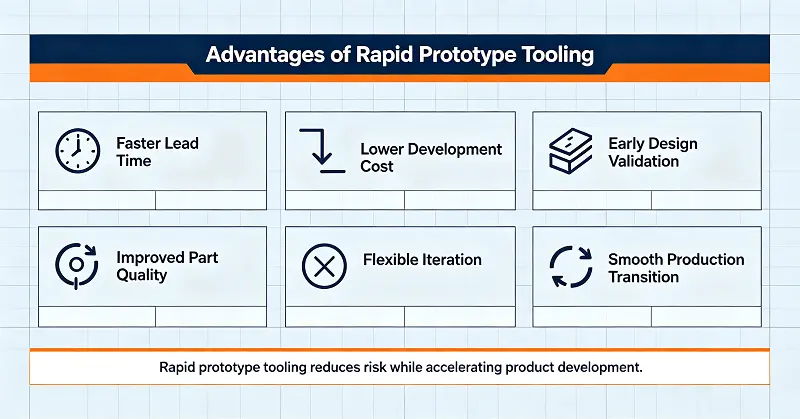
Advantages of Rapid Prototype Tooling
Rapid prototyping tools combine faster development with lower upfront tool investment and can also support small-batch manufacturing and bridging production.
By reducing the gap between prototype development and production tools, rapid prototyping tools can help companies more effectively bring new products to manufacturing.
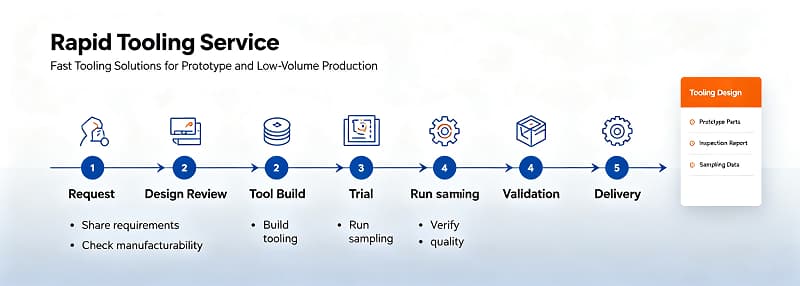
Rapid Tooling Service
A complete rapid mold service should include engineering review, DFM analysis, mold design, material selection, CNC machining, mold manufacturing, sample production, inspection, and mold adjustment. Integrating these steps can improve communication and reduce delays between engineering stages.
For international procurement projects, the company should also assess quality management, dimensional inspection, project communication, production capacity, and experience in similar applications. Reliable process control is as important as machining speed.
Why choose NOBLE as your Rapid Tooling manufacturer
NOBLE is a Sino-British joint venture awarded by the government as a “National High-tech Enterprise”. We have two major business directions: “Smart Manufacturing” and “Care Products”. The “Smart Manufacturing” business specializes in providing customers with project-supporting services, including parts machining and manufacturing.
More than 10 years of professional manufacturing and rapid prototyping experience. Our efficient team provides strong support for your new projects to 100% realize your requirements; Standardized management brings strict quality control of parts & products; a reasonable workflow achieves lower costs with the same quality.
After years of hard work and development, NOBLE has gradually transformed from a precision parts machining and manufacturing enterprise with complete industrial chain supporting service capabilities to a service-oriented enterprise that provides full support for customers’ entire projects.
NOBLE is your trusted one-stop custom manufacturing solution, from prototype design to manufacturing, through huge manufacturing resources, suitable technology, streamlined process, expert guidance, and a perfect quality inspection process to turn your ideas into reality.
NOBLE has the following qualification certificates:
ISO 9001: 2015 – Robust quality management for general manufacturing. Consistent processes. Documented control. Traceable inspection.
ISO 13485: 2016 – Stricter quality standards for medical device parts. Rigorous process validation. Full traceability. Required for implantable and surgical parts.
Conclusion
Prototype molds play a significant role in transforming product concepts into manufacturable products.
By integrating rapid mold making, CNC machining, additive manufacturing, injection molding, casting, and other prototyping technologies, engineers can test the design and manufacturing processes before making large-scale production investments.
The correct prototype mold strategy depends on product requirements, quantity, materials, tolerances, mold life, budget, and development schedule.
When carefully selecting mold methods and prototype processes, companies can shorten the development cycle, reduce manufacturing risks, and establish a more reliable path from initial design to mass production.
FAQs
1. Can rapid tooling molds be modified after fabrication?
Minor modifications are feasible; large changes usually require retooling.
2. What surface roughness can rapid prototype tooling achieve?
It can reach Ra 0.8~3.2 μm, depending on material and post-processing.
3. Is rapid tooling suitable for overmolding projects?
Yes, but mold life will be lower than conventional steel tooling.
4. What is the typical maximum part size limit for rapid tooling?
Most suppliers support parts within 1000 mm in overall dimension.
5. What inspections are required before rapid tooling delivery?
Dimensional inspection, mold trial, and sample validation are required.