A medical injection molding company is easy to find and hard to qualify. Directories list hundreds of them, most hold at least one certificate, and nearly all describe themselves in the same vocabulary. The difficulty is not sourcing; it is deciding, on evidence you can defend, whether a specific supplier should be allowed to make a component that will sit inside a patient.
The stakes are structural rather than commercial. Once you place an order, the molder’s quality system, its controlled environment, its material records and its validation documentation become part of your device’s regulatory story. If a regulator, a notified body or a customer auditor asks how you know the part is consistently made to specification, the answer will include that supplier’s evidence — or reveal that you never obtained it.
This guide sets out a repeatable evaluation sequence: certificate authenticity and scope, cleanroom claims, process validation, material and biocompatibility control, capability level, and finally a weighted comparison with hard disqualifiers. The order is deliberate. Each step is cheaper than the one after it, so a supplier that fails early is eliminated before you spend engineering time on it. The framework is current as of November 2026; standards and regulatory expectations change, so re-check the specific editions and effective dates cited here before you rely on them in a submission.
What a Medical Injection Molding Company Actually Contributes to Your Device
Before you evaluate a molder, establish what it will be responsible for. A supplier that makes plastic parts and a supplier that operates under a medical quality system are different propositions, and the evidence you need differs accordingly. The distinction determines which certificates matter, which records you must hold, and how much of your own regulatory position you are delegating.
The Difference Between Component Supplier and Contract Manufacturer
A component supplier receives your drawing and specification and returns parts to that specification; design authority and device-level decisions stay with you. A contract manufacturer may take on device-level responsibilities — design input, sterilization coordination, finished-device release — and its quality obligations expand with them. Decide which role the molder will play before you evaluate it, because a supplier assessed against the wrong role will look either over- or under-qualified.
Why Supplier Evidence Becomes Your Evidence
Under a risk-based quality system, you are expected to qualify your suppliers and retain records of that qualification. The molder’s certificates, validation reports and material documentation therefore become part of your supplier file and may be reviewed during audits of your own facility. Building that file deliberately, in the order this guide follows, is faster than reconstructing it after an auditor asks for documents you never requested.
How to Verify That a Medical Injection Molding Company’s Certificates Are Genuine and Relevant
Certificate review has two independent parts: is the certificate real and current, and does its scope cover the site and processes that will actually make your part? Both questions must be answered yes. This is the first filter because it is fast and, when it fails, disqualifying.
Reading an ISO 13485 Certificate for Scope, Site and Validity
An ISO 13485:2016 certificate should name the certified legal entity, the specific manufacturing site or sites, the scope of activities, the standard edition, the certification body, and issue and expiry dates. Check each against the location that will mold your part. Certification is performed by independent certification bodies rather than by the standards organization that publishes the standard, so what you are reading is a third-party attestation with its own accreditation behind it. Certificates are widely used to demonstrate conformance to regulators, though the attestation is not automatically a statement about your specific product. The common failure is a certificate held by a parent company or trading office that never names the factory or the injection molding process.
Checking Certificate Authenticity Without Relying on the Supplier’s Word
Confirm the certificate number and scope directly with the issuing certification body, verify that the body itself is accredited, and confirm the certificate is current rather than suspended or withdrawn. Compare the legal entity and address on the certificate with the entity that will invoice and ship. A PDF alone is weak evidence; ask instead for a verification contact at the certification body, a registry lookup you can perform yourself, and an audit summary.
What ISO 9001 Adds — and What It Does Not
ISO 9001:2015 is a general quality management baseline. It supports consistency of process and documentation, and it is a reasonable indicator of organizational discipline. It does not by itself address medical-device-specific requirements such as risk management, traceability and regulatory documentation. The two certificates answer different questions, and a medical molder should be evaluated primarily on the medical-specific system.
The Regulatory Context Buyers Should Understand
A revised quality system regulation for medical devices took effect in the United States in early 2026, aligning that market’s framework with ISO 13485:2016 instead of maintaining a separate set of expectations. The limits matter: that authority does not issue ISO 13485 certificates on its own account, and holding one does not exempt a manufacturer from an inspection carried out on its behalf. The regulation applies to finished-device manufacturers, not automatically to every component supplier. Assess certificate scope and your own regulatory obligations together.
Cleanroom Claims: What the Class Number Does and Does Not Tell You
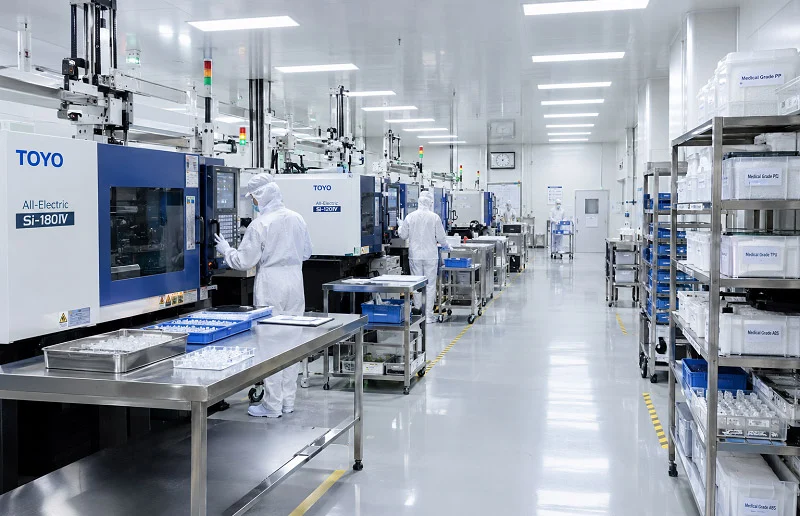
A cleanroom class is a particle-concentration classification under defined conditions. It is not a statement about sterility, chemical cleanliness or bioburden. When a supplier states a class, the useful follow-up questions are which occupancy state the class applies to, which particle sizes were measured, what monitoring evidence supports the claim, and whether the processes that matter for your part actually run inside the controlled space.
ISO 14644-1 Classification: Occupancy State, Particle Size and Monitoring
The widely used international cleanroom classification standard, ISO 14644-1, works by particle concentration and considers only particle sizes from 0.1 µm to 5 µm. It defines three occupancy states — as-built, at-rest and operational — and a designation should state the class, the occupancy state and the particle size considered. Keep in mind what it does not cover: the standard is silent on the physical, chemical, radiological, viable or other nature of airborne particles. Operational state matters most, because that is the condition in which your part is actually molded.
Which Processes Belong Inside the Cleanroom
Molding, part handling, post-processing, assembly, packaging and inspection each carry different contamination risks. Which of them belongs inside the controlled zone should follow the device’s contamination-control strategy, not floor-plan convenience. Ask where each step physically happens, who moves parts between zones, and whether the cleanroom is integral to production or a room used for photographs.
Personnel, Flow and Environmental Monitoring Evidence
A cleanroom is maintained by controlling the introduction, generation and retention of particles, which depends on gowning, material and personnel flow, air handling and routine monitoring. Ask for monitoring trends over time, the gowning procedure, and records of environmental excursions with their investigations. Weak answers describe the room; strong answers describe the trend, the excursion and what changed afterward.
Process Validation IQ/OQ/PQ: What Each Stage Proves and What Evidence to Request

Installation, operational and performance qualification answer three different questions. You should be able to map each question to a specific document in the supplier’s file, and to see that the document addresses the machine and process that will make your part.
Installation Qualification: Confirming the Equipment and Its Documentation
IQ establishes that the equipment, utilities and supporting systems are installed as specified and are documented: the machine, auxiliary equipment, calibration status, and the drawings and procedures that define the installation. The deliverable is an IQ report listing verified items and any deviations. Check that the machine identified in the report is the machine assigned to your project.
Operational Qualification: Proving the Process Window
OQ establishes that the process operates within defined limits across its intended range. It is where the molder challenges the process window, identifies critical parameters, and sets the boundaries within which performance qualification will run. OQ is where a molder demonstrates understanding of its process rather than merely running it, so read it for parameter rationale, not just for passing results.
Performance Qualification: Demonstrating Reproducible Output
PQ answers whether the process, run under normal production conditions, consistently produces parts that meet specification. Expect multiple runs, a stated sampling plan and acceptance criteria tied to the drawing and functional requirements. After PQ, the validated state has to be held: ongoing monitoring, revalidation triggers and change control are what keep the conclusion true.
Reading a Validation Report Like a Reviewer
Read the report for the process and equipment identity, the parameters and their limits, the acceptance criteria and why they were chosen, the sampling rationale, the results, every deviation with its investigation and closure, and an explicit conclusion. Red flags: validation run on a different machine or tool than the one that will supply you, acceptance criteria written after the results, or a report that narrates activity without stating whether the process is validated.
Material Capability and Biocompatibility: Why the Resin Datasheet Is Not Enough
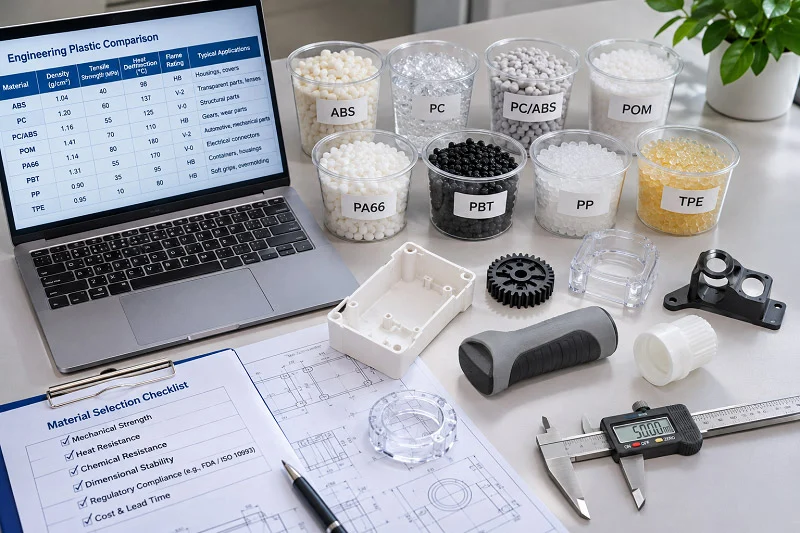
A resin supplier’s biocompatibility data describes a material, not your device. The assessment that matters is performed on the device in its final finished form, and it accounts for processing, manufacturing methods and residuals. So the molder’s material control and process discipline are not paperwork — they are inputs to the biological profile you will defend.
The Molder’s Material Controls: Traceability, Certificates and Change Management
A capable molder controls resin identity and lot traceability, holds certificates of analysis, inspects incoming material, states a regrind policy, controls drying and handling, and runs a change-control process that prevents silent substitution. Undisclosed material substitution is a serious supplier failure, not a minor deviation: it can invalidate your validation and disturb the biological profile you assessed.
Why Biocompatibility Is Evaluated on the Final Finished Device
Regulatory bodies in major markets assess biocompatibility of the whole device in its final finished form, including sterilization where applicable, and they do not clear or approve individual materials on their own. Their guidance directs that the risk assessment cover not only the materials but also the processing of the materials, the manufacturing methods and any residuals from manufacturing aids. That is why a molder’s process control and change notification are biocompatibility-relevant.
What to Ask a Medical Injection Molding Company About Materials
Ask which resins and grades are qualified for medical work; how a lot is traced from resin bag to shipped part; how regrind is limited and recorded; how a material change is communicated and approved before it happens; what documentation accompanies each lot; and how the molder will support your own biological evaluation with process information. Ask for a sample of each document rather than a verbal assurance.
From Build-to-Print to Early Involvement: Distinguishing Capability Levels

Compliance tells you whether a molder can be trusted with a defined job. Capability tells you how much of the job it can help you define. The difference shows up in design feedback, tooling strategy, change control and how early validation is planned — and it is observable in conversation, not in brochures.
What a Build-to-Print Molder Does Well
A build-to-print molder executes a design and specification you have already fixed. For a mature design with stable drawings, that model is efficient and entirely appropriate. It strains when the design still has open questions: tolerance conflicts, gate and ejection constraints, or material choices that only surface once tooling begins.
Observable Signs of Early-Engagement Capability
Look for design-for-manufacturability feedback before tooling is committed, discussion of tolerance and material trade-offs, input on gate and tool design, continuity from prototype to production, structured change control, and validation planning that begins before PQ. Test these by sending a real drawing with a known difficulty and seeing whether the response engages with it or simply quotes a price.
Tooling, Prototyping and the Path to Production
Tooling decisions made early constrain the production part: gate location affects fill and weld lines, cooling affects cycle and warpage, and prototype method affects how much of the production process you have actually exercised. Continuity means the prototype and the production part are made under a process you can trace, not two unrelated exercises.
Change Control as the Real Test of Partnership
Change control is the best single indicator of whether early involvement is real. A robust process identifies the change, assesses its effect on the validated state and on regulatory filings, defines what revalidation is needed, and obtains your approval before implementation. Probe it by asking what happened the last time a resin or tool was changed, and who was told first.
How to Score and Compare Medical Injection Molding Company Candidates
Once the evidence is in hand, comparison needs a structure that reflects your device rather than a generic ranking. Score the dimensions the framework has covered, treat certain findings as stop conditions, and use a site visit to test what the desk review concluded.
Building a Weighted Scorecard
Score each dimension on a defined scale and weight it by what your device and stage demand. A high-risk implantable program should weight validation and material control heavily; a mature Class I part may weight cost and lead time more. The weights are yours to set — what matters is that they are set before you see the bids.
| Dimension | Evidence to score | Weight when device risk is high | Weight when device risk is low |
| Certificate scope and authenticity | Verified certificate naming the site and molding process | High | Medium |
| Cleanroom evidence | Operational-state classification and monitoring trends | High | Low |
| Validation documentation | IQ/OQ/PQ reports with criteria, deviations and conclusions | High | Medium |
| Material control | Lot traceability, CoA, regrind policy, change notification | High | Medium |
| Capability level | DFM input, tooling strategy, prototype continuity | Medium | High |
| Communication and change control | Response quality, approval workflow, escalation path | Medium | High |
Findings That Should Disqualify a Supplier Outright
Treat these as stop conditions rather than deductions: certificates that cannot be verified or do not cover the site and process, refusal to provide validation documentation, inability to trace material lots, undisclosed material substitution, cleanroom claims unsupported by monitoring evidence, and resistance to change control. Each one removes the evidence base the rest of the score depends on, so a strong price cannot compensate.
Site Audits and Sample Part Reviews
Use the site visit to confirm or contradict the desk assessment. On the floor, look at whether material handling matches the procedure, whether the cleanroom is in use during production, whether monitoring records are current, and whether operators can explain what they do when a parameter drifts. In the conference room, ask for the documents you requested in advance and note which ones arrive late or incomplete. Review sample parts against the drawing and against the validation report’s acceptance criteria.
Common Mistakes Buyers Make When Selecting a Medical Injection Molding Company

Most supplier failures are set up long before the first shipment, in the way the supplier was selected. The framework above exists to prevent a small number of recurring errors.
The first is treating a certificate as a conclusion.
A PDF showing an ISO 13485 logo says nothing until you have checked the certified entity, the site, the scope of activities and the certificate’s current status with the issuing body. A certificate held by a parent company or a trading office, naming neither the factory nor injection molding, is a common and expensive discovery.
The second is accepting a cleanroom class number as a description of the environment.
A class is a particle-concentration classification under a stated occupancy state and particle size. Without the operational-state data and the monitoring history, you do not know what the room was doing while your parts were being made — or whether your parts were in it at all.
The third is treating validation as a document to collect rather than a state to maintain.
A validation report that lacks acceptance criteria, or that was produced on a different machine, tells you the molder can assemble paperwork. What you need is evidence that the process was challenged, that deviations were investigated, and that change control keeps the validated state intact.
The fourth is assuming a resin datasheet settles biocompatibility.
The assessment applies to the final finished device, including processing, manufacturing methods and residuals. A molder that substitutes material without telling you has altered an input to that assessment.
The fifth is buying capability on the strength of marketing language.
Early involvement is visible in DFM feedback before tooling commitment, in tooling and gate-design discussion, in prototype-to-production continuity and in a change-control process you can inspect. Ask for the last change record and see how it was handled.
The sixth is scoring before disqualifying.
A weighted scorecard is useful for comparing suppliers that have already cleared the stop conditions. Applied too early, it lets a strong price and a fast quote outweigh an unverifiable certificate.
The seventh is skipping the site visit, or treating it as a courtesy call.
The floor is where procedures meet practice, and the gap between them is what an audit will eventually find.
None of this requires a large quality organization. It requires a sequence: verify the certificate, examine the environment, read the validation, test the material controls, probe the capability, then score. Done in that order, each step is cheap relative to the one it protects.
Choosing NOBLE to Support Your Medical Injection Molding Project
NOBLE is a China-based contract manufacturer that supports medical injection molding projects from prototype through volume production. The company holds ISO 9001:2015 and ISO 13485:2016 certification, and it provides a full service scope that runs from design to assembly rather than production alone — a distinction that matters when you are evaluating early-engagement capability, tooling continuity and post-molding handling under one quality system.
Read that against the framework above rather than in place of it. Certification is a starting filter, not a conclusion: confirm the certificate scope names the site and the injection molding activities that will make your part, and ask for the validation and material-control evidence described in the sections on IQ/OQ/PQ and material traceability. What NOBLE offers within its stated scope is a single manufacturing partner positioned to move a project from prototype tooling into batch production, with design and assembly support in the same relationship. Whether that fits your device depends on your risk classification, your own regulatory obligations and the evidence you verify directly.
FAQs of Medical Injection Molding Company
The answers below apply the framework’s checks to the questions buyers ask most often.
How do I tell whether an ISO 13485 certificate actually covers the factory and processes that will make my part?
Read the certified legal entity, the named site address and the scope of activities, then confirm all three with the issuing certification body. A certificate held by a parent or trading office that does not name your factory or injection molding fails the check.
What should I look for in a cleanroom beyond the class number, and which processes actually need to be inside it?
Ask for the occupancy state (as-built, at-rest or operational), the particle sizes classified and the monitoring trends behind the claim; operational state is the one that reflects molding with people and equipment present. Then confirm which steps — molding, handling, assembly, packaging, inspection — actually run inside the controlled zone.
What do IQ, OQ and PQ each demonstrate, and what evidence should a supplier be able to show me?
IQ shows the equipment and supporting systems are installed as specified and documented; OQ shows the process operates within defined limits across its intended window; PQ shows reproducible output under normal production conditions. Expect a report for each, with parameters, acceptance criteria, sampling rationale, results, investigated deviations and a conclusion.
Why is biocompatibility a final-device question rather than a resin-datasheet question?
Because the assessment applies to the device in its final finished form, including sterilization where applicable, and covers processing, manufacturing methods and residuals from manufacturing aids — not just the resin. Regulatory bodies do not clear or approve individual materials, so a supplier datasheet cannot settle your device’s biological evaluation.
What observable capabilities separate a build-to-print molder from one that can engage early in design?
Look for design-for-manufacturability feedback before tooling commitment, tolerance and material trade-off discussion, gate and tooling input, prototype-to-production continuity, and validation planning that starts before PQ. Test these by asking for a specific past example and the documents behind it, not by asking whether the molder offers early involvement.
How should I weight and score suppliers, and which findings should disqualify a supplier outright?
Weight the scorecard by device risk and project stage: certificate scope and authenticity, cleanroom evidence, validation documentation, material control, capability level, and change control. Treat unverifiable or out-of-scope certificates, refused validation records, untraceable material lots, undisclosed substitution and unsupported cleanroom claims as stop conditions rather than deductions.
What does NOBLE offer for a medical injection molding project?
NOBLE is a China-based contract manufacturer holding ISO 9001:2015 and ISO 13485:2016 certification. It provides a full service scope from design to assembly, not production alone, and supports prototyping and batch production within that scope.