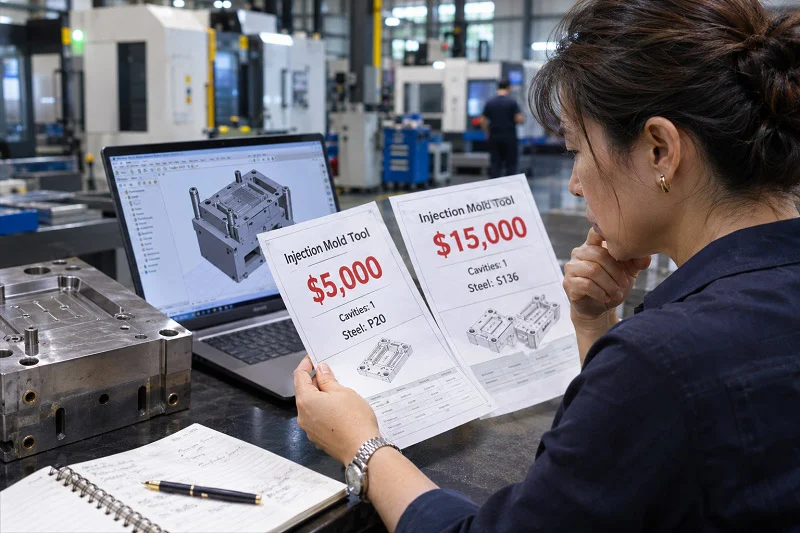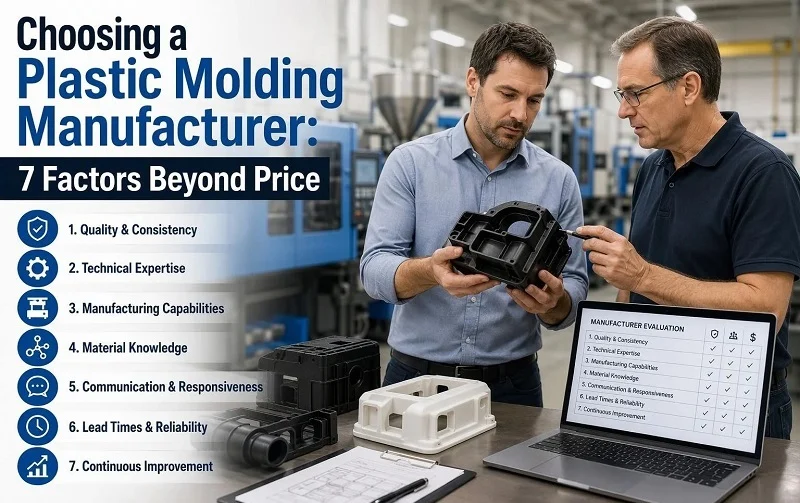
Price is the easiest line to compare and the least informative one. Two quotes for the same part can look identical on paper while hiding very different tooling terms, process discipline and risk allocation — differences that surface months later, when a mold needs rework or a shipment fails inspection.
If you’re sourcing custom parts, the real question isn’t who quoted lowest. It’s whether the shop behind that number can hold your tolerances, hand over your tool, and still answer for the part after the press stops. This guide walks through seven factors worth examining before you sign — certification scope, tool ownership, design-for-manufacturability support, machine fit, quality records, capacity under load, and post-processing accountability — each with the specific questions to ask and the answers that should raise a flag.
1. Industry Certifications: Verify Scope, Not Just the Certificate

A certificate tells you that an independent certification body audited a management system against a standard; it does not tell you what that system covers. The scope statement on the certificate is the part that matters, because it names the activities, products and sites included. ISO’s own auditing guidance warns that a scope can be too broad or vague to convey what an organization actually does, and that a reference to a product specification standard inside a scope statement can misleadingly suggest the product itself is certified. When you shortlist plastic molding manufacturers, ask for the certificate and read the scope line by line: does it name injection molding, or only assembly and warehousing? Does it list the plant that will run your tool?
What ISO 9001 Certification Actually Covers
ISO 9001:2015 sets requirements for a quality management system, and certification against it is voluntary and performed by independent bodies rather than by ISO itself, as ISO’s explanation of the standard makes clear. The standard provides a framework for consistent delivery and continual improvement; it does not prescribe how a molder must run a press. A certified quality system is therefore evidence of process discipline, not proof of part quality.
Medical Work: ISO 13485 and the FDA Overlay
ISO 13485:2016 is the medical device quality management standard, and its Clause 1 permits limited exclusions — design and development among them — where applicable regulations allow. A contract molder building to a customer’s design may legitimately exclude design, but that exclusion should appear in the quality manual and on the certificate scope. For U.S. buyers, note that the FDA’s Quality Management System Regulation took effect February 2, 2026, incorporating ISO 13485 by reference, and the agency states plainly that it will not require or issue ISO 13485 certificates and that a certificate does not exempt a plastic molding manufacturer from an FDA inspection. Treat a certificate as one input, not as regulatory clearance.
Questions to Put in Writing
Ask which sites and processes the scope covers, who issued the certificate, when the last surveillance audit occurred, and whether outsourced steps such as plating or sterilization fall inside the certified system. ISO’s guidance notes that even when a process sits outside the certification scope, the organization must still control it and keep evidence of that control.
2. Mold Ownership Terms: Who Really Owns Your Tooling?
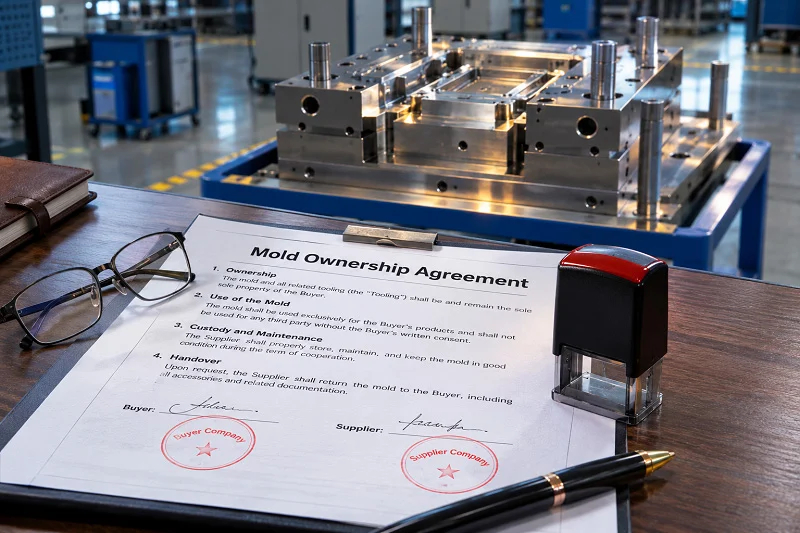
Tooling is often the largest single capital item in a molding program, and ownership is decided by paperwork, not by who paid the invoice. Before steel is cut, establish in the contract who holds title to the mold, who may possess it, and what happens to it if the relationship ends.
Title, Possession and Access
A molder may build or store a tool without owning it. The purchase order, tooling agreement and any side letter should state that the buyer owns the tool, that the molder holds it as bailee, and that the buyer may inspect it and remove it on request after settling outstanding balances. Ambiguity here is common and expensive: a supplier that treats the mold as its own asset can refuse to release it, and a buyer with no written title may have little leverage.
What Happens at the End of the Relationship
Specify the exit terms while everyone is still cooperating. Who pays for crating and freight? Will the molder provide tool drawings, maintenance logs, setup sheets and process parameters? Will it run a final validation before shipment so the receiving molder can match the process? A tool that arrives without its history often needs rework and re-qualification, which can erase the savings that motivated the move.
U.S. Customs: The Tooling Assist
If you are a U.S. importer and you supply molds free of charge to a foreign molder, the tool is a customs “assist.” Under 19 CFR § 152.103, the value of molds, dies and similar items used in producing imported merchandise is added to transaction value; the regulation’s own example confirms that free-of-charge molds supplied to a foreign shipper must be added. Ownership terms and declared value are therefore linked, and your customs broker should see the tooling agreement before the first shipment.
3. DFM Support: Does the Plastic Molding Manufacturer Review Before Cutting Steel?
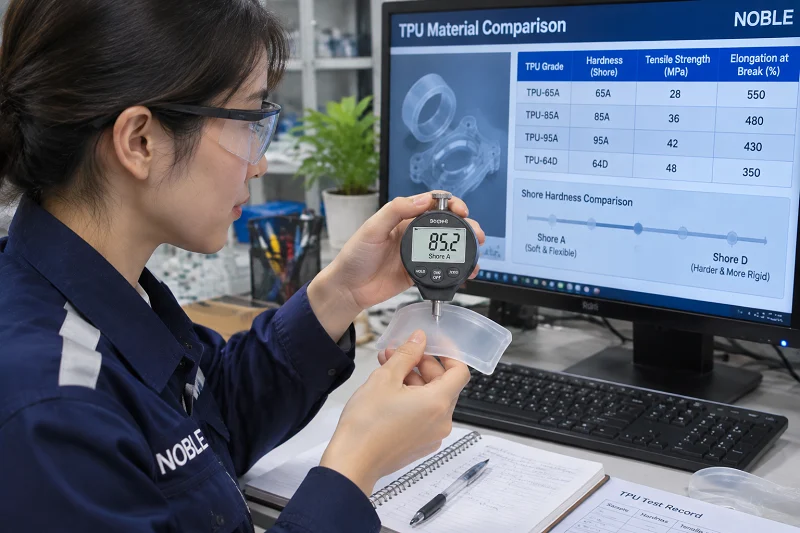
Design for manufacturability review is the cheapest engineering a project will ever receive, because every change made before steel is cut costs a fraction of the same change made after. The question to ask a candidate is not whether it offers DFM but whether its feedback arrives before the tool design is frozen.
What a Real DFM Review Examines
A substantive review looks at wall thickness and transitions, draft angles, gate location and fill balance, ejection and cooling layout, tolerance stack-ups, material shrinkage and the choice of resin itself. It should flag features that will drive tool complexity — undercuts, deep ribs, tight cosmetic requirements — and propose alternatives with a cost or cycle-time consequence attached. A one-page checklist returned in an hour is a formality; a marked-up model with specific recommendations is a review.
Who Does the Review, and When
Ask whether the review is performed by tooling engineers or by sales staff, and whether the molder will sign off on the final part design before committing to steel. The timing matters as much as the content: DFM that arrives after the mold base is ordered cannot influence the design it was meant to improve. Establish a written gate — DFM report delivered, buyer disposition recorded, tool design released — so the sequence is visible to both sides.
Closing the Loop on Changes
When DFM recommendations are accepted, confirm that the revised model, not the original, becomes the controlled drawing used for tool fabrication and first-article inspection. A molder that reviews carefully but then builds to an outdated file has added a step without adding value.
4. Machine and Process Fit: Tonnage, Precision, and Auxiliary Equipment
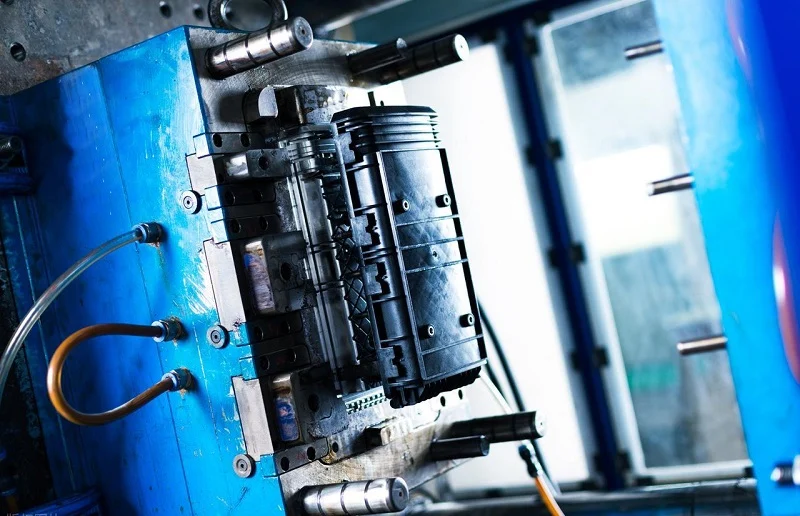
A press is only part of a molding system, and the machine that runs your tool must match the tool’s size, the part’s tolerance and the resin’s processing window. Machine fit is a technical question with checkable answers.
Tonnage and Shot Size
Clamp tonnage must hold the mold closed against injection pressure across the projected area, with margin; too little produces flash, too much can damage the tool. Shot size is the subtler constraint. Plastics Technology notes that shots using less than about 20% of barrel capacity tend to cause long residence times, polymer degradation and poor process control, while shots above roughly 65% risk unmelted material and long recovery times, and recommends a working range of about 25% to 65% with an added safety factor. A molder that fits your part onto whatever press is free may be running outside that window.
Precision and Repeatability
Ask about shot-repeatability specifications, closed-loop process control, and the tolerance the molder will actually guarantee on your part rather than the best it has ever achieved. Cosmetic requirements, optical parts and tight dimensional callouts each stress the machine differently.
Auxiliary Equipment
Drying and conveying, temperature control units, hot-runner controllers, robotics for part removal and granulators all affect consistency. Ask which auxiliaries are dedicated to the cell running your job and how material is dried and verified — moisture-related defects are among the most common and least visible causes of a failing lot.
5. Quality Records vs. Quality Claims: What to Ask For
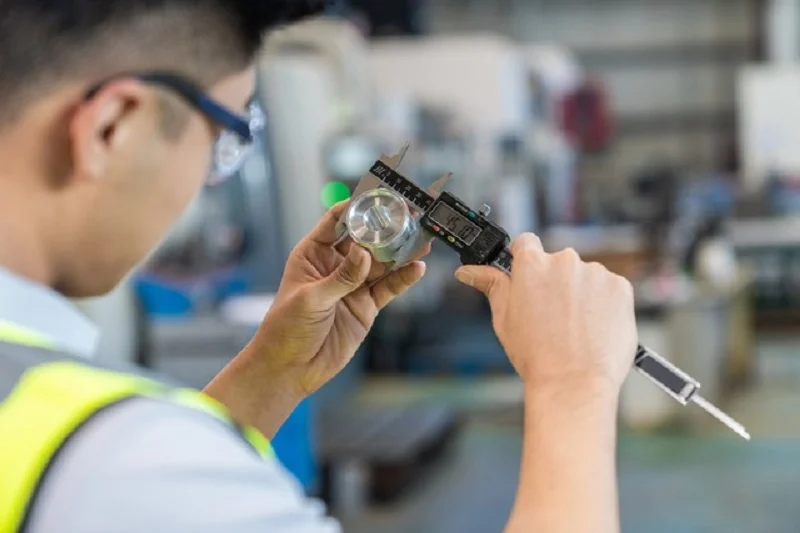
Every molder will tell you it has strong quality control. The useful question is what records exist, who created them, and whether you can see them before you commit.
Records That Should Exist for Your Job
Ask for the first-article inspection report with dimensional results against the drawing, the material certificates and lot traceability, the process parameter sheet for each approved setup, and the control plan naming which characteristics are monitored and how often. If statistical process control is used, ask to see the charts and the reaction plan that tells operators what to do when a signal appears. ASQ’s guidance on SPC draws a distinction worth repeating: control limits come from the process and describe what it actually does, while specification limits come from the drawing and describe what is acceptable — a process can be perfectly stable and still produce out-of-specification parts. A molder that conflates the two is monitoring without understanding.
Claims Versus Evidence
A capability figure quoted in a brochure is a claim. A capability study tied to your part number, with the sample size, the measurement system analysis behind it and the date, is evidence. Ask for the underlying data, and ask what happened the last time a process went out of control on a comparable job.
Audit Rights and Record Retention
Confirm in the contract that you may audit the molder’s quality system on reasonable notice and that records for your parts are retained for an agreed period and made available on request. For regulated products, record retention is not a courtesy; it is part of the compliance chain.
6. Real Capacity and Lead-Time Flexibility Under Load
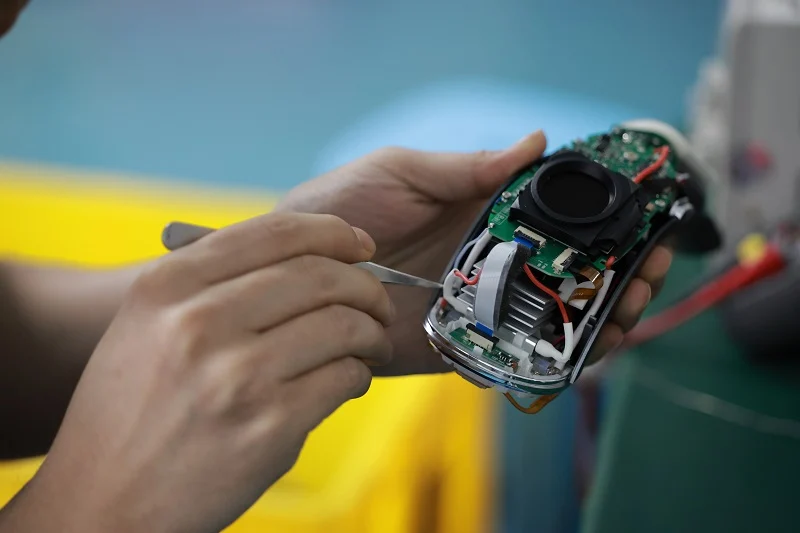
Quoted lead time is a promise made in calm conditions. What you need to know is how the molder behaves when its floor is full.
Reading Capacity Honestly
Ask how many presses of the relevant tonnage exist, how many are currently committed, and what utilization the molder considers full. A shop running at high utilization has little room for your expedite; a shop with idle machines may lack the workload to keep skilled staff. Neither is automatically right, but the answer tells you what to plan for.
Scheduling Under Load
Ask how jobs are prioritized when demand spikes, whether your volume is reserved in a capacity agreement, and how changeovers and mold maintenance are scheduled so they do not collide with your run dates. Request the actual on-time delivery record for the past several quarters, not a target figure, and ask how delays are communicated and recovered.
Tooling and Material as Lead-Time Drivers
Mold fabrication, steel and resin availability, and secondary operations often dominate the timeline more than press time. Ask the molder to break its quoted lead time into tool build, sampling, approval and production phases, so you can see which phase carries the risk and where a buffer is worth paying for.
Planning for the Peak
If your demand is seasonal or launch-driven, discuss the peak scenario before the first order. A molder that has thought about your busiest month is more useful than one that has only priced your average one.
7. Post-Processing and Full-Chain Accountability
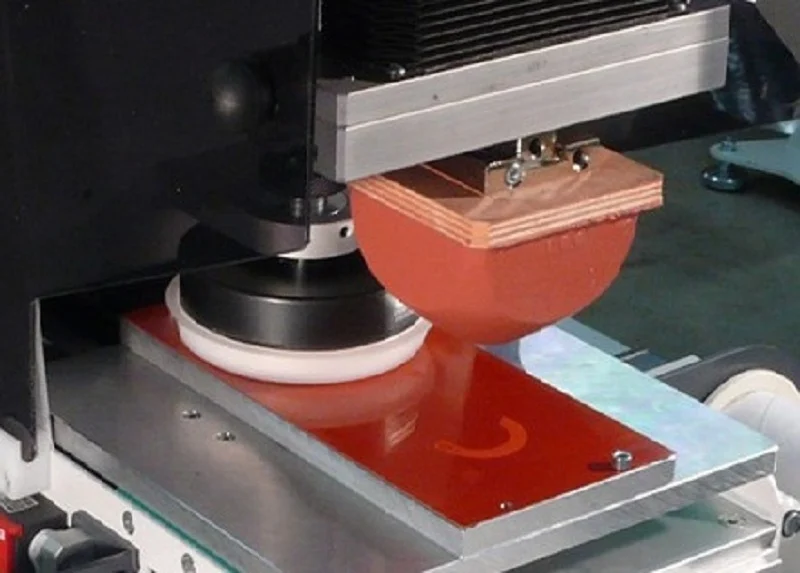
A molded part is rarely a finished product. Painting, printing, laser marking, ultrasonic welding, assembly, packaging and sterilization all sit downstream of the press, and each one is a place where accountability can quietly change hands.
Mapping the Chain
Ask the molder to list every operation your part will undergo, who performs it, and where it happens. If steps are subcontracted, the molder remains responsible for them under its quality system — ISO’s auditing guidance is explicit that outsourced processes must still be controlled and evidenced, even when they fall outside the certification scope. Confirm how incoming material from those steps is verified and what acceptance criteria apply.
Validation of Special Processes
Welding, bonding, coating and sterilization are special processes whose output cannot be fully verified by inspection alone, so they depend on validated parameters and qualified operators. Ask for the validation records and the revalidation triggers.
One Point of Contact
Full-chain accountability means a single party answers when something goes wrong, regardless of which step failed. Establish that in the contract: who owns the nonconformance, who issues the corrective action, and how cost and schedule responsibility is allocated across the chain. A molder that coordinates its supply chain but disclaims responsibility for it has shifted risk to you without saying so.
Choose NOBLE For Your Plastic Molding Manufacturer
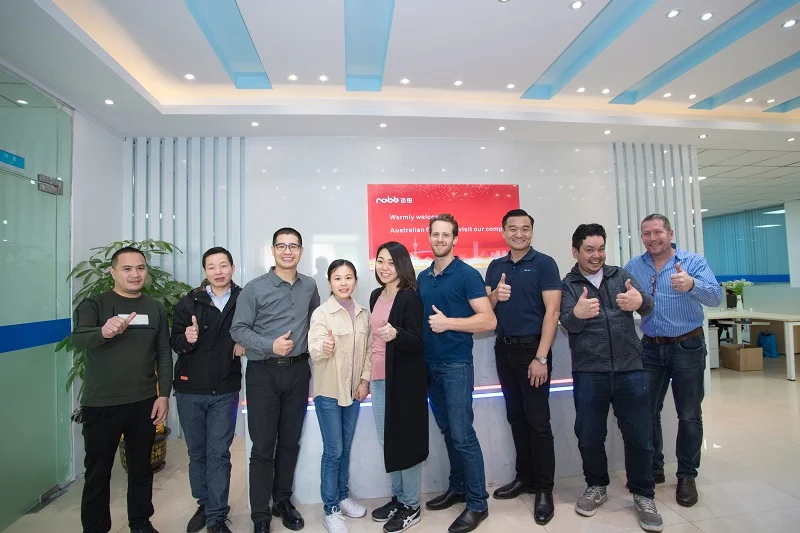
NOBLE is a Sino-British joint venture and a government-recognized National High-tech Enterprise, and we work as a plastic molding manufacturer for customers who need a single partner from concept through production. Our engineering and machining teams support prototyping and volume manufacturing, so a design can move from a first sample to a production run without changing hands.
We are certified to ISO 9001:2015 and ISO 13485:2016. Our services extend from design and prototyping through machining, molding and assembly — not production alone — and our inspection equipment and quality control system are set up to hold the tolerances your drawings specify. Quotes are typically returned within 24 hours of a complete RFQ, and many parts can be finished within 7–10 days.
If you are comparing plastic molding manufacturers on the factors above, send us your drawings and volumes and we will tell you what we can commit to, in writing, before any steel is cut.
FAQs about Plastic Molding Manufacturer
Does an ISO 9001 certificate guarantee part quality?
No. It confirms that an independent body audited a quality management system against the standard’s requirements. Part quality depends on the specific process, tool, material and controls, which is why you should read the certificate scope and ask for records tied to your part number.
Who owns the mold if I pay for it?
Ownership follows the contract, not the invoice. State in writing that you hold title, that the molder possesses the tool on your behalf, and what happens on termination. For U.S. imports, remember that free-of-charge molds supplied to a foreign molder are a customs assist added to transaction value under 19 CFR § 152.103.
When should DFM happen?
Before the tool design is released for fabrication. A review that arrives after the mold base is ordered cannot change the decisions that drive cost and cycle time.
How do I check claimed capacity?
Ask for press counts by tonnage, current utilization, on-time delivery history and how your volume is reserved during peak periods. Request the lead time broken into tool build, sampling, approval and production phases.
Can a molder’s ISO 13485 certificate substitute for FDA compliance?
No. The FDA has stated that it will not require or issue ISO 13485 certificates and that such a certificate does not exempt a plastic molding manufacturer from an FDA inspection, even though the QMSR incorporates the standard by reference.