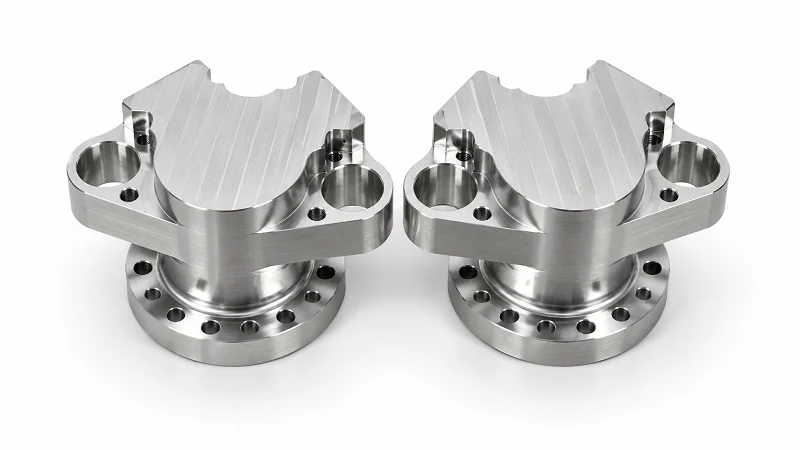
In the field of modern industrial production and manufacturing, metal welding technology holds a very important position. It is a process method that combines two or more metal parts at the atomic level through heating, pressurization, or a combination of both to form a solid whole.
From the processing of metal ornaments in daily life to the construction of aerospace equipment, ships, and Bridges, none can do without the support of metal welding technology.
 |
What is Sheet metal welding?
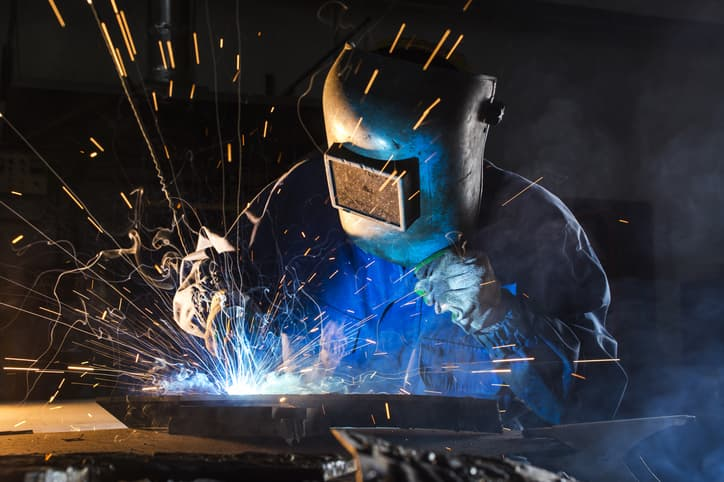
The basic idea of metal welding is to use heat or mechanical force. It breaks the original links between atoms at the joining parts of metal pieces. Then these atoms spread and mix. Finally, they form new metal connections to make a permanent join.
During welding work, the metal’s connecting areas get heated to a melted or bendable state. The atoms then become far more lively. They are able to merge together through the spaces between different metal components. Once it cools, a steady welded link appears. It changes the originally separate metal parts into a firmly united piece.
Metal welding is totally different from mechanical joining methods. Connections like bolts and rivets can be taken apart easily. The metal atoms at their joining spots never really mix. Welding, however, makes a permanent and non-separable link. The welded joints are often as strong as, or even stronger than, the original metal itself. This feature makes welding widely used in areas that need super-strong structures.
The advantages and disadvantages of Sheet metal welding
Advantages
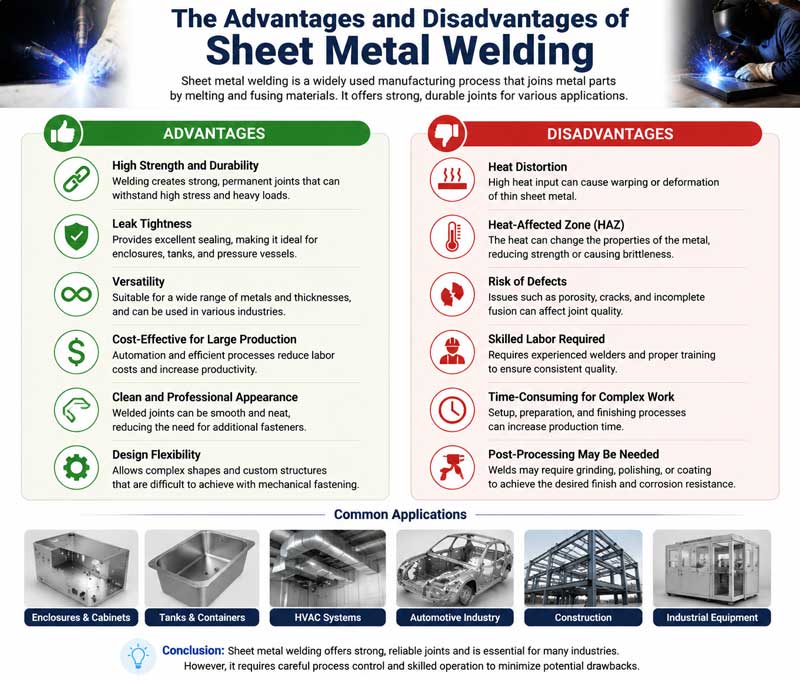
- Strong connection strength: Welded joints can bond metal atoms together. Their strength is usually as high as, or even higher than, the original metal. This makes welded structures very good at bearing weight. They can stand heavy loads, strong shocks, and vibrations.
- Excellent tightness: Joints made by welding are smooth and solid all over. They can stop gas and liquid from leaking out effectively. This feature makes welding very useful. It is great for making pressure tanks, pipes, and storage containers.
Wide range of uses:
Metal welding works for nearly all kinds of metal materials. These materials include carbon steel, stainless steel, aluminum alloy, and copper alloy.
Meanwhile, it can connect metal components of different shapes and sizes. Whether it is thin plate splicing, thick plate butt welding, or the welding of complex structures, all can be achieved by choosing the appropriate welding method.
- Material and cost savings: Compared with bolt and rivet connections, welding does not require additional connecting parts, which can save a large amount of metal materials. Meanwhile, the welding process is relatively simple, with high production efficiency, which can effectively shorten the manufacturing cycle and reduce production costs. In large-scale industrial production, this advantage can significantly enhance the economic benefits of enterprises.
Disadvantages
- There is stress and deformation in the welded joint: During the welding process, local areas of the metal will be rapidly heated and cooled. This uneven temperature variation will cause welding stress to occur in the welding joint area. When the stress exceeds the material’s tolerance range, it will cause deformation of the welded part and even lead to cracks. The subsequent correction and repair work after deformation has increased production costs and procedures.
- High requirements for operational skills: The quality of welding directly depends on the technical level of the operator. During the welding process, the control of parameters such as welding current, voltage, welding speed, and electrode Angle all require rich experience and precise operation. If the parameters are not set properly, it is very easy to have welding defects such as pores, slag inclusions, incomplete penetration, and cracks. These defects will seriously affect the performance of the welded joints and threaten the safe use of the structure.
- The detection of welding defects is rather difficult: Some welding defects, such as internal pores, slag inclusions, and micro-cracks, cannot be directly observed by the naked eye and require the use of professional detection equipment. These detection devices are expensive, and the detection process is complex, which increases the quality control cost during the production process.
Commonly used materials in Sheet metal welding
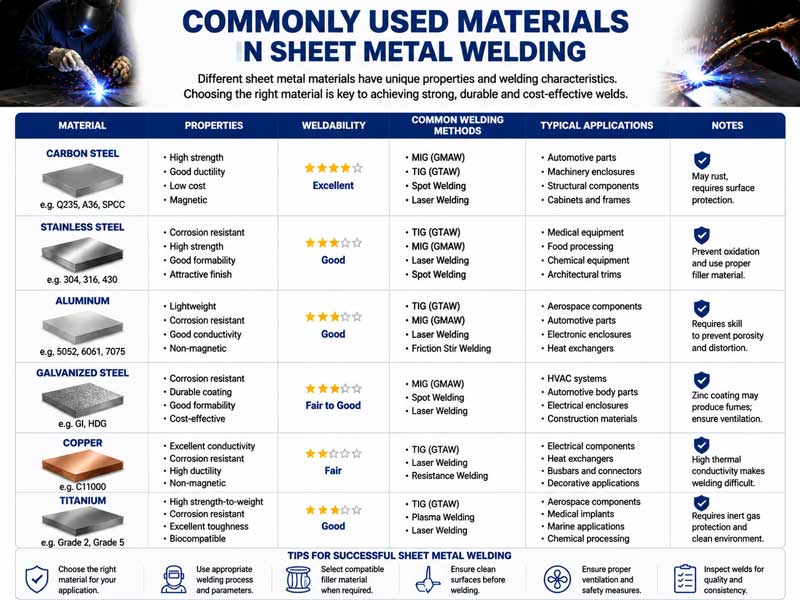
The commonly used materials for metal welding are mainly divided into two categories. The First type is the base material, which is the metal that needs to be welded. The Second type is a filling material, which fills the gaps between the connected parts during welding. There are also some helper materials, like flux and shielding gas. They don’t directly join the metals together. But they have a big influence on the quality of the weld.
(1) Base material
There are numerous types of base materials. Almost all metals and alloys can be used as welding base materials. The common ones include the following categories:
1. Carbon steel: According to the difference in carbon content, it can be classified into low-carbon steel, medium-carbon steel, and high-carbon steel.
Low-carbon steel has the best welding performance, good plasticity, and is less likely to develop cracks during welding.
- Stainless steel: Stainless steel has excellent corrosion resistance and high-temperature resistance.
Depending on its microstructure, it can be classified into austenitic stainless steel, ferritic stainless steel, and martensitic stainless steel. Austenitic stainless steel has excellent welding performance and is a commonly used type of stainless steel in industry. When welding ferritic stainless steel, the problem of coarse grains is prone to occur, which affects the toughness of the welded joint. Martensitic stainless steel has poor weldability and requires heat treatment after welding to improve its performance.
- Non-ferrous metals and alloys: Common ones include aluminum alloys, copper alloys, titanium alloys, etc.
Aluminum alloy is light in weight, high in strength, and good in corrosion resistance. When welding, methods such as argon arc welding should be adopted, and attention should be paid to preventing oxidation.
Copper alloys have good thermal conductivity. During welding, a large amount of heat input is required, and at the same time, it is necessary to avoid the formation of pores.
Titanium alloys possess characteristics such as high strength, low density, and high-temperature resistance. Their welding is rather difficult and needs to be carried out under inert gas protection. They are often used in the aerospace field.
(2) Filling materials
The function of the filler material is to fill the gap of the welded joint, mix with the molten base material to form a welded seam, and ensure the strength and sealing performance of the joint.
Commonly used filler materials include welding rods, welding wires, and welding strips.
- Electrode: An electrode is composed of two parts: the core and the coating.
The core is the metal core of the electrode, whose composition matches that of the base material. Its main function is to provide a metal filling for the weld seam. The coating is a layer applied to the surface of the core weld, composed of mineral powder, ferroalloy powder, binder, etc.
During welding work, the coating produces gas for protection. The gas stops air from contaminating the pool of melted metal. It also helps reduce unwanted elements like oxygen, sulfur, and phosphorus. This improves the quality of the weld. Welding rods come in many kinds based on what they are used for. For example, there are rods for structural steel, stainless steel, and cast iron.
- Wire: Wire is mainly used in welding methods such as gas shielded welding and submerged arc welding.
Its composition is uniform, and the impurity content is low, which can ensure the stable performance of the weld seam. Welding wires can be classified into solid welding wires and flux-cored welding wires based on their different materials. Solid welding wire needs to be used in conjunction with shielding gas.
The flux-cored wire contains powder. During welding, the powder decomposes to produce protective gas and slag, which protect the molten pool. It has high welding efficiency and good weld formation.
- Welding band: Welding bands are often applied to welding methods such as electroslag welding and submerged arc automatic welding. They are suitable for welding thick steel plates. Their width and thickness can be picked according to different welding demands. It helps make the weld seam fill uniformly.
(3) Auxiliary materials
Flux: Flux is mostly used in welding processes like submerged arc welding and electroslag welding. It forms slag when welding is going on. The slag covers the molten metal pool. It keeps air away and stops the metal from rusting. At the same time, flux reacts chemically with impurities in the pool. It removes oxygen, sulfur, and phosphorus. This makes the weld seam much better.
People often use flux in welding methods such as submerged arc welding and electroslag welding. During welding, it creates a layer of slag. The slag covers the surface of the melted metal pool. It blocks air and prevents metal oxidation. Meanwhile, flux also reacts with unwanted materials in the pool. It helps get rid of oxygen, sulfur, and phosphorus. This improves the quality of the weld.
Flux is mainly applied to welding techniques like sub.
- Shielding gas: The function of shielding gas is to protect the arc and molten pool during the welding process, prevent gases such as oxygen and nitrogen in the air from invading, and avoid defects such as porosity and slag inclusion in the weld seam.
Commonly used protective gases include argon, helium, carbon dioxide, etc.
Argon and helium are inert gases with good protective effects and are often used in the welding of non-ferrous metals and stainless steel.
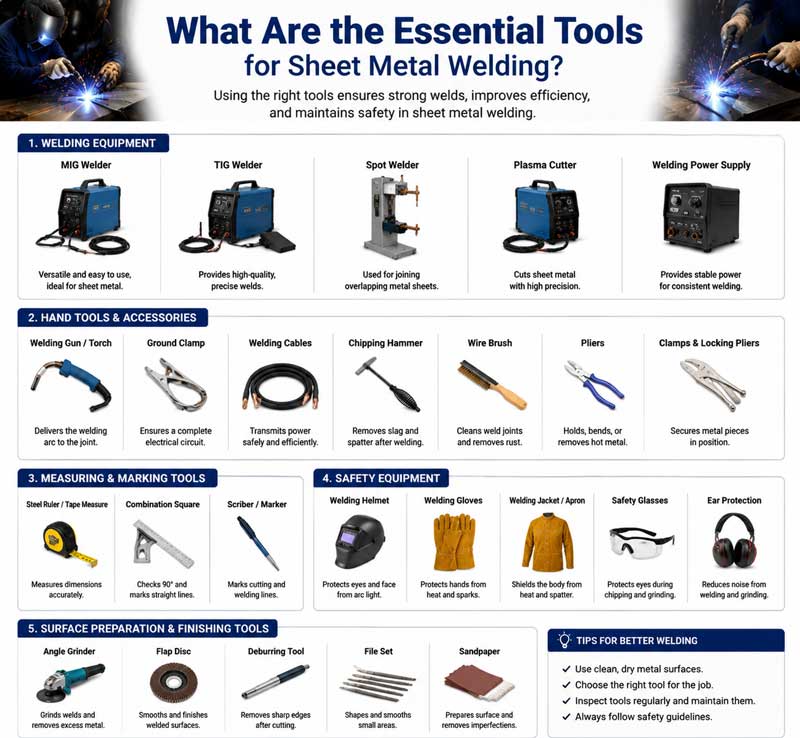
What are the essential tools for Sheet metal welding
There are various types of tools for metal welding. The tools we need change with different welding methods. But no matter which method we choose, these necessary tools are a must-have.
(1) Welding power supply
A welding power supply is a device that provides the electrical energy required for the welding arc and is the core tool for welding operations.
- AC arc welding machine: The AC arc welding machine has a simple structure, a low price, and is easy to maintain. It is mainly used for manual arc welding and is suitable for welding low-carbon steel and other materials.
Its output current is alternating current, and the arc stability is relatively poor.
- DC arc welding machine: The output current of a DC arc welding machine is direct current. The arc has good stability and can weld various metal materials, such as stainless steel and non-ferrous metals.
DC arc welding machines can be further classified into rotary DC arc welding machines and rectifier DC arc welding machines.
Rotary DC arc welding machines are relatively large in size and have high noise levels.
The rectified DC arc welding machine is small in size, light in weight, and highly efficient.
- Inverter welding machine: An inverter welding machine is a new type of welding power source. It uses inverter technology to convert industrial frequency alternating current into direct current, then invert it back into high-frequency alternating current, and finally rectify it into direct current output.
Inverter welding machines have the advantages of small size, light weight, energy conservation, high efficiency, good arc stability, and can achieve various welding methods.
(2) Welding operation tools
- Welding torch: The welding torch is mainly used in gas shielded welding. Its function is to hold the welding wire, conduct current, and convey shielding gas.
The welding torch is used for gas welding. It can mix flammable gas and oxygen and spray them out through a nozzle. After being ignited, it forms a flame to heat the base material and filler material.
- Welding holders: Welding holders are must-have tools for manual arc welding. They grip the electrodes and conduct welding electricity. Welding holders should be good at conducting electricity, resisting heat, and insulating. They keep the welding process safe and steady.
- Welding masks and safety equipment: Welding masks are key tools for protecting welders’ faces and eyes. They have two styles: hand-held ones and head-mounted ones.
(3) Auxiliary tools and equipment
- Angle grinder: The angle grinder has two main uses. It cleans the base metal before welding and grinds the weld after welding. Before welding, it removes impurities like rust, oil, and oxide scale on the metal surface. This helps guarantee the quality of the weld joint. After welding, it polishes the weld seam. It makes the seam smooth and enhances the appearance of the welded pieces.
- Electrode storage bucket: The electrode storage bucket holds welding rods. It keeps them from getting damp. Certain rods, such as alkaline ones, are very easy to absorb moisture. Once they absorb moisture, defects like pores may occur during welding.
The welding rod insulation bucket can dry the welding rods by heating to ensure their performance in use.
- Clamps and positioners: Clamps fix the parts that need welding. They ensure precise positions during welding. They also prevent the parts from changing shape. Positioners can move the welded parts to different positions and angles. They make welding operations smoother. They also boost welding efficiency and quality. They play an extra important role for large and complex welded parts.
- Checking tools: Checking tools are used to test the quality of welded joints. They often judge if the weld’s appearance is up to scratch. Ultrasonic flaw detectors and X-ray flaw detectors detect inner defects in welds. These defects include holes, trapped slag, and cracks
How does metal Sheet welding work
The working principle of metal welding is essentially to shorten the distance between the atoms of the metal to be welded to the range where metal bonds are formed through the action of thermal or mechanical energy, thereby achieving the bonding of atoms.
According to whether the base material melts during the welding process, welding methods can be classified into three major categories: fusion welding, pressure welding, and brazing.
(1)Working Principle of Fusion Welding
Fusion welding is the most commonly used welding method. Its core is to heat the base material of the area to be welded to a molten state to form a molten pool, and at the same time, the filler material will also melt and blend into the molten pool.
After the molten pool cools and solidifies, a welded joint will be formed.
Common fusion welding methods include manual arc welding, gas welding, argon arc welding, carbon dioxide gas shielded welding, etc.
1. The two poles of the welding power supply are respectively connected to the welding tongs and the workpiece to be welded, forming a closed circuit.
2. The operator holds the welding rod with electric welding tongs, brings the welding rod into contact with the workpiece, and then quickly pulls it away a short distance.
At this point, an electric arc will be generated between the electrode and the workpiece. The temperature of the arc can reach 6000-8000℃, which can instantly melt the end of the electrode and the part of the workpiece to be welded, forming a molten pool.
3. At high temperatures, the coating of the electrode will decompose to produce protective gas and slag. The protective gas envelops the arc and the molten pool, isolating the air.
The slag covers the surface of the molten pool to prevent the oxidation of the molten pool metal.
4. As the welding rod keeps moving, new molten pools are constantly formed, while the old ones keep cooling and solidifying. Eventually, a continuous weld seam is formed, achieving the connection of metals.
(2) Working Principle of Pressure Welding
Pressure welding is a welding method in which a certain pressure is applied to the workpiece during the welding process, and at the same time, by heating or not heating, the contact surface of the metal to be welded undergoes plastic deformation, thereby achieving atomic bonding.
The characteristic of pressure welding is that the base material generally does not melt or only melts partially.
Common pressure welding methods include resistance welding, friction welding, forging welding, etc.
- Fit the two welded parts closely together, and then apply a certain pressure through electrodes to ensure that the contact surfaces of the welded parts are in close contact.
- When a large current is passed through the electrode, resistance heat will be generated as the current passes through the contact surface of the welded part.
Due to the relatively high resistance at the contact surface, heat will be concentrated there, heating the metal at the contact surface to a plastic state or a partially melted state.
Under the continuous action of pressure, the metal at the contact surface undergoes plastic deformation, and atoms diffuse with each other, forming a welded joint.
Resistance welding has the advantages of fast welding speed, small deformation, and no need for filler materials. It is widely used in the welding of thin plates, such as the manufacturing of car bodies and home appliance shells.
(3) Working principle of brazing
Brazing is a process that uses a filler metal with a melting point lower than that of the base metal. The filler metal and the base metal are heated together to the temperature at which the filler metal melts, while the base metal does not.
A welding method in which molten solder fills the gaps between the base metal through capillary action, diffuses with the base metal, and forms a welded joint after cooling.
Brazing can be classified into hard brazing and soft brazing based on the different melting points of the brazing filler metal.
The brazing filler metal in hard brazing has a melting point higher than 450℃, and the joint strength is relatively high. It is often used for welding mechanical parts.
The melting point of the brazing filler metal in soft soldering is below 450℃, and the joint strength is relatively low. It is often used for soldering electronic components.
The advantages of brazing are that the welding temperature is low, the microstructure and properties of the base material change little, the deformation of the welded part is small, and it can weld different types of metal materials.
However, the strength of brazed joints is generally lower than that of fusion welding and pressure welding, making them suitable for applications where strength requirements are not high.
|
|
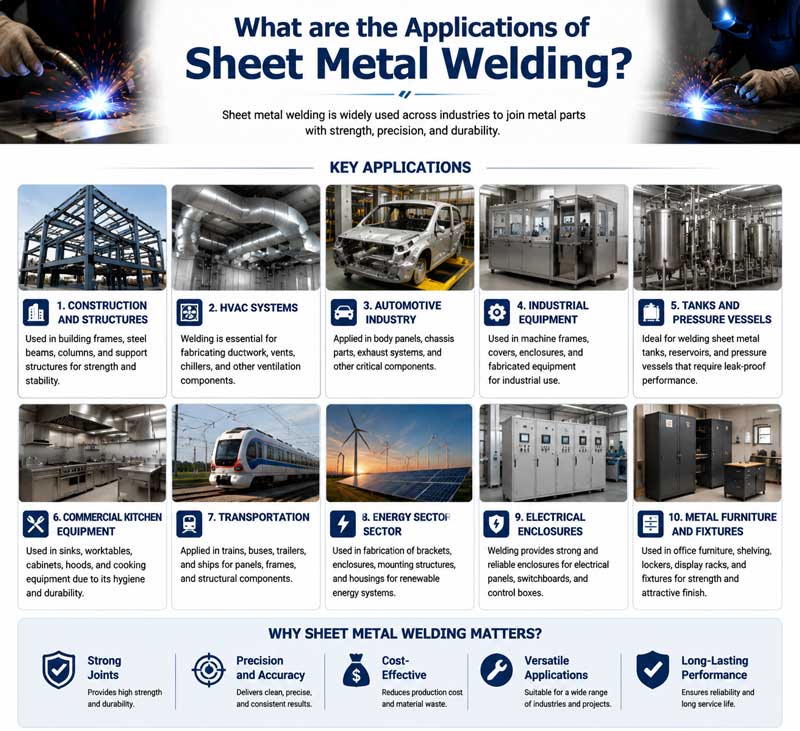
What are the applications of Sheet metal welding
Metal welding technology, with its unique advantages, has been widely applied in various industries and fields, almost covering all aspects of the national economy.
(1) Machinery manufacturing industry:
The beds and columns of machine tools, the buckets and track frames of excavators, and the booms of cranes, etc., are all manufactured through welding processes.
Welding technology can ensure the strength and stability of these structural components and enhance the service life and operational reliability of the equipment.
(2) Transportation industry:
- Car manufacturing: Making car parts like bodies, frames, and chassis all need welding technology. Besides, people also use welding to make parts such as car engines and gearboxes.
- Shipbuilding: The hull shell, deck, cabin, and other parts of the ship all need to be connected by welding.
Ship welding needs to confront technical challenges such as thick plate welding and high-strength steel welding. Commonly used welding methods include submerged arc welding and gas and electric vertical welding.
- Aerospace industry: Aluminum alloys and titanium alloys are high-quality materials. They are used to build aircraft bodies, wings,and engine components. Welding these special materials requires accurate welding techniques. Typical examples are argon arc welding, electron beam welding, and laser welding.
(3) Construction industry:
Steel structure buildings are widely used in high-rise buildings, large-span factories, bridges, and other projects.
For instance, the connection between steel beams and columns in steel structure workshops, as well as the splicing of steel beams in Bridges, all need to be achieved through welding.
(4) Petrochemical industry:
The petrochemical industry requires a large number of pressure vessels, pipelines, storage tanks, and other equipment. The manufacturing and installation of these devices cannot do without welding technology.
(5) In the field of daily life:
The production of metal doors and Windows, the welding of bicycle frames, the processing of kitchenware, etc., all require the use of welding technology.
In addition, the production of some metal ornaments, such as silver and gold jewelry, also employs welding techniques to connect different components together, creating exquisite shapes.
Conclusion
Metal welding technology, as one of the core processes in modern industry, has undergone a long development process from traditional manual forging and welding to today’s automated and intelligent welding.
Its advantages are very significant. It can achieve high-strength and high-sealing metal connections, meeting the production needs of different industries.
At the same time, it also has problems such as welding stress and deformation, high operational requirements, and safety hazards, which need to be solved through continuous technological innovation and process improvement.
With the continuous progress in fields such as materials science, automatic control technology, and artificial intelligence, metal welding technology is also developing towards high efficiency, precision, greenness, and intelligence.
The continuous emergence of new welding technologies such as laser welding, electron beam welding, and friction stir welding has brought new development opportunities to metal welding.
In the future, metal welding technology will play a more significant role in more fields, providing stronger support for industrial production and social development.
Why choose NOBLE as your metal welding manufacturer
NOBLE is your trusted one-stop custom manufacturing solution. From prototype design to manufacturing, with extensive manufacturing resources, suitable technology, streamlined processes, expert guidance, and a rigorous quality inspection process, we can turn your ideas into reality.
Our Sheet Metal Welding Services provide custom solutions that exceed customer expectations at competitive prices. From prototyping to sheet metal welding manufacturing, our experienced team and advanced production equipment ensure you receive sheet metal welding parts with high precision and stable performance. Get a quote in minutes and sheet metal welding parts in days!
NOBLE is equipped with state-of-the-art sheet metal welding equipment and cutting-edge technology, allowing us to tackle the most challenging Sheet Metal Welding tasks with ease. Our team of highly skilled and experienced welders has an in-depth knowledge of various welding techniques and processes. Whether it’s complex metal fabrication, structural welding, or repairs, our experts bring unparalleled craftsmanship to every project.
FAQ
- Can we weld different types of metals together?
Yes, we can. For example, we can weld steel and copper with proper methods. But we need to choose the right filler material.
- Why do welded parts sometimes bend?
Uneven heating and cooling during welding cause stress. The stress makes the metal parts bend or deform.
- Do we need to clean metals before welding?
Yes, we do. We should remove rust, oil, and oxide scale. Clean surfaces help make stronger and tighter welds.