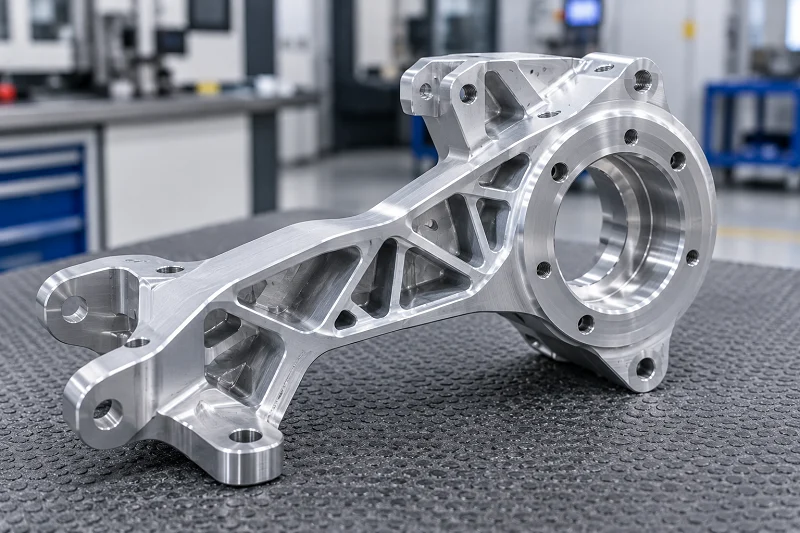
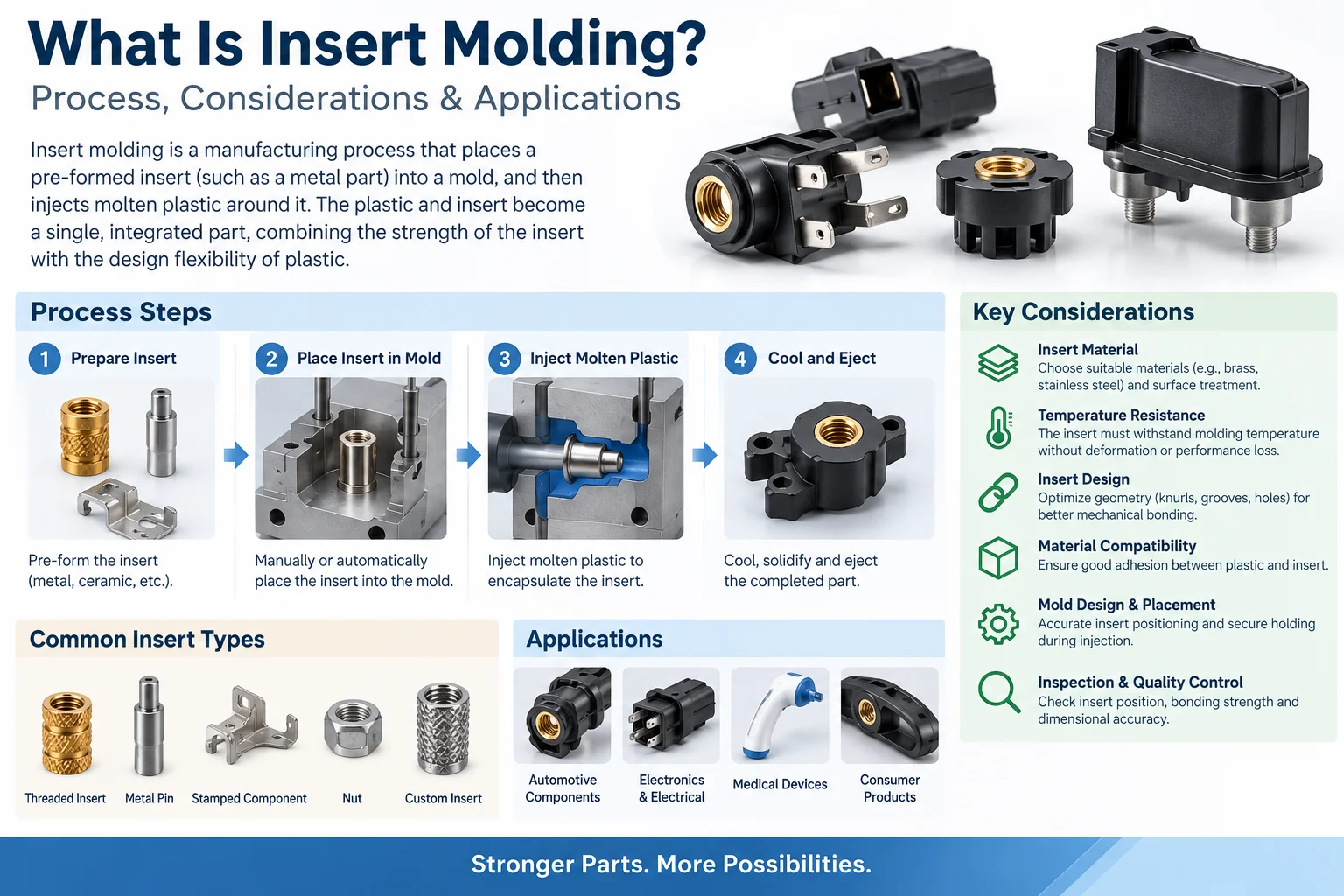
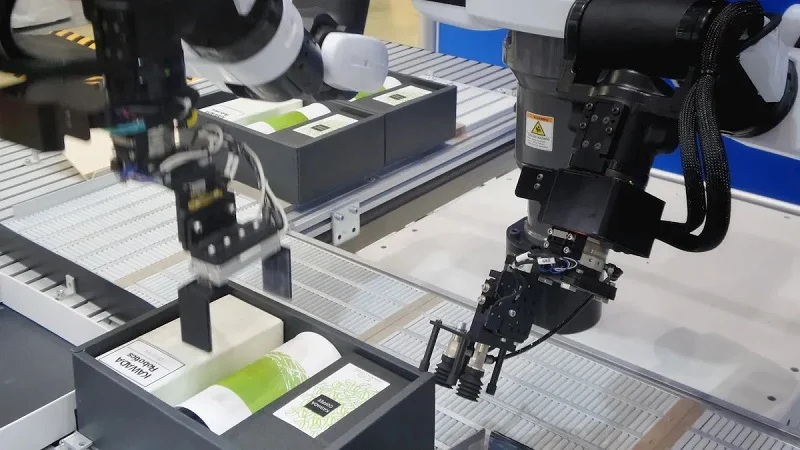
In the evolving landscape of technology, 3D printing stands out as a revolutionary force that is transforming industries and reshaping how we think about manufacturing and design. Often referred to as additive manufacturing, 3D printing involves creating three-dimensional objects from digital files, layer by layer. This innovation offers unprecedented opportunities across various sectors, including manufacturing, healthcare, automotive, aerospace, and consumer products. In this comprehensive guide, we’ll explore what 3D printing is, its benefits, applications, and the future of this groundbreaking technology.
What is 3D Printing?
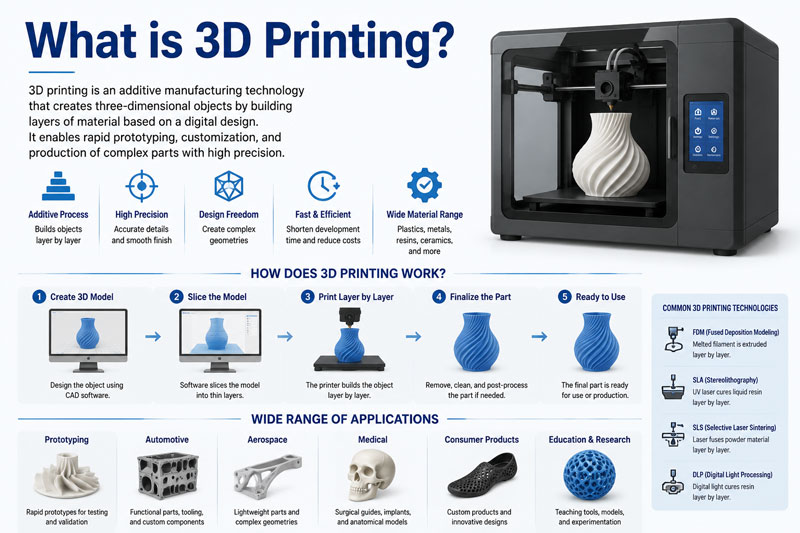
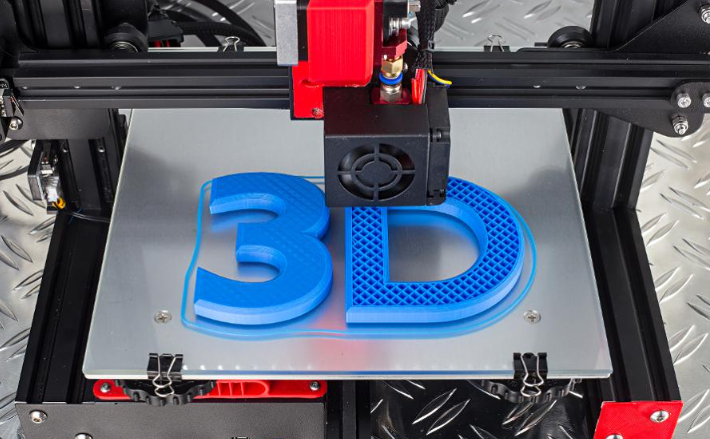
3D printing is a process of creating three-dimensional objects from a digital design. The process begins with a computer-aided design (CAD) file, which is then fed into a 3D printer. The printer reads the digital blueprint and deposits material layer by layer to build up the final product. This additive manufacturing technique contrasts with traditional subtractive manufacturing methods, which involve cutting away material from a larger block.
How does 3D printing work?
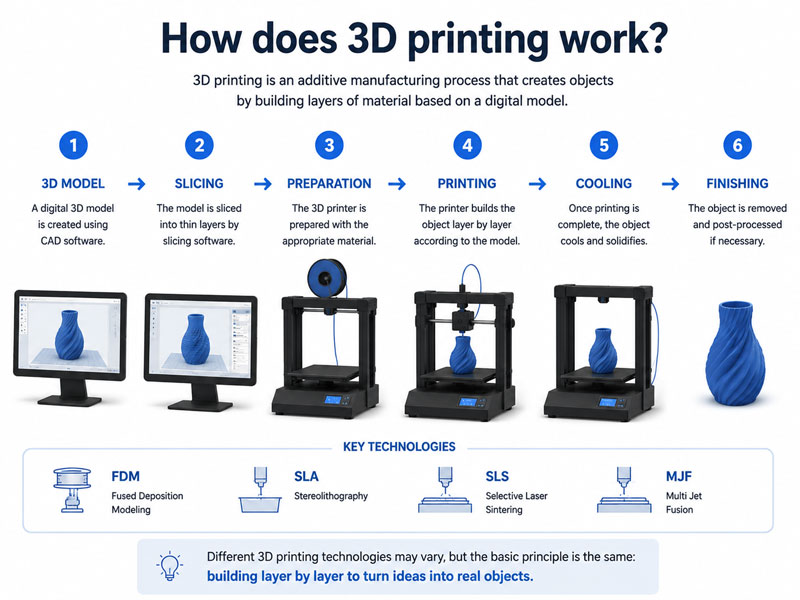
The 3D printing process can be summarized in the following 5 steps.
- Create a 3D model using CAD software. Alternatively, a 3D scanner can be used to create the 3D model. This model defines the shape, size, and complexity of the final product.
- Using specialized software, the digital model is sliced into thin horizontal layers. These slices serve as blueprints for the 3D printer. The machine uses these blueprints to guide its movement and material deposition. Parts are then manufactured layer by layer.
- Depending on the specific 3D printing technology used, a variety of materials can be used, such as plastics, metals, and even food-grade materials. The choice of material depends on the required performance and intended use of the part.
- 3D printers process parts according to the instructions of the sliced model. Material is deposited or solidified layer by layer to gradually form the part. This can be achieved through technologies such as FDM, SLA, or SLS.
- After printing, the object may require further processing, such as painting, polishing, or other surface treatments, to achieve the desired aesthetics and functionality.
Benefits of 3D Printing
-
Customization and Personalization
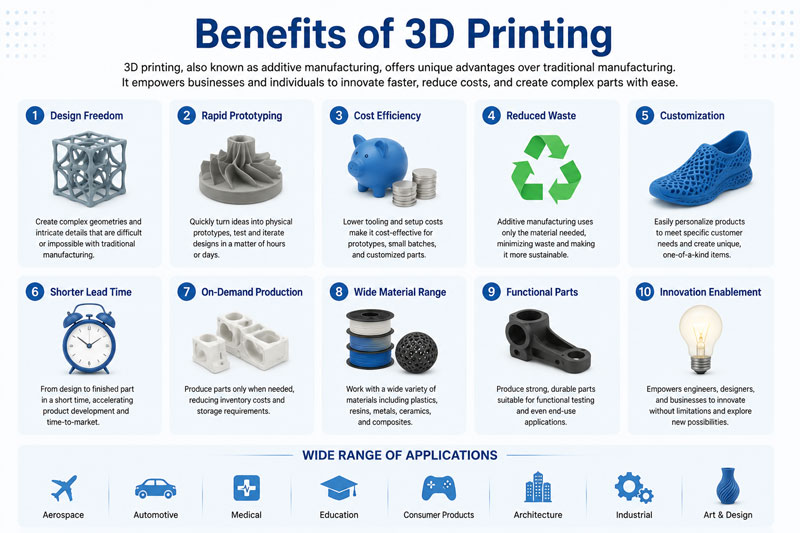
One of the standout benefits of 3D printing is its ability to produce highly customized and personalized items. Traditional manufacturing often relies on mass production, which can limit customization options. With 3D printing, it is possible to create products tailored to individual needs or preferences. This capability is especially valuable in industries like healthcare, where custom prosthetics and dental implants can be manufactured to fit each patient perfectly.
-
Cost-Effectiveness
While the initial setup cost of a 3D printer might be significant, the overall cost of production can be lower compared to traditional methods. This is because 3D printing eliminates the need for expensive molds and tooling. Additionally, material waste is minimized since the printer only uses the exact amount of material required for the object. This efficiency can lead to cost savings, particularly for small-batch and prototype production.
The speed at which prototypes can be developed and tested is another advantage of 3D printing. Traditional prototyping methods can be time-consuming and costly, but with 3D printing, prototypes can be produced quickly and inexpensively. This rapid prototyping capability accelerates the design process, allowing businesses to iterate and refine their products more efficiently.
Applications of 3D Printing
-
Healthcare
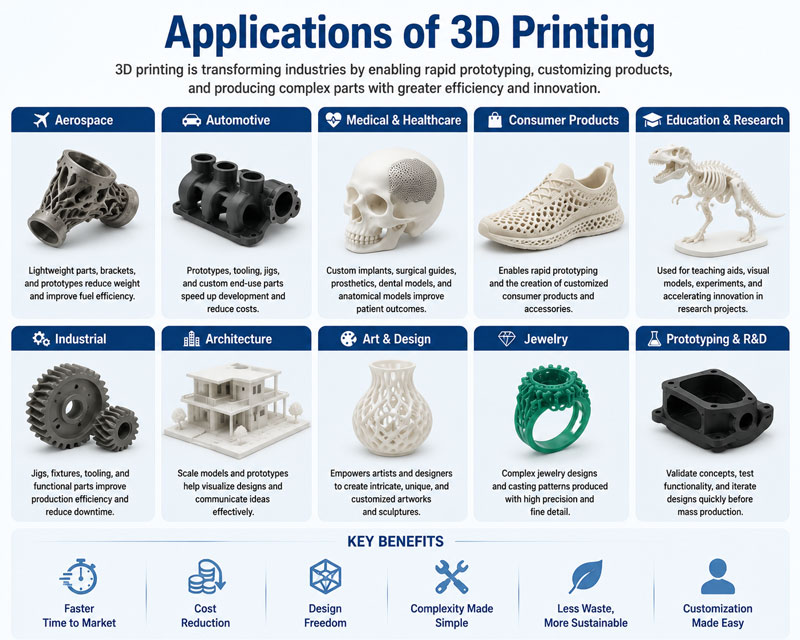
In the medical field, 3D printing is making waves with innovations such as custom prosthetics, implants, and even bioprinting. Surgeons can use 3D-printed models to plan complex surgeries, improving precision and outcomes. Moreover, bioprinting—using living cells as the “ink”—has the potential to create tissue and organ structures for transplantation, although this technology is still in its early stages.
The automotive industry is leveraging 3D printing to streamline manufacturing processes and enhance vehicle performance. Car manufacturers use 3D printing to produce lightweight parts that can improve fuel efficiency and reduce emissions. Additionally, the technology allows for the creation of complex geometries that are difficult or impossible to achieve with traditional methods.
The aerospace sector benefits from 3D printing’s ability to produce lightweight, high-strength components. Parts produced using 3D printing can be significantly lighter than those made with traditional methods, which is crucial for improving fuel efficiency in aircraft. The technology also enables the creation of intricate designs and structures, contributing to advancements in aerospace engineering.
3D printing has a growing presence in the consumer products market, where it allows for the creation of custom items such as jewelry, home décor, and personalized gifts. Consumers can design and print their own unique products, or purchase customized items from online marketplaces. This personalization trend is reshaping how products are designed, manufactured, and consumed.
The Future of 3D Printing
3D printing, also known as additive manufacturing, is transforming the way we approach design, production, and prototyping across a variety of industries. Its unique features set it apart from traditional manufacturing methods, offering unprecedented flexibility, efficiency, and innovation. Here, we explore the key features of 3D printing that make it a game-changer in modern technology.
1. Additive Manufacturing
Unlike traditional subtractive manufacturing, which involves cutting away material from a larger block, 3D printing builds objects layer by layer from a digital model. This additive process means that material is added only where needed, minimizing waste and allowing for the creation of complex geometries that are difficult or impossible to achieve with conventional methods.
2. Design Flexibility
3D printing offers exceptional design flexibility. Designers can create intricate and complex shapes without the constraints imposed by traditional manufacturing methods. This capability allows for the production of custom and bespoke items tailored to specific needs. From intricate lattice structures to organic forms, 3D printing can handle a wide range of design possibilities, making it ideal for applications requiring high levels of customization.
3. Rapid Prototyping
One of the most significant advantages of 3D printing is its ability to rapidly produce prototypes. Traditional prototyping methods can be time-consuming and expensive, often requiring the creation of molds and tooling. 3D printing speeds up this process by allowing for quick iterations of designs. This rapid prototyping capability accelerates development cycles, enabling faster testing, feedback, and refinement of products.
4. Cost-Effectiveness
3D printing can be more cost-effective than traditional manufacturing methods, especially for small-batch production and prototyping. The elimination of molds and tooling reduces upfront costs, and the precise use of materials minimizes waste. For short production runs or one-off items, 3D printing often presents a more economical solution compared to conventional methods that involve high setup costs.
5. Customization and Personalization
The ability to customize and personalize products is a standout feature of 3D printing. From personalized medical implants and prosthetics to custom-designed consumer goods, 3D printing allows for the creation of items tailored to individual specifications. This level of personalization is particularly valuable in sectors such as healthcare, where custom solutions can significantly improve outcomes and patient satisfaction.
6. Material Variety
3D printing supports a diverse range of materials, including plastics, metals, ceramics, and composites. This variety enables the production of parts with different properties and characteristics suited to specific applications. Advanced materials, such as flexible filaments, high-temperature resistant composites, and bio-compatible substances, further expand the possibilities of 3D printing technology.
7. Complex Geometries
One of the most impressive features of 3D printing is its ability to create complex and intricate geometries. Traditional manufacturing techniques often face limitations when producing complex shapes, especially those with internal cavities or intricate lattice structures. 3D printing overcomes these limitations by building objects layer by layer, allowing for the production of detailed and complex designs that would be challenging or impossible to achieve otherwise.
8. On-Demand Production
3D printing enables on-demand production, which reduces the need for large inventories and minimizes storage costs. This feature is particularly advantageous for industries that require frequent updates or small production runs. By producing items only when needed, businesses can respond quickly to market changes and customer demands, reducing the risk of overproduction and excess inventory.
9. Reduced Lead Times
The ability to quickly produce prototypes and final products significantly reduces lead times in the manufacturing process. With 3D printing, design changes can be implemented rapidly, and production can be completed in a shorter timeframe compared to traditional methods. This reduction in lead times is particularly beneficial for industries where speed to market is critical.
10. Local Manufacturing
3D printing supports the concept of local manufacturing, where products can be made close to the point of use. This reduces the need for long supply chains and the associated transportation costs and environmental impact. Local manufacturing also enables faster delivery times and more agile responses to customer needs, contributing to a more efficient and sustainable production model.
11. Integration with Digital Technologies
3D printing seamlessly integrates with various digital technologies, such as computer-aided design (CAD) software and digital file sharing. This integration allows for precise control over the design and manufacturing process, enabling designers to make adjustments and improvements in real-time. The digital nature of 3D printing also facilitates the use of advanced techniques like generative design and simulation to optimize product performance and functionality.
12. Innovation and Experimentation
The flexibility and low cost of 3D printing encourage experimentation and innovation. Designers and engineers can explore new ideas and concepts without the constraints of traditional manufacturing processes. This freedom to experiment has led to groundbreaking developments across various fields, from aerospace and automotive to healthcare and consumer products.
Future Development of 3D Printing Technology
3D printing is a transformative technology with features that set it apart from traditional manufacturing methods. Its additive nature, design flexibility, rapid prototyping capabilities, and diverse material options make it a powerful tool for innovation and customization. As the technology continues to evolve, its impact on manufacturing, design, and production will only grow, opening up new possibilities and opportunities across a wide range of industries. Embracing the features of 3D printing can lead to more efficient, cost-effective, and creative solutions in today’s fast-paced world.
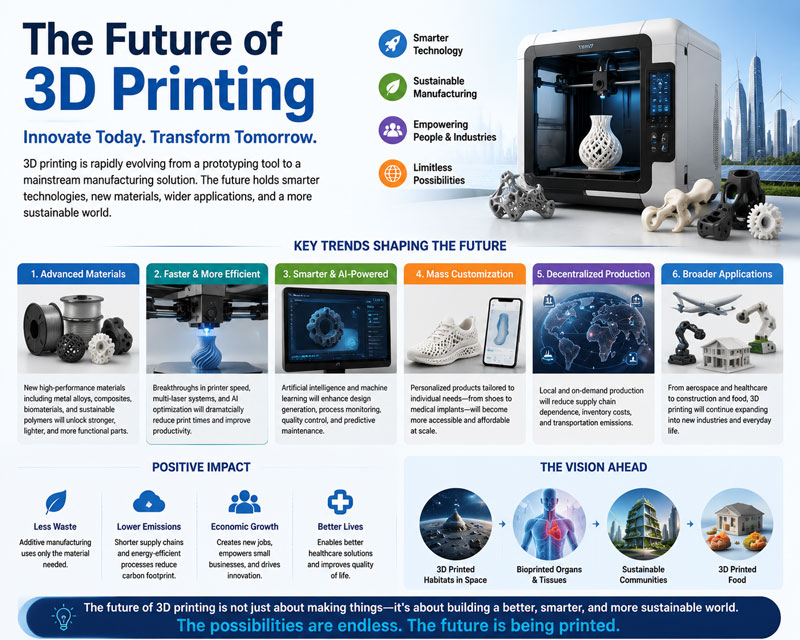
As 3D printing technology continues to advance, its potential applications are expanding rapidly. Here are a few trends and future directions for 3D printing:
-
Sustainability
The drive towards sustainability is influencing 3D printing innovations. Researchers are developing eco-friendly materials and processes that reduce environmental impact. For example, some companies are experimenting with biodegradable filaments and recycling used materials to create new products. As sustainability becomes increasingly important, 3D printing could play a key role in reducing waste and conserving resources.
-
Advanced Materials
The range of materials used in 3D printing is continually expanding. While traditional materials like plastics and metals are commonly used, advancements in materials science are leading to the development of new options, such as composite materials and advanced ceramics. These materials offer enhanced properties like increased strength, flexibility, and resistance to extreme conditions, broadening the scope of 3D printing applications.
-
Integration with AI and Machine Learning
The integration of artificial intelligence (AI) and machine learning with 3D printing technology holds promise for further innovation. AI algorithms can optimize design processes, predict material performance, and enhance quality control. Machine learning can also improve the efficiency of 3D printing processes by identifying patterns and anomalies, leading to better outcomes and reduced production time.
Conclusion
3D printing is more than just a technological marvel—it’s a transformative force that is reshaping industries and paving the way for new possibilities. Its benefits, including customization, cost-effectiveness, and rapid prototyping, make it a valuable tool across various sectors. As technology continues to evolve, the future of 3D printing promises even greater advancements, from sustainability and advanced materials to the integration of AI. Embracing this technology offers a glimpse into a future where manufacturing is more efficient, personalized, and innovative.
For businesses and individuals alike, staying informed about the latest developments in 3D printing is crucial for leveraging its full potential. As this technology advances, it will undoubtedly continue to drive change and create new opportunities across a multitude of fields.