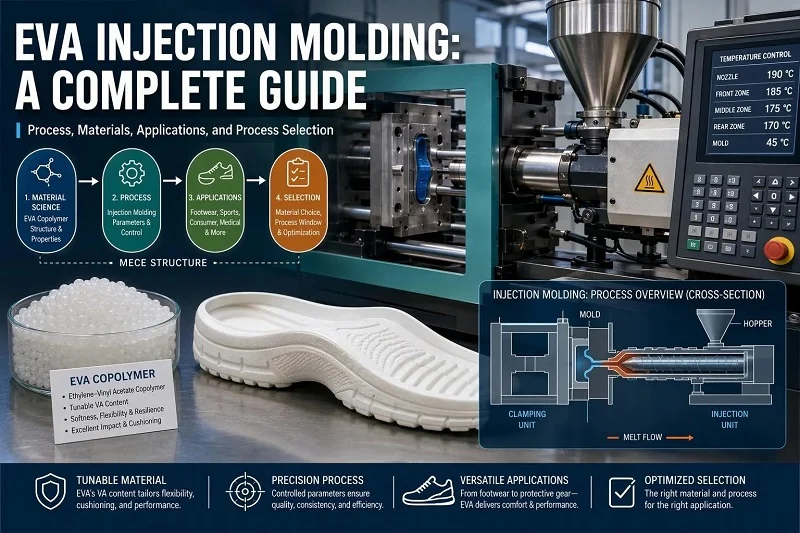
Ethylene-vinyl acetate (EVA) is a copolymer whose balance of softness, toughness and flexibility can be tuned across a wide range by adjusting how much vinyl acetate it contains. EVA injection molding turns that tunable compound into finished parts inside a closed, automated mold cycle, and it occupies a specific niche: soft, resilient, impact-absorbing components rather than rigid structural ones. This guide moves through the material science behind the polymer, the molding sequence from pellet to packed part, the grade and design decisions that determine success, the sectors where the process fits, and how it compares with compression molding, extrusion and rigid-plastic injection molding. Process figures quoted throughout are typical starting ranges; every grade, additive package and machine shifts the working window, so treat them as a basis for trials rather than fixed settings.
What Is EVA Injection Molding?
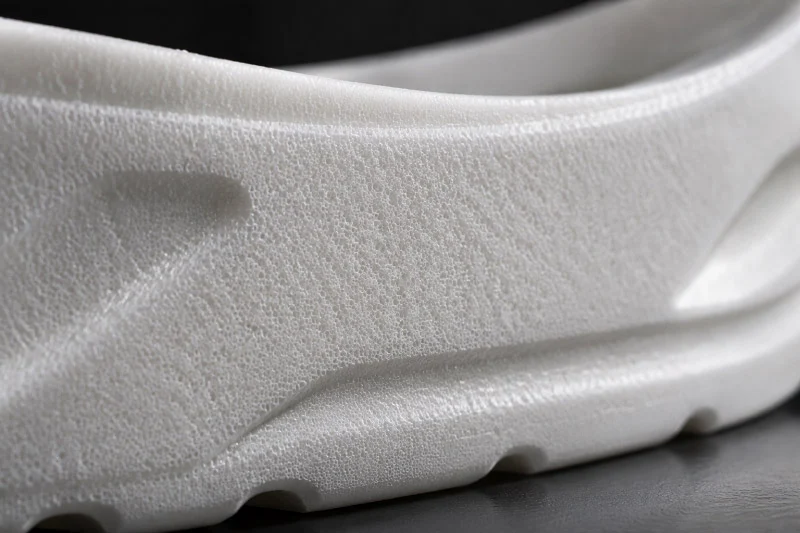
EVA injection molding is the process of melting an ethylene-vinyl acetate compound and forcing it under pressure into a closed, clamped mold cavity, where it cools and solidifies into a discrete part. The value it delivers is a soft, flexible, tough component produced on a repeatable automated cycle. It is not a substitute for rigid engineering plastics, and it should not be confused with the foamed EVA used in shoe midsoles, which follows a different route.
The Chemistry Behind EVA
EVA is built on a polyethylene backbone with vinyl acetate side groups attached along the chain. Vinyl acetate content in commercial copolymers usually runs from about 1% to 40% by weight, and it is this figure that governs most properties: as VA rises, crystallinity falls and softness, adhesion and clarity increase. The glass transition temperature stays relatively invariant at roughly -25 to -30 °C regardless of VA level, while melting behavior and stiffness shift substantially. That split is why grade selection, covered later, starts with VA content.
How EVA Injection Molding Differs from Foamed EVA
Solid EVA injection molding fills a closed cavity with molten compound that sets at roughly the density it entered at. Foamed EVA, by contrast, carries a blowing agent that reacts during the cycle so the part expands after filling into a cellular structure. The two share a polymer family but diverge in tooling, cycle design, density control and the defects that matter most. The comparison section later sets out how to choose between them.
The EVA Injection Molding Process, Step by Step
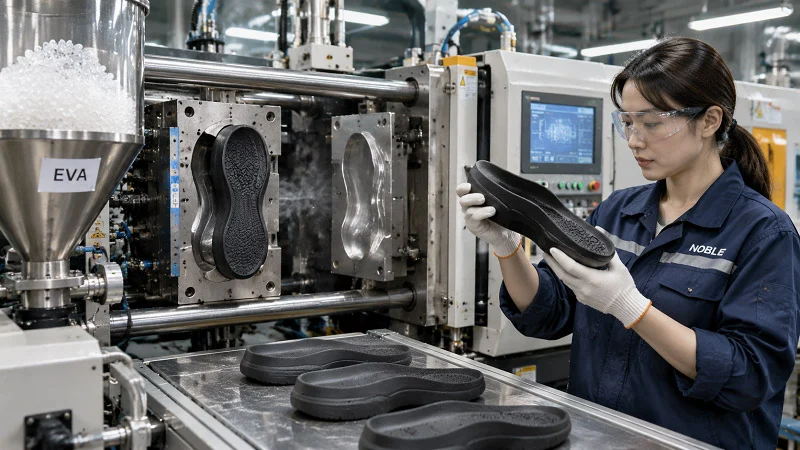
The sequence below follows the material from dried pellet to inspected part. Each stage constrains the next, and the numbers are grade-dependent starting points rather than universal settings.
Material Preparation and Drying
EVA absorbs less moisture than nylon, but surface moisture still produces splay and inconsistent foaming. A typical drying step runs 60–70 °C for 2–4 hours, and resin should be stored sealed because blowing agents degrade under humidity. Solid, non-foamed grades may need less drying, but the same discipline applies.
Plastication and Melt Temperature Control
A reciprocating screw melts the compound through a combination of barrel heat and shear heating, with back pressure controlling how hard the screw works the melt. Typical melt temperatures fall between 160 and 220 °C; above roughly 250 °C, EVA decomposes and releases acetic acid, and a vinegar odor is the warning sign. A flat or slightly decreasing barrel profile is often used for lower-melting polyolefins such as EVA to prevent bridging at the feed throat, and a screw with a compression ratio of 2.5:1 to 3.5:1 and an L/D of 20:1 to 24:1 suits most grades.
Injection, Packing, and Cooling
Injection pressures of roughly 40–80 MPa are lower than those used for rigid plastics, and a medium-to-slow injection speed helps avoid trapped air and burn marks. Holding pressure typically sits at 20–40 MPa with a short hold of 2–5 s, while mold temperature runs 20–40 °C; higher mold temperatures worsen shrinkage. Soft EVA compresses during ejection and then rebounds, which is why ejection design matters as much as the fill itself.
Ejection, Post-Processing, and Quality Checks
Draft of at least 1.5° per side, with 2° preferred, eases release, and generous ejector pin diameters are essential because small pins punch through soft parts. Post-processing covers trimming, secondary heating and decoration such as pad printing, hot stamping or in-mold labeling. Quality checks should include first-article inspection and dimensional verification after full cooling, since EVA continues to relax after ejection.
EVA Grades and Material Selection for Injection Molding
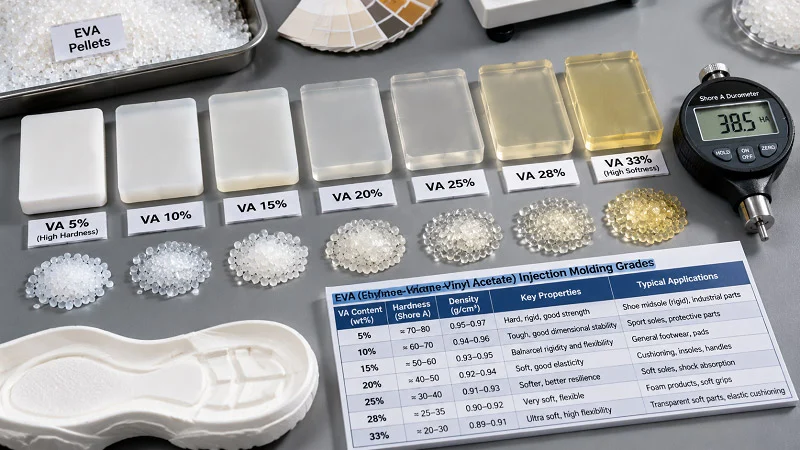
Grade selection is where most of the part’s final behavior is decided. Three levers do most of the work: vinyl acetate content, melt flow rate, and the additive package.
Vinyl Acetate Content: The Primary Lever
Low VA content, roughly 4–18%, retains significant crystallinity and gives LDPE-like stiffness, good seal strength and better dimensional stability, which suits semi-rigid parts. Higher VA, roughly 18–28% and above, disrupts crystallinity progressively and approaches rubber-like softness and resilience, which suits cushioning and impact absorption. Higher VA generally also means higher shrinkage and greater corrosion risk for the screw and barrel from acetic acid released during temperature excursions. Treat these as a spectrum rather than hard cutoffs.
Melt Flow Rate and Molecular Weight
Melt flow rate is inversely related to average molecular weight: as molecular weight rises, MFR falls. Higher molecular weight improves toughness and environmental stress crack resistance but raises melt viscosity and makes molding harder, while higher MFR grades flow more easily into thin walls and complex fills. MFR is measured under standard conditions and serves as a comparative tool, not a direct process setting.
Additives, Fillers, and Foaming Agents
Unstabilized EVA yellows under UV as vinyl acetate groups oxidize, so outdoor grades carry UV stabilizers; carbon black is common in wire and cable jacketing, and thermal stabilizers support agricultural film. Blowing agents create the foamed variants, while fillers change shrinkage, density and surface finish, so always validate with the exact compound rather than a generic data sheet. Crosslinking agents appear in some EVA systems but alter the recycling picture, which the sustainability section returns to.
Design Rules for EVA Injection Molded Parts
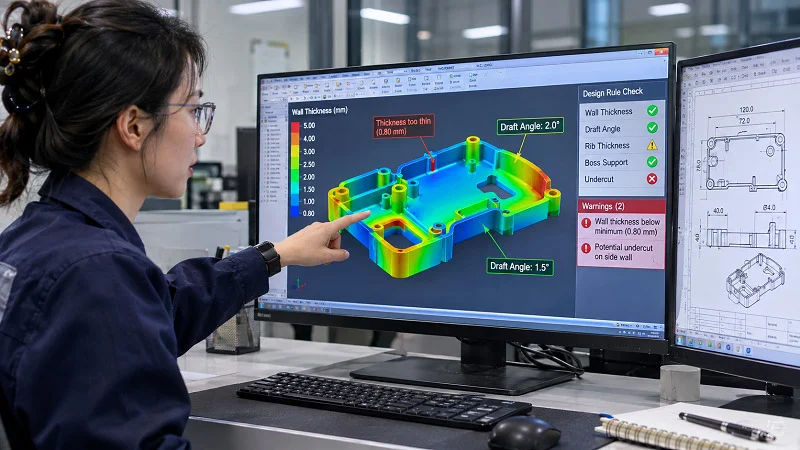
EVA’s softness is an asset at ejection and a liability for dimensional tolerance. The rules below translate that trade-off into concrete geometry decisions.
Wall Thickness, Ribs, and Draft
Uniform wall thickness reduces warpage and sink. Ribs should be thinner than the main wall, with a common rule of thumb of 50–60% of wall thickness, to avoid sink over the rib. Draft of at least 1.5° per side, with 2° preferred, is the baseline; deep ribs in foamed parts tend to stick, so generous draft and ejector design matter more than they do in rigid plastics.
Shrinkage, Tolerances, and Tooling Allowance
EVA shrinkage typically falls between 1.0% and 2.0%, but it moves with foam density, VA content, wall thickness and mold temperature; higher VA and stronger foaming generally increase it. Tooling should not be cut from nominal CAD alone. Build expected shrinkage into the mold design, verify with first-article samples, and for critical fits measure after full cooling and a settling period. Where tight dimensional tolerance is the dominant requirement, EVA is usually the wrong material.
Inserts, Undercuts, and Assembly Features
Soft EVA can accommodate some snap-fit and press-fit features that would crack in rigid plastics, but creep under sustained load is a real limitation. Metal inserts are possible yet require careful thermal management because of the mismatch in thermal expansion between metal and polymer. Living hinges are generally not recommended in EVA, and the comparison with rigid plastics later explains why.
Where EVA Injection Molding Is Used
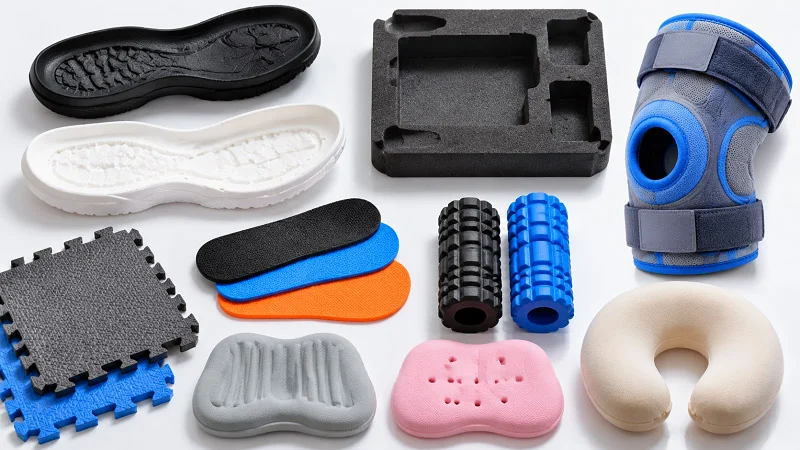
EVA injection molding is commonly used where cushioning, flexibility and impact absorption matter more than rigidity. The sectors below show where it fits and where another route serves better.
Footwear and Sports Equipment
EVA is widely used for shoe midsoles, sports padding, helmet liners and yoga mats. Compression molding remains the standard for flat midsoles where uniform foam density across the part matters, while injection molding suits complex geometries and higher volumes. Both coexist in footwear depending on geometry and volume, so injection should not be described as the default for every component.
Automotive and Industrial Components
Interior parts such as armrests and headrests, vibration damping elements, protective packaging, and gaskets and seals where flexibility is needed are common EVA applications. Automotive uses often require UV and thermal stabilization, since unstabilized EVA yellows and loses mechanical properties under prolonged UV exposure.
Consumer Products, Electronics, and Medical Adjacent Uses
Protective cases, covers, housings, toys, play mats and sports gear all draw on the same cushioning and impact resistance. For medical-adjacent parts, the material grade and the quality system behind it matter more than the molding process itself; EVA is not a medical-grade material by default, and suitability depends on the specific grade and its regulatory documentation.
EVA Injection Molding vs. Other Processes
Process choice usually turns on geometry, volume, tooling budget and how tightly the part must hold tolerance. The comparisons below keep each option scoped to the same criteria so the trade-offs stay visible.
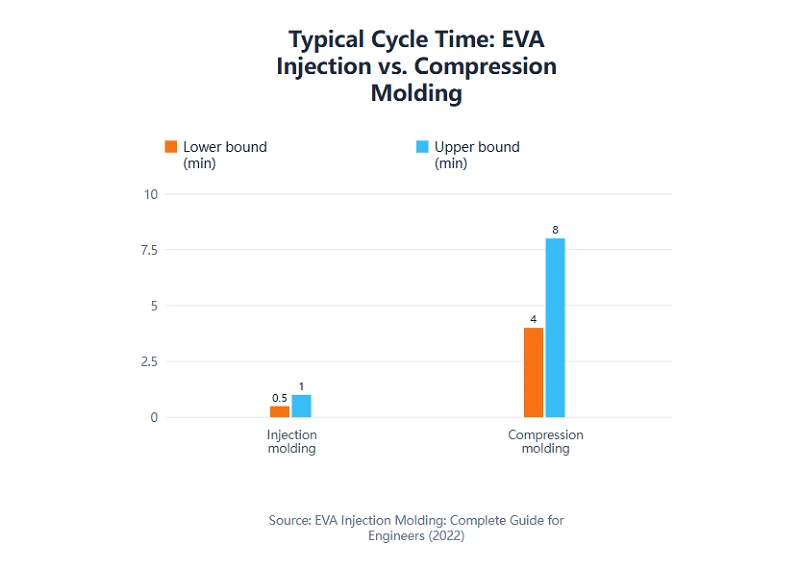
Typical cycle times for discrete EVA parts: injection molding versus compression molding. Ranges are typical and depend on part geometry, foam density and tooling; they are not a like-for-like benchmark for every component.
EVA Injection Molding vs. Compression Molding
Injection closes the cavity before melt enters, which suits complex geometry, multi-cavity tools and higher volumes; compression places a pre-weighed charge in an open mold, giving more uniform foam density across flat parts with simpler, cheaper tooling. In footwear contexts, injection cycles run roughly 30–60 seconds against 4–8 minutes for compression, but injection generates runner and sprue waste. Both coexist depending on geometry and volume.
EVA Injection Molding vs. Extrusion
Extrusion produces continuous profiles, film, sheet and wire coating rather than discrete three-dimensional parts, so the two are complementary rather than competing: extruded sheet can later be thermoformed or machined. EVA film and packaging grades are typically extruded, not injection molded.
Solid vs. Foamed EVA Injection Molding
Solid EVA gives dense, tough parts with better dimensional control. Foamed EVA reacts during the cycle and expands after filling, producing lightweight cushioning that is harder to hold to tight tolerances; regrind does not return to the same cellular structure because the blowing agent has already reacted. Choose based on whether weight reduction or dimensional precision dominates.
EVA vs. Rigid Plastics: When Not to Use EVA
EVA is the wrong choice when structural rigidity, chemical resistance or tight dimensional tolerances dominate. For those requirements, rigid engineering plastics such as PC, PA or POM are more appropriate, and specifying EVA anyway invites creep, warpage and rejected fits.
Common Defects in EVA Injection Molding and How to Address Them
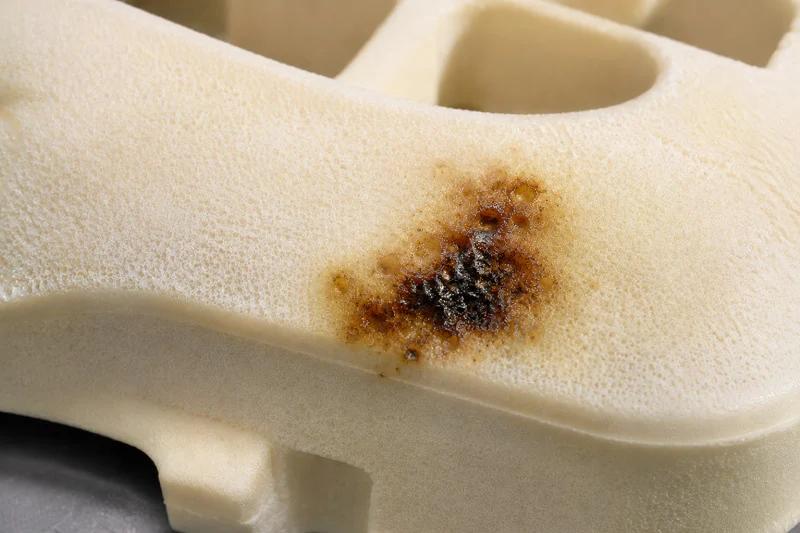
Most EVA defects trace back to moisture, venting, cooling balance or ejection design rather than to the resin itself. The cause-and-fix patterns below follow the process parameters already covered.
Splay, Silver Streaks, and Moisture-Related Defects
Surface moisture and volatiles flash to vapor in the barrel and drag silvery streaks across the part. Verify drying at 60–70 °C for 2–4 hours, check hopper sealing, confirm barrel venting, and inspect blowing-agent storage, since humidity exposure degrades those additives.
Burn Marks, Air Traps, and Weld Lines
Fast fills trap air that compresses and scorches at the end of flow, and converging flow fronts leave weld lines. Slow the injection speed, add or deepen vents at the parting line and flow-front extremities, check gate location, and balance runners in multi-cavity tools.
Warpage, Sink, and Shrinkage Variation
Uneven cooling, thick-to-thin transitions and shrinkage that shifts with VA content and foam density all distort the part. Fix with uniform wall thickness, cooling circuit design, mold temperature control and shrinkage verification on first-article samples, measuring after full cooling because EVA keeps relaxing after ejection.
Sticking, Ejection Damage, and Dimensional Drift
Soft parts grip deep ribs, and small ejector pins punch through instead of pushing. Increase draft, enlarge ejector pin diameters, and consider stripper rings or air ejection for shallow-draft molds. Dimensional drift over time is creep and relaxation, so validate critical fits with time-delayed measurement.
Sustainability and Material Handling in EVA Injection Molding

EVA is a thermoplastic, so solid scrap can technically be reground and reprocessed, and that is where the straightforward part of the story ends. Foamed EVA does not return to the same structure after the first molding cycle because the blowing agent has already reacted. Regrind from foamed scrap often produces denser, less uniform parts, which makes it better suited to non-cosmetic or non-foamed applications than to a visible cushioning surface.
Crosslinked EVA systems complicate recycling further. Once the polymer network is formed, the material no longer flows freely on reheating, so it cannot simply be melted back into the same product stream. If a project relies on crosslinked foam for its resilience and compression-set recovery, plan for that scrap to leave the mechanical recycling loop rather than assuming it will re-enter it.
If recycled content is required, test the exact regrind percentage before production rather than adopting a generic figure. During validation trials, watch for changes in density, surface quality, odor, shrinkage and rebound. Odor is easy to overlook in a data sheet but hard to overlook in a consumer product, and rebound is the property that quietly determines whether a cushioning part still performs after several cycles of loading.
Material handling deserves the same discipline. Keep pellets sealed and dry, because blowing agents degrade with humidity and surface moisture produces splay and inconsistent foam expansion. Purge thoroughly between materials: EVA degrades quickly if it sits at barrel temperature without movement, and the acetic acid released by decomposed EVA will corrode the barrel and screw over time. Running 3–5 shots of purging compound when switching materials is cheaper than replacing hardware.
Choosing NOBLE to Support Your EVA Injection Molding Project

NOBLE is a China-based contract manufacturer whose service and processing capabilities support clients from prototype through mass production. The criteria below are the ones worth applying to any EVA injection molding partner, and they frame how NOBLE’s capabilities map to a real project.
What to Look For in an EVA Injection Molding Partner
Look for grade expertise across the VA and MFR spectrum, tooling design that builds verified shrinkage allowance rather than nominal CAD, process-window development backed by air-shot measurement, and practical defect troubleshooting. Quality system certification matters as evidence of process discipline, and the partner should be able to carry a part from prototype tooling into volume without changing hands.
How NOBLE Supports Prototyping and Mass Production
NOBLE provides a full scope of service from design to assembly, not production alone, so design support, prototyping, tooling, molding and assembly sit under one roof. That single-partner continuity shortens the prototype-to-production transition. NOBLE holds ISO 9001:2015 certification for quality management and ISO 13485:2016 certification for medical-device quality management systems.
FAQs About EVA Injection Molding
These answers summarize the guidance above and stay within the same scope.
What melt temperature should I use for EVA injection molding?
A typical range is 160–220 °C, depending on grade. Above roughly 250 °C, EVA decomposes and releases acetic acid. Confirm with the resin supplier’s datasheet and an air-shot measurement.
Can EVA be recycled or reground?
Yes for solid EVA, with caveats. Foamed EVA does not return to the same cellular structure because the blowing agent has reacted. Test the regrind percentage before production and watch density, surface, odor, shrinkage and rebound.
Is EVA injection molding suitable for medical devices?
The process can produce medical-adjacent components, but suitability depends on the specific grade, the regulatory pathway and the quality system. ISO 13485:2016 certification supports a medical-device quality management system; it does not by itself qualify a material or part. Confirm grade and regulatory requirements with the material supplier and quality team.
How does EVA injection molding compare with compression molding for footwear?
Injection molding runs faster cycles and handles complex geometries and multi-cavity tools better; compression molding gives more uniform foam density across flat midsoles at lower tooling cost. Both remain in use depending on geometry and volume.
What draft angle do EVA injection molded parts need?
Allow at least 1.5° per side, with 2° preferred. Soft EVA compresses during ejection, but deep ribs in foamed parts still stick, so generous draft and large ejector pins matter.
Why does my EVA part show splay marks?
Surface moisture or volatiles are the usual cause. Verify drying at 60–70 °C for 2–4 hours, check hopper sealing, confirm barrel venting, and inspect blowing-agent storage conditions.