Introduction
Product development is changing. The old way was linear. Design, build, test, repeat. That cycle is expensive, slow, and even wastes material and time.
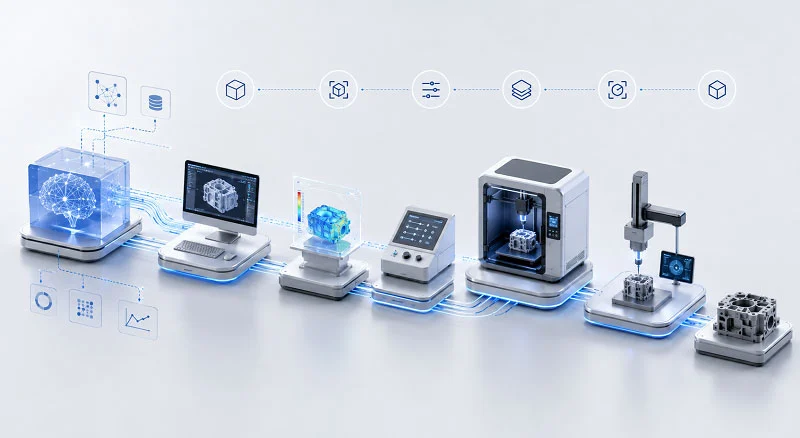
AI changes the cycle. It introduces intelligence at each step. Design generation, simulation, manufacturing optimization, and inspection can all be augmented. The technology is not theoretical. It is being used on factory floors and in engineering offices right now.
AI for rapid prototyping is the application of machine learning, generative design, and computer vision to accelerate the prototype development process. It does not replace the engineer. It handles repetitive tasks. It explores more design options. It flags problems before they become physical.
AI rapid prototyping is not a magic solution. The algorithms need data, and the outputs need verification. The engineer remains responsible for the final design. The AI provides speed and scale. The engineer provides judgment.
This guide covers the practical applications, measurable benefits, and emerging trends in AI for rapid prototyping. The focus is on what works today, not what might work in five years.
How to Use AI for Rapid Prototyping?
AI-Assisted Product Design
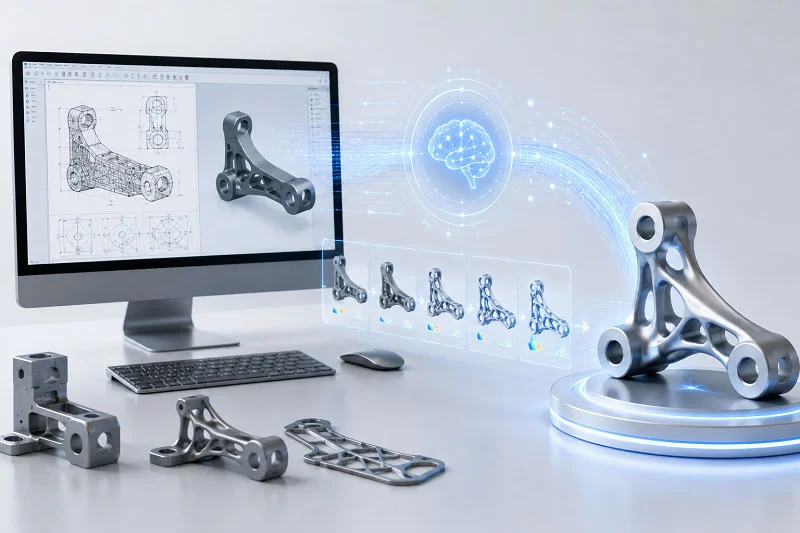
Artificial intelligence generates preliminary concepts based on requirements. Engineers input various constraints—such as materials, loads, dimensions, and cost. The AI then produces a variety of design options, from which engineers select the most promising ones.
The scope of design exploration continues to expand. The AI proposes alternative solutions that engineers may not have considered, such as unconventional geometries or unexpected material distributions. This process is highly creative—it is not merely automation.
Generative Design and Topology Optimization
Generative design begins with functional requirements. Engineers must define load conditions, material properties, and manufacturing constraints. Artificial intelligence then explores the solution space, removing excess material and reinforcing areas that bear the load.
The result is a lightweight, performance-optimized geometric structure. These structures often take on organic forms that human designers would find difficult to conceive intuitively, yet artificial intelligence can generate them in just a few hours.
AI for rapid prototyping uses generative design to produce prototypes that are stronger and lighter than conventional designs. These prototypes are validated through simulation and physical testing.
AI-Assisted CAD Modeling
CAD work involves repetitive tasks, and artificial intelligence handles these tasks. It can generate basic geometric shapes from sketches, modify features based on advanced instructions, and create multiple design variations from a single base model.
Artificial intelligence handles routine tasks, allowing engineers to focus on critical decisions, thereby improving work efficiency.
AI for Design for Manufacturing (DFM)
Manufacturing issues are detected early on. Artificial intelligence analyzes CAD models to identify thin walls, sharp corners, undercuts, and unsupported features, and flags geometric structures that are difficult to machine, print, or injection mold.
AI for product prototyping incorporates DFM feedback before production begins, adjusting the design accordingly to ensure the prototype is manufacturable, thereby facilitating a smoother transition to mass production.
AI for 3D Printing
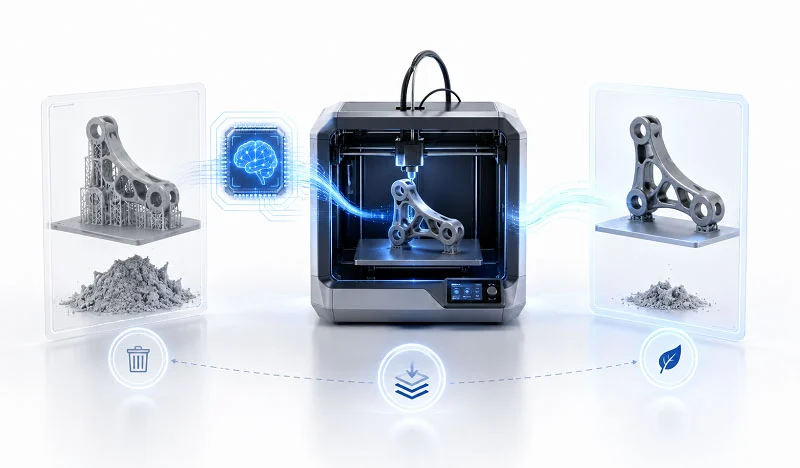
The orientation of parts affects print quality and support material usage. The AI recommends the optimal orientation to minimize support structures and reduce print time.
The system suggests print parameters based on geometry and material. Layer height, infill density, and print speed are all automatically adjusted. The entire process is optimized, eliminating the need for engineers to perform manual trial and error.
Monitoring during the print process detects defects. The AI compares the print results with the model to identify layer misalignment, warping, and extrusion issues, and makes real-time corrections to reduce the scrap rate.
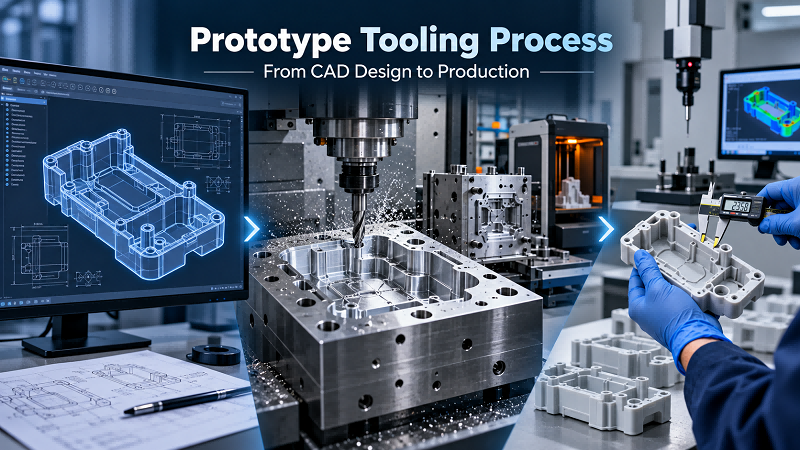
AI for rapid prototyping is integrated throughout the entire workflow. Design, design for manufacturability (DFM), and manufacturing are interconnected, resulting in faster prototyping with fewer errors.
AI for CNC Rapid Prototyping
The trained AI calculates the optimal path, taking into account tool geometry, material, and machine tool performance. This reduces machining cycle times and achieves a better surface finish.
Cutting parameters are optimized simultaneously. The spindle speed, feed rate, and cutting depth for each machining segment are finely adjusted. The system predicts tool wear, and the algorithm adjusts parameters accordingly to extend tool life.
Machining time estimates are accurate. The AI takes acceleration, deceleration, and tool-change times into account. These estimates are not arbitrary guesses but are based on the performance data of the specific machine tool.
AI-assisted rapid prototyping in CNC machining reduces setup time, extends tool life, and improves part quality. Machine tool operation becomes more predictable, resulting in a lower scrap rate.
AI for Material Selection
Selecting the right material is no easy task. Tensile strength, impact resistance, thermal stability, and cost are all factors that must be considered. AI compares the material database with the specific requirements.
The algorithm takes manufacturing compatibility into account. Materials that are strong but difficult to process are flagged, as are materials that print well but have a low heat deflection temperature. The system presents these trade-offs to the engineer.
AI for product prototyping includes material guidance capabilities. Engineers receive a list of candidate materials, each accompanied by performance predictions and manufacturing considerations.
AI for Prototype Testing and Simulation
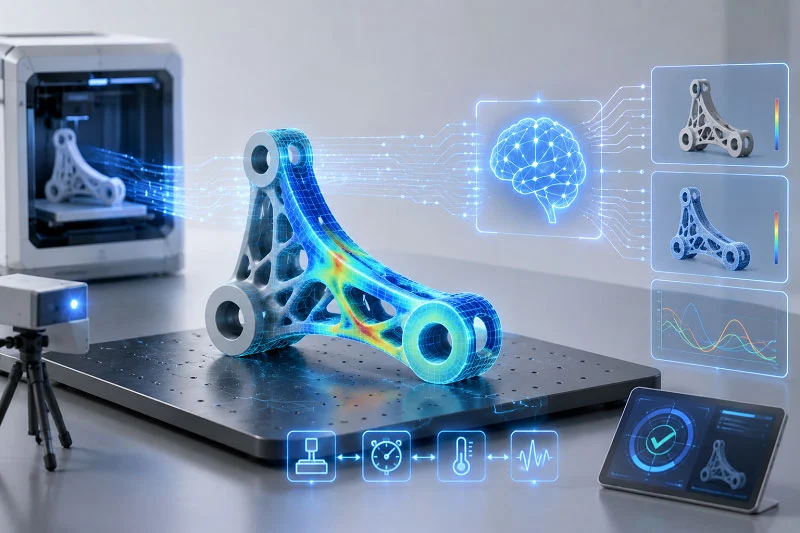
Simulation software is powerful but runs slowly—artificial intelligence accelerates this process. Neural networks can predict structural, thermal, and fatigue performance. These predictions are fast enough to support real-time design iterations.
AI can identify failure areas early on. Stress concentration points are flagged, and thermal gradients are visualized. Engineers can pinpoint areas requiring design reinforcement before manufacturing physical prototypes.
Engineers validate their designs through simulation and confirm them with targeted physical testing.
AI-Based Prototype Quality Inspection
Computer vision automates the inspection process by capturing images of prototypes, which are then compared to CAD models using artificial intelligence. This process detects dimensional deviations and flags surface defects.
Since AI applies the same inspection standards to every part, human error is eliminated, leading to increased production output.
AI for rapid prototyping enables in-line inspection. Prototypes are inspected as they are being produced. Defects are detected immediately, allowing the production process to be adjusted accordingly, thereby reducing the scrap rate.
AI for Prototype Cost and Lead-Time Estimation
Cost estimation is a complex task. Material costs, processing time, tooling and molds, and overhead all affect the final cost. AI estimates the total cost based on historical data and process models.
Lead time forecasting is equally important. AI estimates processing or printing time and takes into account factors such as setup, inspection, and post-processing to accurately predict timelines.
The system compares different prototyping processes, evaluating techniques such as FDM, SLA, SLS, CNC, and vacuum casting. The AI recommends the most cost-effective and time-efficient solution based on data-driven decision-making.
AI-assisted rapid prototyping closes the loop from design to delivery. Engineers have a clear understanding of costs and schedules before manufacturing begins, ensuring precise and reliable production planning while minimizing unexpected issues.
Benefits of AI for Rapid Prototyping
Faster Product Development

Design cycles are significantly shortened. AI can simultaneously generate design variants, run simulations, and verify manufacturability. Work that used to take weeks can now be completed in just a few days. Parts are iterated more quickly, and products reach the market faster.
More Design Possibilities
Engineers can use AI to evaluate dozens of concepts in the time it previously took to evaluate just one. AI can explore geometric structures that human designers might overlook, including non-traditional shapes, organic forms, and highly efficient structures. AI for product prototyping expands the solution space and directions.
Improved Prototype Performance
Weight, thermal performance, and fatigue life are optimized without sacrificing strength. AI achieves multiple design objectives simultaneously by adjusting geometry and material distribution.
Reduced Prototyping Costs
The number of physical prototypes required is reduced. AI-based simulations accurately predict performance, thereby minimizing material waste and equipment runtime. AI for rapid prototyping lowers overall development costs.
Better Manufacturing Efficiency
Certain CNC parameters can be automatically adjusted by AI. Tool wear can be predicted and effectively managed. Equipment operates within optimal parameters to achieve higher efficiency and reduce scrap rates.
Earlier Defect Detection
Designs are refined before manufacturing begins. Issues such as excessively thin walls, overly sharp edges, and unsupported structures are identified. With AI-assisted rapid prototyping catches errors that would otherwise appear on the shop floor or during testing.
AI for Rapid Prototyping vs. Traditional Rapid Prototyping
| Aspect | Traditional Rapid Prototyping | AI-Assisted Rapid Prototyping |
| Design generation | Mainly engineer-driven | AI + engineer |
| Design optimization | Manual/simulation-based | AI-assisted optimization |
| Process selection | Engineering experience | Data + engineering analysis |
| Quality inspection | Manual/automated measurement | AI-assisted inspection |
| Iteration | Relatively time-consuming | Faster iterations |
| Data utilization | Limited | Historical and real-time data |
| Decision-making | Primarily experience-based | Data-driven + engineering judgment |
We need to be clear: Engineers still retain control, while artificial intelligence provides speed, scale, and data-driven recommendations. AI-assisted rapid prototyping complements—rather than replaces—traditional methods.
Challenges and Limitations of AI for Rapid Prototyping
- AI-generated designs still require validation by engineers. Geometries generated by algorithms may be theoretically optimal but may not be manufacturable—engineers must verify them.
- The quality and quantity of data are critical. AI models are trained on historical data. If the data is limited or of poor quality, the predictions will also be limited or inaccurate. The principle of “garbage in, garbage out” applies to AI just as it does to other tools.
- Integration with existing systems is no easy task. CAD, CAM, and manufacturing execution systems were not originally designed with AI applications in mind. Connecting them requires significant effort and financial investment.
- Manufacturing constraints are not always fully accounted for. AI may suggest a fully optimized feature, but that feature might require a five-axis machine tool and custom cutting tools. Practical constraints are often more difficult to code than physical ones.
- Initial costs are quite high. Software licenses, hardware upgrades, and training all require financial investment. The return on investment is not immediate; it requires a long-term commitment.
- Data security is a significant concern. Prototype designs are typically proprietary information, and manufacturing data is also highly valuable. AI systems must protect sensitive information.
- Safety-critical applications require additional oversight. Medical devices, aerospace components, and automotive safety components all require human verification. AI is merely a tool; engineers bear ultimate responsibility.
AI for Rapid Prototyping Services at NOBLE

NOBLE provides rapid prototyping services across plastic and metal manufacturing. The capabilities cover design review, prototyping, finishing, and production transition.
Our Rapid Prototyping Services Capabilities
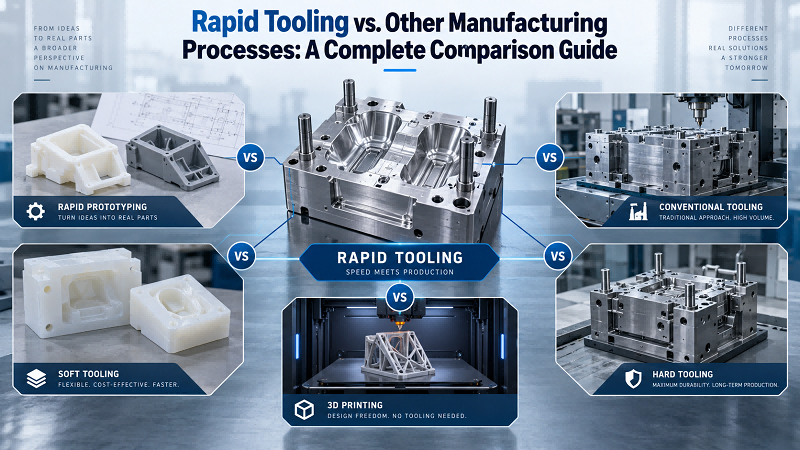
Available prototyping technologies include 3D printing, CNC machining, vacuum casting, sheet metal fabrication, and rapid injection molding. The rapid prototyping method is selected based on the application. Speed, accuracy, material, and quantity all drive the choice.
Our Commitment
Quality inspection is applied throughout. Dimensions are checked. Surface quality is verified. Functional testing is performed where required. Production support ensures the prototype is ready for the next stage.
FAQs About AI for Rapid Prototyping
What is AI for rapid prototyping?
Artificial intelligence applied to the prototyping workflow. Machine learning, generative design, and computer vision are used to accelerate design, optimize manufacturing, and automate inspection. AI for rapid prototyping is a toolset, not a single application.
How does AI improve rapid prototyping?
Speed and exploration improve. Design iterations are faster. Manufacturing parameters are optimized automatically. Inspection is automated. Defects are detected earlier. The result is faster development and lower cost. AI-assisted rapid prototyping reduces manual effort and increases consistency.
Can AI generate prototypes?
AI generates designs. It does not generate physical prototypes. The design is output as a CAD model or a set of manufacturing instructions. The physical prototype is produced by a 3D printer, CNC machine, or other manufacturing equipment. AI generates the instructions. The machine makes the part.
How is AI used in 3D printing?
Three areas are common. Part orientation and support structures are optimized. Printing parameters—layer height, temperature, speed—are recommended. In-process monitoring detects defects during printing. Corrections are applied in real time.
What industries use AI for rapid prototyping?
Automotive uses it for lightweight structural parts. Aerospace uses it for topology-optimized components. Medical uses it for patient-specific implants and devices. Consumer products use it for design exploration. Industrial equipment uses it for replacement parts. The applications span all sectors where prototypes are required.
What are the limitations of AI in rapid prototyping?
Data dependency is the main limit. AI models need good data. Poor data gives poor predictions. Integration with existing systems is challenging. Manufacturing constraints are not always fully captured. Initial cost and implementation effort are significant. Engineering validation is still required.