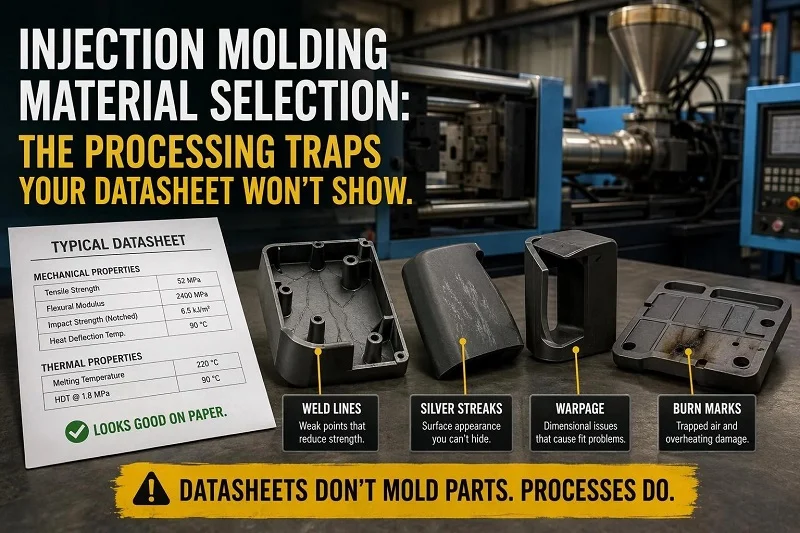
Selecting an injection molding material is usually framed as a comparison of mechanical properties, but the processing traps that decide whether a grade actually works in production rarely appear on the datasheet. This guide covers four of them: drying sensitivity, thermal stability, flow limits, and mold temperature. Each one can turn a technically suitable resin into a costly production problem, and each is cheapest to resolve before the tool is cut.
Trap 1 — Drying Sensitivity
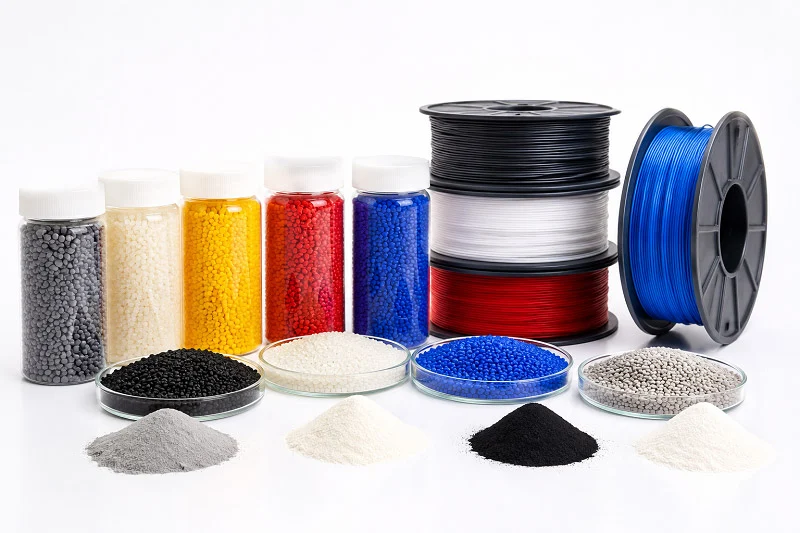
Drying is the first trap because it is invisible in the quote and invisible in the part until the part fails. A datasheet lists a drying temperature and a time; it does not tell you whether the dryer on the floor can hold a dew point through a humid afternoon, whether the hopper seals, or how long pellets sit between drying and the screw. For an injection molding material that absorbs water, those unlisted conditions decide whether the delivered resin behaves like the grade that was tested. The sections below separate the resins that genuinely need strict drying from those that only need a token pass, then set out what to verify before you commit to a supplier.
Which Resins Need Strict Drying
PA (nylon) is highly hygroscopic. Inadequate drying directly causes silver streaks, bubbles, and surface defects, and PA6 and PA66 are particularly sensitive to moisture. A glass-fiber-reinforced PA6 grade illustrates how tight the target is: one processing data sheet specifies a recommended moisture content of 0.03–0.06% after drying at 80 °C for 4 hours in a dry-air dryer, and notes that drying time depends on the granule’s initial moisture, the drying temperature and the dew point of the dried air.
PC (polycarbonate) is moisture-sensitive at high temperatures. Hydrolysis leads to molecular chain scission and a drop in impact strength. Published PC guidance is blunt about the consequence: undried material causes decreased mechanical strength, bubbles and crazes on the surface, silver streaks and poor transparency, and the resin should be dried to below 0.02% moisture with a dehumidifying dryer at a dew point of −30 °C or lower.
PET and PBT also require strict drying, otherwise ester bonds hydrolyze. For PET, the working dew point is typically around −40 °C, and a dew point of −20 °C caps how dry the resin can become no matter what temperature setpoint the dryer displays.
Non-hygroscopic materials such as PP, PE and PS have low drying requirements. The contrast matters commercially: a supplier equipped for polyolefins may have no dehumidifying dryer at all. For PA, PC, PET and PBT, confirm whether the supplier has matching drying equipment and dew point control capability before the material is written into the specification.
| Material Type | Typical Drying Temp | Dew Point Requirement | Typical Defects from Inadequate Drying |
| PA6 (GF30 grade) | 80 °C, 4 h | Dry-air dryer; dew point affects drying time; target moisture 0.03–0.06% | Silver streaks, bubbles, surface defects |
| PC | ~120 °C, 3–4+ hours | ≤ −30 °C; moisture below 0.02% | Bubbles, crazes, silver streaks, loss of impact strength, poor transparency |
| PET | ~160–180 °C for PET, grade-dependent | Around −40 °C typical for PET | Hydrolyzed ester bonds, reduced molecular weight and viscosity, brittle parts |
| PP / PE / PS | Minimal | Not critical | Few moisture-driven defects |
Values are indicative starting points from published processing guidance; the resin supplier’s data sheet for the specific grade governs.
Questions to Ask Before Committing
Ask directly: “What dew point can your dryers consistently maintain? Is the hopper sealed? How long does dried material sit in the hopper?” The word to press on is consistently — a dryer that reaches −40 °C on a dry morning and drifts on a humid afternoon produces intermittent defects that are hard to trace back to material handling.
The follow-up questions expose the same risk from other angles. Is the conveying path closed, or does a vacuum loader pull humid plant air across the pellets between dryer and machine throat? Is the hopper kept full, since a half-empty hopper allows moisture regain and resets residence time? Does the supplier re-dry material that has been sitting unused, or top up the hopper with fresh pellets over a partially dried load?
If a supplier cannot answer questions about dew point control, the risk of choosing PA or PC rises significantly — not because the resin is unsuitable, but because the process window the datasheet assumes will not exist on that floor. That is a material-selection decision, not a production detail to fix later.
Trap 2 — Thermal Stability

Thermal stability is the trap that damages the machine as well as the part. Some injection molding materials degrade within a narrow band above their recommended melt temperature, and the degradation products are aggressive: they attack screw, barrel and mold, and they leave marks that no amount of process tweaking will remove. The question at selection is not only whether the resin meets the functional requirement, but whether the supplier’s equipment and habits can keep it inside a window that may be only a few degrees wide.
POM and PVC: Heat-Sensitive Risks
POM (acetal) has poor thermal stability. Excessive melt temperature or long residence times cause it to decompose and release formaldehyde gas, leading to burn marks, black specks, and corrosive gas. Published POM guidance frames residence time as a two-sided constraint: too long at temperature degrades the material, while too short a residence time raises shear and formaldehyde emission and can leave unmelted granules in the part.
PVC is even more heat-sensitive, decomposing to release HCl, which corrodes the barrel and mold. Rigid PVC processing guidance notes that the melt degrades when left at processing temperatures for extended periods or when it sees high shear through restricted gates, runners or thin walls, and that the released hydrogen chloride has a strong acrid odor at low levels and irritates the nose and throat at higher ones. POM and PVC should not share a machine without thorough purging and mechanical cleaning between them.
These materials require a precise melt temperature window, controlled residence time, good venting, and a proper purging procedure at shutdown — PVC in particular should not be left in the barrel when the machine stops.
If your part needs POM’s wear resistance or PVC’s flexibility, confirm the supplier has experience processing heat-sensitive materials. Experience here means specific: low-shear screw geometry, corrosion-resistant barrel and mold surfaces, and a documented purge routine.
Residence Time and Shot Size
Residence time is set by the ratio of barrel capacity to shot size, multiplied by cycle time — so it is fixed by machine selection and part design long before anyone adjusts a temperature. Published guidance for high-heat polyphthalamide puts the acceptable band at a shot size between roughly 30% and 70% of barrel capacity, with a target residence time no greater than about 6 minutes; PEEK processing guidance recommends a barrel capacity between 2 and 5 times the total shot weight including sprue and runners.
The practical implication is that a large machine running a small shot holds melt at temperature far longer than the resin was designed for. A heat-sensitive injection molding material in that situation is being degraded on every cycle, and the effect compounds with long cycle times. Machine sizing is therefore a material-selection question: the correct press is the one whose barrel matches the shot, not the largest one available.
Spotting Degradation Early
In scenarios involving small parts, multi-cavity molds, or long cycle times, heat-sensitive materials experience longer residence times, increasing the risk of decomposition. The defect signature is usually progressive rather than sudden: darkening, black specks, a rising odor, or a purge that comes out discolored before the parts themselves look wrong.
Ask: “What is the part weight and total shot size? Is the barrel capacity-to-shot size ratio within a reasonable range?” A supplier who can quote both numbers immediately has the ratio under control; one who has to look it up is telling you something about how the machine was chosen.
This must be considered at the material selection stage: if the part is tiny and the machine is huge, heat-sensitive materials may not be suitable — either the material changes or the machine does.
Trap 3 — Flow Limits
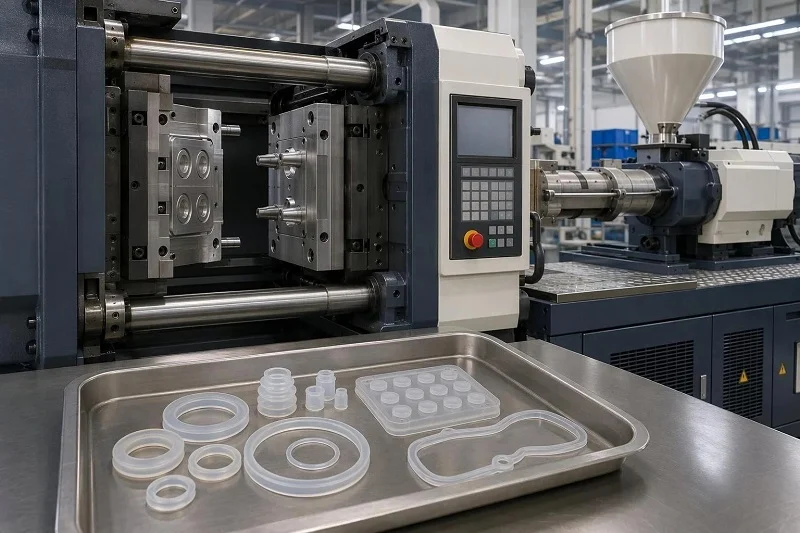
Flow is the trap that survives the trial run. A mold that fills during sampling can still be marginal in production, because the trial runs at settings that mass production cannot sustain. Flow limits are a property of the injection molding material, the wall thickness and the flow length taken together, and they need to be checked before the tool is cut rather than diagnosed after.
High Viscosity and Thin Walls
PC has high viscosity and poor flowability, making thin-wall parts prone to short shots, while thick-wall parts are prone to internal stress cracking. Published PC guidance reflects this by raising injection pressure for thin-walled parts and recommending higher melt temperatures within the grade’s range to keep the cavity filling.
High-performance materials like PEEK and PPS have high processing temperatures and narrow flow windows, requiring stringent mold temperature and injection speed control. PEEK processing guidance, for example, works within a melt range of roughly 360–400 °C and recommends generous gates — a minimum gate diameter of about 1 mm for natural grades and 2 mm for compounds.
Glass fiber-reinforced materials (e.g., PA-GF, PBT-GF) further reduce flowability, and fiber orientation causes anisotropic shrinkage, increasing warpage risk. A glass-fiber PA6 data sheet shows the effect in the shrinkage figures: 0.26% parallel to flow against 0.76% normal to it for the same grade.
The Flow-Length-to-Wall Ratio
At the material selection stage, estimate whether the part’s maximum flow length to minimum wall thickness ratio falls within the feasible range for that material. The ratio is a rough screen, not a guarantee: it tells you whether a candidate injection molding material is plausible before you spend money proving it.
Flow length ratios vary significantly between materials. Spiral flow test data on datasheets can serve as a reference, but actual mold gate design and cavity surface roughness will alter the result — a polished cavity with a generous gate will fill where a rough one with a pin gate will not.
Ask: “Have you done projects with similar wall thickness and flow length ratios? What material and gate design did you use?” A concrete past project is better evidence than a datasheet number, because it already includes the tooling effects.
| Material | Typical Flow Length Ratio Range | Thin-Wall Risk Level |
| PC | Low to moderate | High — short shots in thin walls, stress cracking in thick ones |
| PA (unfilled) | Moderate to high | Moderate |
| PA-GF / PBT-GF | Reduced versus unfilled | Moderate to high — plus anisotropic warpage |
| POM | Moderate | Moderate — limited more by thermal stability than flow |
| PEEK / PPS | Low, narrow window | High — needs hot mold and high injection speed |
| PP / PE / PS | High | Low |
Ranges are qualitative; confirm against spiral flow data for the specific grade and against comparable past projects.
Flow Issues After Tooling
Short shots and weld lines might be temporarily solved during trial runs by increasing injection speed, but in mass production, speed is limited by flash and venting, narrowing the process window. The trial run is a best case: a clean, cool mold, a fresh operator and no production pressure. Once the tool heat-soaks and the cycle tightens, the margin that existed at sampling disappears.
If flow margin is insufficient at the material selection stage, the cost of modifying gates or changing materials later is extremely high. Gate rework means pulling the tool, re-cutting steel and re-qualifying; a material change can invalidate the whole approval chain. Both are avoidable by screening the flow-length-to-wall ratio before the tool is designed.
Trap 4 — Mold Temperature
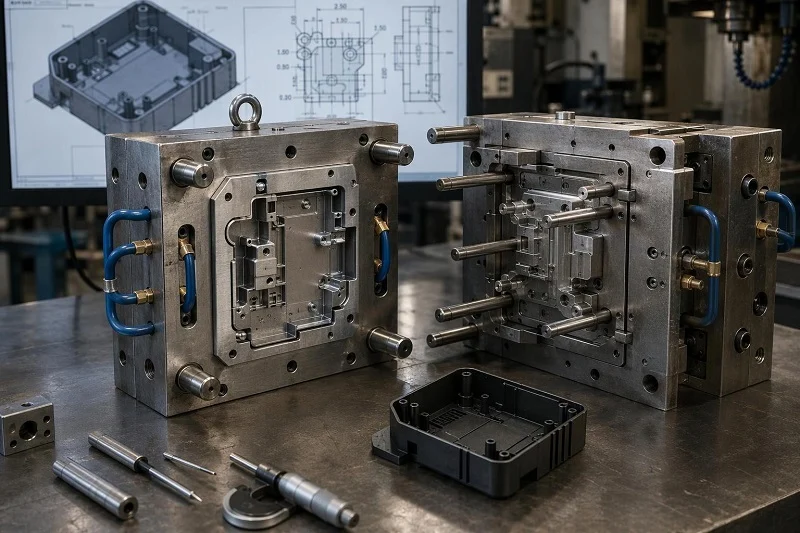
Mold temperature is the trap with the longest tail, because it reaches back into tool design and forward into unit cost. A resin that needs a hot mold is not simply run hotter; the temperature controller, the cooling circuit layout and the cycle time all have to be built for it. Choosing such an injection molding material on a tool designed for a cool-running one produces surface and dimensional problems that look like process faults but are really design mismatches.
Resins That Require Hot Molds
Mold temperature is the fourth processing trap, and it is the one most often treated as a machine setting rather than a material property. It is not. Several common resins only deliver their datasheet properties when the cavity surface is held well above what a cold-mold shop runs by default: PC at 80–120 °C, PA at 80–100 °C, POM at 80–90 °C, and PEEK at 160–200 °C. These are not preferences. A PC part molded at 40 °C may fill and eject cleanly, yet carry internal stress that shows up as crazing weeks later.
High mold temperatures propagate through the whole tooling system. The mold temperature controller must have the heating power and flow rate to hold the setpoint across the full cavity, not just at the inlet. Cooling channel layout has to be designed for uniform heat removal at that elevated temperature rather than for a cold mold. Cycle time lengthens because the part cannot be ejected until the cavity surface has given up its heat. If the supplier’s mold temperature equipment cannot reach or hold the required range, choosing these materials produces poor surface quality, high internal stress, and dimensional instability — defects that appear in production, not in the quote.
The Hidden Cost of High Mold Temp
A hot mold is a slow mold, and slow cycles are the largest single driver of per-part cost in injection molding. Cooling time scales with the temperature difference between the melt and the cavity surface; raising the mold temperature narrows that difference and extends the cooling portion of every cycle. On a high-cavity tool running millions of parts, a few added seconds per cycle compounds into a substantial cost difference that never appears on the resin datasheet.
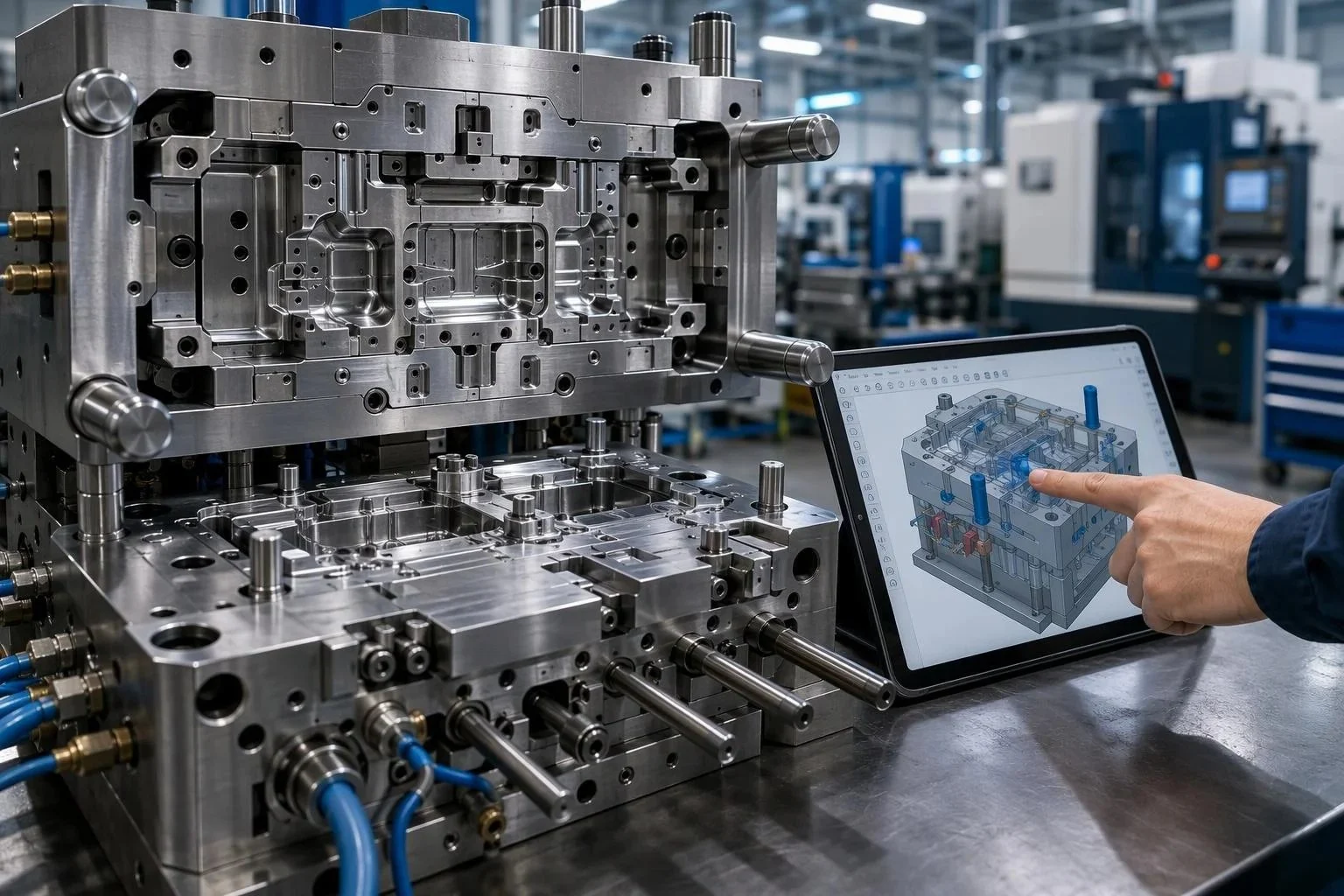
The cost is decided at mold design, not at the press. Mold temperature controller selection, heating capacity, and cooling channel design — including baffles and high-conductivity inserts such as beryllium copper in deep cores — must be incorporated before the tool is cut. Retrofitting a hot-mold capability into a tool designed for cold running is expensive and sometimes impossible.
At the material selection stage, ask: “What is the maximum temperature your mold temperature controllers can reach, and does the cooling channel design support this mold temperature requirement?” A supplier who cannot answer both parts of that question has not built tools for these resins.
When Lower Temp Wins
If the part’s function allows it, choosing a material with a lower mold temperature requirement can reduce mold cost and cycle time more than any other single decision. A non-critical cosmetic part specified in PC at 80–120 °C mold temperature might be equally serviceable in ABS at 50–80 °C, which offers a wider processing window, shorter cooling, and a less demanding tool.
This is the discipline the whole article points toward. Material selection is not about choosing the highest-performing injection molding material; it is about choosing the one that best balances processing feasibility against functional requirements. A resin that meets every mechanical specification but demands equipment, drying, and residence-time control your supply chain does not have is not the lower-risk choice — it is a deferred cost.
Choose NOBLE to Support Your Injection Molding Project
NOBLE is a leading contract manufacturer in China. Its service and machining capabilities help customers complete prototyping and volume production efficiently. NOBLE is certified to ISO 9001:2015 and ISO 13485:2016, and provides a full service from design to assembly — not production alone.
FAQs about Injection Molding Material
Which injection molding materials are most sensitive to moisture?
PA (especially PA6 and PA66), PC, PET, and PBT are the hygroscopic families that require strict drying and dew point control. PP, PE, and PS absorb little moisture and have far lower drying requirements. The practical question is not whether a resin is hygroscopic but whether the supplier has drying equipment that can hold the required dew point.
What happens if POM or PVC overheats in the barrel?
POM decomposes and releases formaldehyde gas, producing burn marks, black specks, and corrosive gas. PVC is more heat-sensitive still: it dehydrochlorinates to release HCl, which corrodes the barrel and mold. Both need a precise melt temperature window, controlled residence time, good venting, and a proper purging procedure at shutdown.
How do I know whether a part is too thin for a given material?
Estimate the ratio of maximum flow length to minimum wall thickness and compare it with the material’s practical range. PC, PEEK, PPS, and glass fiber-reinforced grades have narrow flow windows; spiral flow data on datasheets is a starting reference, but gate design and cavity surface roughness change the real result. Ask the supplier whether they have run projects at similar wall thickness and flow ratios.
Why does mold temperature matter if the part already fills?
Because filling is not the same as meeting specification. PC at 80–120 °C, PA at 80–100 °C, POM at 80–90 °C, and PEEK at 160–200 °C need that cavity temperature for surface quality, low internal stress, and dimensional stability. A cold mold can produce parts that pass a visual check and fail in service.
Can I change material later if the first choice causes problems?
It is possible but expensive. Insufficient flow margin, drying capability, or mold temperature capacity discovered after tooling usually means modifying gates, adding equipment, or re-cutting the tool. These traps are cheapest to resolve at the material selection stage, before steel is cut.
Does a higher-performance resin always give a better part?
No. A material that meets every mechanical requirement but demands drying, residence-time, and hot-mold control your supply chain cannot deliver carries hidden cost and risk. The better choice balances processing feasibility against functional requirements.