What Is Nylon Rapid Prototyping?
Nylon rapid prototyping means using nylon—polyamide—to produce prototype parts that actually perform. The material is engineering-grade. It survives real-world conditions. Parts printed or machined from nylon are used in assemblies, mechanisms, and test rigs. They are not just for looks.
PLA is for concept models. ABS is for moderate-duty parts. Nylon is for parts that must work. That is the distinction. When the prototype will be assembled, loaded, cycled, or exposed to heat, nylon rapid prototyping is the appropriate method. When the prototype is purely visual, other materials may suffice.
Why Is Nylon Used for Rapid Prototyping?
High Strength and Toughness
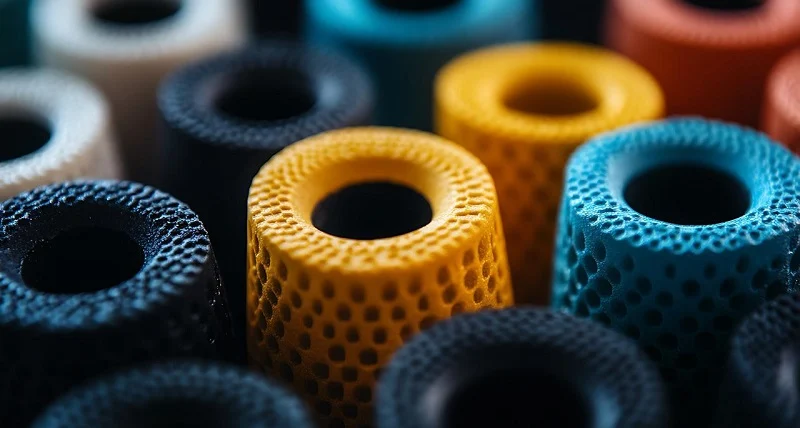
Nylon is highly durable and does not break easily. It can also bend, absorb impact, and then return to its original shape. For this reason, nylon is widely used for functional prototypes. Even under mechanical stress, nylon parts can maintain their integrity.
Testing with nylon rapid prototyping means the prototype can have performance similar to the actual production part. Design flaws become easier to identify, and weak points can be found and addressed in time.
Good Wear and Abrasion Resistance
Moving parts rub against each other. Bushings, gears, and sliding rails are constantly exposed to friction. Nylon has excellent wear resistance, and its surface can effectively withstand this friction.
Prototype parts made from nylon can be tested while in motion. They can run through repeated cycles, handle different loads, and operate continuously for long periods. Excellent wear resistance helps ensure accurate test results. The prototype parts are less likely to fail before testing is completed.
Lightweight Construction
Nylon is not the lightest material. However, it is lighter than metal. Weight is an important factor in automotive, aerospace, and handheld device design. Nylon provides an excellent strength-to-weight ratio, which is comparable to that of commercial engineering plastics.
The part can be designed with weight reduction in mind. Prototype testing can then confirm whether the lightweight structure has enough strength.
Good Chemical Resistance
Nylon can resist many solvents, oils, and fuels. It is less likely to swell or degrade when exposed to common industrial fluids. This is especially important for prototypes that come into contact with lubricants, cleaning agents, or moisture in the environment.
Chemical stability means that test results are less likely to be affected by material degradation. The prototype can perform as expected.
Suitable for Complex Geometries
SLS (Selective Laser Sintering) and MJF (Multi Jet Fusion) can produce nylon parts without support structures. Internal channels, recesses, and complex organic shapes can be printed directly. No molds or fixtures are required.
Nylon rapid prototyping enables designs that cannot be machined. Design complexity is not a limitation. It can become an opportunity.
Common Materials for Nylon Rapid Prototyping
PA12
PA12 is the workhorse of nylon rapid prototyping. It offers excellent strength and good dimensional stability. It also provides stable powder flow during SLS and MJF processes. Parts made from PA12 have high accuracy and smooth surfaces.
Typical applications include functional prototypes, housings, and various components that require moderate stiffness and good surface accuracy. PA12 is the first choice for most nylon prototyping projects, and its mechanical properties are easy to predict.
PA11
PA11 is stronger than PA12. It offers better impact resistance and greater flexibility. PA11 parts can withstand more bending before breaking. This makes PA11 ideal for parts that need to bend repeatedly, such as snap-fits and clips.
Typical applications include automotive interior parts, protective housings, and medical device components. In these applications, toughness and durability are more important than absolute stiffness.
Glass-Filled Nylon
Adding glass fibers increases the material’s stiffness and strength. The material becomes more rigid. Creep resistance also improves, along with thermal stability. Parts can maintain their shape even under load.
Applications include structural parts, brackets, and housings that need to support weight or resist bending forces. Glass fiber content is usually between 10% and 40%. Higher glass fiber content provides greater stiffness but reduces ductility.
Carbon-Fiber-Reinforced Nylon
Carbon fiber increases stiffness while reducing weight. It provides a very high stiffness-to-weight ratio. Carbon-fiber-filled parts are both strong and lightweight. They also have a typical matte surface, which is a common feature of carbon fiber materials.
This material can be used when weight reduction is important, such as in lightweight structural parts, drone frames, and automotive components. Although it costs more than glass-filled nylon, it offers higher specific stiffness.
Nylon 6 and Nylon 66
Nylon 6 and Nylon 66 are both common engineering thermoplastics. They offer high strength, heat resistance, and chemical resistance. Compared with Nylon 6, Nylon 66 has a higher melting point and better creep resistance.
These materials are not commonly used in SLS printing, but they can be used as filaments for FDM printing and as raw materials for CNC machining. They are considered when higher operating temperatures or specific chemical resistance are required. The choice between materials depends on the temperature and mechanical requirements of the application environment.
Nylon Rapid Prototyping Processes
SLS Nylon 3D Printing
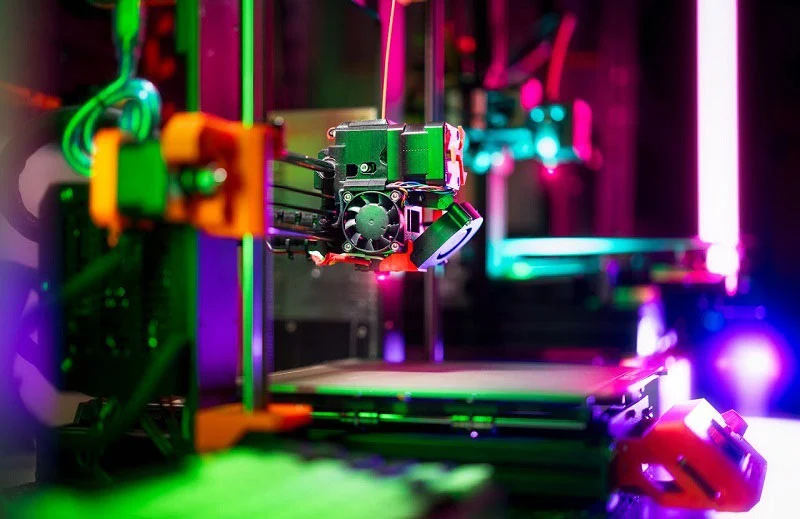
Selective Laser Sintering (SLS) is a process that builds parts layer by layer. A laser scans a layer of nylon powder. When the laser hits the powder, the particles fuse in that area. The powder bed then moves down, and a new layer of powder is applied. The printer repeats this process until the part is complete.
Its main advantage is a high degree of design freedom. No support structures are required, so complex geometries, internal channels, and grooves can be printed directly. Parts made through SLS nylon prototyping can be tested in real-world environments.
Typical applications include housings, brackets, pipes, and moving parts. The material is industrial-grade nylon, so the finished parts are more than just visual models.
MJF Nylon Prototyping
Multi Jet Fusion (MJF) works in a different way. Fusing agents and detailing agents are deposited layer by layer onto the powder bed using an inkjet-style process. Infrared energy is then applied to the surface of the powder bed. The treated areas melt and fuse. This process is repeated layer by layer until the nylon rapid prototyping process is complete.
MJF produces parts faster than SLS. It also provides more consistent mechanical properties, smoother surfaces, and higher detail resolution.
Compared with SLS, MJF is faster and provides more consistent performance. SLS offers a wider range of materials and is more widely known. Both methods are suitable for nylon rapid prototyping services.
CNC Machining Nylon
Nylon can also be shaped through machining. Solid raw materials, such as rods and sheets, are processed using CNC machines or lathes. Rotating cutting tools continuously remove material to create the final shape.
CNC-machined nylon prototypes can provide better dimensional accuracy than injection-molded parts. They also offer excellent surface quality. The material properties remain intact because the polymer structure is not changed during machining.
NOBLE engineers recommend CNC machining when very tight tolerances are required, when the part has a simple shape that can be machined efficiently, or when the prototype must have the same material properties as the production-grade material.
Vacuum Casting with Nylon-Like Materials
Vacuum casting uses silicone molds and castable resins. First, a master pattern is created, usually through 3D printing or machining. A silicone mold is then made around the master. Resin is poured into the mold under vacuum. After the part cures, it is removed from the mold.
The casting material is not nylon. It is a polyurethane material designed to simulate some of nylon’s properties. It provides a very smooth surface finish. Multiple identical parts can be produced from one mold. This material is suitable for functional testing when nylon itself cannot be used as the casting resin.
The difference between the two materials is clear. Nylon is a thermoplastic, while cast polyurethane is a thermoset plastic. Although they have some similar mechanical properties, they are not the same. During final validation, machined or printed nylon prototypes are usually preferred for testing.
Nylon vs. Other Materials for Rapid Prototyping
Nylon vs. ABS
Nylon is stronger and more durable than ABS. It has better wear resistance and is less likely to crack under impact. ABS provides a smoother surface finish and is easier to print with lower-cost FDM printers. However, nylon is more expensive.
Use nylon for functional prototypes that see mechanical loads, wear, or impact. Use ABS for visual models, enclosures, and parts with moderate mechanical requirements.
Nylon vs. PLA
PLA is brittle and can break when exposed to impact or external forces. It also becomes softer in low-temperature environments. Nylon is tough, flexible, and heat-resistant. PLA is easy to print and inexpensive. Nylon is more difficult to print, but it provides better engineering performance.
For functional testing, nylon is the clear choice. PLA is suitable for concept models and form-fit checks only.
Nylon vs. TPU
TPU is highly flexible and can bend and stretch. Nylon, in comparison, is relatively rigid. TPU is often used for seals, gaskets, and soft-touch surfaces. Nylon is more commonly used for structural parts, gears, housings, and other rigid components.
Both materials resist wear. Both are durable. The difference is stiffness. Choose nylon when rigidity is required. Choose TPU when flexibility is required.
Nylon vs. Polycarbonate
Polycarbonate (PC) is stronger and more impact-resistant than nylon. It can also withstand higher temperatures. However, PC can become more vulnerable under continuous loads.
PC is used for transparent parts, high-impact housings, and structural components requiring high load capacity. Nylon is used for parts requiring toughness, wear resistance, and chemical resistance. The choice depends on the loading condition and the environment.
Nylon Rapid Prototyping Services at NOBLE
NOBLE produces plastic prototypes for functional testing and product development. Nylon rapid prototyping is a core capability. The material is engineering-grade.
Nylon rapid prototyping services cover the full range of project needs. Early-stage concept validation, mid-stage functional testing, and pre-production verification are all supported. The same material used in prototypes can transition to production parts.
Quality Control and Certifications
We implement a series of quality control processes.
Dimensional inspections are used to verify critical product features. Quality control procedures are documented and consistently followed. ISO 9001:2015 covers general quality management requirements, while ISO 13485:2016 applies to quality management for medical device components.
These certifications help ensure process consistency, traceability, and quality control. NOBLE’s nylon rapid prototyping follows the same strict standards used for mass production.
FAQs About Nylon Rapid Prototyping
What is nylon rapid prototyping?
Nylon rapid prototyping is the use of nylon materials—typically PA12, PA11, or reinforced grades—to produce functional prototype parts using 3D printing, CNC machining, or vacuum casting.
Is SLS nylon stronger than FDM nylon?
You’re right. SLS parts are isotropic—strength is consistent in all directions. FDM parts are anisotropic—weakness exists between layers. SLS nylon is stronger under load and impact. FDM nylon is acceptable for low-load applications but does not match SLS performance.
What is the difference between SLS and MJF nylon?
SLS uses a laser to selectively fuse powder. MJF uses inkjet arrays and infrared energy to fuse powder. MJF is faster and produces smoother surfaces and more consistent mechanical properties. SLS offers a wider range of materials and is more established. Both produce high-quality nylon prototype parts.
Can nylon be CNC machined for rapid prototyping?
Yes. Nylon is machined from solid stock—rod, sheet, or block. CNC machining produces accurate, dense parts with excellent surface finish. Machining is preferred when tight tolerances are required, when the part is simple and does not benefit from additive manufacturing, or when material properties must match the final production grade.
How long does nylon rapid prototyping take?
SLS and MJF printing typically take 1 to 3 business days for standard parts. CNC machining may take 3 to 5 business days depending on complexity. Surface finishing and assembly add additional time. Total lead time ranges from a few days to two weeks depending on project scope.
How much does nylon rapid prototyping cost?
Cost depends on part size, complexity, volume, and manufacturing method. SLS and MJF are cost-effective for complex geometries and multiple parts. CNC machining is higher cost for complex shapes but offers superior accuracy. Material cost, machine time, and post-processing all contribute. Nylon is more expensive than PLA or ABS but cost-effective for functional testing compared to production tooling errors.
What are the limitations of nylon prototypes?
Nylon absorbs moisture, which affects dimensional stability and mechanical properties. Parts may require drying before use. UV exposure degrades nylon over time. Surface finish is rougher than injection-molded parts without post-processing. Thin features may warp or deform during printing. Color options are limited in SLS and MJF. These limitations are manageable with proper design and process selection.