In Spritzgießen, insert molding is a commonly used process. When we buy parts made with this process, cost is the first thing we think about. How do we judge if the part we buy is worth the money we pay? Did we pay too much? And did we chase a low price and end up with poor quality? This guide will answer all your questions. It gives you practical tips for talking with suppliers.
1. Was ist Formteil einlegen?
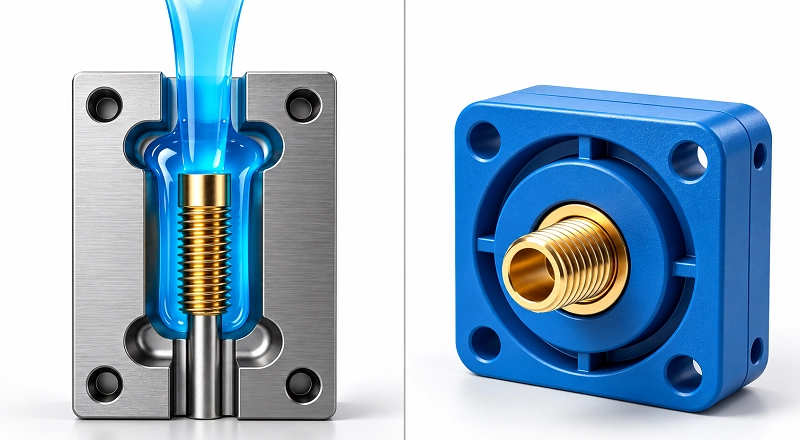
Insert molding is one of the injection molding processes. A pre-made insert is placed into the mold before melted plastic is injected. After cooling, the insert becomes part of the finished plastic part. The insert is usually metal. It can also be a magnet, ceramic part, terminal, pin, bushing, sleeve, or other specialized functional part.
The main purpose of insert molding is to combine the design freedom of plastic with the strength, conductivity, wear resistance, or positioning function of another material. Plastic provides shape, insulation, light weight, and surface finish. The insert provides thread strength, electrical contact, wear resistance, or reinforcement.
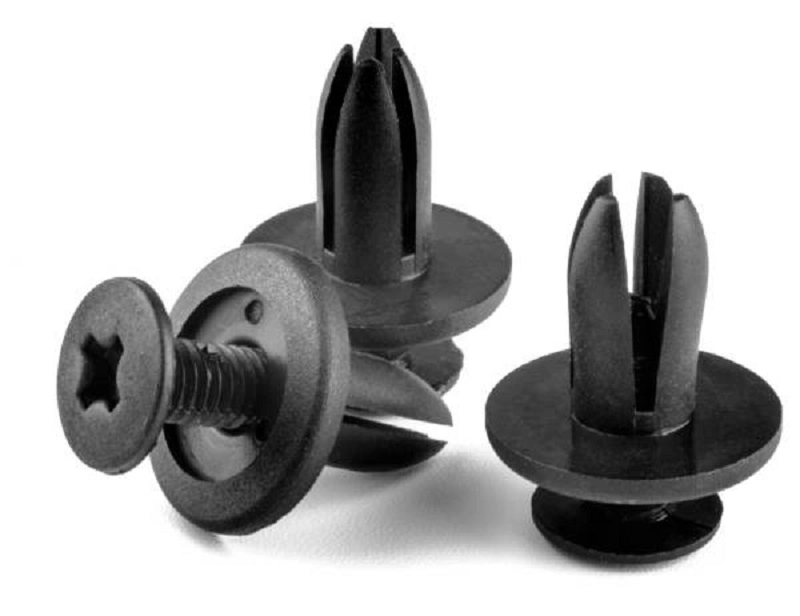
2. What Are the Benefits of Insert Molding
The advantages of insert molding usually come from function integration, not the process name itself. A good insert molding design can reduce secondary assembly, improve insert position consistency, and make the final part more reliable during repeated use.
2.1 Reduce Secondary Assembly
One reason manufacturers choose insert injection molding is to reduce assembly work after molding. Inserts do not need to be installed separately. They are molded into the part from the start. This helps lower labor costs and improve product consistency, especially in high-volume production.
2.2 Better Function Integration
Insert molding is often used when a plastic part needs functions that plastic alone cannot provide. For example, a brass insert can strengthen threads. A metal terminal can provide reliable electrical contact. By integrating these functions directly into the molded part, the final assembly is usually stronger and more reliable.
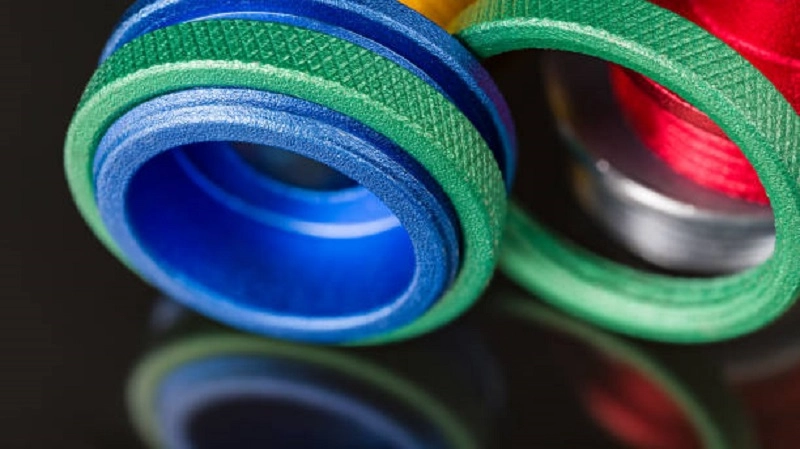
3. What Are the Common Types of Insert Molding?
3.1 Threaded Inserts
Threaded inserts are the most common type of insert molding. Their main job is to provide metal threads in a plastic part that can be assembled and disassembled many times. Plastic alone has limited strength. Direct tapping will strip after a few uses. With a brass or stainless steel threaded insert, screws can be tightened repeatedly without damaging the plastic body. Brass is the most common material. It has good machinability, moderate corrosion resistance, and a thermal expansion coefficient close to most engineering plastics. This reduces interface stress during thermal cycling. Stainless steel is used for humid, chemical, or high-load areas. It has better strength and corrosion resistance. Aluminum alloy is suitable for lightweight applications. The outer wall of the insert usually has knurling, grooves, or a hex shape. After molding, the plastic flows into these features and forms a mechanical lock. This prevents the insert from rotating or pulling out. The plastic wall around the insert should be uniform. This avoids sink marks or stress concentration. The insert height should be slightly below or flush with the plastic surface. This prevents it from sticking out and affecting assembly. Threaded inserts are widely used in medical device housings, electronic equipment enclosures, and automotive interior parts that need repeated assembly.
3.2 Knurled Inserts
Knurled inserts use a textured outer surface to create mechanical engagement between the insert and the surrounding molding material. This helps improve resistance to rotation and pull-out. So knurl geometry is an important design factor when designing inserts for molded parts.
Knurl patterns can be selected based on insert geometry, molding material, and holding force requirements. Common knurl patterns include straight knurl, spiral knurl, and diamond knurl. Each provides a different outer contact profile.
Straight knurl: Made of parallel ridges arranged along the insert direction. It provides a direct mechanical connection. It is suitable when the main need is to increase clamping force between the insert and the molding material.
Spiral knurl: Uses angled or spiral ridges around the insert. The angled profile creates mechanical engagement on the insert surface. It is suitable when holding force requirements and insert geometry fit a spiral pattern better.
Diamond knurl: Forms crossed ridges on the outer surface. This provides many mechanical engagement points with the surrounding material. It is very useful in designs where resistance to movement is a key concern.
Choosing straight, spiral, or diamond knurl should not be based on the pattern alone. When deciding the right knurl shape, also consider insert diameter, insertion length, surrounding wall thickness, molding material, expected torque, and pull-out load.
For precision molded inserts, consistent knurl geometry is very important. Changes in the outer profile affect how the insert interacts with the surrounding molding material.
3.3 Bushings and Sleeves
Bushings and sleeves provide controlled openings, mounting points, and rigid mechanical interfaces in molded parts. They are usually used for:
- Shaft alignment and guidance
- Bolt and fastener mounting
- Spacing between components
- Lastverteilung
- Providing a stable mechanical interface
Sleeves are especially useful when the surrounding molding material needs to stay flexible, lightweight, or vibration-resistant. The insert provides a rigid and dimensionally stable surface. This makes sleeves especially suitable in rubber and elastomer parts. The surrounding material can absorb movement or vibration. The sleeve supports the mounting connection.
The inner diameter, outer diameter, length, and wall thickness should be selected based on the supported component and expected load. This maintains correct alignment and reliable performance.
3.4 Custom Shaped Inserts
Not all applications can be met with standard insert geometries. Custom molded inserts can be designed with specific dimensions, contours, holes, threads, retention features, or other properties based on the final part requirements.
Custom designs are especially useful when the insert must fit into a special mold or perform multiple functions in one assembly.
Different insert parts fit different molding applications. The best insert design is determined by its use. Insert molding is not “one insert fits all.” Different insert types need their material, shape, fixing method, and surface treatment to be reverse-designed based on the final use. Choosing the wrong insert type can lead to weak bonding and assembly difficulties. In serious cases, it can affect product function and safety.
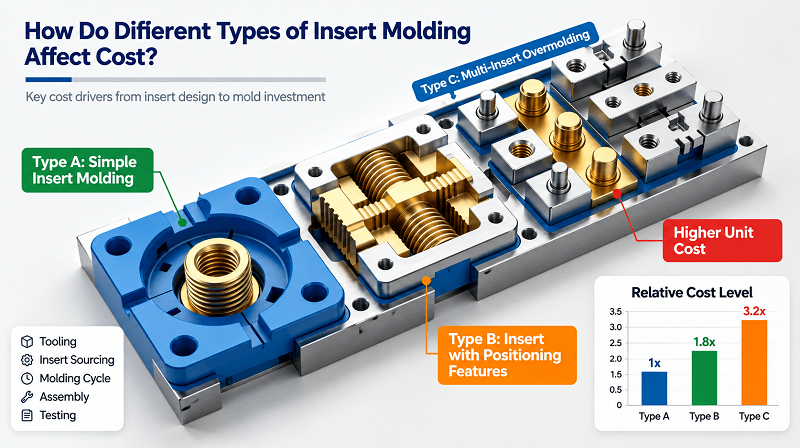
4. What Factors Affect the Cost of Insert Molding
Many customers only look at the unit price when ordering insert parts. But the cost of insert molding is affected by many factors. Insert molding can remove assembly steps. But the final cost depends on the factors below.
| Kostenfaktor | Was zu überprüfen |
| Einfügetyp | Standard or custom part |
| Vorbereitung einfügen | Cleaning, plating, inspection, or preheating needed? |
| Formendesign | How the insert is positioned, closed, flowed around, cooled, and ejected |
| Lademethode | Manuell oder automatisiert |
| Produktionsvolumen: | Prototype, small batch, or large batch |
| Qualitätsanforderungen | Pull-out force, torque, electrical, dimensional, or appearance |
| Ausschussrisiko | Insert shift, short shot, flash, cracks, poor retention |
| Montageeinsparungen | Which post-install inserts, screws, terminals, or manual steps are removed |
The cheapest mold quote is often not the lowest total project cost. Cheap molds cause problems easily—inserts do not sit stably, inspection is difficult, and samples need to be changed often. Later scrap and line downtime costs quickly eat up the mold savings.
A truly cost-saving plan starts at the mold design stage. Think clearly about insert positioning, plastic flow path, and cooling efficiency. Spend a little more upfront. Avoid many problems later.
5. What Materials Are Used for Different Types of Insert Molding
The choice of insert molding material depends on the insert function, the surrounding molding material, and the operating environment.
| Material | Warum wählen Sie es? | Typische Überlegungen |
| Messing | Good machinability and suitable corrosion resistance | Threaded inserts, connectors, HVAC, electrical applications |
| Stahl | Hohe Festigkeit und Haltbarkeit | Higher mechanical loads and structural interfaces |
| Edelstahl | Korrosionsbeständigkeit | Humid, chemical, and harsh environments |
| Kupfer | Elektrische und thermische Leitfähigkeit | Conductive and special applications |
| Bronze | Gute Verschleißfestigkeit und Korrosionsbeständigkeit | Bushings, sleeves, and applications needing durability |
| Aluminium | Leicht und einfach zu bearbeiten | Lightweight components and applications needing weight reduction |
| Kunststoff / Polymer | Lightweight, good thermal insulation, strong material compatibility | Applications needing electrical insulation or non-metal structures |
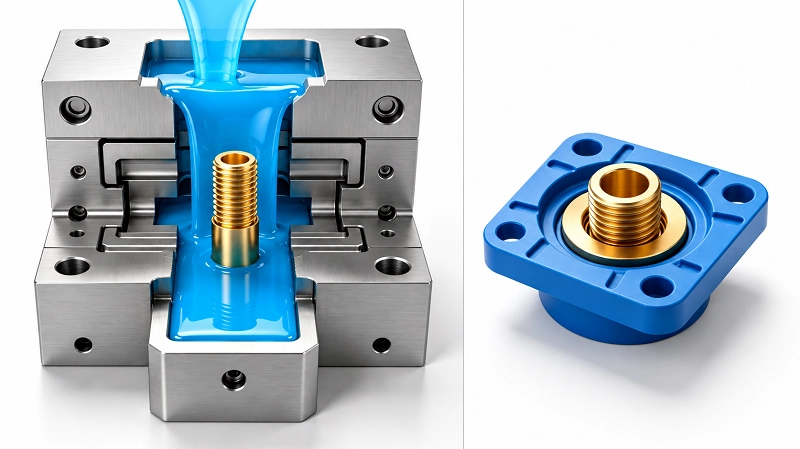
6. How Do Machining Methods Differ for Different Types of Insert Molding?
Insert types differ a lot in how they are processed. It is not something you can solve simply by changing a tool.
Gewindeeinsätze: For example, brass nuts. The key is to keep plastic out of the threads. The mold needs locating pins. The insert must be pressed tight before the mold closes. Plastic must not leak into the threads during injection. These inserts usually use vibratory bowl feeding. Manual placement easily causes missing or misaligned inserts.
Conductive inserts: For example, copper terminals and pins. Requirements are the highest. If the position is off by 0.1mm, electrical contact may fail. These inserts mostly use tape feeding. They are fixed by precision locating holes in the mold. During processing, the plating must not be damaged. Otherwise, conductivity drops.
Load-bearing inserts: For example, steel reinforcement plates. They are large and heavy. Manual placement is unstable. Special fixtures or robots are usually needed. Injection pressure is high. The insert can be pushed out of position. Support structures must be added to the mold.
Bushing-type inserts: For example, stainless steel bushings. The key is concentricity. Usually done in two steps: first overmolding, then CNC finishing the inner bore. This ensures bearing seat precision.
Kunststoffeinsätze: For example, PEEK parts. Temperature must be monitored during processing. If mold temperature is too low, bonding is weak. If too high, the insert deforms.
The more precise, heavier, and contamination-sensitive the insert is, the more complex the machining method. Before choosing a process, first understand what type of assembly the insert goes into.
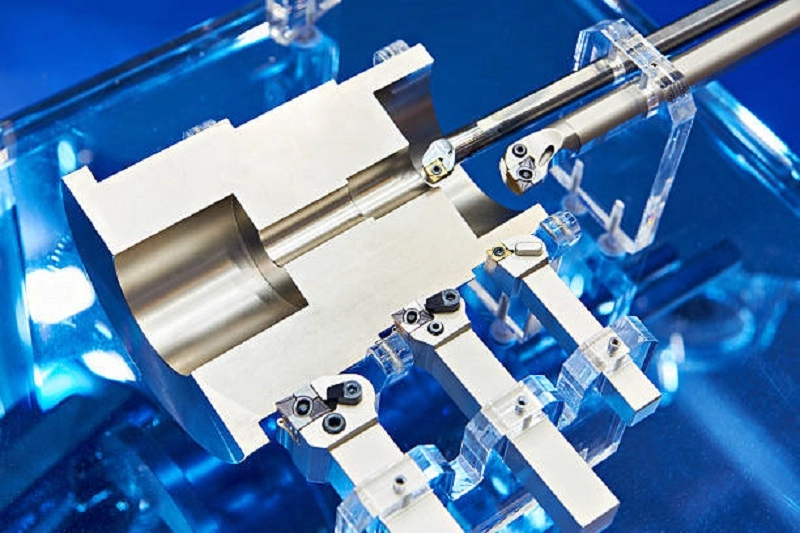
7. What Wrong Choices Cause Insert Molding to Go Over Budget?
Material selection is a key factor in cost control. But most buyers underestimate this. If a standard-grade resin can meet the need, but an engineering-grade resin is chosen instead, it is like using filet mignon to make a burger. Standard POM has a market price of about USD 1.15 per kg. Engineering-grade PEEK costs about USD 42 per kg. The unit price difference is huge. At 50 grams per part and 100,000 units, the material cost difference alone is about USD 5,750 versus USD 210,000. This does not even include PEEK’s very high processing temperature requirements, longer molding cycle, and the special mold and process needed.
On the other hand, not considering material requirements also causes huge losses. For example, if a structural part needs glass fiber reinforced nylon but unfilled polypropylene is used, it can cause field failures, warranty claims, or even product recalls. These costs far exceed the material cost saved. The key is honest application analysis: what are the actual mechanical, thermal, chemical, and regulatory requirements? We have experience with over 400 materials. We can usually recommend a grade that meets the real need without over-designing. Sometimes, the best cost control method is spending 15 minutes talking with the customer about what the part actually does.
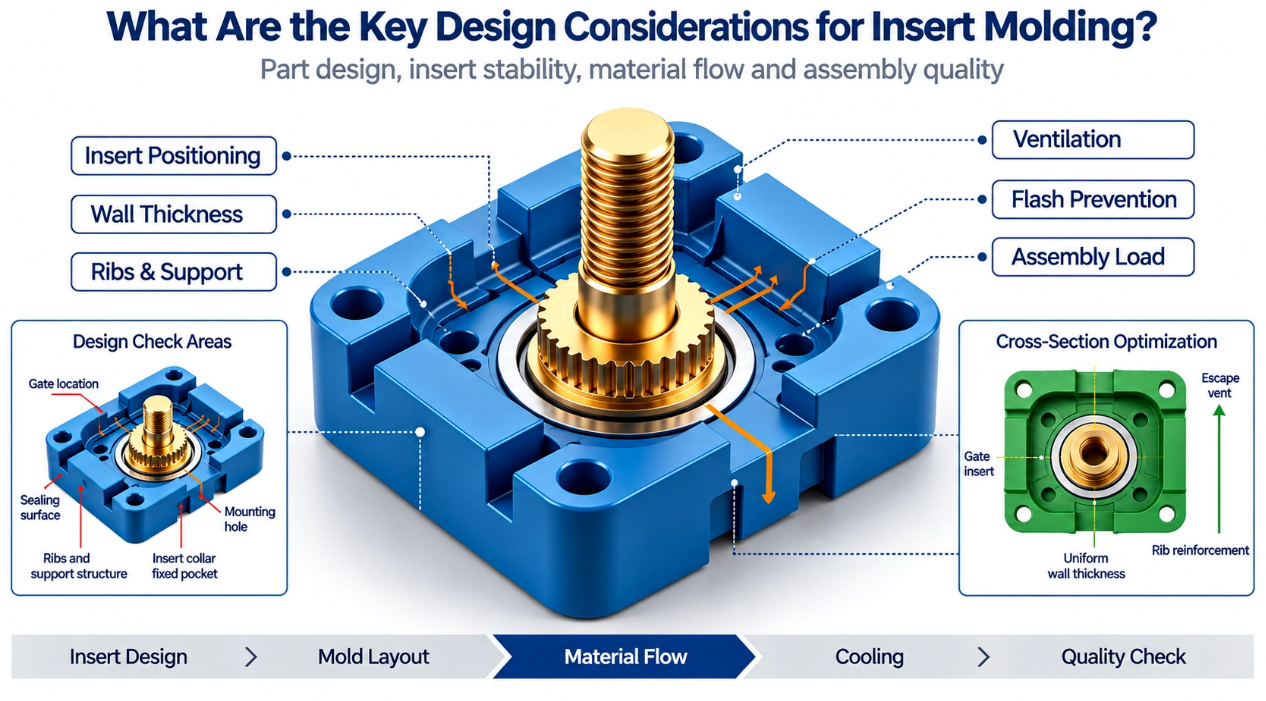
8. What Are the Key Design Considerations for Insert Molding?
Designing effective molded inserts requires considering both the insert itself and the final molded part.
8.1 Insert Geometry
The insert shape should support its intended function and provide enough fixing in the molding material.
8.2 Maßgenauigkeit
The insert needs to meet specified dimensions and tolerances. This allows it to fit correctly into the mold and work as required in the finished part.
8.3 Positionierung
Precise positioning is of vital importance, especially for threaded inserts, electrical contacts, and mounting points. Inaccurate positioning can affect assembly, wall thickness, alignment and the overall performance of components.
8.4 Retention Force
Inserts need to remain firmly in position during the forming process and throughout the entire service life of the component. Where appropriate, knurling, grooves, planes and other external features can be used to enhance holding power.
8.5 Materialverträglichkeit
The insert material and molding material should be compatible with operating and processing conditions. Factors like temperature, chemical exposure, humidity, and thermal expansion coefficient differences must be considered.
8.6 Formenbau
The mold must hold the insert precisely. It must also let the molding material flow correctly around the insert. Poor mold design causes insert shift, incomplete material coverage, flash, or other defects.
9. How to Choose the Right Molded Insert for Your Application
Choosing the right insert starts with understanding what the finished assembly needs to do.
Halten:
- Application requirements—define the specific function the insert must provide.
- Molding material—determine if the part will use plastic, rubber, elastomer, or another material.
- Insert material—choose brass, steel, stainless steel, copper, plastic, or another suitable material.
- Mechanical load—consider pull-out force, torque, vibration, and repeated fastening.
- Thread requirements—define thread size, pitch, depth, and tolerance if applicable.
- Operating environment—consider temperature, humidity, chemicals, and other environmental factors.
- Insert geometry—choose suitable retention and functional features.
- Production volume—determine the right manufacturing and insert placement method.
- Dimensional requirements—determine critical dimensions and tolerances.
- Inspection requirements—define how to verify the insert and finished assembly.
The goal is not simply to choose the strongest insert. The insert must meet the required performance. It must also be compatible with the molding material, manufacturing process, and final assembly.
10. Why Choose NOBLE for Molded Inserts?
NOBLE provides full support for insert molding projects. We help with design review, material selection, and mold making. We handle both manual and automated insert loading. We also provide in-line inspection to check insert position and bond quality. Every part is traceable from raw material to finished product. This meets ISO 13485 requirements for medical projects. From prototype to mass production, we support the whole process.
Häufig gestellte Fragen
1. Welche Arten von Einsätzen gibt es?
Professional tooling systems are more commonly organized by machining operation, such as:
Turning inserts; Milling inserts; Drilling inserts; Threading inserts; Grooving and parting inserts.
2. What plastic resins are compatible with insert molding?
Insert molding works with most thermoplastics. Common choices include ABS, PC, PA, PBT, PPS, PP, PE, POM, and acrylic. The main limitation is very high-temperature plastics like PEEK and PEI, which are harder to process.
3. How does insert molding reduce manufacturing cost?
It removes secondary assembly steps. Inserts are molded directly into the part. This saves labor, improves consistency, and lowers total cost.
4. What industries use insert molding most widely?
Medical devices, automotive, consumer electronics, power tools, aerospace, and industrial equipment.
5. What tolerance can insert molding achieve?
Insert molding typically achieves ±0.05mm to ±0.1mm for insert position. Critical dimensions can reach ±0.02mm with precision molds.