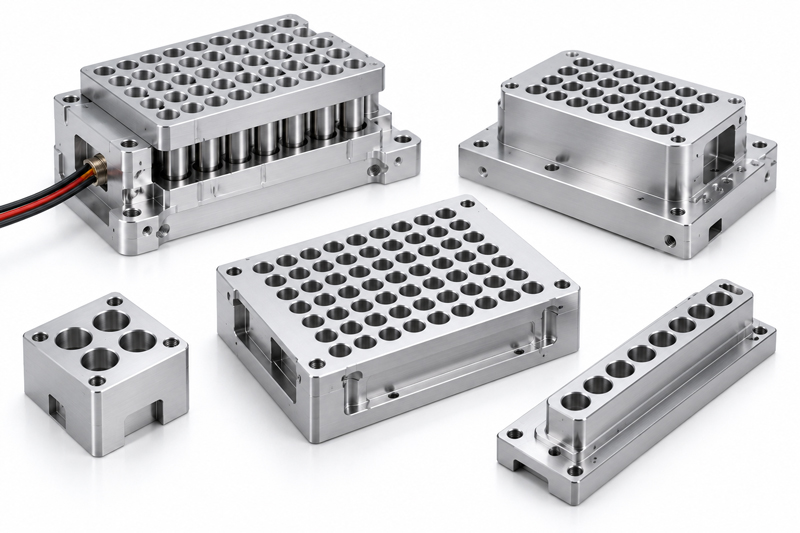
The PCR heating block, also known as the PCR temperature control module, is the thermal management structure of PCR equipment. It is responsible for completing the precise heating and cooling cycle of samples. Its machining accuracy, heat conduction uniformity, and structural stability directly determine the success rate of nucleic acid amplification experiments and the accuracy of detection data.
This article comprehensively analyzes the value of CNC machining of PCR temperature control modules from seven dimensions: functional demands, machine advantages, material selection, improvement of temperature control performance, quality control compliance, application scenarios, and industry summary.
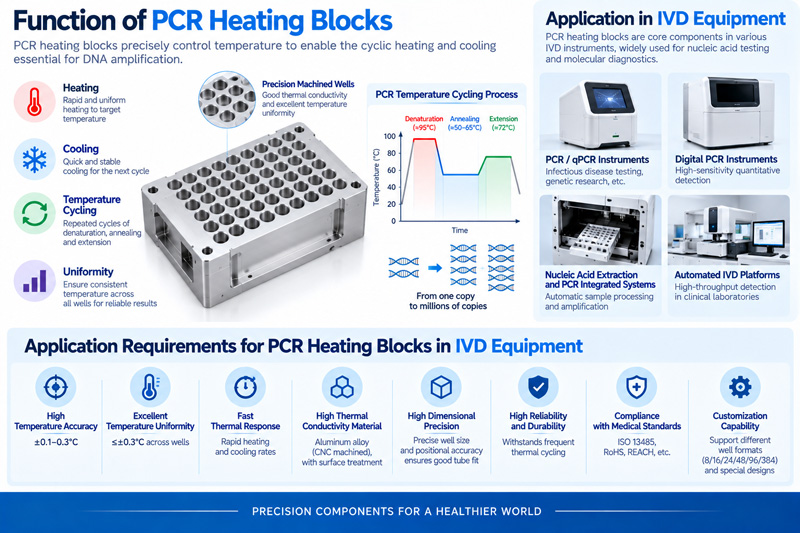
Function of PCR heating blocks and the application requirements of IVD equipment
The working principle of PCR heating blocks
PCR nucleic acid amplification relies on standardized temperature cycling to complete the three major reactions of DNA denaturation, annealing, and elongation.
As the core for sample carrying and heat conduction, the heating block provides a stable reaction environment for nucleic acid samples in PCR tubes, eight-tube tubes, and microplates through precise heating, constant temperature, and cooling cycles.
Three major temperature control requirements for medical PCR equipment
Medical-grade PCR equipment has three clear and strict requirements for heating blocks.
The first is the accuracy of temperature control. The temperature difference between Wells and the overall temperature control error need to be controlled within ±0.1℃ to ±0.3℃ to ensure uniform reaction conditions for all samples.
The second is the high efficiency of temperature rise and fall, which enables rapid temperature switching, shortens the amplification cycle, and is suitable for screening a large number of clinical samples.
The third is long-term stability. When the equipment operates at high frequencies and in cycles of high and low temperatures over a long period of time, the heating blocks must not experience warping, deformation, heat conduction attenuation, oxidation, or rust, ensuring the long-term stable operation of the equipment.
The value of CNC machining
The CNC integrated precision milling machine fundamentally resolves the shortcomings of traditional machines, achieving high-precision and high-stability mass production machining of medical heating blocks.
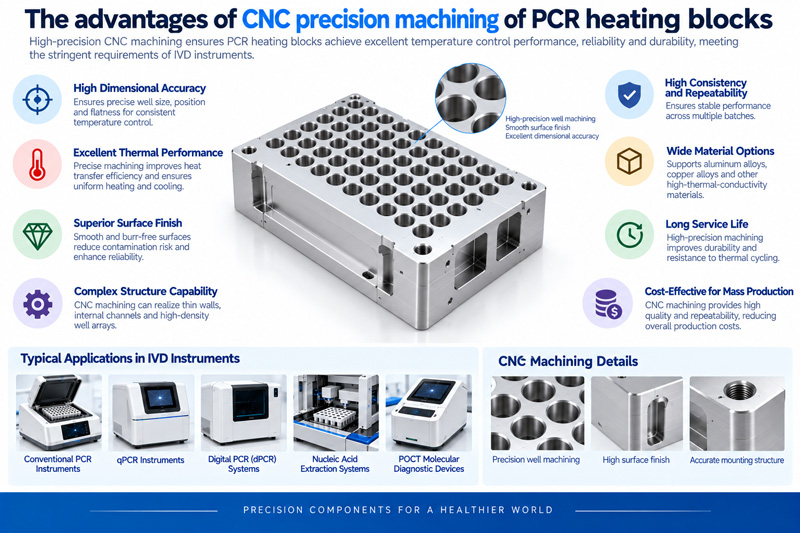
The advantages of CNC precision machining of PCR heating blocks
Ultra-high precision tolerance, matching medical temperature control standards
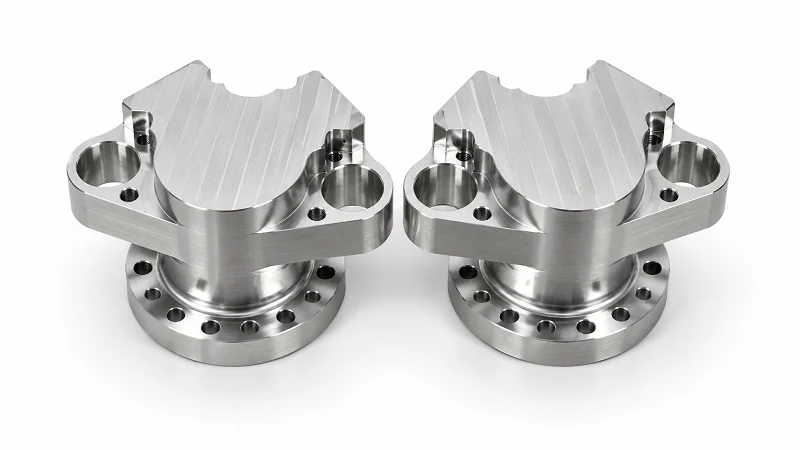
CNC precision machining, relying on automated precision machine tools and standardized programming, can control the overall dimensional tolerance of the heating block within ±0.01mm. The hole positioning is precise, the hole wall is smooth without burrs, and the planar flatness error is extremely small.
The high-precision structure ensures a 360°tight fit between the PCR tube and the heating block holes, without any gaps or looseness. This eliminates issues such as thermal conduction lag and uneven local temperatures, guaranteeing temperature control accuracy from a structural perspective and meeting the strict testing standards for Class II IVD medical devices.
Integrated milling forming, with stronger anti-deformation stability
The PCR heating block is constantly in an alternating cycle of high and low temperatures ranging from 4℃ to 99℃, experiencing frequent thermal expansion and contraction.
CNC uses a single piece of aviation aluminum and brass profiles for integrated milling forming, without any splicing or welding gaps. It features uniform structural density and low internal stress, and has extremely strong resistance to thermal deformation.
Long-term cyclic operation will not cause problems such as warping, deformation, oxidation, and peeling. The heat conduction performance is long-lasting and stable, significantly extending the overall service life of the PCR equipment and reducing the failure rate of equipment repair.
High consistency in mass production and support for customized medical production
CNC machining can replicate standardized machining parameters. Whether it is a small-batch sample or a large-batch mass production, the size, precision, and structure of each heating block are uniform, solving the problem of poor consistency in traditional machining and meeting the large-scale mass production requirements of IVD equipment.
It also supports multi-specification customization, capable of machining 96-well, 48-well, 32-well, 16-well, and other well-position structures suitable for 0.1ml and 0.2ml PCR tubes. The sensor holes, heat dissipation slots, and positioning card slots are integrally formed and are combined with anodic oxidation precision surface treatment, which is clean and corrosion-resistant and meets medical production standards.
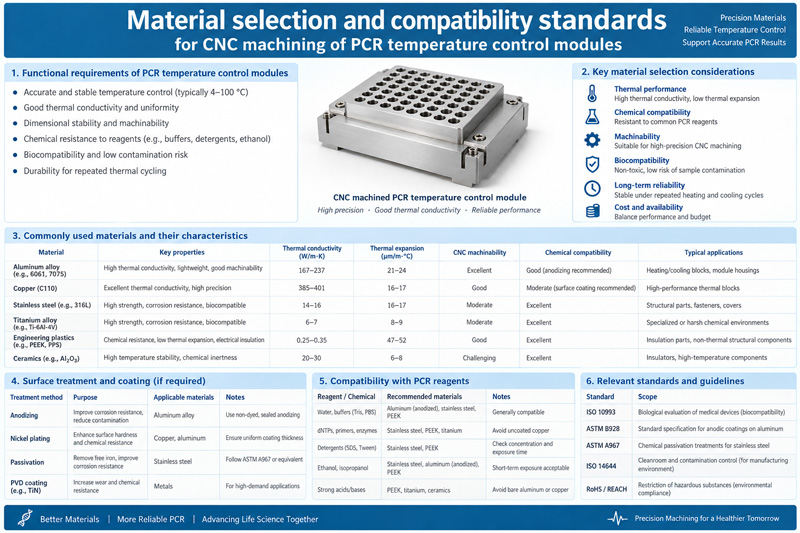
Material selection and compatibility standards for CNC machining of PCR temperature control modules
6061 aluminum: A mainstream material for general medical use
6061 aluminum is currently the most widely used material for PCR heating blocks. It features high thermal conductivity, fast thermal response speed, a small thermal expansion coefficient, light weight, and is extremely easy to be precisely machined by CNC.
This material has a stable structure after molding and is not prone to deformation under long-term high- and low-temperature cycles. After hard anodizing treatment, it has excellent oxidation resistance, wear resistance, and corrosion resistance, with outstanding cost performance. It is compatible with over 90% of conventional PCR instruments and ordinary fluorescence PCR equipment on the market and is the preferred material for clinical universal temperature control modules.
7075 aluminum: Specifically designed for high-end and high-precision equipment
7075 ultra-high strength aluminum features uniform density and excellent thermal stability. Its thermal deformation rate is much lower than that of ordinary aluminum materials, and the temperature difference between holes can be precisely controlled within ±0.1℃.
This material has extremely high requirements for machining technology. It needs high-precision CNC finishing and complete removal of internal cutting stress to prevent any minor deformation in the later stage.
The high-end real-time fluorescent PCR equipment is mainly used in tertiary hospitals, disease control centers, and key laboratories, and is suitable for high-precision viral load detection, gene sequencing, and other strict scientific research and clinical scenarios.
Brass material: Specifically designed for portable and rapid detection equipment
The thermal conductivity of brass far exceeds that of aluminum, and its temperature control response is extremely sensitive, enabling rapid temperature rise and fall. It is suitable for POCT portable and rapid PCR testing equipment.
Through CNC fine machining, the machining problems of brass being too soft, prone to burrs, and deformation can be solved. The formed hole positions are precise, and the heat conduction is uniform.
Due to its relatively large self-weight and high cost, brass material is only suitable for small portable detection devices and not for large 96-well high-throughput PCR equipment.
All materials must undergo stress relief treatment after machining to ensure long-term stability during use.
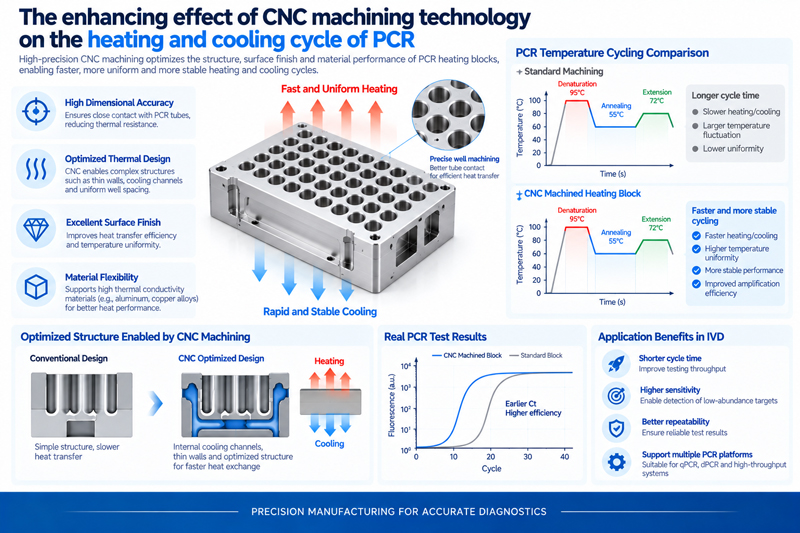
The enhancing effect of CNC machining technology on the heating and cooling cycle of PCR
High-precision hole positions ensure uniform temperature distribution throughout the entire area
The complete PCR amplification cycle involves high-temperature denaturation at 94℃, medium-temperature annealing at 55-60℃, and constant-temperature extension at 72℃. The temperature switching is frequent, and the precision requirements are strict.
The depth and flatness of the holes in the heating blocks made by traditional machines are uneven, which can easily lead to excessive temperature differences between the central and edge holes, resulting in uneven sample amplification and poor experimental repeatability.
The heating block machined by CNC integrated precision grinding has uniform hole parameters and a flat surface. There are no dead corners or delays in heat conduction. The temperature distribution of the entire module is uniform, ensuring a consistent reaction environment for each nucleic acid sample.
The dense integrated structure enhances the response efficiency of temperature rise and fall
The heating block formed by CNC milling has a dense and uniform material, without pores or loose defects, and the heat conduction path is smooth.
The heating stage can quickly conduct heat and shorten the preheating time.
During the cooling stage, rapid heat dissipation can be achieved through reserved heat dissipation structures, effectively shortening the single temperature control cycle.
Compared with traditional machining heating blocks, the heating and cooling rates of CNC precision machining modules can be increased by 15% to 25%, significantly enhancing the detection throughput of PCR equipment and meeting the rapid screening needs of a large number of samples in medical institutions.
Low-stress structure ensures long-term temperature control accuracy without attenuation
Medical PCR equipment operates at high frequency for long periods of time every day. Repeated cycles of high and low temperatures can easily cause deformation of ordinary heating blocks and temperature control drift.
The CNC machining combined with stress relief technology ensures an extremely stable module structure. After long-term use, the flatness and hole position fit remain unchanged, and the temperature control accuracy will not decline.
At the same time, the sensor card slot, heat insulation, and heat dissipation structure can be machined as a whole, ensuring precise adhesion of the temperature sensor and real-time data collection, achieving closed-loop precise temperature control, eliminating problems such as temperature overshoot and temperature lag, and guaranteeing the authenticity and repeatability of experimental data.
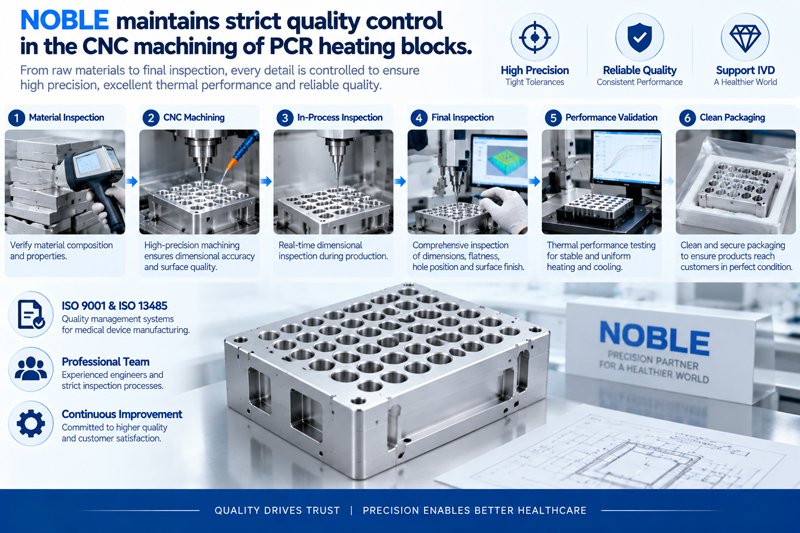
Quality control and compliance requirements for CNC machining of medical device-grade PCR heating blocks
Precise dimensional quality control builds a solid foundation for temperature control compliance
PCR equipment is classified as a Class II medical device, and the machining of its components must comply with the GMP quality management norms for medical devices.
All CNC-machined products are comprehensively inspected by professional equipment, with strict control over parameters such as hole diameter, hole position, and hole depth. The error of all finished products is controlled within the medical standard range, and all substandard products are removed to ensure that the temperature control accuracy of the equipment complies with and meets the standards.
Clean machine quality control eliminates the risk of sample contamination
Medical components must be free from oil stains, metal shavings, burrs, and scratches to prevent contamination of nucleic acid samples.
The entire CNC precision machining machine adopts medical-grade cutting technology. After machining, it undergoes multiple procedures such as precise grinding, ultrasonic cleaning, and high-temperature degreasing to remove machining residues.
The entire machine ensures that the product surface is clean and neat, fully meeting the clean production standards for IVD medical equipment.
The materials and production process are fully compliant and traceable
All raw materials are made of medical-grade compliant profiles, accompanied by material inspection reports. Recycled and inferior materials are strictly prohibited.
Finished products need to pass tests such as high- and low-temperature cycling tests, thermal deformation tests, and corrosion resistance tests to simulate long-term medical working conditions and verify performance stability.
The entire production process is completed in a dust-free and constant-temperature workshop. From raw material warehousing, CNC machining, post-treatment, quality inspection, to outbound, the entire machine is traceable. It can provide complete and compliant materials for equipment manufacturers, assisting in the filing and market access of medical devices.
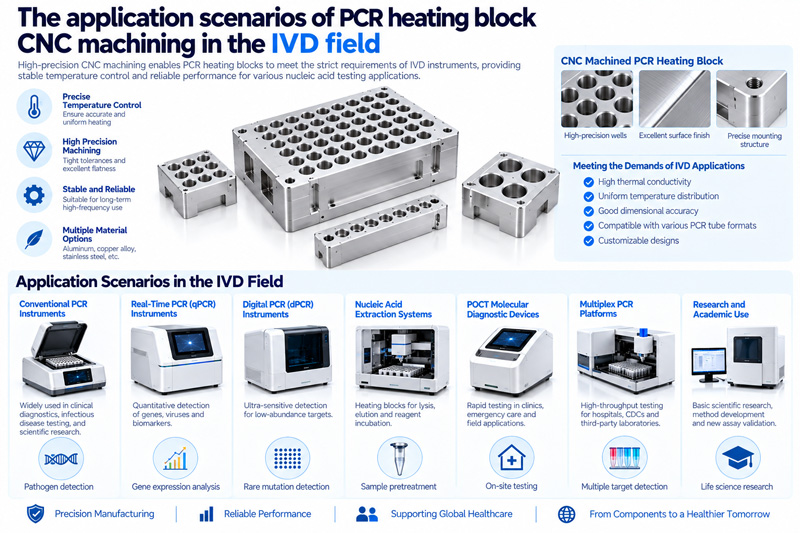
The application scenarios of PCR heating block CNC machining in the IVD field
Clinical routine PCR instrument accessory module
Conventional PCR instruments in hospitals at all levels, primary medical institutions, and physical examination centers are mainly used for routine pathogen screening such as HPV, tuberculosis, and hepatitis B.
This type of equipment pursues stability, high cost performance, and mass production. It generally adopts 96-hole and 48-hole standard heating blocks machined by 6061 aluminum CNC in an integrated manner.
With the advantages of high consistency in mass production, low failure rate, and stable temperature control, it meets the regular and high-frequency detection needs of clinical practice.
Structure of high-end real-time fluorescence quantitative PCR equipment
High-end fluorescent PCR equipment in top-tier hospitals, disease control centers, third-party testing institutions, and research institutes is mostly used for quantitative analysis of viral load, genotyping, and precise scientific research experiments, and is equipped with high-precision optical detection systems.
The equipment has extremely strict requirements for the flatness of the heating block, the verticality of the hole positions, and the temperature difference between holes. It mostly adopts 7075 aviation aluminum CNC precision machining modules to ensure the accuracy and high repeatability of optical detection data, supporting high-precision quantitative diagnosis work.
POCT portable rapid detection customized module
In scenarios such as field quarantine, emergency rapid screening, and food safety testing, small portable PCR rapid testing devices are relied upon.
This type of equipment focuses on rapid heating and cooling, as well as being compact and lightweight. It often uses CNC custom heating blocks made of brass or lightweight aluminum alloy.
CNC can be customized with irregular structures and integrated heat dissipation structures according to the compact design of the equipment, meeting the scene requirements of outdoor and grassroots immediate detection.
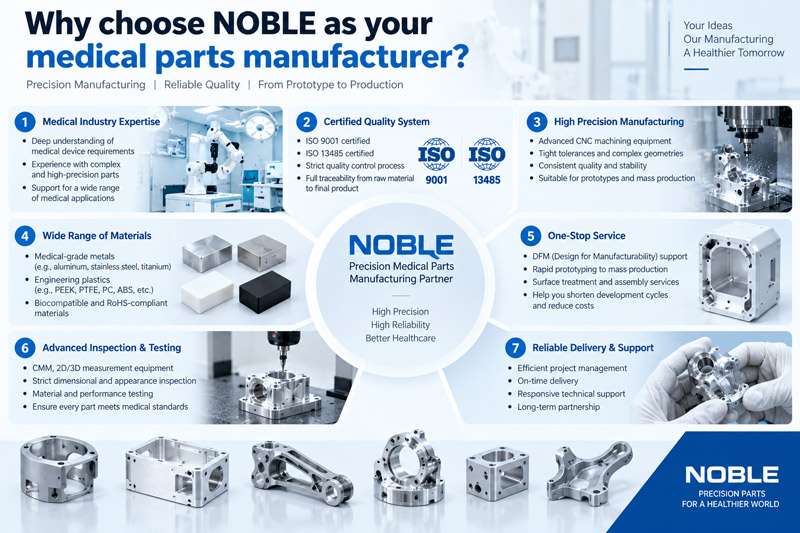
Why choose NOBLE as your medical parts manufacturer
NOBLE is a Sino-British joint venture awarded by the government as a “National High-tech Enterprise”. We have two major business directions: “Smart Manufacturing” and “Care Products”. The “Smart Manufacturing” business specializes in providing customers with project support services, including parts machining and manufacturing.
More than 10 years of professional manufacturing and rapid prototyping experience. Our efficient team provides strong support for your new projects to 100% realize your requirements; Standardized management brings strict quality control of parts & products; a reasonable workflow results in lower costs with the same quality.
After years of hard work and development, NOBLE has gradually transformed from a precision parts machining and manufacturing enterprise with complete industrial chain supporting service capabilities to a service-oriented enterprise that provides full support for customers’ entire projects.
NOBLE is your trusted one-stop custom manufacturing solution, from prototype design to manufacturing, through huge manufacturing resources, suitable technology, streamlined process, expert guidance, and a perfect quality inspection process to turn your ideas into reality.
NOBLE has the following qualification certificates:
ISO 9001: 2015 – Robust quality management for general manufacturing. Consistent processes. Documented control. Traceable inspection.
ISO 13485: 2016 – Stricter quality standards for medical device parts. Rigorous process validation. Full traceability. Required for implantable and surgical parts.
Conclusion
In conclusion, the PCR heating block, as the thermal management structure of PCR instruments and real-time fluorescent PCR equipment, directly determines the temperature control accuracy, work efficiency, data repeatability, and overall stability of IVD nucleic acid testing equipment. It is a key component for the compliant production of medical devices.
The CNC precision machining of PCR heating blocks, with its advantages of ultra-high machining accuracy, integrated anti-deformation structure, uniform heat conduction performance, strong consistency in mass production, and complete medical compliance, has solved the industry pain points of traditional heating blocks, such as large temperature differences, easy deformation, short service life, and unstable precision.
FAQs
Q: What surface treatment is not suitable for PCR heating blocks for IVD instruments?
A: Electroplating is not recommended, as plating layers may peel off under frequent thermal cycling and contaminate nucleic acid samples.
Q: How to judge whether a CNC Machining PCR heating block has residual internal stress?
A: Carry out a simulated high-low temperature cycle aging test; obvious warping indicates residual stress exists.
Q: Will the total number of PCR heating blocks affect CNC machining difficulty?
A: Higher-density multi-well structures raise requirements for tool accuracy and fixture flatness.
Q: What are the common risks when retrofitting non-medical grade heating blocks into IVD PCR devices?
A: Unverifiable material safety, poor thermal consistency, and failure to meet medical device filing requirements.
Q: Can CNC-machined PCR heating blocks be repaired after long term thermal aging deformation?
A: Generally cannot be repaired; deformation changes internal stress distribution and damages overall thermal performance.