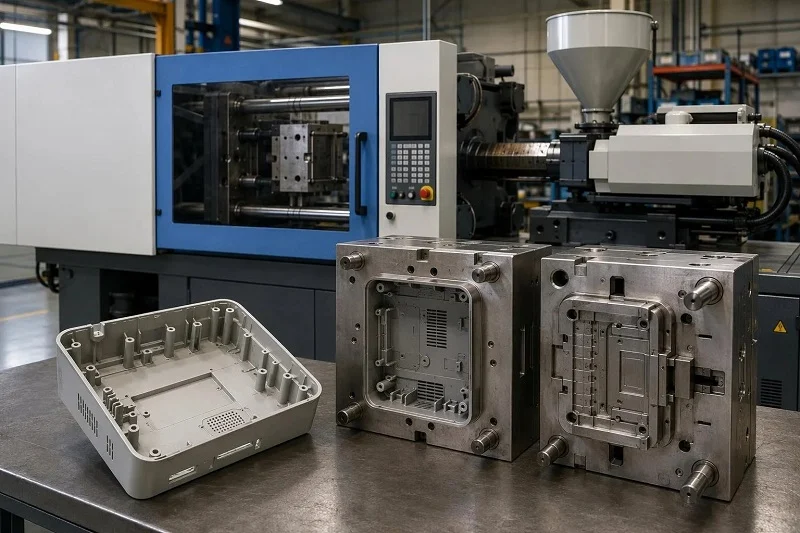
TPE injection molding looks deceptively familiar. The machine is a standard reciprocating screw unit, the mold opens and closes like any other, and the parts come out soft, grippy and slightly warm. Then a program moves from an SEBS grip to a TPU boot and the same setup stops working: the granulate starts pulling moisture from the air, the melt loses properties under shear, and hardness becomes a variable that reshapes drying, packing and ejection all at once.
That gap is the reason this guide treats process control and defect diagnosis as one connected system. Material condition, machine setup, mold design and parameter stability all constrain each other, and most defects that show up at the press were decided earlier in that chain. The sections that follow work through the TPE injection molding family as a whole — styrenic compounds, TPV, TPO and the polyurethane grades — with TPU used throughout as the hard case, because once a process holds on TPU it usually holds on everything softer.
Where the TPE Injection Molding Family Splits
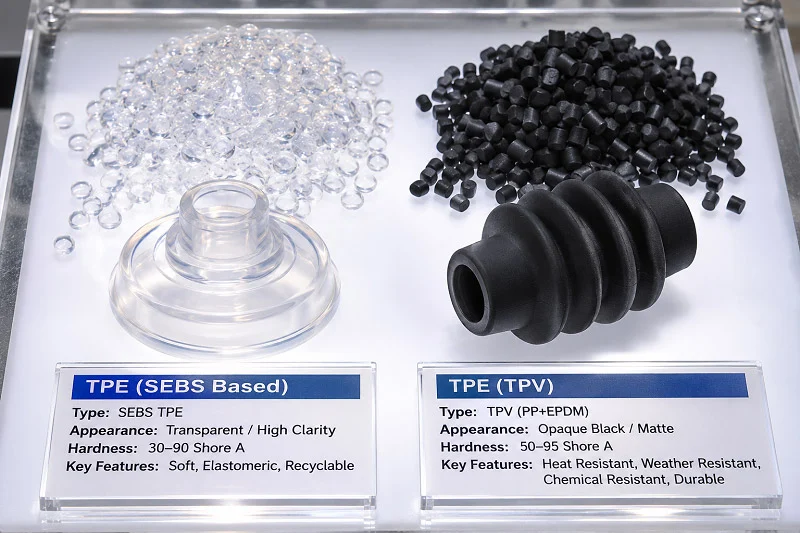
It helps to sort TPEs by what actually governs the process, because the family name hides three quite different behaviors. Styrenic compounds such as SEBS and SBS are usually non-hygroscopic, forgiving on temperature and easy to eject. TPV and TPO sit in the middle. Polyurethane grades — TPU — are the outlier: hygroscopic, shear-sensitive, and continuous across a hardness span that runs from tacky, nearly amorphous soft grades to semicrystalline grades that behave almost like engineering plastics.
A parameter set copied from an SEBS or SBS job will usually produce TPU parts — and then produce splay, sink, sticking or a compression set that never reaches the datasheet value. Each of the three behaviors below changes a different part of the setup.
Hygroscopic Behavior and Why It Dominates Defect Analysis
TPU granulate absorbs atmospheric moisture rapidly unless it stays in sealed packaging, and that absorbed water turns to steam in the barrel. The consequences — splay, silver streaks, internal bubbles, a foamy melt — appear at the part surface and inside the wall, so moisture is the first hypothesis to eliminate in almost any TPU defect investigation. Treat dryness as a process variable with a measured value, not a housekeeping detail.
Shear Sensitivity and the Soft-Grade Constraint
TPU melts are shear-sensitive, and excessive screw rotation rates can reduce the properties of the finished part — a loss that may not show up until mechanical testing. This is why back pressure stays low and screw speed is limited by circumferential velocity rather than a fixed rpm. At the soft end, grades below roughly 70 Shore A are often impractical for commercial molding: many are nearly amorphous, so setup takes far longer, and they can be tacky enough to stick to metal mold surfaces.
Hardness as the Master Variable
Hardness drives drying temperature, barrel profile, shrinkage, demolding behavior and cycle time, so a process window belongs to a grade, not to the family. Harder grades above about 90 Shore A behave as semicrystalline materials that set up quickly and eject easily; softer grades soften gradually, flow at low pressure and demand more patience at ejection. A hardness change late in a program is a tooling and validation event, not a drop-in substitution.
Drying and Material Handling: The First Control Point

Not every TPE needs a dryer — SEBS and SBS grades often run straight from a sealed bag — but for any hygroscopic grade in the family, and for TPU in particular, drying is the first control point in the job and the one most often verified once at setup and then assumed. A workable program covers how the granulate is stored, what the dryer is set to, and how dryness is confirmed while the press is running.
Storage, Sealing and Condensation Control
Store granulate dry and ideally at room temperature. Material held below room temperature should be brought up to room temperature before the packaging is opened, so condensation does not form on cold pellets. Reseal packaging after every removal, expose the granulate to air only as long as necessary, and cover the feed hopper on the machine. These steps decide whether drying starts from a known baseline or from an unknown moisture load.
Drying Equipment and Starting Parameters
For TPU, published guidance calls for drying below 0.02% moisture content before processing, using either circulating-air or dehumidified-air dryers. One representative TPU grade family gives 3–4 hours at 90–110 °C in circulating air for 70–90 Shore A, 100–120 °C for harder grades, and 90–100 °C in dehumidified air across that range; aliphatic and specialty grades carry lower limits and are not suited to circulating-air drying. Soft styrenic grades usually need no drying at all, while some TPV and TPO compounds specify a short cycle. With circulating-air dryers, keep the granulate layer no deeper than about 4 cm. The grade datasheet governs.
Verifying Dryness in Production, Not Just at Setup
A low dewpoint reading describes the drying air, not the pellet, so pair it with direct residual-moisture measurement of material at the feed point. A −40 °C inlet dewpoint is a common target for dehumidifying hopper dryers. Also track hopper residence time and throughput: a dryer that performs at setup can be overwhelmed by a full hopper, a wet transfer line or a first-in batch that sat exposed. Treat drying as a monitored loop with a recorded result per lot.
Machine, Screw and Nozzle Configuration
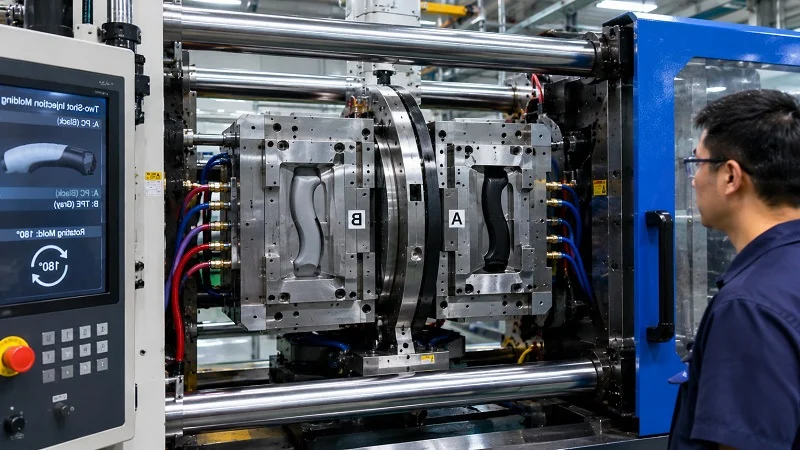
Hardware sets the achievable process window before a single parameter is entered, and in TPE injection molding the same screw usually has to run several members of the family. Shot size relative to barrel capacity, screw geometry, back pressure and nozzle choice each determine how much shear and residence time the melt sees — the two variables most damaging to TPU and, to a lesser degree, to high-hardness TPV compounds.
Shot Size Relative to Barrel Capacity
A shot weight of 60–75% of barrel capacity is recommended: it shortens melt residence time and allows higher stock temperatures without degradation. Shot sizes as low as 30–35% are workable but narrow the processing latitude, raise the injection pressure needed to fill, and increase molded-in stress. Correct for specific gravity when the machine is rated in general-purpose polystyrene — a barrel rated 1.7 kg in GPPS delivers about 1.9 kg of a 1.20-specific-gravity TPU, so a 75% target becomes roughly 1.4 kg. Styrenic grades run lighter, near 0.9 to 1.0, so the same barrel holds less useful volume than the nameplate suggests.
Screw Geometry, Compression Ratio and Back Pressure
Single-flighted three-zone screws with an L/D of 18–22 D suit TPU, typically proportioned around 0.40 L feed, 0.35 L compression and 0.25 L metering. Short-compression-zone screws are unsuitable because of the high shear they generate. Back pressure should stay low — 5–10 bar is a common recommendation, up to about 20 bar when additives are present — enough to homogenize the melt without shearing it.
Nozzle and Hot Runner Choices
Low-shear, free-flow, automatic-shut-off nozzles are preferred, with a channel designed for easy flow and no restricted regions where melt can sit and degrade into deposits. In hot runner systems, heaters must cover the full runner so no cold spots exist, and nozzle tips need good insulation from the cold side of the mold — poor insulation plus the fast setup of harder grades can plug nozzles. Valve gates suit surface-critical parts because they leave only a slight ring; gate diameters typically run 0.8–3.2 mm depending on part size and thickness.
Setting the Process Window for a New Grade

Do not copy a window from a harder grade. Start near the middle of the published range for the new grade, then move one major variable at a time and record each result. The goal is a documented set of conditions that makes good parts reliably, not a single passing setup — and that discipline is what makes a single press able to run several TPE grades without guesswork.
Temperature Profiles by Hardness and Chemistry
Published barrel, melt, nozzle and mold temperatures cluster in a recognizable band for each TPE family, but they shift with hardness, backbone and grade. Mold temperature is a good example of how far apart the family members sit: TPU is run relatively cool because it sets quickly, with one processing guide giving 10–44 °C, while styrenic and TPV grades often need 20–60 °C for surface quality and weld-line strength. Verify the actual melt temperature with an air shot rather than trusting controller setpoints, and confirm every number against the grade datasheet before writing it into a process sheet.
Injection Speed, Pressure and Hold
The failure modes are directional. Too little hold pressure produces sink marks; excessive injection pressure makes demolding difficult and raises molded-in stress. Injection speed should be kept as low as gating, wall thickness and flow distance allow, because faster fill means more shear. Injection and hold pressures commonly sit in the 100–1000 bar range, with hold typically one-half to two-thirds of first-stage pressure and higher for thick sections.
Transfer Position, Cushion and Pack
Control transfer by screw position rather than time, so a consistent volume reaches the cavity. Start a new mold with short shots and increase the shot size gradually until cavities are 80–90% filled, then note the screw position and use it as the transfer point. Maintain a small cushion ahead of the screw so hold pressure can still pack the part as it shrinks; without a cushion there is no control of densification, and overpacking only loads the sprue and runner.
Cooling Time and Demolding Balance
Cooling scales with wall thickness and hardness rather than following a universal figure, so derive it from the part instead of copying a cycle. Too little cooling produces warpage and ejection distortion; too much wastes cycle time without improving quality. For flexible parts, confirm that draft angle and ejection design let the part deflect out of the tool rather than being dragged, and check that mold temperature is uniform across both halves.
Defect Diagnosis: A Systematic Method
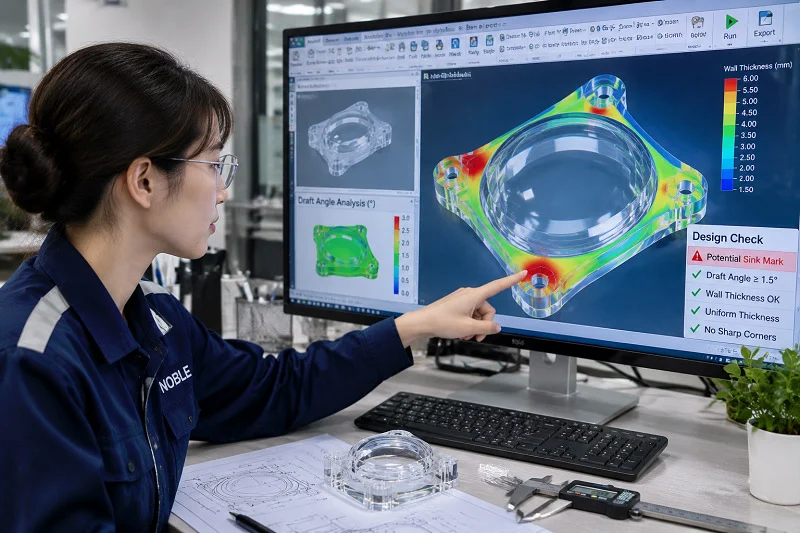
Most TPE defects fall into the same handful of categories across the family — moisture, thermal and shear damage, filling problems, packing problems and ejection problems — but the weight of each cause shifts with the grade. Diagnose in a fixed order: identify the defect precisely, check material condition first, compare current settings with the established window, inspect the mold, then change one major variable at a time and record the result. Changing temperature, pressure, speed and material together makes root-cause analysis much more difficult.
Separating Moisture Defects from Thermal and Shear Defects
Both bubbles and silver streaks can originate from moisture, which is why TPU produces them so readily and why styrenic grades rarely do. Confirm the feed-point moisture result first, then compare a purged shot against the running material. A defect that clears after purging points to residence time or melt temperature; one that persists points to wet granulate or contamination.
Flash on Soft Grades: Which Parameter First
Verify clamp force and tool condition before touching the process. Worn parting lines, damaged shut-offs and insufficient clamp tonnage produce flash on any hardness, and soft grades only make an existing gap more visible. Once the tool is sound, reduce injection pressure and speed, then melt temperature.
Warpage Inside a Compliant Mold-Temperature Range
Mold temperature inside the recommended band does not guarantee flat parts. Anisotropic shrinkage orients chains in the flow direction, so differential cooling between the two mold halves, unbalanced packing across cavities, and gate location can all warp a part that is otherwise running to specification.
Flow Marks Versus Weld Lines
Flow marks are surface ripples or dull bands left where the melt front advanced unevenly; they are primarily cosmetic and respond to injection speed, melt temperature and gate size. Weld lines form where two flow fronts meet and can reduce strength at that plane, so their location and the venting around them deserve attention.
Sink Marks, Short Shots and Sticking
Sink marks usually trace to low hold pressure or time, thin gates, or a wall section that stays molten after the gate freezes. Short shots point to insufficient shot size, low melt or mold temperature, restricted gates and runners, or blocked vents. Sticking is a mold-design and ejection issue as much as a process one: insufficient draft, a polished surface on a tacky grade, short cooling and weak ejection all hold the part in the tool.
Overmolding TPE onto a Rigid Substrate
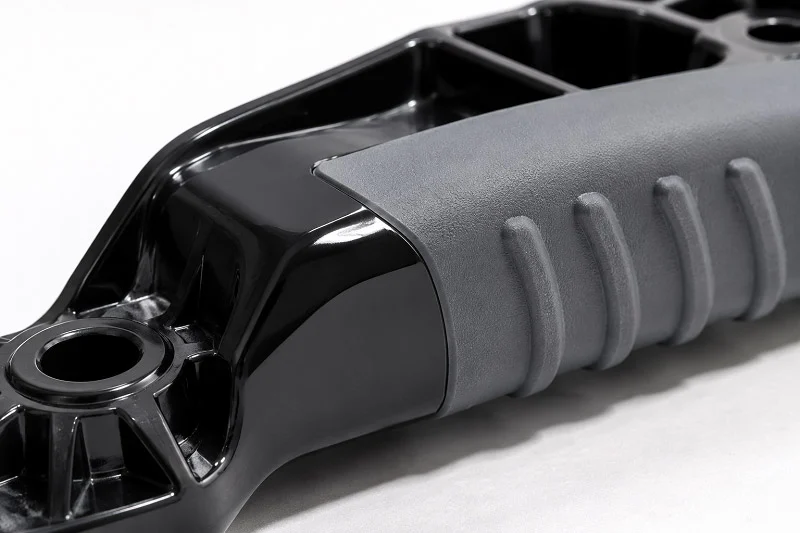
Overmolding changes the problem from filling one cavity to bonding two materials without damaging the first. The substrate arrives with its own moisture content, its own melt history and its own shrinkage, and the TPE shot must be hot enough to adhere while staying cool enough not to distort what it lands on. In TPE injection molding terms, the second shot inherits every decision made in the first. TPU and TPV handle this differently: TPU bonds by partly dissolving at the interface, so it wants a hot melt, while styrenic overmolds typically rely on mechanical interlocking and a mechanically keyed substrate.
Insert Molding Vs Multi-Shot
Insert molding places a pre-molded substrate into the tool and shoots the TPE directly over it. It runs on conventional single-shot machines and carries lower tooling cost, which makes it the more widely used route. Multi-shot molding keeps both materials in one machine and one cycle, avoiding handling between shots and improving registration, but it requires a dedicated machine and a more expensive tool. Choose insert molding when volumes and budgets are moderate; choose multi-shot when bond consistency and cycle integration justify the tooling investment.
Adhesion, Substrate Drying and Gate Placement
Bond strength depends on a clean, dry substrate and, for TPU, a melt hot enough to wet and partially dissolve the interface. Hygroscopic substrates must be dried to their own specification, because moisture at the bond line produces voids and weak adhesion. Two mold-temperature controllers are common practice so the substrate side and the overmold side can be held at different temperatures. Gate the TPE so it flows over fresh, hot substrate surface rather than into a dead corner, and keep the overmold thickness at or below the substrate thickness to limit warpage, especially on long, flat parts.
Quality Control and Documentation for TPE Production
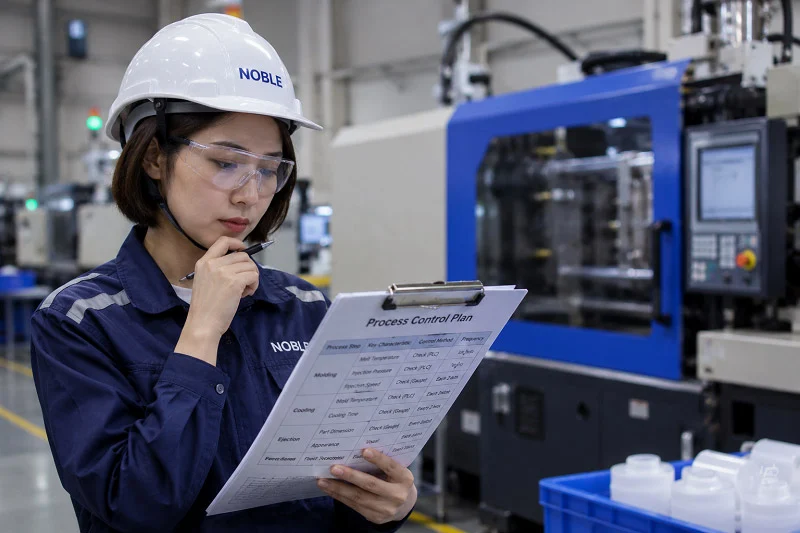
A process window is only as good as the records that show it is still being held. TPE production drifts quietly: a hopper that has been open too long, a regrind ratio that crept upward, a heater band losing efficiency. Documentation turns those slow changes into visible signals before they become scrap — and it matters more when one press runs several family members in a week.
Regrind Ratios and Contamination Control
Published TPU guidance allows up to 30% regrind blended with virgin material, depending on the quality the part requires, and the regrind must match the virgin grade in type and Shore hardness and be free from contamination. Regrind should ideally be diced, dried and reused without intermediate storage, since it absorbs moisture like virgin granulate. Not every TPE tolerates the same ratio, so treat 30% as TPU-specific and confirm softer styrenic grades against their own supplier limit. Contamination pathways are the usual culprits behind splay and inconsistent properties: mixed grades in the granulator, dust from other resins, lubricants, and colorant carriers that are incompatible with TPU. Segregate regrind, verify its moisture before blending, and treat the approved ratio as a process limit rather than a target.
What to Record and How to Detect Drift
Log the parameters that actually move: barrel zone and melt temperatures, injection and hold pressures, transfer position, cushion, screw recovery time, back pressure, mold temperatures and cooling time, plus drying temperature, dewpoint and hopper residence time. Then log the outcomes that reveal drift earliest — cushion stability, peak injection pressure and part weight. A cushion that shortens shot after shot, a peak pressure creeping upward, or a part weight trending outside its band all indicate a change in material condition, feed behavior or tool condition before a visible defect appears. Time-ordered records let you correlate the shift with a lot change, a regrind addition or a dryer event instead of guessing.
Choosing NOBLE to Support Your TPE Injection Molding Project
The same discipline this article applies to TPE injection molding — documented drying, controlled temperature profiles, stable packing and recorded process data — carries directly into high-performance polymer work such as PEEK injection molding, where the processing window is narrower and the cost of a failed trial is higher.
NOBLE is a China-based contract manufacturer and a Sino-British joint venture, recognized by the government as a National High-Tech Enterprise, with more than 10 years of experience in custom manufacturing. Our service capability and processing expertise help customers move efficiently from prototype to mass production. We are certified to ISO 9001:2015 and ISO 13485:2016, so processes, records and corrective actions follow an auditable framework rather than depending on individual practice.
We provide a full range of services from design through assembly, not production alone. That means design-for-manufacturability input on wall transitions, gate position and shrinkage allowance; rapid prototyping to verify a design before tooling is committed; tooling and molding in-house; inspection supported by a full set of inspection equipment and an overall quality control system; and assembly to complete the chain, so a program does not have to be split across multiple suppliers.
Certification supports a quality process but does not by itself certify a specific part. Part-level validation and any regulatory submission a device requires remain project-specific and are agreed as part of the program.
FAQs about TPE Injection Molding
Short answers to the questions that come up most often when setting up or troubleshooting a TPE job, with TPU noted wherever its behavior differs from the softer family members.
How do I tell whether a bubble or silver streak is caused by moisture versus overheating or shear degradation?
Check the material first. Confirm the feed-point moisture result, then compare a purged shot with the running material. Defects that clear after purging suggest residence time or melt temperature; defects that persist suggest wet granulate or contamination.
Which process parameter should I adjust first when I see flash on a soft TPE part?
Verify clamp force and tool condition before changing any process setting. If the tool is sound, reduce injection pressure and speed, then melt temperature.
Why does my TPE part warp even when mold temperature is within the supplier’s recommended range?
Anisotropic shrinkage, differential cooling between mold halves, unbalanced packing and gate location can all warp a part even when mold temperature sits inside the recommended band.
How do I set a process window for a new hardness grade rather than copying settings from a harder grade?
Start in the middle of the grade’s published range, run short shots and increase shot size until the cavities fill, then change one major variable at a time and record each result.
What is the difference between a flow mark and a weld line, and does either indicate a strength problem?
Flow marks are surface ripples from uneven fill and are primarily cosmetic. Weld lines form where flow fronts meet and can reduce strength at that plane.
How should drying be verified in production, not just at setup?
Measure residual moisture at the feed point, monitor dryer dewpoint, and track hopper residence time so material is not left exposed or overheated between drying and molding.
What changes when the same part is overmolded onto a rigid substrate instead of molded as a single shot?
The substrate must be dried and clean, the overmold melt is run hot enough to bond — toward the upper end of the TPU range when TPU is used — the two mold halves are held on separate temperature controllers, and overmold thickness should not exceed substrate thickness to limit warpage.