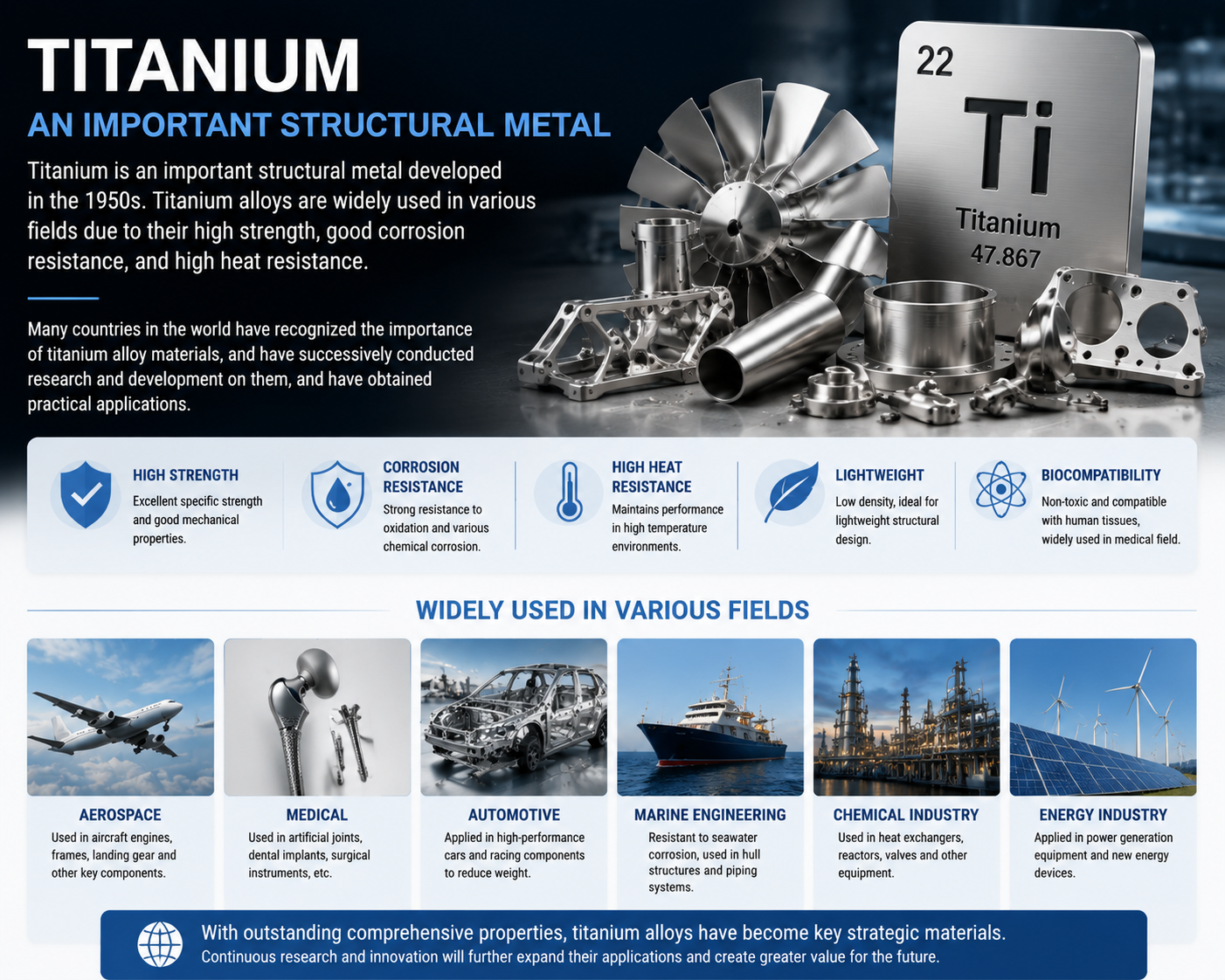
Titanium is an important structural metal developed in the 1950s. Titanium alloys are widely used in various fields due to their high strength, good corrosion resistance, and high heat resistance. Many countries in the world have recognized the importance of titanium alloy materials, have successively conducted research and development on them, and have obtained practical applications.
What is titanium alloy?
Titanium alloy refers to a variety of alloy metals made of titanium and other metals. Titanium is an important structural metal developed in the 1950s. Titanium alloy has high strength, good corrosion resistance, and high heat resistance. In the 1950s and 1960s, the main focus was on the development of high-temperature titanium alloys for aircraft engines and structural titanium alloys for aircraft bodies.
Characteristics of titanium alloys
-
High thermal strength
The operating temperature is several hundred degrees higher than that of aluminum alloys. It can still maintain the required strength at medium temperatures and can work for a long time at temperatures of 450-500℃. These two types of titanium alloys still have high specific strength in the range of 150℃-500℃, while the specific strength of aluminum alloys decreases significantly at 150℃. The working temperature of titanium alloys can reach 500℃, while that of aluminum alloys is below 200℃.
-
Good corrosion resistance
Titanium alloys work in humid atmospheres and seawater media, and their corrosion resistance is far better than that of stainless steel; they are particularly resistant to pitting, acid corrosion, and stress corrosion; they have excellent corrosion resistance to alkali, chloride, chlorine, organic substances, nitric acid, sulfuric acid, etc. However, titanium has poor corrosion resistance to reducing oxygen and chromium salt media.
-
Good low-temperature performance
Titanium alloys can still maintain their mechanical properties at low and ultra-low temperatures. Titanium alloys with good low-temperature performance and extremely low interstitial elements, such as TA7, can still maintain a certain plasticity at -253℃. Therefore, titanium alloys are also important low-temperature structural materials.
-
High chemical activity
Titanium has high chemical activity and reacts strongly with O2, N2, H2, CO, CO2, water vapor, ammonia, etc. in the atmosphere. When the carbon content is greater than 0.2%, hard TiC will be formed in the titanium alloy; when the temperature is high, it will also form a TiN hard surface layer when it reacts with N; above 600°C, titanium absorbs oxygen to form a hardened layer with high hardness; when the hydrogen content rises, a brittle layer will also be formed. The depth of the hard and brittle surface layer produced by absorbing gas can reach 0.1-0.15 mm, and the degree of hardening is 20%-30%. Titanium also has high chemical affinity and is prone to adhesion with the friction surface.
-
Low thermal conductivity and elasticity
The thermal conductivity of titanium is λ=15.24W/(m·K), which is about 1/4 of nickel, 1/5 of iron, and 1/14 of aluminum, while the thermal conductivity of various titanium alloys is about 50% lower than that of titanium. The elastic modulus of titanium alloy is about 1/2 of that of steel, so it has poor rigidity and is easy to deform. It is not suitable for making slender rods and thin-walled parts. The springback of the processed surface is very large during cutting, about 2 to 3 times that of stainless steel, causing severe friction, adhesion, and bonding wear on the back face of the tool.
Price of Titanium Alloy Machining
Titanium alloy has the advantages of light weight, high specific strength, and good corrosion resistance, so it is widely used in the automotive industry. The most widely used titanium alloy is in the automotive engine system. There are many benefits to using titanium alloy to manufacture engine parts.
The low density of titanium alloy can reduce the inertial mass of moving parts. At the same time, titanium valve springs can increase free vibration, reduce the vibration of the car body, and increase the speed and output power of the engine.
Reducing the inertial mass of moving parts reduces friction and improves the fuel efficiency of the engine. Choosing titanium alloy can reduce the load stress of related parts and reduce the size of parts, thereby reducing the weight of the engine and the whole vehicle. The reduction of the inertial mass of parts reduces vibration and noise and improves the performance of the engine. The application of titanium alloy in other parts can improve the comfort of personnel and the beauty of the car. In the application of the automotive industry, titanium alloy has played an immeasurable role in energy saving and consumption reduction.
Although titanium alloy parts have such superior performance, there is still a long way to go before titanium and its alloys are widely used in the automotive industry. The reasons include high prices, poor formability, and poor welding performance.
The main reason that hinders the widespread use of titanium alloys in the automotive industry is still the high cost.
Whether it is the initial smelting of the metal or the subsequent processing, the price of titanium alloys is much higher than that of other metals. The cost of titanium parts that the automotive industry can accept is 8 to 13 US dollars/kg for titanium connecting rods, 13 to 20 US dollars/kg for titanium valves, and less than 8 US dollars/kg for titanium springs, engine exhaust systems, and fasteners. It is 6 to 15 times that of aluminum plates and 45 to 83 times that of steel plates.
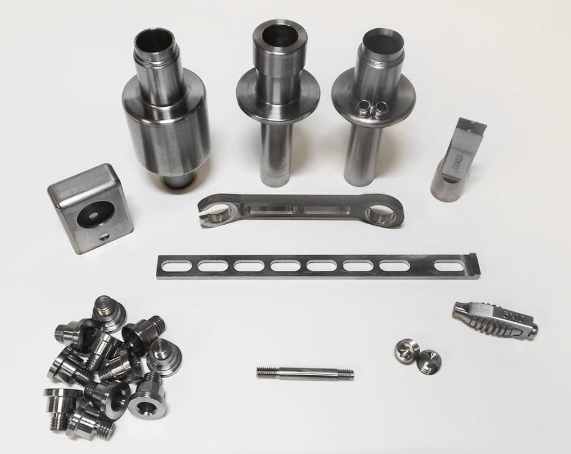
Common Processes for Titanium Alloy Machining
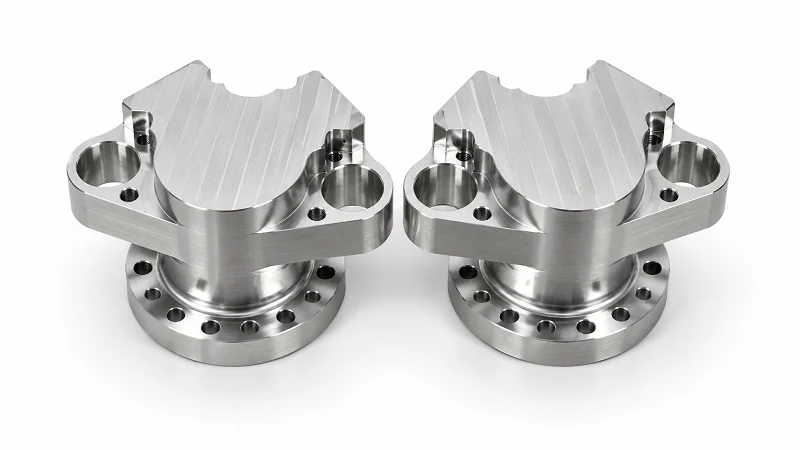
Titanium alloys are widely used in aerospace, medical, automotive, marine, and high-performance industries due to their high strength-to-weight ratio, excellent corrosion resistance, and high-temperature performance. However, titanium is a difficult-to-machine material because of its low thermal conductivity and high cutting forces. Advanced CNC machining processes are commonly used to manufacture precise titanium components.
1. CNC Milling
CNC milling is one of the most common processes for machining titanium alloys. It uses multi-axis cutting tools to remove material and create complex shapes.
Advantages:
- Produces complex geometries and contours
- Achieves high dimensional accuracy
- Suitable for prototype and production parts
- Supports 3-axis, 4-axis, and 5-axis machining
Typical applications:
- Aerospace brackets
- Engine components
- Structural parts
- Medical implants
2. CNC Turning
CNC turning uses a rotating titanium workpiece and stationary cutting tools to produce cylindrical components.
Advantages:
- High machining efficiency
- Excellent concentricity and dimensional control
- Suitable for shafts and rotational parts
Typical applications:
- Aircraft fasteners
- Medical screws
- Hydraulic components
- Precision shafts
3. 5-Axis CNC Machining
5-axis machining is widely used for complex titanium components because it allows simultaneous movement along multiple axes.
Advantages:
- Machines complex curved surfaces
- Reduces multiple setups
- Improves machining accuracy
- Provides better surface finish
Applications:
- Aircraft structural components
- Turbine parts
- Medical prosthetics
- Defense components
4. CNC Drilling
CNC drilling creates accurate holes in titanium alloy parts for assembly and fastening.
Advantages:
- High positioning accuracy
- Suitable for deep holes and precision features
- Supports aerospace-grade requirements
Applications:
- Aircraft frames
- Engine components
- Medical devices
5. Tapping and Threading
Titanium alloy components often require precision internal and external threads.
Advantages:
- Enables reliable assembly
- Produces accurate thread profiles
- Suitable for high-strength fastening applications
Applications:
- Aerospace fasteners
- Medical screws
- Industrial equipment parts
6. CNC Boring
Boring enlarges existing holes to achieve higher precision and surface quality.
Advantages:
- Improves hole accuracy
- Achieves tight tolerances
- Suitable for critical assemblies
Applications:
- Engine housings
- Hydraulic components
- Precision mechanical parts
7. CNC Grinding
CNC Grinding is used for titanium parts requiring excellent surface finish and tight dimensional control.
Advantages:
- Produces smooth surfaces
- Improves dimensional accuracy
- Suitable for finishing operations
Applications:
- Aerospace precision parts
- Medical components
- Tooling components
8. Electrical Discharge Machining (EDM)
EDM machining uses electrical sparks to remove titanium material without direct cutting force.
Advantages:
- Machines complex shapes
- Suitable for difficult-to-cut areas
- Minimizes mechanical stress
Applications:
- Turbine components
- Precision aerospace parts
- Complex medical devices
9. Laser Cutting
Laser cutting is commonly used for titanium sheets and thin components.
Advantages:
- High cutting speed
- Precise profile cutting
- Minimal material waste
Applications:
- Aerospace panels
- Lightweight structures
- Prototype parts
10. Waterjet Cutting
Waterjet cutting uses high-pressure water mixed with abrasive particles to cut titanium without creating a heat-affected zone.
Advantages:
- Prevents thermal distortion
- Maintains material properties
- Suitable for thick titanium plates
Applications:
- Aerospace structures
- Industrial components
- Custom prototypes
11. Surface Finishing Processes
Titanium alloy parts often require surface treatments to improve performance and appearance.
Common finishing methods:
Anodizing
- Improves corrosion resistance
- Creates decorative colors
- Used for medical and aerospace parts
Polishing
- Produces smooth surfaces
- Improves appearance
Bead Blasting
- Creates uniform matte finishes
- Removes machining marks
PVD Coating
- Improves wear resistance
- Enhances surface hardness
Passivation
- Improves corrosion protection
Comparison of Titanium Alloy Machining Processes
| Machining Process | Main Advantages | Typical Applications |
|---|---|---|
| CNC Milling | Complex shapes, high accuracy | Aerospace structures |
| CNC Turning | Efficient cylindrical machining | Shafts, fasteners |
| 5-Axis Machining | Complex surfaces, fewer setups | Turbine parts |
| Drilling | Precision holes | Aircraft components |
| Tapping | Accurate threads | Medical screws |
| Boring | High hole accuracy | Engine parts |
| Grinding | Excellent surface finish | Precision components |
| EDM | Complex precision features | Aerospace & medical |
| Laser Cutting | Fast sheet processing | Titanium panels |
| Waterjet Cutting | No heat damage | Thick titanium plates |
Conclusion
Titanium alloy machining requires advanced CNC technologies, optimized cutting parameters, and proper tooling strategies due to titanium’s unique material properties. Processes such as 5-axis CNC milling, turning, drilling, EDM, and precision finishing enable manufacturers to produce high-performance titanium components for aerospace, medical, automotive, and industrial applications.
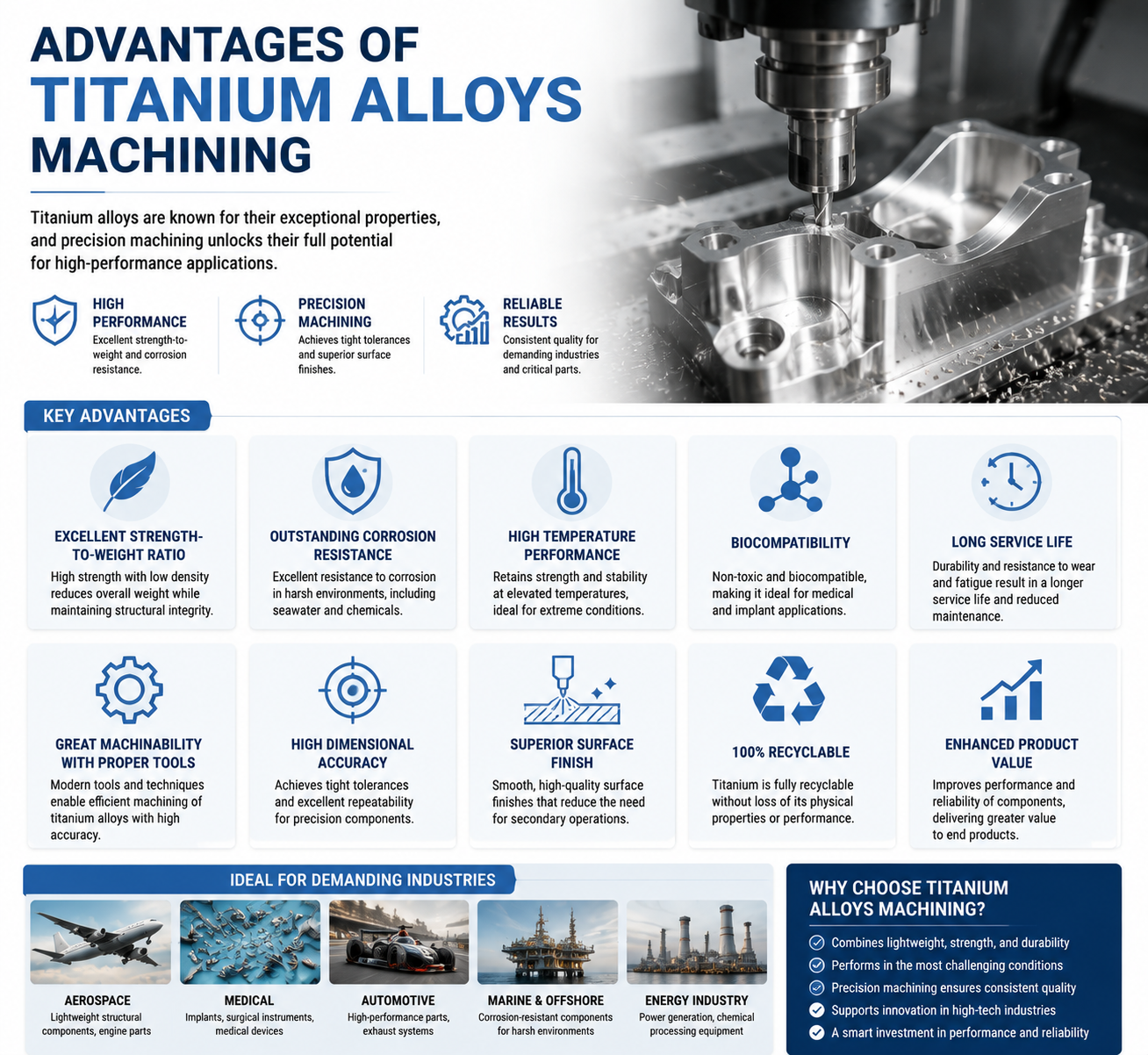
Advantages of Titanium Alloys Machining
- High Strength: Titanium alloys possess high mechanical properties and tensile strength, allowing them to withstand high loads and high-intensity movements. This makes them widely used in a wide range of fields, such as aerospace and medical implants.
- Good Corrosion Resistance: Due to their stable chemical properties, titanium alloys maintain excellent stability in various environments and are not susceptible to oxidation or corrosion. Therefore, they are widely used in equipment manufacturing in marine environments and in applications where longevity is critical.
- Easy Processing: Titanium alloys have excellent plasticity and ductility, making them easy to process and handle through methods such as casting and forging. Furthermore, with technological advancements and the expansion of applications, more and more new titanium alloys are emerging, further improving their overall performance and quality.
Application of Titanium Alloy Machining
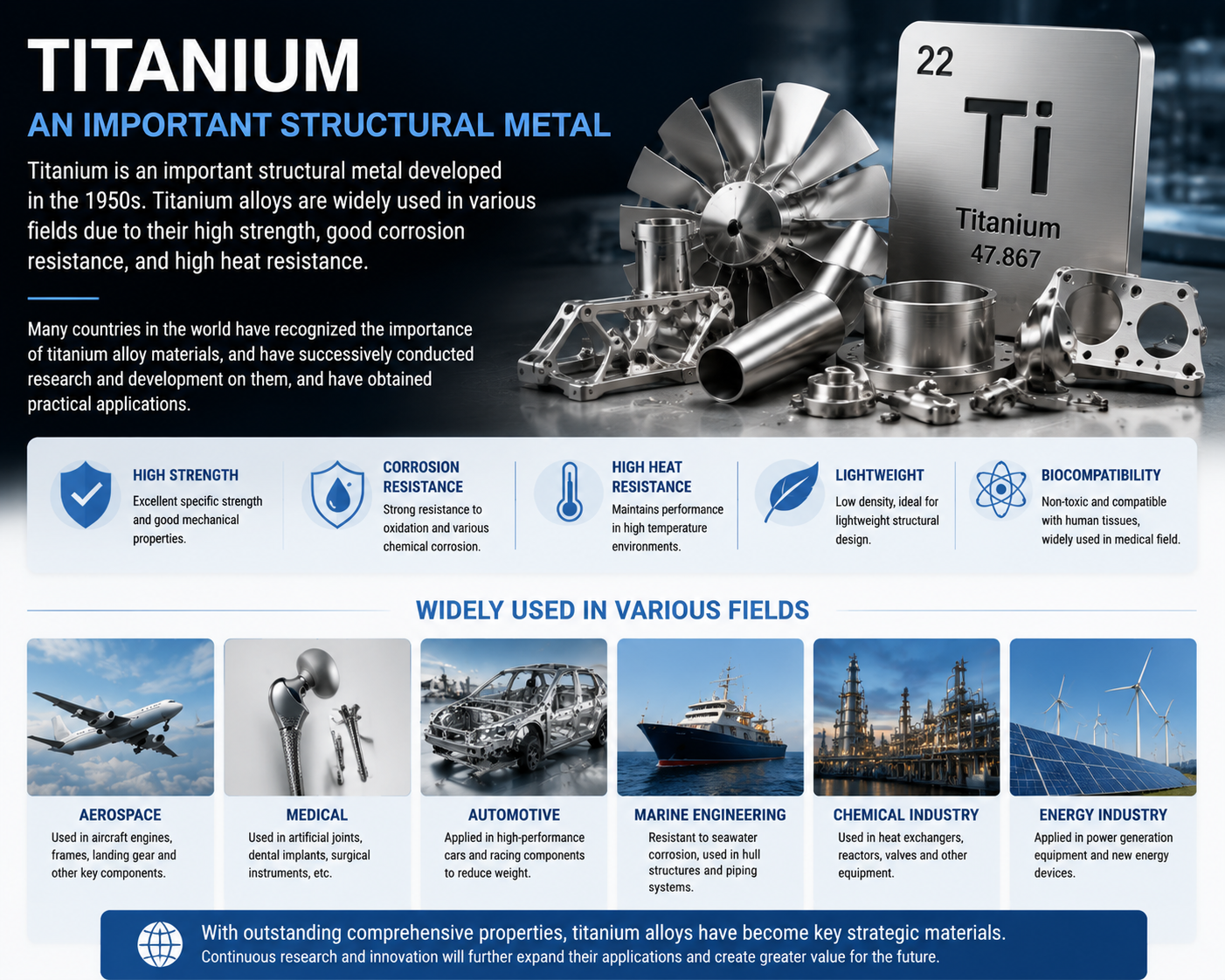
Titanium alloy is a very important metal material. It has become an indispensable material in modern industry due to its high strength, low density, corrosion resistance, high temperature resistance, and biocompatibility.
The following are its core application areas and specific uses:
Aerospace:
Due to the high strength, light weight, and corrosion resistance of titanium alloy, it is widely used in the manufacture of aircraft and rocket parts.
In aircraft structural parts, such as fuselage frames, wing beams, fasteners, etc., titanium alloy can reduce weight by 20%-30% and improve fuel efficiency (such as Boeing 747 uses 3640 kg of titanium).
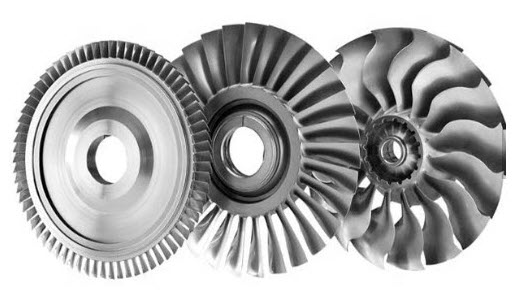
Engine parts: compressor blades, disks, casings, etc., can work at high temperatures of 500℃, and the thrust-to-weight ratio is increased to 8-10 (such as the SR-71 reconnaissance aircraft, titanium accounts for 93%).
Spacecraft: rocket shells, fuel tanks, satellite structures, etc., using their low-temperature properties (such as the TA7 alloy still maintains plasticity at -253℃).
Automotive industry:
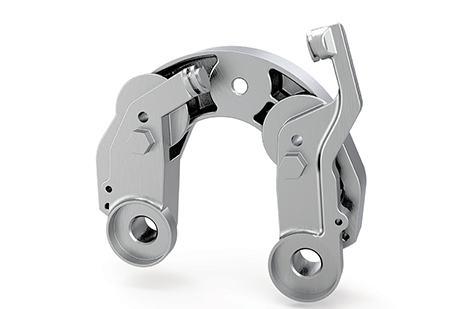
Titanium alloys are also widely used in the automotive manufacturing industry, mainly to improve the fuel efficiency and safety of automobiles. For example, titanium alloy materials may be used in automotive brake systems, suspension systems, and moving parts. In addition, with the development of new energy vehicles and the growing demand for lightweight technology, the application of titanium alloys in electric vehicle battery packs is also increasing.
Medical industry:
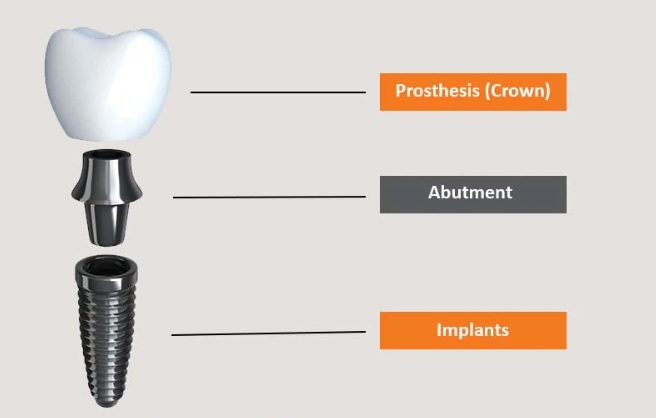
Due to their biocompatibility and corrosion resistance, certain types of titanium alloys are widely used in the production and manufacture of medical equipment and tools, such as dental implants and surgical instruments.
Sports equipment industry:
Many high-end sports equipment also use titanium alloys as raw materials to enhance the durability of equipment and reduce weight to improve athlete performance. For example, titanium alloys are often used in the production of bicycle frames, baseball bats, and rowing oars. In addition to the above aspects, due to its superior strength and good processing capabilities, it is also commonly used in the chemical industry, oil extraction, and military equipment. It can be said that titanium alloys have penetrated all areas of human society.
Chemical and marine engineering
Corrosion-resistant equipment: heat exchangers, reactors, desalination pipelines, etc., which have better resistance to pitting and acid corrosion than stainless steel.Ship parts: submarine hulls, propeller shafts, which resist seawater corrosion (the former Soviet Union once developed all-titanium submarines).
Emerging technology fields
Low-altitude economy: drone fuselages, flying car structures, weight reduction, and improved endurance (such as titanium alloy drone fuselages).
Energy and environmental protection: hydrogen energy storage tanks, nuclear power plant condensers, using their pressure resistance and corrosion resistance.
The application of titanium alloys is still expanding, especially in high-end manufacturing and emerging technologies. Its titles of “space metal” and “honorary metal king” reflect its irreplaceability. China has been developing it since the 1950s and has become an important player in the global titanium industry.
FAQs for Titanium Alloy Machining
1. What is titanium alloy machining?
Titanium alloy machining is a precision manufacturing process that uses CNC machining technologies, including CNC milling, turning, drilling, and 5-axis machining, to manufacture complex titanium components with high strength, lightweight properties, and excellent corrosion resistance.
2. Why is titanium alloy widely used in machining applications?
Titanium alloys are widely used because they provide:
- Excellent strength-to-weight ratio
- Superior corrosion resistance
- High-temperature performance
- Outstanding fatigue resistance
- Excellent biocompatibility
- Long service life
These properties make titanium ideal for aerospace, medical, automotive, and industrial applications.
3. Why is titanium alloy difficult to machine?
Titanium alloys are challenging to machine due to:
- Low thermal conductivity: Heat remains concentrated near the cutting edge.
- High chemical reactivity: Titanium can react with cutting tool materials at high temperatures.
- High strength: Requires higher cutting forces.
- Elastic deformation: Titanium may deflect during machining, affecting accuracy.
Proper tooling, cutting parameters, and cooling methods are required for successful machining.
4. What are the most common titanium alloys used for CNC machining?
Common titanium alloys include:
| Titanium Alloy | Features | Applications |
|---|---|---|
| Ti-6Al-4V (Grade 5) | High strength, lightweight, excellent corrosion resistance | Aerospace, medical implants, automotive |
| Grade 2 Titanium | Good corrosion resistance and ductility | Chemical equipment, marine parts |
| Grade 7 Titanium | Excellent corrosion resistance | Chemical processing equipment |
| Grade 23 (Ti-6Al-4V ELI) | High purity and biocompatibility | Medical implants and surgical tools |
5. What CNC machining processes are used for titanium alloys?
Common machining processes include:
- CNC milling
- CNC turning
- 5-axis CNC machining
- Drilling
- Threading
- Boring
- Grinding
- Electrical discharge machining (EDM)
5-axis machining is often used for complex aerospace and medical components.
6. What cutting tools are recommended for titanium machining?
Recommended cutting tools include:
- Carbide end mills
- Coated carbide inserts
- High-performance CNC tools
- Diamond-coated tools for special applications
Tool selection depends on the titanium grade, machining operation, and required surface finish.
7. What machining parameters are suitable for titanium alloys?
Titanium machining typically requires:
- Lower cutting speeds
- Controlled feed rates
- High-pressure coolant
- Stable tool engagement
- Proper chip evacuation
These methods help reduce heat buildup and extend tool life.
8. What surface finishes are available for titanium alloy parts?
Common surface treatments include:
- Anodizing
- Polishing
- Bead blasting
- Sand blasting
- Passivation
- PVD coating
- Laser surface treatment
Surface finishing improves appearance, wear resistance, and corrosion performance.
9. What tolerances can titanium CNC machining achieve?
High-precision CNC machining of titanium alloys can typically achieve tolerances of:
±0.01 mm to ±0.05 mm
Actual accuracy depends on:
- Part complexity
- Machine capability
- Tool selection
- Material condition
- Inspection methods
10. What industries use titanium alloy machined parts?
Titanium CNC machined components are widely used in:
Aerospace
- Aircraft brackets
- Engine components
- Structural parts
- Landing gear components
Medical
- Bone implants
- Surgical instruments
- Dental components
Automotive
- Racing components
- Lightweight performance parts
- Exhaust systems
Marine
- Corrosion-resistant components
- Marine fasteners
Energy
- Heat exchangers
- Chemical processing equipment
11. What are the advantages of CNC machining titanium alloys?
Key advantages include:
- Lightweight yet extremely strong components
- Excellent corrosion resistance
- High dimensional accuracy
- Ability to manufacture complex geometries
- Long service life
- Reliable performance in harsh environments
12. What are the disadvantages of titanium alloy machining?
The main challenges include:
- Higher machining costs
- Faster tool wear
- Lower cutting speeds
- More demanding process control
- Higher material costs compared with aluminum and steel
13. How can titanium machining costs be reduced?
Costs can be optimized by:
- Designing parts for manufacturability (DFM)
- Reducing unnecessary tight tolerances
- Selecting appropriate titanium grades
- Using optimized cutting tools
- Applying efficient CNC strategies
- Reducing machining time through multi-axis machining
14. Can titanium alloys be used for prototypes?
Yes. Titanium alloys are suitable for functional prototypes when the final application requires:
- High strength
- Lightweight performance
- Corrosion resistance
- Heat resistance
- Medical compatibility
Titanium prototypes are commonly used in aerospace, automotive, and medical product development.
15. What inspection methods are used for titanium machined parts?
Quality inspection commonly includes:
- Coordinate Measuring Machine (CMM)
- Optical measurement
- Surface roughness testing
- Dimensional inspection
- Material certification verification
- Non-destructive testing (NDT)
16. How does titanium machining compare with aluminum machining?
| Feature | Titanium Alloy | Aluminum Alloy |
|---|---|---|
| Strength | Very high | Moderate to high |
| Weight | Lightweight | Very lightweight |
| Machinability | More difficult | Easier |
| Corrosion resistance | Excellent | Good |
| Heat resistance | Excellent | Moderate |
| Cost | Higher | Lower |
17. Why choose titanium alloy machining?
Titanium alloy machining is the preferred solution for demanding applications requiring high strength, lightweight construction, corrosion resistance, and long-term reliability. Advanced CNC machining technologies enable manufacturers to produce precision titanium components for critical aerospace, medical, and industrial applications.