Introduction
If the wrong process is chosen, the part will be scrapped. This is not necessarily due to a design flaw, but rather because the process cannot meet the design requirements.
Vacuum investment casting occupies a unique position. It uses a wax pattern, which is embedded in ceramic, the wax is melted out, and then metal is poured under vacuum conditions. The resulting part features high integrity, excellent surface finish, and tight tolerances.
This article will explore two issues. First, it will compare vacuum lost-wax casting with other casting methods; second, it will contrast casting with other non-casting processes. The aim is to provide a clear framework for process selection.
What Is Vacuum Investment Casting?
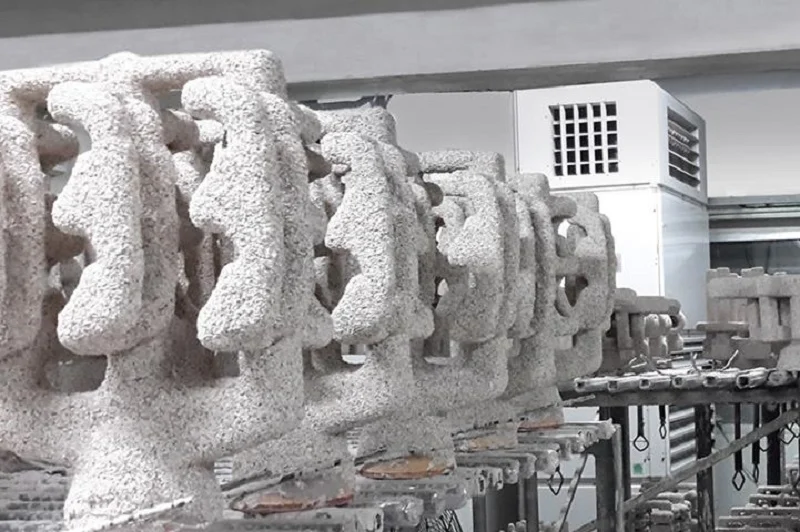
A ceramic layer is applied to the wax pattern. Once the ceramic hardens, the wax is melted out, leaving a mold cavity. Molten metal is poured into the cavity, and after the casting solidifies, the ceramic layer is removed.
This is known as lost-wax casting. If a vacuum chamber is incorporated into the process, it is called vacuum lost-wax casting. The metal is melted and poured in a vacuum or inert atmosphere—free of oxygen, nitrogen, and moisture—ensuring that the casting remains clean.
This process combines two technologies. Lost-wax casting ensures dimensional accuracy and surface finish, while the vacuum environment guarantees the metallurgical purity of the metal. For reactive materials, the process is incomplete without either of these elements.
How Vacuum Investment Casting Works
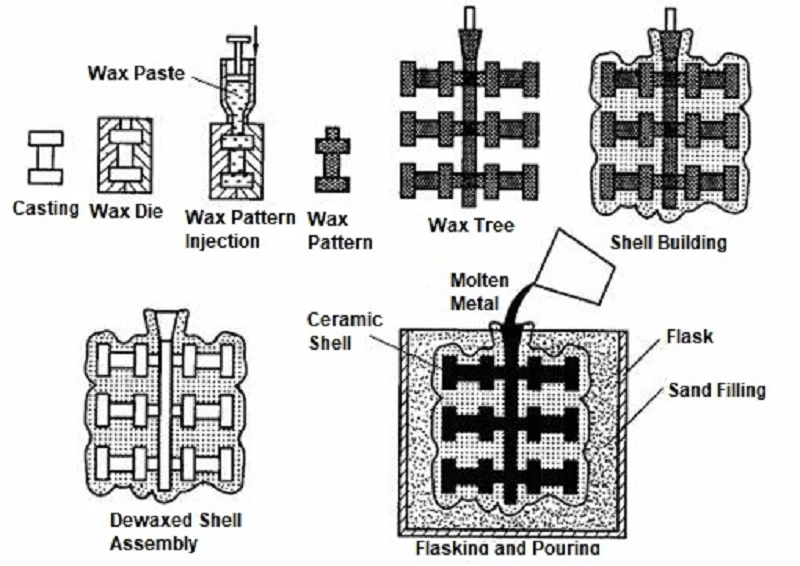
The process has eight steps. Each one must be done correctly. A mistake in an early step ruins the final part.
Step 1 – Wax Pattern Production
Inject the wax into a precision mold. Once machined, the mold meets the dimensional requirements of the final part. The wax pattern perfectly replicates every feature, and this is where dimensional accuracy begins. If the wax pattern is inaccurate, the metal part will also be inaccurate.
Step 2 – Wax Tree Assembly
Multiple mold inserts are connected to a central runner system. The runners deliver the metal into each cavity. The design of the pouring system controls the flow and solidification of the metal. The wax tree is a cluster-like structure composed of multiple parts, all of which can be filled in a single pour.
Step 3 – Ceramic Shell Building
Dip the wax pattern into the ceramic slurry, then apply a layer of sand-lime plaster. Wait for the coating to dry. Repeat this process continuously, building up layer by layer. The ceramic shell must be able to withstand high temperatures and thermal shock. The choice of shell material depends on the alloy to be cast.
Step 4 – Dewaxing
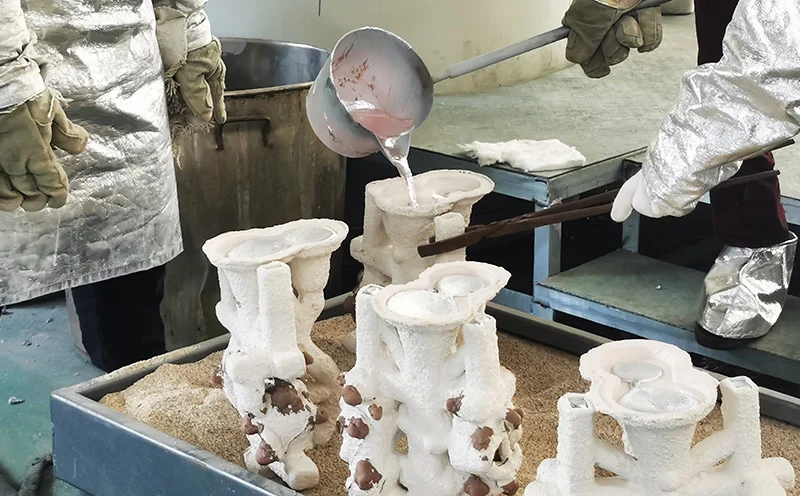
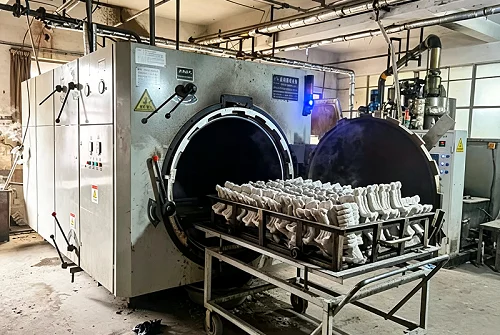
The coated tree is placed in a steam autoclave. High-pressure steam melts the wax, causing it to flow out. The ceramic shell remains, and the internal cavity is left completely empty. This is the step in the “lost-wax process.” The wax has disappeared, and the shell is now ready.
Step 5 – Shell Firing
The green body is loaded into the kiln. The high temperature burns off any remaining wax and moisture. The ceramic is sintered, increasing its strength. The green body becomes strong enough to hold molten metal.
Step 6 – Vacuum Melting
The alloy is melted in a vacuum induction furnace. There is no air. The vacuum draws gases out of the melt. The alloy’s composition is precisely controlled. Impurities rise to the surface, leaving behind pure metal. This step is crucial for reactive alloys and high-temperature alloys.
Step 7 – Vacuum Pouring
Molten metal is poured into a ceramic shell. The pouring process takes place inside a vacuum chamber. The environment is kept inert, preventing oxidation and the ingress of gases. The metal solidifies after filling the cavity, and the shell remains intact throughout the entire process.
Step 8 – Knockout and Finishing
The ceramic shell is broken away. The tree is cut. Individual parts are separated. Heat treatment may be applied to adjust mechanical properties. Surface finishing removes rough edges. Machining brings critical dimensions to tolerance. Inspection verifies every part.
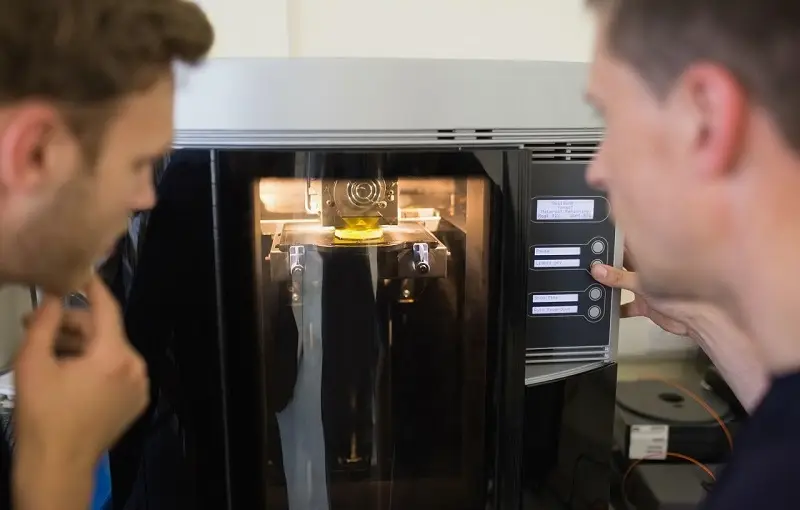
Vacuum investment casting is a series of controlled operational processes. Each step builds upon the previous one. Neglecting quality control at any stage can result in defects that cannot be corrected in subsequent stages. The vacuum process stages—namely, melting and pouring—are precisely what distinguish this process from standard investment casting. It is these steps that enable the use of reactive alloys.
Vacuum Investment Casting vs. Other Casting Methods
The choice of process depends on several factors—precision, surface finish, material compatibility, part complexity, production volume, and cost constraints. No single process excels in every respect.
Vacuum Investment Casting vs. Conventional Investment Casting
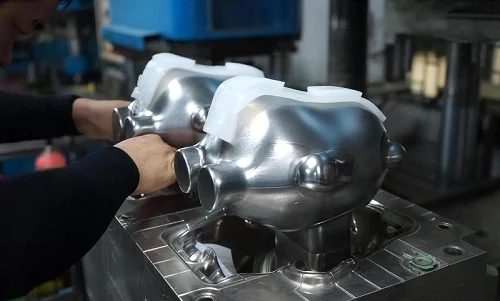
The difference lies in the environment. Vacuum investment casting involves pouring in a vacuum environment, whereas traditional casting is performed in air.
Oxidation is the key distinction between the two. Traditional casting leads to oxidation of reactive alloys, resulting in a higher defect rate and compromised mechanical properties. Vacuum investment casting, on the other hand, produces metals with higher purity and superior performance.
Suitable alloys: Vacuum investment casting can be used for titanium, nickel-based superalloys, and zirconium; traditional casting is limited to aluminum, steel, and copper alloys.
Typical applications: vacuum is for turbine blades and implants. Conventional is for industrial parts and jewelry.
Vacuum Investment Casting vs. Sand Casting
Sand casting uses bonded sand molds. It is fast and low-cost, with low mold costs.
The trade-off lies in precision and surface finish. Under ideal conditions, sand casting can achieve a tolerance of ±0.5 millimeters. The surface finish is relatively rough. Vacuum investment casting can achieve a tolerance of ±0.1 millimeters or better. The surface finish is smooth.
Part Size: Sand casting is suitable for large parts—such as engine blocks and valve bodies. Vacuum investment casting, on the other hand, is limited to smaller components.
Production Flexibility: Sand casting is highly adaptable and allows for quick adjustments. Vacuum investment casting requires the creation of a wax pattern, resulting in a longer lead time, but offers higher precision.
Vacuum Investment Casting vs. Die Casting
Die casting is high-speed. Metal is injected under pressure. Cycle times are measured in seconds.
Alloy limitations are the problem. Die casting works with aluminum, zinc, and magnesium. It cannot handle titanium or nickel superalloys. The tooling investment is high. Mechanical properties are lower due to porosity.
Vacuum investment casting is slower. But it handles the difficult alloys. It produces denser parts with better fatigue resistance. The choice depends on volume and material.
Vacuum Investment Casting vs. Permanent Mold Casting
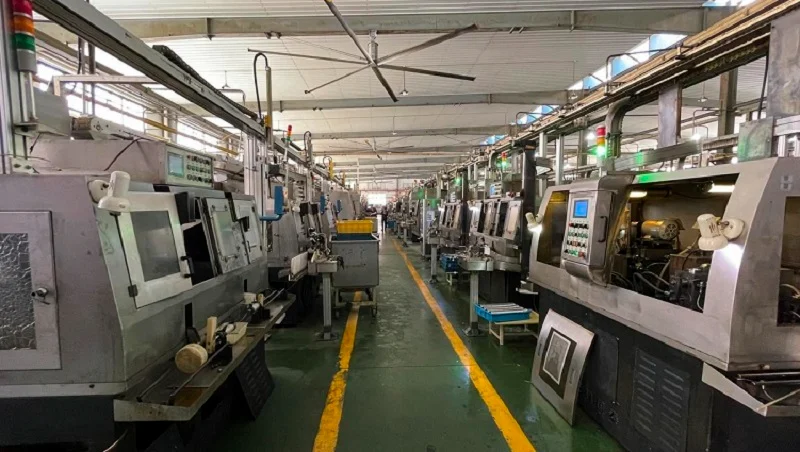
Permanent mold casting uses reusable metal molds. It offers excellent repeatability, long mold life, and high production efficiency.
Alloy selection is limited. Reactive metals can corrode the mold surface, causing the mold to degrade. Vacuum investment casting uses disposable ceramic shells. It can handle reactive alloys without any issues.
Typical applications: Permanent mold casting is suitable for wheel rims and cylinder heads; vacuum investment casting is suitable for jet engine components and medical implants.
Vacuum Investment Casting vs. Centrifugal Casting
In centrifugal casting, the mold is rotated to use centrifugal force to force the metal into the mold cavity. The resulting parts have high density and excellent internal compactness.
The applicable geometries are limited to axisymmetric parts—such as tubes, rings, and cylinders. Vacuum lost-wax casting, on the other hand, is suitable for complex, asymmetric shapes.
The primary application area for centrifugal casting is long, hollow components. The primary application area for vacuum lost-wax casting is precision active alloy components. They serve different markets.
Vacuum Investment Casting vs. Lost Foam Casting
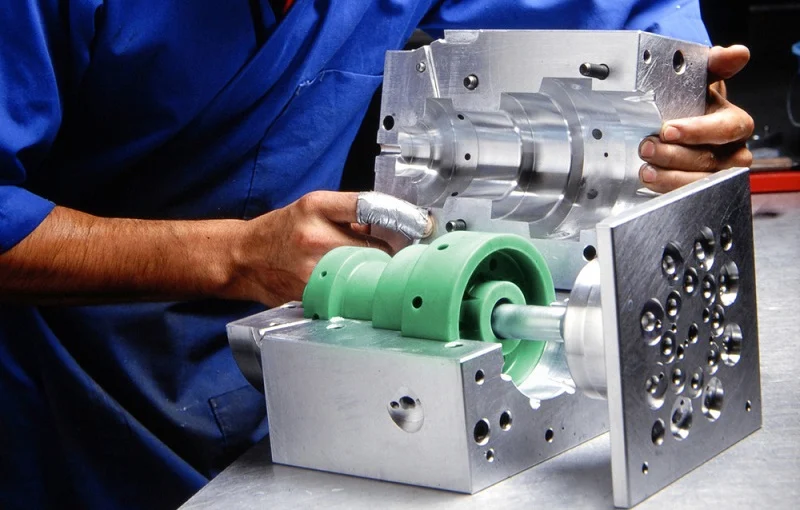
Lost foam casting uses polystyrene models. These models are coated and embedded in sand. The molten metal causes the foam to vaporize, filling the mold cavity.
Mold preparation for lost foam casting is simpler. There is no need to make a wax pattern or construct a ceramic shell.
Complexity: Lost foam casting is suitable for parts of moderate complexity. Vacuum investment casting is suitable for parts with higher complexity and finer details.
Surface finish: Vacuum investment casting produces smoother surfaces. Cost: For large parts, lost foam casting is less expensive. Production efficiency: For parts with simple shapes, lost foam casting is faster. Although vacuum investment casting is slower, it produces higher-quality parts. When making a choice, a trade-off between cost and quality must be considered.
Vacuum Investment Casting vs. Other Manufacturing Processes
Engineers will evaluate forging, machining, additive manufacturing, and metal injection molding alongside casting. Each process has its own advantages and limitations.
Vacuum Investment Casting vs. Forging
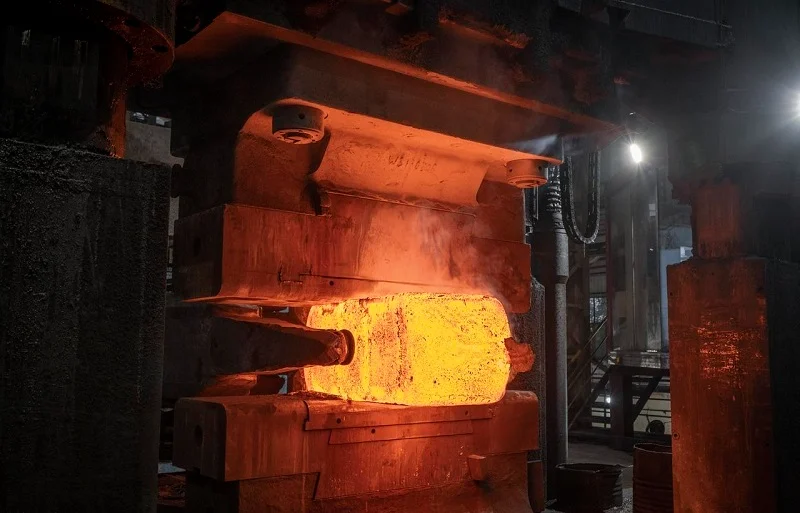
Forging is a process of plastic deformation of metal. The grain structure aligns with the part’s geometry. It offers high mechanical strength and excellent fatigue resistance.
Geometric limitations are the primary challenge. Forging cannot produce complex internal cavities or deep chamfers. Material utilization is low—a significant amount of metal is removed during machining.
Vacuum investment casting can produce near-net-shape parts with complex geometries. It offers high material utilization. For complex parts, it is more cost-effective. For simple, high-strength shapes, forging is the better choice; for complex, high-integrity shapes, vacuum lost-wax casting is the better choice.
Vacuum Investment Casting vs. CNC Machining
Machining begins with a blank. Material is removed through cutting. Precision depends on the capabilities of the CNC machine; tolerances as tight as ±0.005 millimeters are common.
Material waste is a drawback of this process. Chips are considered scrap, machining complex geometries is costly, and internal features are difficult or even impossible to machine.
Vacuum investment casting is a near-net-shape process. Material waste is minimal. Complex geometries are formed during the casting process rather than achieved through machining. For small-batch production, machining is faster. For high-volume production of complex-shaped parts, the cost of casting followed by finishing is lower.
Vacuum Investment Casting vs. 3D Printing
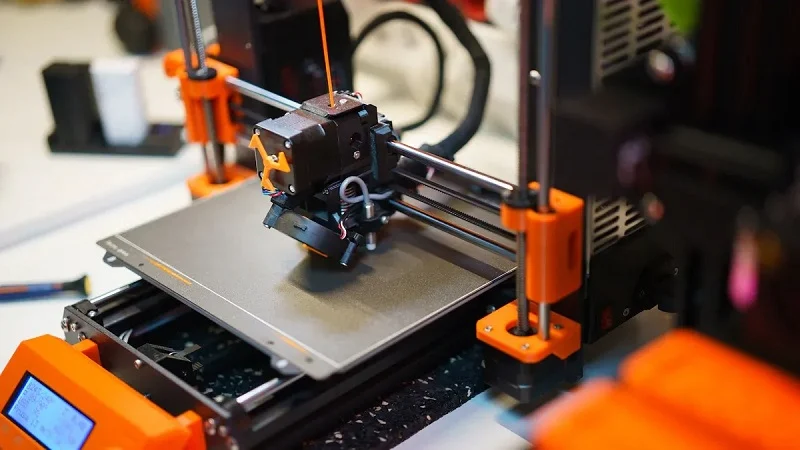
3D printing manufactures parts by stacking layers one by one, offering a high degree of design freedom and the ability to create internal channels and lattice structures.
Production speed is relatively slow—manufacturing a single part can take several hours or even days. Surface finish is relatively rough. Mechanical properties are anisotropic—strength varies depending on the direction. Post-processing is required. The cost per part is relatively high.
When production volumes exceed a few pieces, vacuum investment casting is faster, offers a better surface finish, and provides isotropic mechanical properties. Unit costs are lower for mass production. For single-piece production, 3D printing has the advantage; for mass production, vacuum investment casting has the advantage.
Vacuum Investment Casting vs. Metal Injection Molding
Metal injection molding uses a feedstock of metal powder and binder. It is injection-molded plastic. The binder is removed. The part is sintered.
Component size is small—under 100 grams. Precision is high. Production volume must be high to justify tooling. Material choices are limited to certain powder grades.
Vacuum investment casting handles larger parts. It uses wrought alloys, not powders. Material properties are equivalent to those of wrought material. Cost is lower for larger parts. MIM is excellent for small, high-volume components. Vacuum investment casting is better for larger, lower-volume components.
How to Choose the Right Manufacturing Process
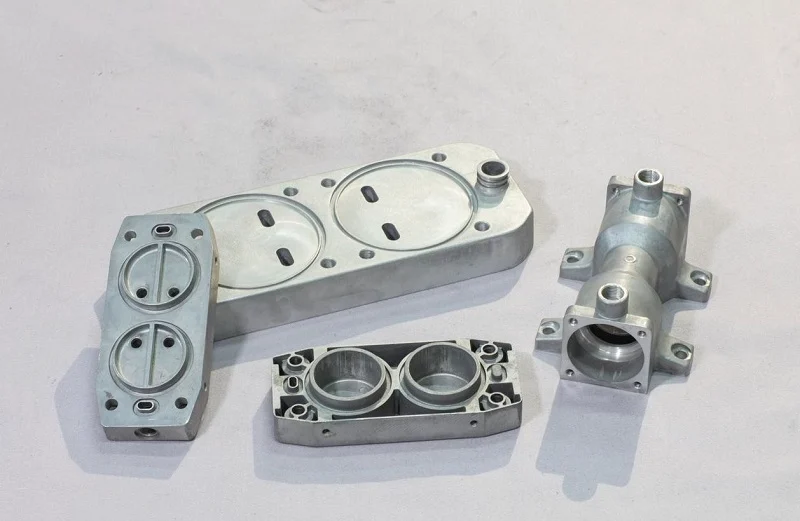
Selection is not guesswork. Six criteria drive the decision. Geometry. Material. Performance requirements. Volume. Budget. Lead time. Post-processing needs. Prioritize them correctly, and the process choice becomes clear.
Decision Guide
| Requirement | Recommended Process |
| Highest precision casting | Vacuum Investment Casting |
| Lowest cost for large parts | Sand Casting |
| Highest-volume aluminum production | Die Casting |
| Maximum strength | Forging |
| Rapid prototype | CNC Machining |
| Highly complex internal structures | Additive Manufacturing |
Partner with NOBLE for End-to-End Manufacturing Solutions
This article provides a detailed overview of the vacuum investment casting process. However, most projects extend beyond the casting stage and require a combination of various processes: machining, sheet metal fabrication, assembly, and surface treatment. Rarely can a single process cover all these stages.
NOBLE provides support throughout the entire product lifecycle. Precision CNC machining meets strict tolerance requirements; sheet metal fabrication is used to manufacture enclosures and brackets; prototyping and small-batch production are used to validate designs; and mass production can be flexibly adjusted based on production volume. Mechanical assembly brings the components together. Secondary surface treatment and inspection bring the entire project to a successful conclusion.
From Design Support to Finished Products
Our service begins even before manufacturing starts. Design for Manufacturability (DFM) reviews help identify issues early on. Engineering consulting optimizes the design. Rapid prototyping validates design concepts. Guidance on material selection ensures the alloy is suited to the application.
Next comes the precision manufacturing phase. Surface treatments protect while enhancing aesthetics. Quality inspections verify every critical dimension. Assembly and packaging prepare the product for shipment. Supply chain coordination handles logistics.
From concept design to final delivery, a single partner manages the entire process. That is our model.
FAQ
What are the advantages of vacuum investment casting?
Superior purity, excellent surface finish, and the ability to cast reactive alloys like titanium and nickel superalloys. Porosity is minimized, and mechanical properties are maximized.
How is vacuum investment casting different from conventional investment casting?
The environment is the difference. Conventional casting pours in air, leading to oxidation and gas pickup. Vacuum investment casting pours in a vacuum, eliminating these defects and enabling the use of high-performance alloys.
Which casting method offers the best dimensional accuracy?
Vacuum investment casting and standard investment casting both hold tight tolerances—typically ±0.1 mm or better. Among casting methods, investment casting is the most accurate.
Is vacuum investment casting better than die casting?
It depends on the application. Die casting is faster and cheaper for high-volume aluminum parts. Vacuum investment casting is better for reactive alloys, complex geometries, and applications where porosity is unacceptable.
When should manufacturers choose forging instead of casting?
When maximum strength and fatigue resistance are required, and the geometry is simple enough to forge. Forging aligns grain structure with the load path. Casting is better for complex shapes.
Can vacuum investment casting replace CNC machining?
No. Casting produces near-net shapes. Machining provides final tolerances and critical surfaces. The two processes are complementary, not competitive. Most cast parts require some machining after casting.