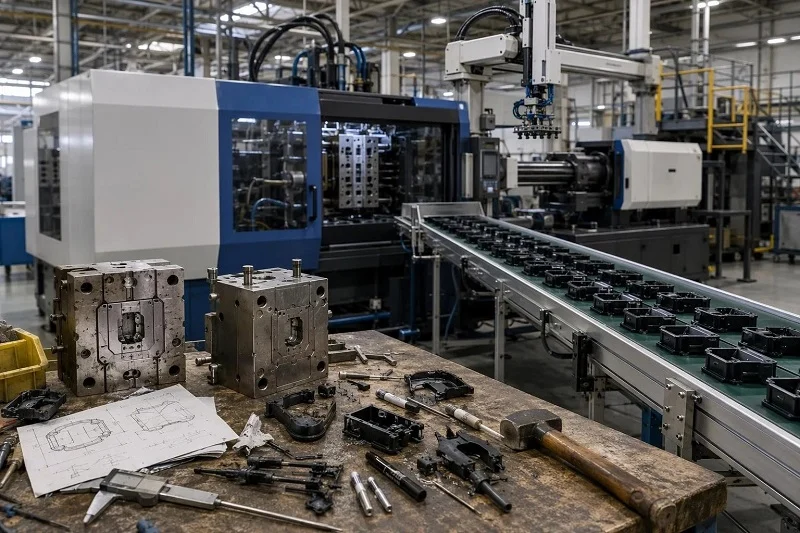
A prototype proves that a part can be molded. High-volume injection molding proves that the same part can be molded again, and again, and again — within specification, on every cycle, for the life of the program. Those are different claims, and the practices that satisfy the first frequently undermine the second.
The gap is rarely dramatic at the start. A validated prototype typically emerges from a short run on a simple tool, tuned by an experienced technician until acceptable parts appear. Nothing about that sequence is wrong; it is simply optimized for speed and learning rather than repeatability. Once annual demand reaches hundreds of thousands of parts, every informal choice made during prototyping becomes a production variable: the tool that was built to iterate, the process that lived in one operator’s memory, the inspection that relied on eyes, the geometry that was never pressure-tested for cycle time.
The cost of carrying those assumptions into volume is not paid in the prototype budget. It is paid in scrap, unplanned downtime, revalidation effort and delayed launches — usually after tooling steel has been cut and commitments have been made.
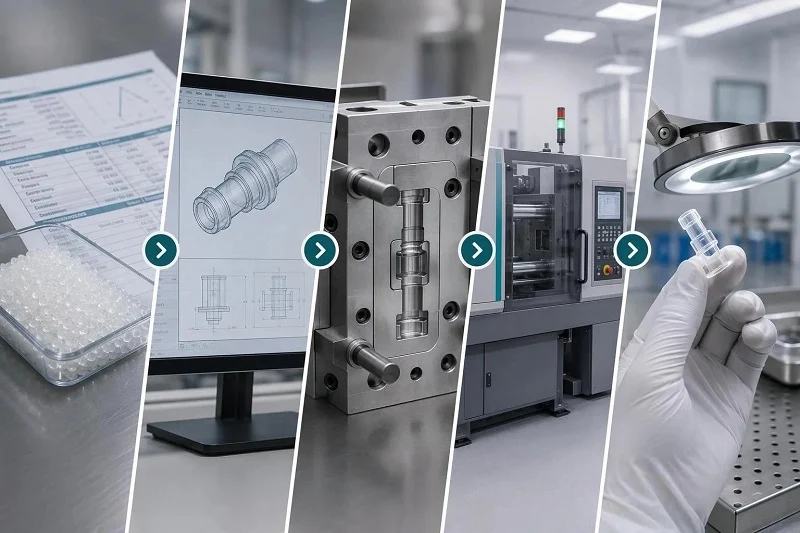
This guide follows the transition through five areas where prototype rules stop working: the mold itself, the process window, the inspection strategy, the part design, and the manufacturing partner who carries all four. Each section explains what changes, why the change is forced, and what to decide before committing to production tooling.
What Changes When a Validated Part Becomes a High-Volume Injection Molding Program
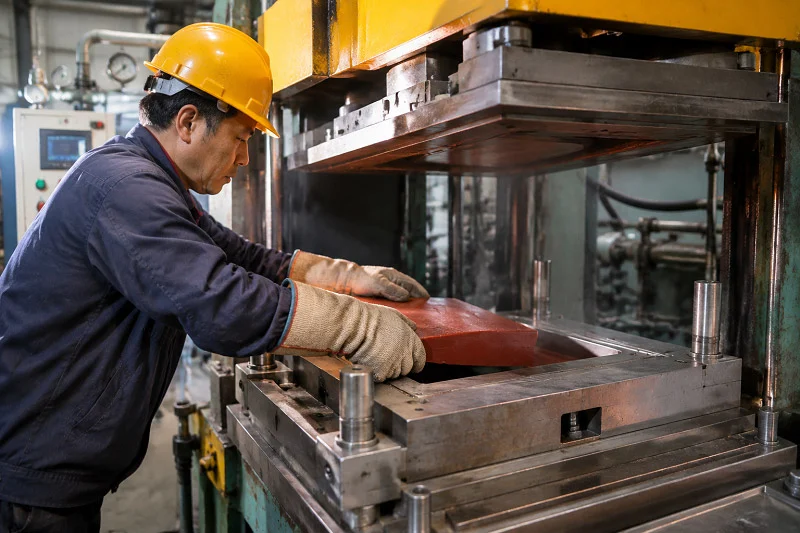
The short answer: prototype work proves a part can be made once, while high-volume injection molding proves a process can make that part within specification on every cycle for the life of the program. The transition is best treated as a shift from proving the part to proving the process, and it changes the criteria for tooling, process control, inspection and cost.
Prototype parts serve a different purpose. They support form, fit and function testing, bench validation, internal reviews and early user feedback, and speed carries high value because teams need physical parts to make design decisions before committing to a full production path. Volume production adds a different set of pressures: repeatability, stable cycle time, controlled cost, inspection efficiency, validated process parameters and supply continuity. A geometry that performs well during prototyping may still require changes before it runs efficiently at production scale.
The contrast shows up along four dimensions that the rest of this guide develops:
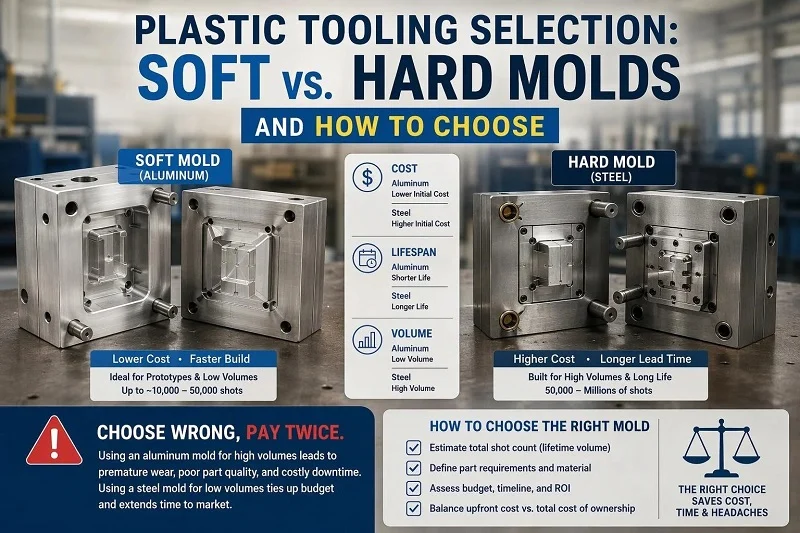
- Tooling durability. A prototype tool is built to release parts quickly and tolerate change. A production tool must survive a much longer run with predictable maintenance, so steel selection, cooling design, wear surfaces, ejection and spare-part planning all move from optional to specified.
- Process capability. A prototype process can depend on close operator attention and frequent adjustment. A production process cannot; it needs stable settings, repeatable material behavior, balanced filling, controlled cooling and reliable part removal, documented well enough to survive shift changes and press transfers.
- Inspection economics. Checking every prototype part is affordable because there are few of them. At volume, labor scales with output while human inspection still misses defects, so the strategy shifts toward layered, statistically grounded controls.
- Cost structure. Prototype spending is front-loaded and small. Production cost accumulates per part, which makes cycle time, scrap rate and mold maintenance the dominant financial variables rather than the purchase price of the tool.
“It passed the prototype” therefore answers a narrower question than it appears to. It confirms the design is moldable; it does not confirm the mold is durable, the process is reproducible, the inspection plan is affordable, or the part geometry is economical at scale. Programs that plan for the shift early — reviewing tooling, materials, tolerances, surface finish, inserts, automation, secondary processes and test requirements before production tooling begins — tend to move through qualification with fewer surprises. Programs that treat low-volume output as a direct preview of high-volume output often discover the difference during ramp-up, when correction is most expensive.
Prototype Tooling Practices That Fail First at Volume
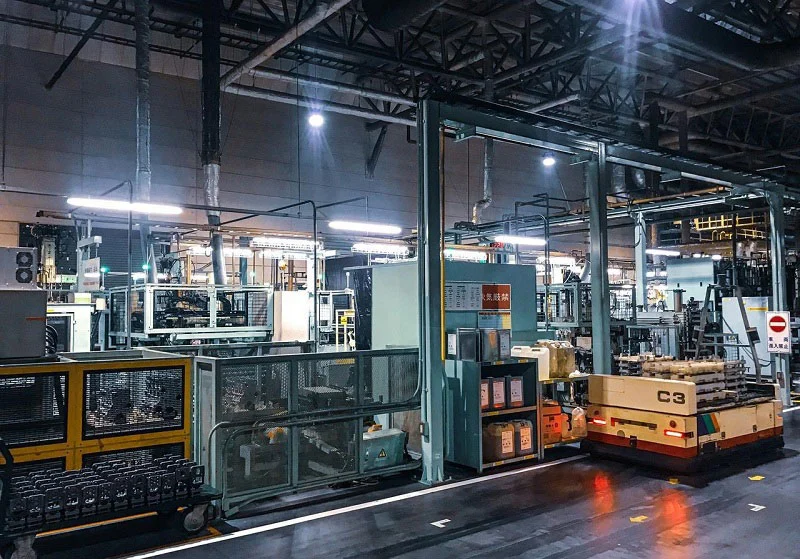
Tooling is usually where prototype assumptions surface first, because the mold is the longest-lead, hardest-to-reverse commitment in the program. Prototype tooling prioritizes lead time and engineering flexibility; it may use softer steel, aluminum, modular inserts, simplified cooling or lower cavitation, on the reasonable logic that geometry may still change. Production tooling must instead deliver durability, maintainability and performance over a far longer run.
Buyers and mold makers commonly use the SPI mold classification system as shared language for expected mold life and build robustness. The classes run from Class 101, rated at one million cycles or more and described as a medium-to-high production tool suited to abrasive materials and parts requiring close tolerances, down through lighter classes intended for lower volumes. A class on a quote is a starting point for a conversation rather than a complete specification, and cycle counts describe expected life under normal conditions — actual life depends on resin, part geometry and maintenance. Class selection should map to annual volume and program duration, and the steel grade, hardness and finish should be confirmed in writing.
Single-Cavity Tooling and the Cavity-Count Decision
A single-cavity prototype tool is a learning instrument, not a production asset: it produces enough parts to answer design questions without committing to a full production asset too early. At volume, cavity count becomes an economic and technical decision. Higher cavitation spreads fixed tooling cost across more parts per cycle, but raises tool cost and machine tonnage requirements and makes balanced filling harder to achieve.
Balance matters because in multicavity tools all cavities should fill at the same time to preserve the widest possible process window; cavity-to-cavity and shot-to-shot variation makes it difficult to consistently mold parts with uniform dimensions, and that variation can increase qualification time, scrap, inspection burden and warranty spend. Cavity count should therefore follow annual volume, part tolerance, material and program life rather than defaulting to whatever the prototype tool happened to use.
Tool Steel, Cooling and Wear Surfaces
Once cycle counts climb, construction details that were easy to defer become the difference between a stable program and a chronic one. Steel grade and hardness, cooling-channel design, wear surfaces, shutoffs, vents, ejection, sliders, lifters and spare-part planning all determine how the tool behaves after hundreds of thousands of shots.
The failure modes are well understood. Poor cooling can increase cycle time and dimensional variation. Weak venting can create burns or short shots. Unstable ejection can damage parts or increase the number of cosmetic defects. These details may seem small during prototype builds, yet they can affect thousands or millions of parts at volume. As a maintenance and traceability practice, SPI guidance recommends that, wherever feasible, all tool components be marked with steel type and approximate Rockwell hardness — so a replacement insert can be matched to the original rather than guessed at.
Why Mold Maintenance Planning Belongs in the Quote
Maintenance is a production cost that prototype budgets never carry, and leaving it out of the quote hides a real liability. Preventive maintenance intervals, wear-part spares and repair downtime exposure should be priced and scheduled before the tool is built, because downtime cost scales with program value: an hour of mold repair on a high-volume program costs far more in lost output than the same hour on a prototype run.
This is where the SPI class decision pays for itself. A higher class is justified when annual volume is high, the program will run for years, and downtime for mold repair would be expensive — the conditions under which hardened steel, strong cooling design, wear plates and guided ejection earn back their upfront cost. Underbuilding is the classic error: choosing a light class for a product that later grows to several hundred thousand units invites mold wear, rising scrap and a second tooling bill at the worst possible time.
Process Windows: From Informal Tuning to Validated, Locked Parameters
The short answer: prototype runs tolerate a technician dialing in settings until good parts appear, while volume production requires a documented, validated window that survives shift changes, press changes and material lot variation. A process that depends on constant correction to stay in control is not a production process, however good its output looks during a trial.
The practical mechanism is to express the process in plastic variables rather than press-specific dial readings. Melt temperature, flow rate, fill time, transfer position, pack pressure and time, and cooling describe what the plastic actually experiences, so the same process can be duplicated and revalidated on a different machine. Setup sheets built this way — sometimes called universal or machine-independent setup sheets — convert the original press settings into machine-independent values and then into settings for the receiving press, which is what makes a mold transfer a controlled event rather than a fresh experiment.
Establishing and Documenting the Process Window
A validated window contains four things: the target settings, the proven upper and lower boundaries for each critical variable, the evidence used to set those boundaries, and the part characteristics each boundary protects. The window must be wide enough to absorb normal variation — material lot differences, ambient conditions, routine wear — not merely wide enough to pass one trial run.
This is the difference between a process that produced acceptable samples and one demonstrated to be robust enough for sustained production. Establishing the window takes deliberate study: varying one parameter at a time, recording the effect on critical dimensions and defects, and confirming the operating limits before the process moves into routine production. The payoff is a setup sheet that lets a mold move between presses without repeating the full validation effort.
Change Control and Revalidation Triggers
Revalidation is required whenever something that shaped the validated window changes. The usual triggers are mold repair or modification, transfer to a different press, a material or supplier change, altered drying or handling conditions, and any process-parameter adjustment outside the proven window. Each of these can shift the plastic variables the window was built around.
Undocumented drift is the most common route by which a validated process silently degrades — settings nudged back toward “what works” over successive shifts, until the process no longer resembles the one that was qualified. The countermeasures are unglamorous and effective: a change log that records what changed and who approved it, defined approval authority for adjustments, and a standing rule that the setup sheet, not floor memory, is the reference. Moving a mold between presses is a routine operational need, but it usually requires revalidation, and the costs — press time, material, engineering time, metrology, documentation and the risk of repeating the cycle after a failure — are large enough that avoiding unnecessary transfers is itself a cost decision.
Inspection at Scale: Why 100% Manual Checking Cannot Survive High-Volume Injection Molding
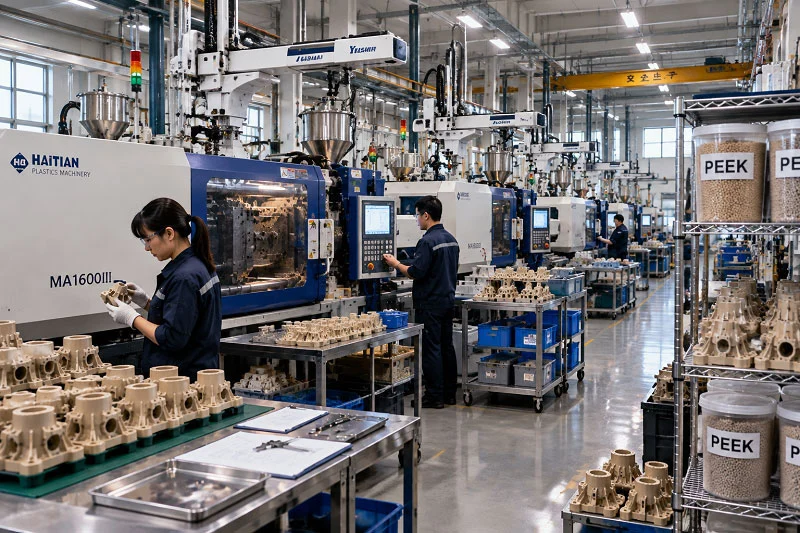
The short answer: manual inspection of every part consumes labor proportional to volume and still misses defects, so high-volume programs shift to a layered strategy rather than inspecting harder. That strategy typically combines first-article inspection, in-process checks, cavity-specific monitoring, automated vision, go/no-go gauges, coordinate measuring machine (CMM) measurement, destructive and functional testing, and statistical process control for critical features.
The inspection plan should reflect risk, process capability and customer requirements, and it should be designed to identify drift before defects reach customers. Two of its layers are routinely confused with each other — acceptance sampling, which judges lots, and statistical process control, which judges the process making them — so they are treated separately below.
Acceptance Sampling and the AQL Framework
Acceptance sampling by attributes is codified in ISO 2859-1, whose current edition was published in January 2026. It provides a system of single, double and multiple sampling plans indexed by Acceptance Quality Limit (AQL) for lot-by-lot inspection, with switching rules between normal, tightened, reduced and skip-lot inspection. Its stated purposes are to encourage producers to maintain a process average at or better than the defined AQL, to limit the risk of accepting poor-quality lots, and to reduce reliance on costly 100% inspection.
The 2026 edition introduces a formalized skip-lot sampling procedure with qualification requirements for eligibility, and replaces printed operating characteristic and average sample number tables with methods for generating those curves. Keep the scope in view: this framework decides whether to accept or reject a lot from a statistical sample. It is not a substitute for controlling the process that makes the lots, and it works as intended only when the upstream process is stable.
SPC, Control Limits and Capability Indices
Control limits and specification limits answer different questions, and treating one as the other is among the most common errors in production quality. Control limits are derived from the process’s own natural variation, typically set at ±3σ; specification limits are the customer’s requirement on the part. Reacting to a stable process as though ordinary variation were a specification violation is tampering, and it usually makes output worse.
Capability indices describe how comfortably the process fits inside the specification. Cp and Cpk express short-term capability, while Pp and Ppk express longer-term performance and capture shift-to-shift and day-to-day variation — which is why reporting Cpk without its longer-term partner tells an incomplete story. Capability is only meaningful when calculated on properly formed rational subgroups, where samples within a subgroup reflect common-cause variation only; mixing operators, shifts or materials into one subgroup destroys the variance structure. Signals also extend beyond single points outside the limits: trends and runs indicate that something has changed. Connect those signals to assignable causes — cavity wear, material variation, drying problems or parameter drift — rather than adjusting the chart.
Tying Defects Back to Cavity and Cause
Cavity-specific monitoring turns a reject count into a diagnostic. If nonconforming parts trace to one cavity, the likely causes narrow to that cavity’s gate, cooling circuit, vent or wear condition, and the fix can be made without disturbing a process that is otherwise stable. Inspection data should therefore connect each nonconforming part to a specific cause — cavity wear, material variation, drying issues or parameter drift — rather than only tallying rejects. This is also why inspection planning belongs before production release: a plan written after problems appear tends to document sorting rather than prevent it.
Design Decisions That Only Become Expensive at Volume
Design for manufacturing issues that a prototype tolerates convert directly into cost at volume: thick sections, unbalanced flow, tight cosmetic requirements in hard-to-fill areas, and tolerance stack-ups that demand more process capability than the mold can deliver. Cooling time dominates the cycle — commonly cited as 80% to 90% of total cycle time, driven by mold temperature, melt temperature, maximum wall thickness, part shape and material — so wall-thickness decisions made early set a floor on cycle time for the life of the program.
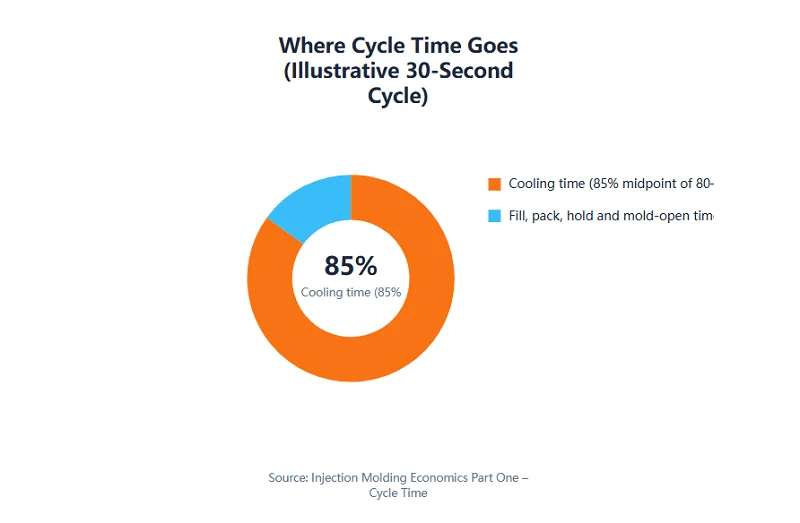
Cooling dominates the molding cycle: cooling of the plastic in the mold is typically 80% to 90% of total cycle time, with the remainder split between fill/pack/hold and mold-open time. The example assumes a 30-second total cycle; cooling time depends on mold temperature, melt temperature, maximum wall thickness, part shape and material.
Tolerance Strategy: Specifying What the Process Can Hold
Set tolerances against demonstrated process capability, not against what a prototype achieved in a single run. Over-tight tolerances add cost, inspection burden and narrower windows; loose tolerances carried over from prototype informality surface as fit and function failures at scale. A small prototype batch can hide variation that appears later across resin lots, machines, operators, cavities and environmental conditions, so confirm capability on critical dimensions before freezing drawings for production tooling.
The Cost of a Few Seconds of Cycle Time
Published molding-economics analysis makes the arithmetic concrete. A job planned for 15,000 production hours at a 30-second cycle runs 1,000 extra hours if the cycle is actually 32 seconds, costing roughly $40,000 at a $40/hour machine rate; optimizing to 28 seconds saves a comparable amount. The example assumes the job could have run faster and that start-up time was available to refine it — which is precisely the point. Cycle-time optimization deserves start-up time and expert attention, and a part designed for fast cooling pays back on every cycle.
Qualifying a Manufacturing Partner for High-Volume Injection Molding
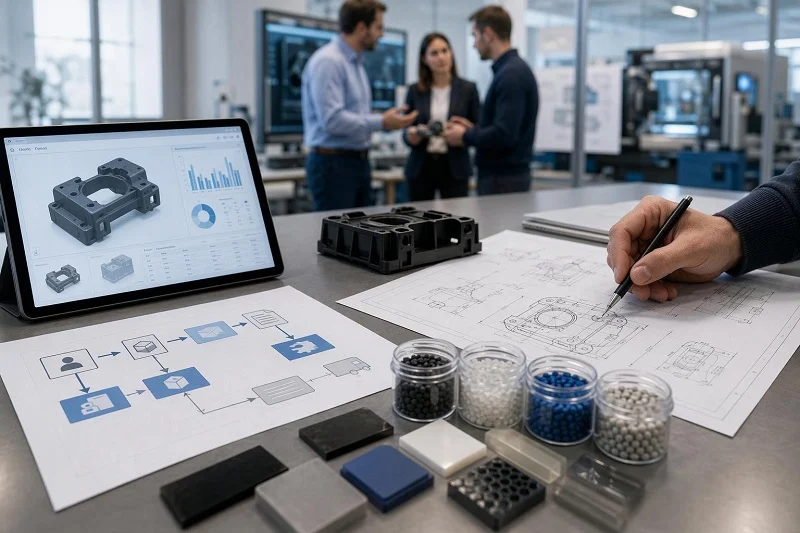
Qualify a high-volume injection molding partner on evidence, not on a sample approval. The framework below converts the preceding sections into documents to request and questions to ask, so that a supplier’s answers can be checked rather than taken on trust.
| Area | What to request | What a weak answer looks like |
| Tooling class | Written steel grade, hardness and finish for each mold, plus the SPI class the quote assumes and the annual volume it was chosen for | A class number with no steel specification behind it |
| Process validation | Machine-independent setup sheets stating melt temperature, flow rate, fill time, transfer position, pack pressure and time, and cooling | Press dial readings only, or a process that lives in one technician’s memory |
| Change control | A change log, defined approval authority, and a written list of what triggers revalidation | Revalidation described as something that happens “when needed” |
| Inspection strategy | The inspection plan, showing where sampling, SPC, gauging and vision are used and which features each protects | 100% manual inspection presented as the quality plan |
| Traceability | Cavity-level identification and a route from a nonconforming part to a cause | Reject counts with no cavity or cause attribution |
| Maintenance | Preventive maintenance intervals, wear-part spares and expected repair downtime | Maintenance treated as an unplanned expense |
| Certification | Current certificates, with the edition and scope stated | A logo without a certificate or scope |
On certification, match the standard to the product’s regulatory context. ISO 9001:2015 sets out general quality management system requirements, and ISO has since published a 2026 edition, so buyers should confirm which edition a supplier actually holds. ISO 13485:2016 sets out quality management system requirements specific to medical devices, with greater emphasis on regulatory requirements, risk management and process validation than ISO 9001. A supplier serving medical programs should be able to show the certificate and its scope, not merely name the standard.
Choosing NOBLE to Support Your High-Volume Injection Molding Project
NOBLE is a Chinese contract manufacturer and a Sino-British joint venture, and it is one practical answer to the qualification framework above. NOBLE’s service capability and specialized machining and manufacturing expertise help clients complete prototyping and mass production efficiently, which is the transition this guide has described: proving a part, then proving the process that makes it. NOBLE holds ISO 9001:2015 and ISO 13485:2016 certification. Its service scope runs from design to assembly, not only production, so tooling, process and inspection decisions can be reviewed together rather than handed between separate suppliers. Buyers evaluating NOBLE for a high-volume injection molding program can apply the same document requests listed in the previous section.
FAQs about High-Volume Injection Molding
Which prototype practices fail first at volume?
Tooling decisions usually fail first, because a prototype mold is built for speed and flexibility rather than durability. Soft steel, simplified cooling and low cavitation are reasonable for learning but become wear, dimensional variation and a second tooling bill once cycle counts climb. Informal process tuning and 100% manual inspection are the next to break down.
How should cavity count and tool steel be chosen for a given annual volume?
Treat both as functions of annual volume, part tolerance, material and program life. Higher cavitation spreads fixed tooling cost across more parts per cycle but raises tool cost, machine tonnage requirements and the difficulty of balancing fill. Steel grade and hardness should follow the expected cycle count and the resin’s abrasiveness, and the SPI class on a quote is a starting point for a conversation rather than a complete specification.
How are process windows validated, locked and change-controlled?
A validated window records target settings, proven upper and lower boundaries for critical variables, the evidence used to set them, and the part characteristics each boundary protects. Expressing the process in plastic variables rather than press dial readings lets it be duplicated across machines. Mold repair, press transfer, material or supplier change, drying changes and adjustments outside the proven window should all trigger revalidation, recorded in a change log.
How does inspection shift from manual checking to sampling and SPC?
Volume programs move to a layered strategy: first-article inspection, in-process checks, cavity-specific monitoring, automated vision, go/no-go gauges, CMM measurement, functional testing and SPC for critical features. Acceptance sampling to ISO 2859-1 judges lots against an AQL, while SPC watches the process itself. They answer different questions and are not substitutes for each other.
Which DFM decisions only become costly at volume?
Wall thickness, flow balance, cosmetic requirements in hard-to-fill areas and tolerance stack-ups are the main ones. Cooling is commonly cited as 80% to 90% of cycle time, so a thick section chosen early sets a cycle-time floor for the life of the program. Tolerances set beyond demonstrated capability add inspection burden and scrap.
What should a buyer verify in a manufacturing partner?
Ask for written steel grade, hardness and finish per mold; machine-independent setup sheets; a change-control system with defined approval authority; an inspection plan combining sampling and SPC; cavity-level traceability; maintenance and spare-part planning; and current certificates with their edition and scope stated.