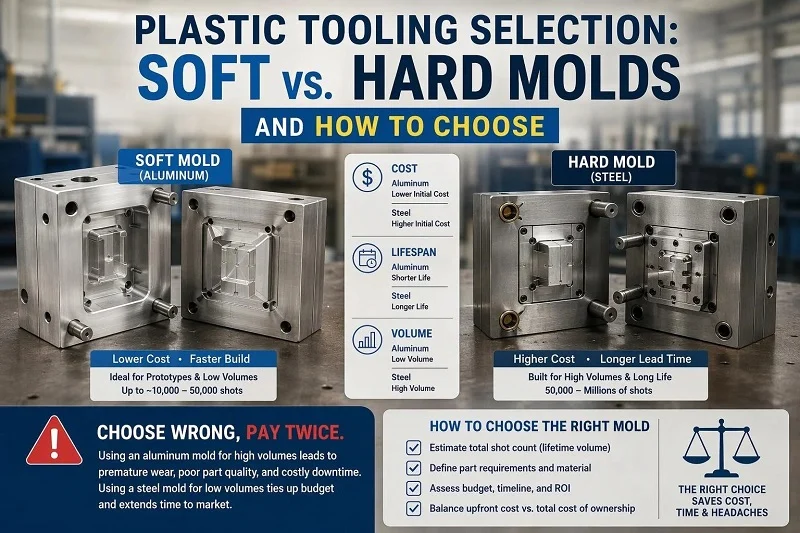
Most plastic tooling projects go wrong before the first chip is cut, because the mold is chosen on price rather than on total cost. An aluminum mold run at high volume wears out mid-program, and the replacement tool plus the lost production time can erase every dollar saved upfront. A hardened steel mold built for a few thousand parts does the opposite: the tooling cost is spread across so few pieces that the cost per part becomes absurd. Plastic tooling generally splits into two families. Soft tooling covers aluminum molds and bridge tools; hard tooling covers P20 pre-hardened steel and H13 or S136 hardened steel. Choosing correctly is not mainly a question of precision. It is a trade-off among three variables: volume, material and tolerance.
Soft vs. Hard Plastic Tooling: A Quick Comparison
The table below summarizes the practical differences. Treat the figures as typical ranges rather than guarantees, since cavity count, part size, surface finish and supplier capability all shift the numbers.
| Dimension | Soft plastic tooling | Hard plastic tooling |
| Typical mold material | Aluminum (often 7075-T6 or QC-10) | P20 pre-hardened steel; H13 or S136 hardened steel |
| Mold cost | Low | High |
| Lead time | Roughly 2–4 weeks | Roughly 8–12 weeks |
| Typical lifespan | About 1,000–10,000 shots, higher with harder aluminum alloys and mild resins | About 100,000–1,000,000+ shots depending on steel grade |
| Best fit | Prototyping, design validation, bridge production | Mass production, abrasive resins, tight tolerances |
| Surface finish ceiling | Around SPI B-2; not suited to mirror optics | SPI A-1 mirror polish achievable with hardened, polished steel |
| Geometry limits | Simple to moderate; limited side actions | Complex side actions, deep features, slender inserts |
The lifespan gap is the number that matters most. Simple aluminum prototype and bridge tools typically run about 1,000–10,000 shots, while harder aluminum alloys running non-abrasive resins are commonly quoted at 5,000–20,000 shots and drop to 2,000–5,000 shots with glass-filled grades. P20 at roughly 28 HRC is often rated at 100,000–200,000 shots and H13 at 48–52 HRC at 500,000–1,000,000 shots.
Factor 1 — Production Volume: The ROI of Plastic Tooling
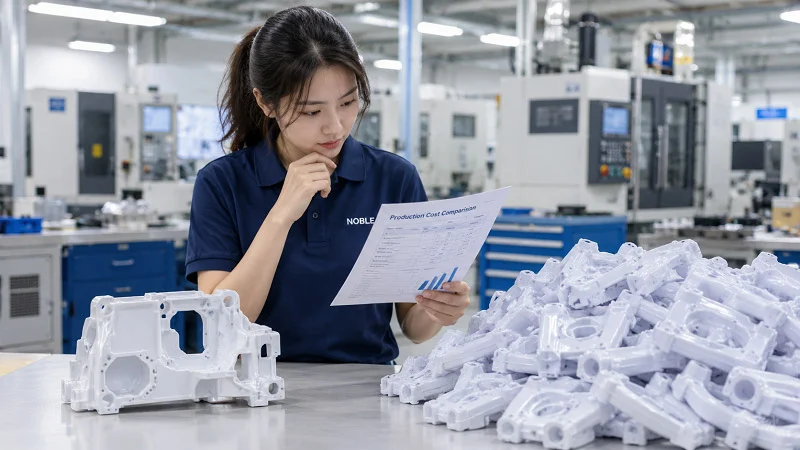
Volume decides whether the mold cost is a rounding error or the dominant line item. The right question is not which mold is cheaper, but which mold produces the lowest total cost across the whole program.
The Volume Thresholds for Soft and Hard Plastic Tooling
The following breakdown is a rough reference, not a rule:
- Under 1,000 parts: 3D printing or direct CNC machining often needs no mold at all. Machining is usually the economical route when the goal is a handful of parts or a few hundred, and it avoids tooling investment entirely.
- 1,000–10,000 parts: the golden zone for soft tooling. Aluminum mold cost is low, lead time is short, and the amortized cost per part is at its best.
- 10,000–50,000 parts: bridge tooling or a lower-cost P20 steel mold. This is the transition band where aluminum is still possible but the risk of wear-related defects is rising.
- Over 50,000 parts: hard tooling in hardened steel. Aluminum molds face high failure risk here, and the downtime from replacing a mold mid-program typically exceeds the initial savings.
A worked example makes the arithmetic concrete. Suppose a steel mold costs $30,000 and an aluminum mold costs $10,000. At 5,000 parts, steel adds $6.00 per part in tooling cost while aluminum adds $2.00. At 500,000 parts, steel adds $0.06 per part and aluminum adds $0.02 — but only if the aluminum tool survives, which it will not. Once a second and third aluminum tool are needed, the apparent saving disappears and the schedule slips with each rebuild.
The Hidden Cost of Worn-Out Soft Plastic Tooling
Aluminum does not fail suddenly at a rated shot count; it degrades. As the tool approaches its limit, flash increases, dimensions begin to drift from the nominal, and yield drops as more parts are scrapped or reworked. Each of those symptoms adds cost that never appeared in the mold quote.
Forcing soft tooling through a large order turns those symptoms into a schedule problem. Expect frequent repairs, unplanned machine downtime, and in the worst case a mold scrapped mid-production, which means paying for a second tool and losing weeks. The total cost can easily double. A useful check is to compare repair cost per cycle against new tooling cost per cycle; when repairs consistently exceed the replacement benchmark, the tool should be replaced rather than nursed.
Factor 2 — Resin Abrasiveness: When Plastic Tooling Must Be Steel
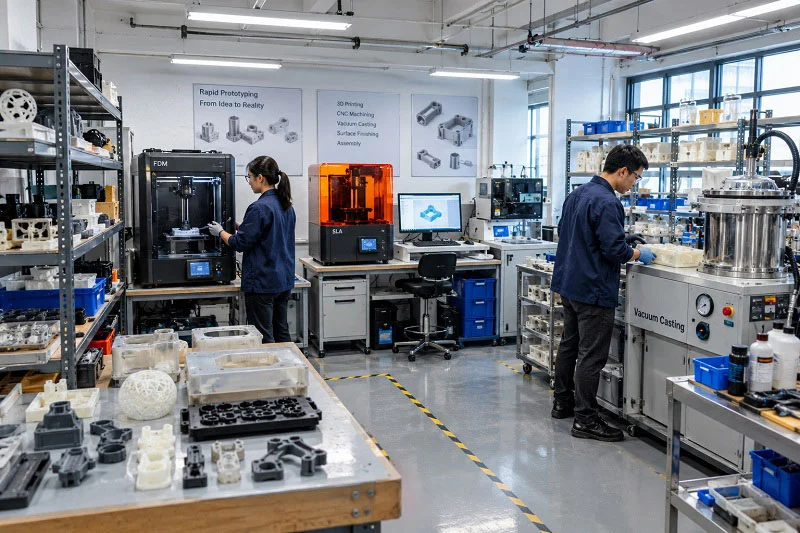
Material can override volume entirely. A resin that erodes the cavity makes an aluminum tool uneconomical even at a few thousand parts, so check the resin before the quantity.
Glass-Filled Resins Destroy Aluminum Plastic Tooling
This is a hard veto factor. When a material contains roughly 30% or more glass fiber or carbon fiber — PA6-GF30 and PBT-GF30 are common examples — or when it is a high-temperature engineering plastic such as PEEK or PSU, the aluminum gates and cavities are eroded under high injection pressure much as sandpaper wears a surface. Glass-filled grades can cut mold life by 30–50% compared with unreinforced resins, and an aluminum tool running abrasive fill may show significant parting-line damage within 5,000–10,000 cycles.
The result is predictable: enlarged gates, severe flash and dimensions that fall out of tolerance. Even a small 5,000-piece order in glass-filled material may justify H13 hardened steel, because the alternative is scrapping the tool partway through. PEEK raises a second issue: it is processed at melt temperatures of 350–400°C with mold temperatures of 150–200°C, which demands properly hardened, heat-treated tooling rather than aluminum.
Resins Compatible with Soft Plastic Tooling
Unfilled commodity and engineering resins are the natural home for soft tooling: ABS, PP, PE and PS, and in many cases unfilled PC and nylon. These materials place modest wear demand on the cavity, so aluminum’s faster machining and higher thermal conductivity can be used to advantage. The caveat is that unfilled nylon still shrinks substantially — around 1.2–1.8% for unfilled PA66 — so the cavity must be cut oversize for shrinkage, and any change to a filled grade later in the program should trigger a fresh tooling review rather than a simple material swap.
Factor 3 — Tolerance and Complexity: The Limits of Plastic Tooling
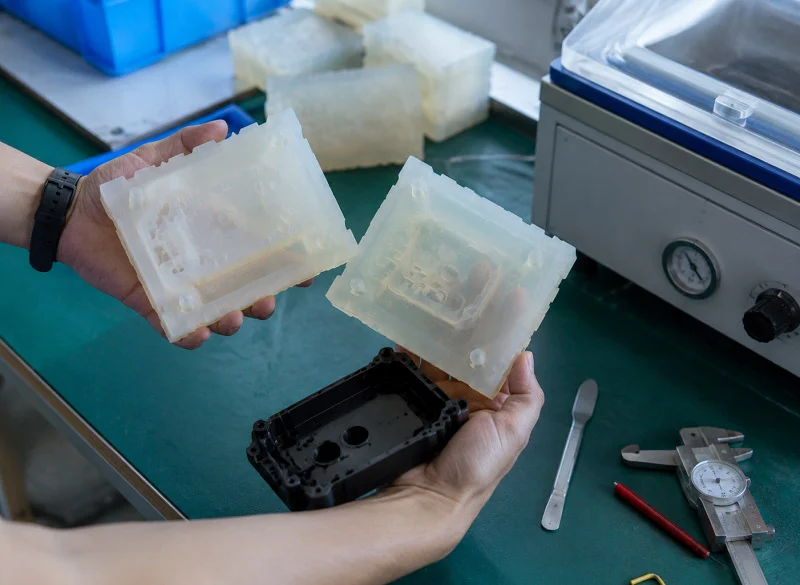
Tolerance and geometry set the ceiling on what soft tooling can hold. When a part demands either tight dimensions or demanding mechanisms, the mold material stops being a cost decision and becomes a capability decision.
When Complex Geometry Demands Hard Plastic Tooling
Aluminum has lower rigidity and is softer than steel. Where a part contains complex side actions, sliders, slender inserts or extremely deep features, aluminum molds can deform under continuous friction, leading to mold sticking or a gradual loss of precision. Thin ribs, sharp inside corners and gate areas are the first places to show deformation under repeated injection pressure and thermal cycling.
Only hard tooling can support complex mechanisms reliably over a long program. The practical test is whether the tool must maintain its shut-offs and slide fits through hundreds of thousands of cycles; if so, hardened steel is the sound choice regardless of the initial volume estimate.
Medical and Precision Applications
When a part demands tight tolerances — on the order of ±0.01 mm — or an excellent surface finish such as that required for optical lenses or medical connectors, aluminum molds often cannot meet the mold temperature control and surface hardness requirements. Aluminum polishing generally tops out around SPI B-2, while hardened H13 or S136 can reach SPI A-1 mirror finish. For optical and high-cosmetic work, high-polish S136 or a comparable stainless mold steel is the appropriate specification, and the acceptance standard for the finish should be written into the tooling requirement rather than assumed from the steel grade alone.
Using SPI Classes to Verify Your Plastic Tooling Quote
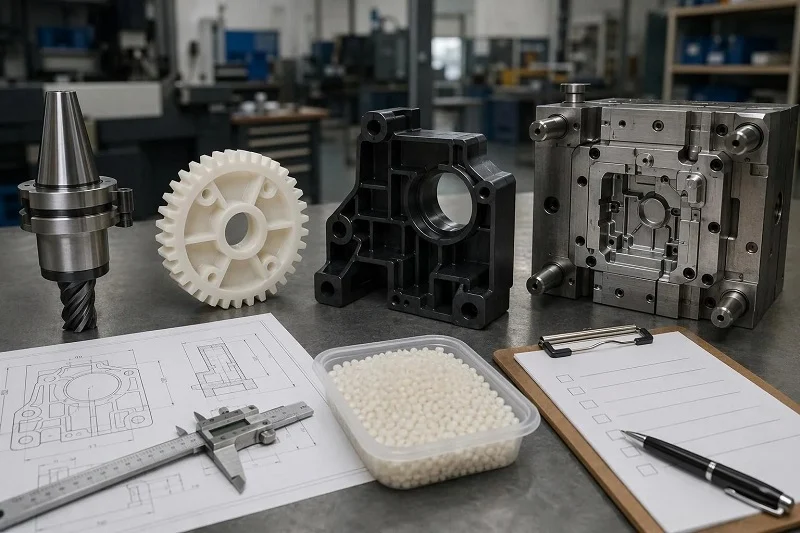
The SPI mold classification system, maintained today by the Plastics Industry Association, gives you a shared vocabulary for checking whether a quote matches the program you described. Higher class numbers mean lower cost, shorter life and fewer construction requirements.
| SPI class | Expected mold life | Typical construction |
| Class 101 | 1,000,000+ cycles | Cavities and cores hardened to at least 48 Rc; hardened slides and wear plates |
| Class 102 | Up to 1,000,000 cycles | Based largely on Class 101; suited to abrasive resins and close tolerances |
| Class 103 | Under 500,000 cycles | Mold base at least 165 BHN; cores and cavities 280 BHN or higher |
| Class 104 | Under 100,000 cycles | Mold base may be mild steel or aluminum; cavities may be aluminum or mild steel |
| Class 105 | Up to 500 cycles | Prototype tooling |
In short: Class 101–102 corresponds to hard plastic tooling in hardened steel, Class 103 to pre-hardened steel such as P20, and Class 104–105 to soft plastic tooling in aluminum or mild steel.
Use the class as a cross-check on the quote. If a project is planned for 500,000 parts but the supplier’s quote specifies a Class 104 mold, that is a red flag: either the wrong class was quoted, or a short-life tool is being substituted to cut cost. The same logic applies in reverse — paying for a Class 101 tool on a 5,000-part bridge program is over-specification. Ask for the class in writing, request material certifications with hardness test reports, and confirm the class against your own volume, resin and tolerance requirements before the purchase order is issued.
Choosing NOBLE to Support Your Plastic Tooling Project
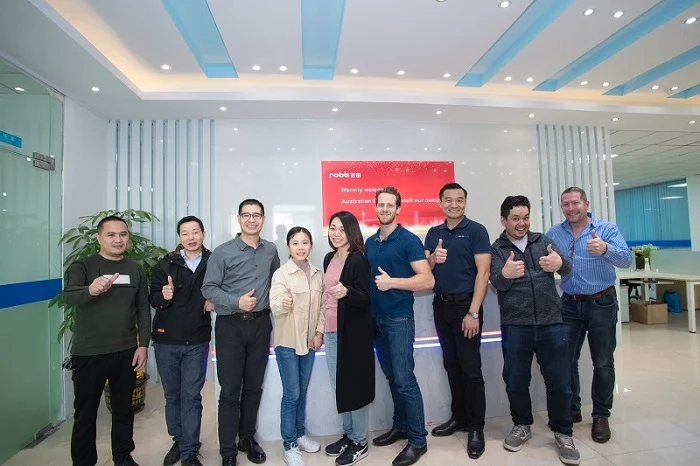
NOBLE is a premier machining manufacturer in China, combining strong service capability with practical machining expertise to support efficient prototyping and volume production. NOBLE is certified to ISO 9001:2015 and ISO 13485:2016, and it provides a complete service from design through assembly rather than production alone.
FAQs about Plastic Tooling
Which plastic tooling should I choose for a 5,000-piece run in unfilled ABS?
Soft tooling is usually the better fit. Aluminum cavities machine quickly, keep upfront cost low, and handle unfilled ABS, PP, PE, and PS well within a short-run program. Confirm the resin has no abrasive filler and that the part tolerances are achievable in aluminum before you commit.
Can an aluminum mold survive a glass-filled resin if I only need a few thousand parts?
Generally no. Glass and carbon fibers abrade aluminum cavities and gates quickly, and the wear shows up as enlarged gates, heavy flash, and drifting dimensions rather than a clean break. For PA6-GF30, PBT-GF30, or similar grades, specify hardened steel such as H13 even at low volumes.
Does a higher SPI class always mean a better mold?
No. SPI classes describe expected construction and cycle life, not fitness for your program. A Class 103 tool built to its requirements can be the correct, cost-effective choice for a medium-volume part, while a Class 101 tool on a 3,000-piece prototype run simply spends money on durability you will never use.
What should I check first when comparing plastic tooling quotes?
Start with the stated SPI class and the cavity steel grade and hardness behind it, then confirm both match your planned lifetime volume and resin. A quote that names a class but not the steel, or names a steel that contradicts the class, needs clarification before you compare price.
Can one supplier handle both soft and hard tooling?
Yes, and it is often preferable, because the same team can carry part design intent from prototype tooling into production tooling. Ask how the supplier decides between aluminum and hardened steel, and whether that decision is documented in the quote.