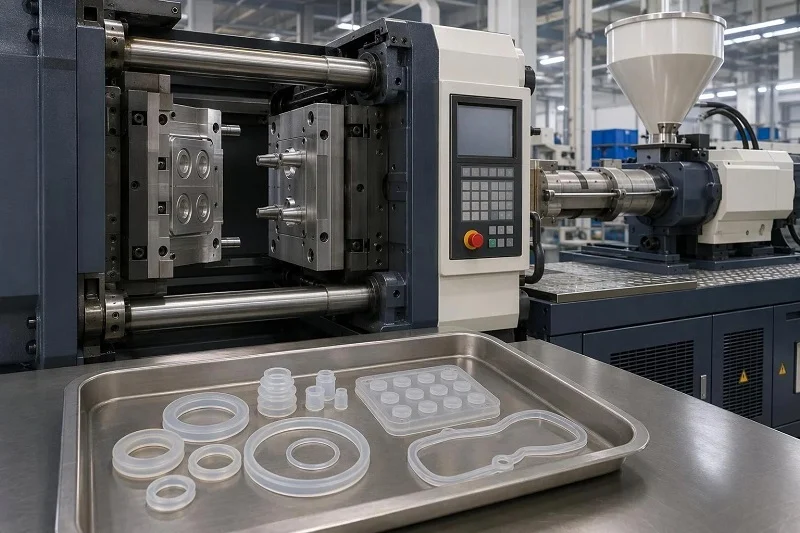
Silicone injection molding is not simply rubber molding with a different feedstock. It is a distinct manufacturing discipline: a two-component liquid compound is metered, mixed and injected into a hot cavity where it crosslinks into a thermoset elastomer, rather than cooling into shape as a thermoplastic does. That single difference in chemistry reshapes everything downstream — the tooling rules, the tolerance expectations, the cycle economics and the design freedoms available to you.
This guide is organized around the decision a product developer actually faces: whether liquid silicone rubber (LSR) injection molding is the right route for a given part, and what must be settled before tooling is cut. It covers the process cycle, the material properties that constrain design, the geometry rules worth applying at the CAD stage, the applications where silicone earns its premium, and honest comparisons against other materials and other molding routes — including the cases where silicone injection molding is the wrong answer.
Figures quoted here reflect published technical and industry literature available as of November 2026. Silicone properties are formulation-specific, so treat every range as a starting point for discussion with a material supplier rather than a specification for your part.
What Silicone Injection Molding Is and How the LSR Process Runs

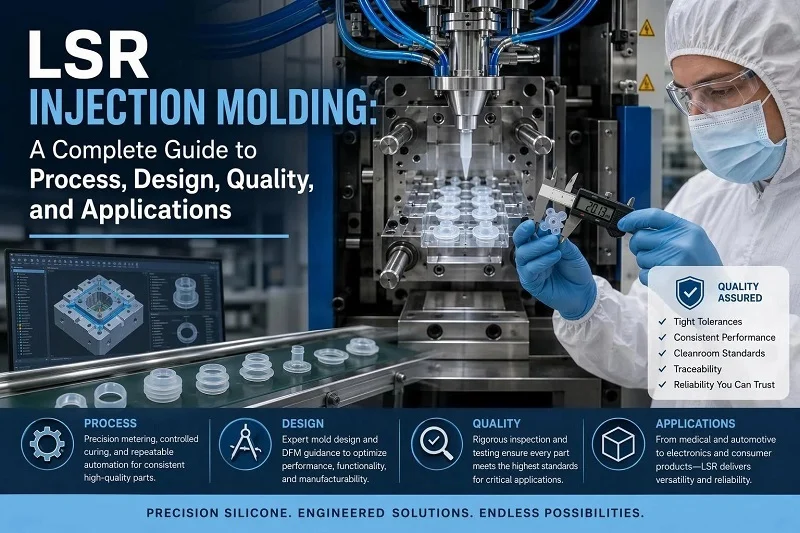
Silicone injection molding feeds a platinum-catalysed, addition-cure liquid silicone rubber through a cooled delivery system into a heated mold, where the compound vulcanises in the cavity. Understanding the cycle stage by stage is what makes the later design and comparison sections usable.
The chemistry behind addition-cure liquid silicone rubber
Commercial injection-grade LSR is a two-component system built from vinyl-functional polydimethylsiloxane, a hydrogen-containing siloxane crosslinker, a platinum catalyst, an inhibitor and reinforcing silica. Once heated, hydrosilylation between Si–H and vinyl groups builds a three-dimensional network, and the balance of those reactive groups governs network development while catalyst activity and inhibition set how much processing time you have. Filler content and surface chemistry matter too: modified fillers can change viscosity and even retard cure by inhibiting the catalyst. Because formulation and equipment are coupled, the same injection profile can produce different filling and curing histories across compounds and geometries.
Metering, mixing and cold-runner delivery
The A and B components are dosed from separate containers at the specified ratio, with pigment added where required, then passed through a static mixer whose fixed elements repeatedly divide, redirect and recombine the streams. Accurate dosing preserves the ratio; adequate mixing distributes it. Both matter more than they appear to, because off-ratio material changes crosslinking temperature, viscosity, cavity pressure, shrinkage, hardness and elongation at break. Downstream, a cooled barrel and cold-runner system hold the compound below cure temperature until it reaches the cavity.
Injection, cavity filling and thermal cure in the mold
Injection speed, holding pressure and the velocity-to-pressure switchover shape the flow and pressure history, while mold temperature and part geometry control heat transfer into the compound. These pathways interact: flow determines the thermal exposure during filling, and rising temperature plus advancing crosslinking modify viscosity and the resulting pressure response. Molds are typically electrically heated into the 150–200 °C range to trigger rapid vulcanisation. The literature links processing history to shrinkage, surface replication, mechanical properties and defects, so cure is a quality variable rather than a fixed step.
Demolding, post-cure and part assessment
Soft, high-elongation parts resist conventional ejector pins, so LSR tooling often uses ejector plates or brushes, and lightly textured mold finishes help with demolding and transparency. Post-cure is recommended where low compression set matters. Assessment should separate process measurements from part measurements: cavity pressure shows whether a controlled response hit target, whereas dimensional, replication and mechanical tests show whether the part actually improved. Published reviews describe relationships under investigated conditions; they do not establish a universal operating window.
Silicone Material Properties That Drive Part Design

The properties below are the ones that belong on a drawing or datasheet. Each is grade-dependent, and a range quoted for the silicone family is not a rating for any individual compound.
Hardness and elastic recovery
Silicone is commonly supplied from roughly 10 to 95 Shore A, and it retains resilience after long-term stress — which is why sealing force survives the service life. Hardness is not a cosmetic choice: softer grades seal better against imperfect surfaces but strip and eject poorly, while harder grades resist extrusion into gaps. Hardness also feeds directly into wall-thickness and undercut rules.
Continuous vs. peak temperature resistance
Continuous service temperature describes sustained load over months or years; peak temperature describes short excursions. General-purpose silicone is commonly cited at roughly −50 °C to 180 °C continuous with short-term peaks to about 250 °C, and highly stabilised grades reach higher. Published figures assume correctly dimensioned parts without additional extreme chemical load, so treat them as a design envelope to confirm, not a guarantee.
Chemical and solvent resistance
Silicone’s chemical profile is asymmetric. It is essentially unaffected by polar organic compounds, alcohols and dilute acids or bases, with swelling typically in the 10–15% range, and it swells in non-polar solvents such as toluene and gasoline without dissolving, recovering when the solvent is removed. Strong acids and bases do attack it. That asymmetry makes media contact the first question in most applications.
Biocompatibility and regulatory grades
Biocompatibility belongs to a specific compound and its documentation, not to “silicone” in general. Common frameworks include ISO 10993 for biological evaluation, USP Class VI for pharmaceutical suitability, and FDA-related food-contact expectations, alongside cleanroom production classes. Certification is compound-specific: the exact formulation, cure system and processing must each be tested and documented, and a material datasheet may not close a finished-device evaluation on its own.
Electrical insulation, UV and weathering performance
Insulating grades are commonly quoted at 28–32 kV/mm dielectric strength, and silicone holds its electrical properties across a wide temperature band. It also resists UV radiation and environmental exposure throughout the service life, which is what supports outdoor gaskets, connector seals and automotive use. Confirm the values for your specific grade rather than assuming the family figure applies.
Design Key Points for Silicone Injection Molding

These rules translate material behaviour into geometry decisions you can make at the CAD stage. Breaking one rarely fails a part outright; it adds tooling complexity, scrap or inspection burden.
Wall thickness and shrinkage consistency
Keep nominal walls consistent — a commonly cited target is walls within about 20% of one another — so the part shrinks evenly and avoids sinks, warpage and local stress. In LSR, thickness also sets cycle time, because heat must penetrate the section to cure it; a heavy boss can dominate the whole cycle.
Radii, corners and stress concentration
Generous internal and external radii reduce stress concentration, improve fill into corners and ease ejection in soft grades. Sharp internal corners concentrate strain exactly where a flexible part flexes, and they are harder to fill without trapped air. Note the exception: edges at the parting line must remain sharp so thin flash can be sheared off cleanly.
Draft angles and ejection of soft parts
Apply draft to every pulled surface — about one degree is a common baseline. Low-hardness parts are the harder case: their recovery stretch limits how aggressively they can be pulled, and silicone tends to stick to polished steel, so draft and surface finish work together to determine whether ejection is clean or tears the part.
Undercuts, side actions and tooling complexity
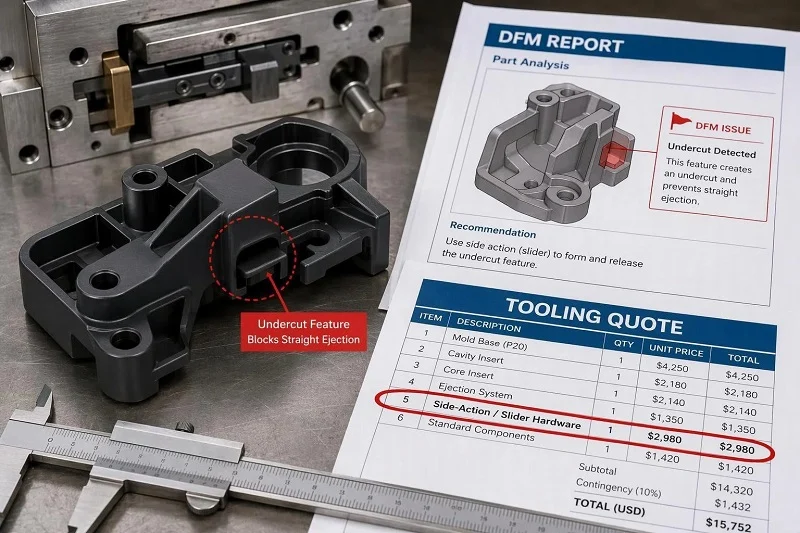
A flexible silicone part can often be stripped off an undercut that would require a lifter in a rigid thermoplastic, provided the geometry stays within the compound’s recovery stretch. Beyond that limit, the undercut forces side actions or collapsing cores, which raises tool cost and adds maintenance. Decide this early: it is the single design feature most likely to change the tooling quote.
Flash control, parting lines and sealing features
In a seal, flash is not cosmetic. Low-viscosity LSR penetrates narrow gaps, so venting and sealing must be tuned together: closing the parting surface too tightly traps air, while opening it too far admits material. One study reported flash-free molding at low clamping forces where insert fit and vent geometry were carefully controlled, which places surface fit alongside clamp force as a flash variable. Decide parting-line position with the seal geometry, not after it — a line crossing the sealing zone creates a leak path no deflashing step can repair.
Tolerances and what to specify on a drawing
Soft elastomers do not hold dimensions the way machined metal does. Rubber tolerances are graded by class — ISO 3302-1 and the RMA MO-1 classes run from precision to commercial — and tightening one class can raise tooling cost substantially while still requiring non-contact inspection, because contact gauges distort soft parts. Hardness and wall section both widen the scatter. Specify tight limits only on dimensions that perform a function, mark the rest as reference, and state the measurement method and condition on the drawing.
Applications of Silicone Injection Molding

Silicone injection molding tends to become the default wherever elasticity must survive heat, repeated sterilization, weathering or biological contact, and where volume justifies tooling. The sections below group the common cases by industry so you can locate your own; in each, the deciding property is named rather than assumed.
Medical devices and healthcare components
Seals, valves, respiratory masks, tubing connectors and wearable interfaces rely on silicone’s inertness and its tolerance of steam and chemical sterilization. The material choice is a grade decision, not a category decision: biocompatibility rests on compound-specific testing under frameworks such as ISO 10993 and USP Class VI, and device-level evaluation remains the sponsor’s responsibility. Cleanroom-compatible LSR molding supports the contamination control these parts require.
Automotive sealing, sealing and under-hood parts
Gaskets, connector seals, spark-plug boots and protective bellows sit in engine bays where temperatures cycle widely and fluids are present. Silicone’s continuous range near −50 °C to 180 °C, with short excursions higher, covers much of that envelope, and its cold flexibility helps at the low end. Where hot oil or fuel dominates instead, a fluorocarbon or fluorosilicone grade is usually the better fit — the temperature window and the fluid decide together.
Consumer products, infant care and food-contact goods
Nipples, teats, spatulas, bakeware and personal-care items combine repeated heating, mouth or skin contact and a demand for taste and odour neutrality. Food-contact compliance is jurisdiction-specific and formulation-specific, so the grade and its documentation must match the intended use and market. Post-cure matters here: it reduces residual volatiles, and suppliers often recommend it where low compression set or low emission is required.
Electronics, electrical insulation and protective components
Keypads, connector seals, EMI gaskets and insulating parts draw on dielectric strength of roughly 28–32 kV/mm for insulating grades, plus arc and tracking resistance that hold up better than most organic rubbers. Silicone also keeps its volume resistivity across a wide temperature band, which suits components that run warm. Weathering resistance extends the same parts to outdoor enclosures and lighting.
Industrial, robotics and emerging applications
Soft-robotic actuators, grippers, wearable electrodes and optical components use silicone’s compliance as a design function rather than a side effect. Here the functional requirement drives manufacturing: optical parts emphasize surface replication and low internal stress, multi-material parts emphasize adhesion at the interface, and actuators emphasize cavity geometry and wall consistency. Injection molding is one route among several for these structures, and the review literature treats it as a means of reproducing required geometry repeatably rather than a universal answer.
Silicone Vs. Other Materials

Before comparing processes, settle the material. Silicone is rarely the cheapest elastomer and rarely the strongest; it earns its place on temperature breadth, weathering, electrical insulation and biological inertness. The comparisons below are framed around the property that usually decides the choice, so you can see quickly whether silicone is even in contention.
Silicone vs. EPDM, NBR, FKM and natural rubber
EPDM matches or beats silicone on outdoor weathering at roughly a third of the raw-material cost, and it is the default for exposed gaskets that never exceed about 150 °C. NBR wins on hydrocarbon oil resistance; FKM wins on hot fuel, amines and aggressive chemicals, typically rated to about 205 °C continuous but only around −26 °C at the cold end for standard grades. Natural rubber offers high tensile and tear strength at low cost but poor heat and ozone resistance. Silicone’s case is the wide window — roughly −50 °C to 180–200 °C continuous — combined with weathering, insulation and biocompatibility.
Silicone vs. thermoplastic elastomers and thermoplastics
TPEs are melt-processable: they can be injection molded on conventional equipment, reground and cycled in seconds, which makes them cheaper per part at volume. They soften on heating, though, and their compression set at elevated temperature is generally worse than a crosslinked silicone’s. Rigid thermoplastics beat silicone outright on stiffness, tensile strength and dimensional precision. Choose silicone when permanent elasticity above 150 °C, low compression set or biological inertness is the governing requirement; choose a TPE or thermoplastic when it is not.
Where silicone loses on performance and cost
Silicone’s tensile strength and tear resistance are modest next to natural rubber or polyurethane, which matters for thin sections, snap fits and parts that see abrasion or crack propagation. It swells in non-polar solvents such as toluene and gasoline — usually recovering on drying, but not usable where dimensional stability under solvent exposure is required — and it is attacked by strong acids and bases. Raw material costs more than most organic elastomers. Where these limits bind, no amount of process refinement will fix the material choice.
Silicone Injection Molding Vs. Other Molding Processes
With the material settled, the question becomes which molding route. The comparisons below use cycle time, tooling cost, flash behaviour, automation and part-to-part consistency as the axes, because those are what separate the routes economically rather than technically.

Order-of-magnitude comparison of rubber molding routes. Tooling, cycle and break-even figures are practitioner ranges compiled from comparative process guides, not measured guarantees; actual values shift with part size, wall thickness, compound, cavity count, automation and inspection regime. LSR cycle band reflects wall thickness and part size dependence.
Injection molding vs. compression molding
Compression molding places a preform in an open heated cavity and closes the mold. Tooling is the simplest and cheapest of the routes — entry costs commonly cited from about $1,000 to $30,000 — with lead times of two to four weeks, which suits prototypes and short runs. Its cycles run minutes, per-part labour is high, and flash is harder to control. Injection molding costs far more in tooling but delivers repeatability and automation; published break-even estimates against compression cluster around 50,000 to 100,000 parts per year, though the crossover shifts with part size and geometry.
Injection molding vs. transfer molding
Transfer molding loads compound into a pot and forces it through a sprue into a closed cavity. It sits between the other two on tooling cost and cycle, and it is often chosen not for volume but because fragile metal inserts must be positioned before material arrives — a flow front would displace them. The residual cull pad is thermoset and non-recoverable, so material waste is typically higher than compression. Injection molding generally wins on cycle time and consistency once volume supports the tool.
Liquid silicone rubber injection molding vs. high-consistency rubber injection molding
Both are injection processes; the feedstock differs. LSR arrives as two liquid components, is metered and mixed through a static mixer, and cures in a heated mold with a cold runner keeping the delivery path below cure temperature. HCR arrives as solid strip or compound that must be milled and fed into the barrel. Published comparisons put LSR cycles in the range of roughly 10 to 90 seconds depending on wall thickness and part size, against 1 to 3 minutes for HCR, with LSR producing little flash from a fully closed cavity and clean enough for ISO 13485 Class 7 cleanrooms.
Injection molding vs. 3D printing of silicone
Additive routes — including UV-cure liquid silicone printing with follow-on curing — build parts directly from CAD with no hard tooling, which makes them attractive for one-offs, custom geometries and design iteration. They give up surface finish, mechanical consistency and cycle economics at volume, and the review literature notes that printed structures still require service-relevant testing before they can be trusted in demanding roles. Printing fits low volume and unusual geometry; injection molding fits repeatability at scale.
Choosing a process: a decision framework
Work through four gates in order. Annual volume comes first: below roughly 10,000–15,000 parts per year, compression tooling rarely pays back an injection mold, while the crossover toward injection is often cited between 50,000 and 100,000 parts annually once cycle time and labor are counted. Second, tolerance and cosmetic requirements — precision classes and optical surfaces pull the decision toward injection. Third, confirm the grade you need is available in the form the process accepts, since LSR and high-consistency compounds are not interchangeable. Fourth, weigh tooling budget and lead time: injection tools are commonly quoted from about $5,000 to $100,000+ with 5–10 week lead times, against $1,000–$30,000+ and 2–4 weeks for compression. Material constraints can override volume, so treat the sequence as a starting point for quoting rather than a verdict.
When Silicone Injection Molding Is the Wrong Choice

Silicone injection molding is a poor fit in several recurring situations, and recognising them early saves tooling money.
High volume where a thermoplastic would do. If the part does not need permanent elasticity, heat resistance or biocompatibility, a thermoplastic or thermoplastic elastomer usually wins on cycle time, recyclability and unit cost. Silicone earns its premium only when its property set is actually required.
Applications demanding high tear or tensile strength. Silicone’s mechanical strength is modest compared with several organic elastomers. High-tear silicone grades are classified at above roughly 25 kN/m with peroxide cure or 30 kN/m with platinum cure, so check the grade before ruling silicone out. Where the part sees abrasion and crack propagation, other compounds or polyurethane may serve better.
Service in concentrated solvents, strong acids or strong bases. Silicone swells in non-polar solvents such as benzene, toluene and gasoline, and is adversely affected by strong acids and bases. If media contact dominates the duty cycle, a fluorocarbon elastomer is usually the more honest choice.
Extremely tight tolerances on very soft grades. Soft elastomers deflect under contact gauges and vary with temperature, humidity and cure history. Specifying a precision tolerance class on a 30 Shore A part can raise tooling cost substantially without producing a measurable benefit.
One-off parts and very low volumes. Where annual demand cannot amortise an injection tool, compression molding or 3D printing avoids the tooling investment entirely. Prototype quantities rarely justify a production mold.
Parts better made by printing. Where geometry freedom matters more than mechanical consistency — internal channels, custom one-offs, design iterations — additive routes can be the faster path.
NOBLE’s Silicone Injection Molding Support
NOBLE is a leading contract manufacturer in China, and silicone injection molding is one of the capabilities behind that position. Our service capability and professional processing capability help customers — including you — complete prototyping and mass production efficiently, moving a part concept from design intent to repeatable output without unnecessary handoffs.
NOBLE is certified to ISO 9001:2015 and ISO 13485:2016. The second certification matters particularly for medical and healthcare programs, where documented process control is part of the deliverable rather than an afterthought.
We provide a full service range from design to assembly — not production alone. That means design-for-manufacturing input before tooling is cut, prototype evaluation, production molding, and the assembly steps that turn molded parts into a finished component. For a program where silicone injection molding is one operation among several, that continuity reduces the coordination burden on your team and keeps accountability in one place.
FAQs about Silicone Injection Molding
What lead times should I expect for silicone injection molding?
Tooling is typically the long pole. Industry ranges put injection tool lead time at roughly 5–10 weeks, against 2–4 weeks for compression tooling. Once the tool is qualified, LSR cycles are commonly cited at 10–90 seconds depending on wall thickness and part size. Prototype or bridge tooling shortens the front end at the cost of tool life.
What is the minimum volume that justifies a mold?
There is no universal number, but published comparisons place the crossover where injection beats compression at roughly 50,000–100,000 parts per year, with some sources citing lower figures around 10,000–15,000 parts per year for specific geometries. Below that, compression molding or printing usually costs less in total.
What hardness range is achievable?
Silicone is commonly cited across roughly 10 to 95 Shore A. Most molded sealing and consumer parts sit in the middle of that band. Softer grades ease sealing but complicate ejection and tolerance control; harder grades resist extrusion but seal less readily against imperfect surfaces.
How long does a tool last?
Tool life depends on steel selection, surface treatment, compound abrasiveness and maintenance discipline. Production tools are typically built in pre-hardened or hardened tool steel for repeatability over thousands of cycles; prototype aluminum tooling uses the same LSR chemistry but trades cycle time and tool life.
What files do you need to quote a part?
A 3D CAD model in a standard format, a 2D drawing with critical dimensions and tolerance classes, the intended material grade or its property requirements, annual volume and target timing. Marking which dimensions are functional and which are reference-only helps the molder propose a realistic tool concept.
How do I specify a biocompatible grade?
Name the framework and the intended use — ISO 10993 for device biocompatibility, USP Class VI for pharmaceutical suitability, or the applicable food-contact regulation — and ask for compound-specific test documentation. Compliance is a property of a specific formulation and its supporting data, not of silicone in general, so a category-level claim is not enough for a sourcing decision.