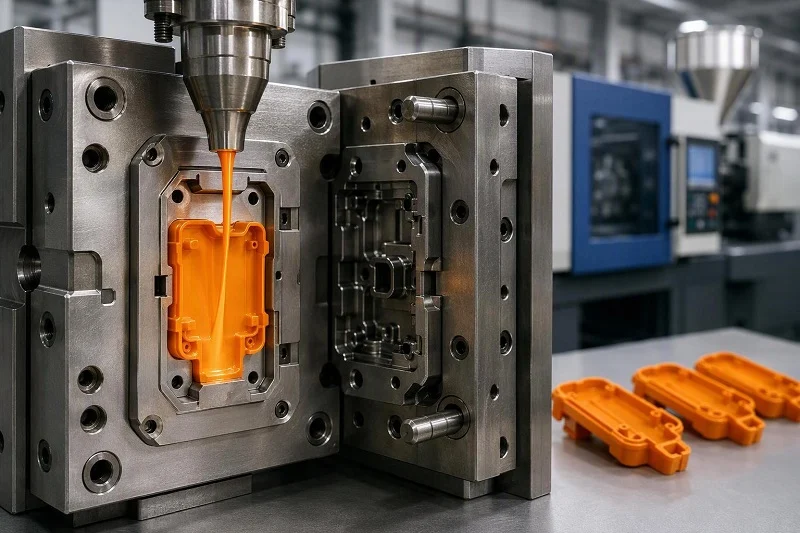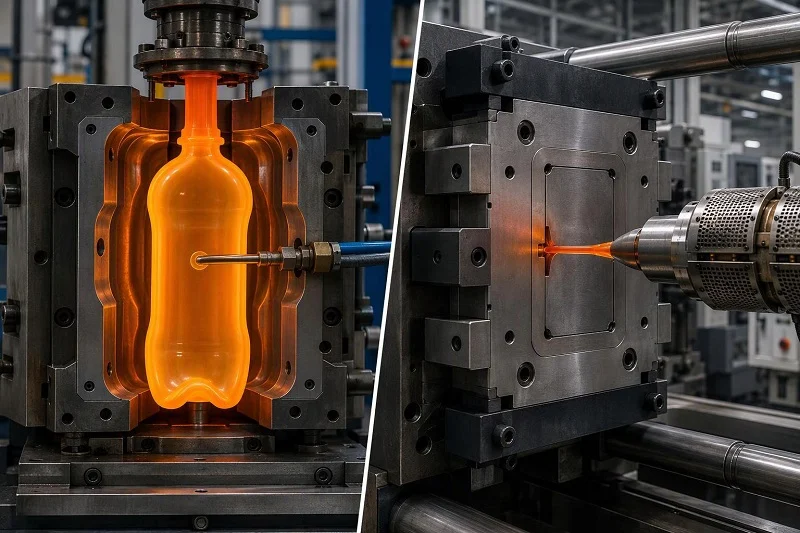
The choice between blow molding and injection molding usually comes down to one question about the part: does it need to be hollow and closed, or solid and detailed? Blow molding inflates a heated plastic parison (or a reheated preform) against the walls of a mold cavity, so the finished article is a one-piece shell — a bottle, a tank, a duct. Injection molding forces molten resin under high pressure into a closed, machined cavity, so the finished article can be solid, open, or finely featured — a cap, a housing, a gear.
That mechanical difference propagates through everything else a buyer cares about: how tight the tolerances can be, how wall thickness is controlled, which resins will run, what the tool costs, and at what volume the economics make sense. This comparison of blow molding vs. injection molding works through procedures, advantages and disadvantages, applications, materials, design limits, and volume economics in that order, so you can match the process to your part rather than to a general preference.
Blow Molding vs. Injection Molding at a Glance

The table below condenses the dimensions developed in the rest of the article. Tooling and cycle figures are typical ranges drawn from published process comparisons; they shift with part size, cavity count, tool material, and machine class, so treat them as planning figures to confirm against a specific quote rather than as fixed prices.
| Dimension | Blow molding | Injection molding |
| Part geometry | Hollow, closed: bottles, tanks, ducts, containers | Solid or open: caps, housings, gears, enclosures |
| Wall thickness control | Indirect, ±10–20%, thins at corners | Direct, designed per feature, roughly ±0.05 mm |
| Achievable tolerance | ±0.5 mm on body dimensions; tighter neck finish | ±0.05 to 0.1 mm achievable |
| Tooling cost | Roughly $15,000–$50,000 per blow mold | Roughly $25,000–$150,000 per tool |
| Typical cycle time | 10–20 s per bottle, multi-cavity | 15–60 s, multi-cavity; as short as 10 s in favorable cases |
| Forming pressure | Low: 6–10 bar blow air | High: clamp force of roughly 2–5 tons per in² of projected area |
| Common resins | HDPE, PET, PP, PVC mainly | Nearly all thermoplastics, including filled grades |
The two rows that drive most downstream decisions are wall thickness and tolerance. Because blow molding stretches a parison against a cavity rather than filling a defined gap, wall thickness is a process outcome rather than a tooling dimension, and the tolerance band follows. Injection molding defines the cavity precisely, so both wall and tolerance are set in the tool.
How Each Process Works
Both processes start from the same premise: a thermoplastic is heated until it flows, shaped in a cooled tool, and ejected as a solid part. What separates them is the forming step. Blow molding uses low-pressure air to push a hollow tube of melt outward until it meets a cavity wall. Injection molding uses high pressure to push melt into a cavity that is already closed and fully defined. Everything else — tolerance, feature detail, material range, tool cost — follows from that difference in how the plastic meets the mold surface.
The Blow Molding Procedure
The sequence runs: melt and homogenize the resin in an extruder; form a parison by extruding a tube of melt downward (or, in preform-based variants, heat a pre-molded preform); close the two mold halves around the parison, pinching it shut at the top and bottom; introduce compressed air through a blow pin so the plastic expands against the cooled cavity wall; cool until the part is rigid enough to handle; open the mold and eject; then trim flash and perform any secondary operations such as deflashing, hole punching, labeling, leak testing, or assembly.
The Three Blow Molding Variants
The three main variants differ in how the parison is made. Extrusion blow molding (EBM) extrudes the parison continuously and is the cheapest and most size-flexible route, handling everything from small bottles to large industrial tanks and ducts, at the cost of limited feature detail. Injection blow molding (IBM) injection-molds a precise preform on a core pin and then blows it, which yields high detail and an accurate neck but limits final part size. Injection stretch blow molding (ISBM) reheats an injection-molded preform and stretches it biaxially before blowing — the route that makes the PET beverage bottle possible, with good clarity and strength but a narrower window of shapes and a two-step process.
The Injection Molding Procedure
The sequence runs: melt and homogenize resin in the injection unit’s screw and barrel; inject the melt under high pressure into a closed mold held shut by the clamp; pack and hold to compensate for shrinkage as the part cools; cool until the part is rigid; open the mold; eject the part, often with ejector pins, lifters, or slides; then degate and perform any post-processing.
Clamp Force and What It Buys
The clamp force is what makes the process work. Injection pressures of roughly 500–2,000 bar act on the projected area of the part, and the clamp must resist that force to keep the mold halves closed — otherwise melt escapes at the parting line as flash. In exchange for that force and the precision tooling it requires, the closed cavity defines every surface, so solid geometry, fine features, engraved text, molded textures, and tight dimensional control all become achievable in a single cycle.
Advantages and Disadvantages of Blow Molding
Where Blow Molding Wins
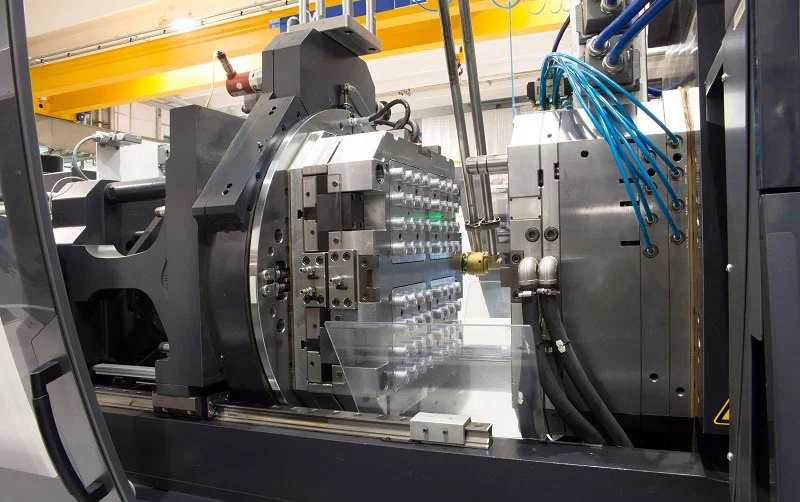
Blow molding’s strengths are structural, not incidental. Tooling is the cheapest of the major plastic processes, which lowers the entry cost for a new container. Cycles are fast — 10–20 seconds per bottle on multi-cavity equipment. Very large hollow parts, including industrial tanks and ducts, are practical because the low forming pressure keeps machine and tool loads modest. And extrusion blow molding is the only common method that can produce an integral handle, because the mold simply pinches the parison shut where the handle opening goes.
Where It Falls Short
Its limits are equally structural. Wall thickness is controlled indirectly, by programming the die gap or the preform profile rather than by the tool, so thickness varies across the part and thins most at corners. Flash is generated at the pinch-off and must be trimmed, with the regrind managed — material waste in blow molding operations commonly runs 5–15% of polymer consumption, and each regrind cycle degrades the polymer somewhat. Neck threads are formed by pinching rather than molding, so their accuracy is only moderate compared with an injection-molded finish. Feature complexity is restricted: low blow pressure cannot force plastic into deep ribs or sharp detail.
These disadvantages are manageable rather than disqualifying when the part is a container with moderate dimensional demands. A well-designed parison profile, generous corner radii, and a planned trim-and-regrind loop turn the weaknesses into routine production costs. They become disqualifying only when the design needs fine internal features or tolerances in the hundredths of a millimeter.
Advantages and Disadvantages of Injection Molding
Repeatability and Detail in the Tool
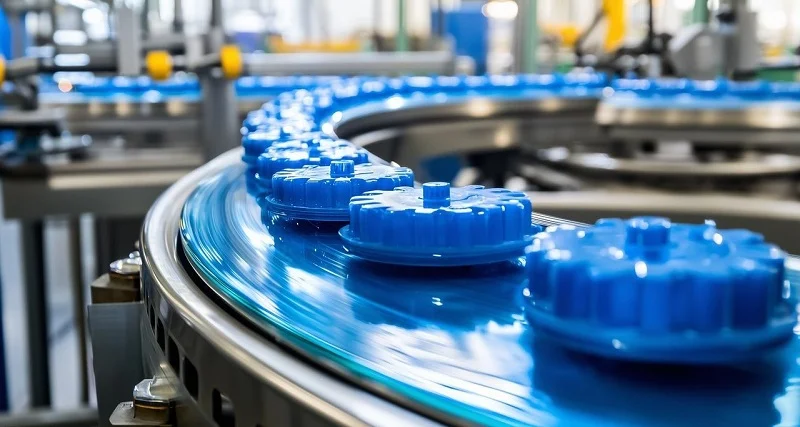
Injection molding’s core strength is repeatability. Once the tool is developed, identical parts are produced consistently, which is what makes tight tolerances and reliability across high volumes possible. Cycles can be as short as 10 seconds in favorable cases, with 15–60 seconds typical for multi-cavity tools. Post-processing is usually minimal because molded parts often have good aesthetics straight from the tool, and the tool itself can carry a specific texture, finish, logo, or engraved text that appears on every part. Waste is low, and excess plastic can often be recycled.
Front-Loaded Tooling Costs
The costs are front-loaded. Steel tooling for high volumes (100,000+) takes significant time and machining to produce and represents a substantial capital cost; at lower volumes, that tooling weighs heavily on cost per part. The process also imposes design discipline: undercuts generally require lifters or sliders (or should be eliminated), walls should be uniform to avoid sink and warp, and parting lines need deliberate placement to keep flash and cosmetic defects under control.
Aluminum Tooling at the Low End
Aluminum tooling changes the economics at the low end. Where a program needs hundreds to thousands of parts with consistent cosmetics and tight dimensional control, aluminum or rapid tooling cuts the upfront cost substantially compared with hardened steel, and bridge tooling lets deliveries begin while production tooling is built. The trade-off is tool life, which is covered in the volume section below.
Applications: Blow Molding vs. Injection Molding
What Blow Molding Covers

Blow molding serves hollow, closed, one-piece articles: beverage and household bottles, jerry cans, drums, automotive fuel and fluid tanks, air ducts, industrial containers, and large cases. The common thread is a shell that must hold volume or fluid and be produced as a single seamless piece. Where the shell also needs an integral handle, extrusion blow molding is effectively the only option.
What Injection Molding Covers
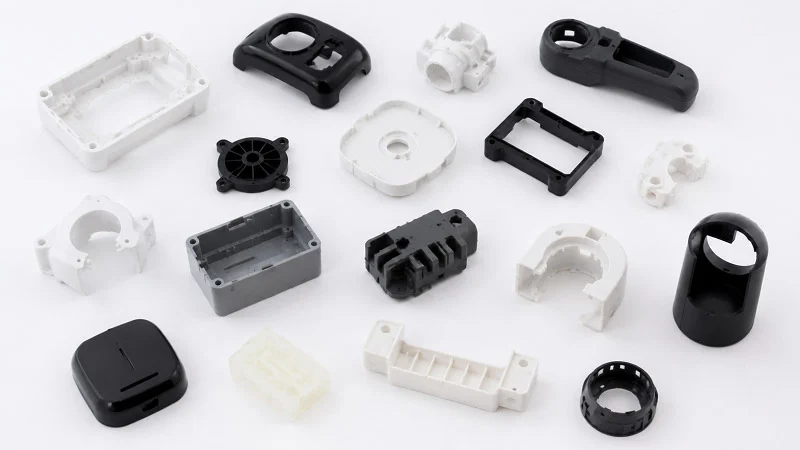
Injection molding serves solid or open components: caps and closures, housings, gears, enclosures, connectors, brackets, medical device components, and consumer product bodies. The common thread is defined geometry — features, fits, and surfaces that must repeat within tight limits, often with inserts, overmolding, or assembly into a larger system.
The In-Between Case
The in-between case is a design that is hollow but needs fine features — a container with a precision-molded internal fitment, for example, or a housing with a sealed internal cavity. What usually decides it is where the precision actually lives. If the tight tolerances are confined to the neck or an interface, a hybrid approach works: injection mold the precise element and blow mold the body, or design the part so the critical features sit in an injection-molded component that assembles to a blown shell. If the precision is distributed across the hollow form itself, the design usually has to be opened up or split into injection-molded pieces and joined — which adds tooling and an assembly step, and is why the same container made by injection can require two tools plus a welding operation.
Materials: What Blow Molding vs. Injection Molding Can Run

Why Blow Molding Runs a Narrow Resin Family
Blow molding is concentrated in a small resin family: HDPE, PET, PP, and PVC. The reason is melt strength. A parison must hang from the die head without sagging excessively, then stretch uniformly as it inflates; a preform must reheat and stretch without tearing. Resins that flow easily but lack melt strength in the parison state are difficult or impractical to blow. Material choice also shifts cycle behavior — PP crystallizes faster than HDPE in thin sections but is more sensitive to parison sag and sealing, while PETG and PVC demand tighter die-head temperature control, and PC and PA require higher melt and mold temperatures that lengthen cooling.
The Wider Injection Molding Range
Injection molding runs nearly all thermoplastics, including filled and reinforced grades, because the constraint is flow into a detailed cavity under high pressure rather than the strength of a free-hanging tube. Glass-filled nylons, PBT, POM, ABS, PC/ABS blends, TPU, and liquid silicone rubber all fall within its range.
Where the Choice Is Genuinely Open
The overlap is where the choice is genuinely open. HDPE, PP, and PET can be processed both ways, so a bottle or container design is not automatically a blow molding job. What decides it is geometry and tolerance: if the part can be molded as an open or split form and assembled, injection molding becomes viable and brings tighter tolerances and better feature detail; if it must be a closed one-piece shell, blow molding is the practical route.
Tolerances, Wall Thickness, and Design Limits

The numbers follow from the mechanics. Blow-molded body dimensions typically hold around ±0.5 mm (roughly ±1%), while injection-molded neck finishes hold about ±0.13 mm; wall thickness in blow molding is not directly controllable and commonly varies 30% or more across a part, against a designed ±0.05 mm in injection molding. Injection molding typically produces parts within ±0.5 mm as a general band, with tighter tolerances feasible down to ±0.125 mm and even ±0.025 mm at significantly higher cost.
Design Rules for Blow Molded Parts
For blow molding, the practical design rules that follow are: keep the blow-up ratio between 2:1 and 2.5:1 (3:1 is the limit, beyond which corners thin out and go brittle); use internal radii of 2–3× wall thickness, since corners stretch most and end up thinnest; allow 0.5–1° draft per side on smooth surfaces and 1–1.5° on textured ones; and keep rib or emboss depth at or below 0.5× wall, because low blow pressure cannot force material into deep detail. Typical container body walls run 0.3–1.0 mm, while industrial extrusion blow molded walls run 2–6 mm. Tight-tolerance features belong at the neck, which is why necks are often injection molded even on blown bodies.
Design Rules for Injection Molded Parts
For injection molding, the rules are different in kind: keep walls as uniform as the design allows to avoid sink and warp, plan undercuts deliberately (eliminate them, or budget for lifters and sliders), and place parting lines along sharp edges or natural transitions where flash and cosmetic defects are least visible. Tolerances tighter than the standard band are possible but should be reserved for the features that need them, because they raise tooling and inspection cost across the whole part.
Production Volume and Cost: When the Economics Flip

Tooling and Material Costs
The economics are a trade between tooling capital and cost per part. Blow mold tooling runs roughly $15,000–$50,000; a single-cavity extrusion blow mold for an HDPE bottle sits at the lower end, around $15,000–$40,000. Injection tooling runs roughly $25,000–$150,000, and the same container made by injection can require two tools plus a welding operation, pushing tooling to $80,000–$150,000. Material also favors blow molding for hollow parts: a 1 L HDPE bottle uses 30–45 g of resin.
Expected planning ranges for injection mold tool life by SPI mold class, as listed by the cited source. These are planning figures, not guarantees; the source does not define how a ‘shot’ is counted, and actual life depends on material, part design, and maintenance regime.
Tool Life by Mold Class
Tool life determines how that capital is repaid. Aluminum molds (SPI Class 105) are typically rated at 500–10,000 shots; P20 pre-hardened steel (Class 103) at 100,000–500,000 shots; hardened steel such as H13 at 500,000–1,000,000 shots; and hardened stainless (Class 101) at 1,000,000+ shots. Published figures vary by source and by maintenance regime — one comparison puts P20 at 50,000–100,000 shots — so the class, not a single number, is the useful planning unit.
Where the Flip Point Sits
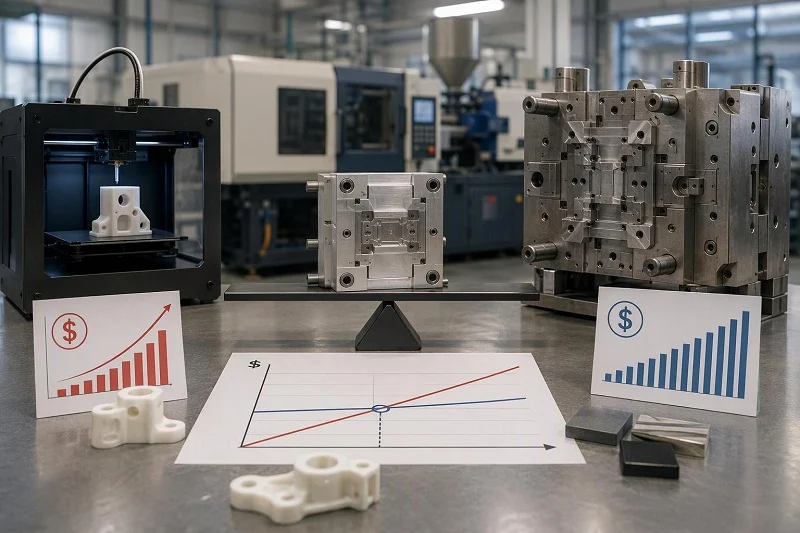
The flip point follows. At low volumes, the injection tool’s cost is spread across few parts and dominates unit cost, while a blow mold’s lower capital is recovered quickly. As volume rises, injection molding’s shorter per-part cost and longer tool life take over, and the higher upfront tooling is repaid. But volume alone does not decide it: if the part must be hollow and closed, blow molding wins at essentially any volume, because injection molding cannot produce that geometry without splitting the part and adding assembly. Injection molding only competes on a hollow design when the geometry can be opened up or split. Where volume is low but the part is solid and detailed, aluminum injection tooling or a bridge tool can change the calculation in injection molding’s favor.
Blow Molding vs. Injection Molding: Which Process Should You Choose?
When Blow Molding Is the Answer
Choose blow molding when the part is a hollow, closed container or tank, the dimensional demands are moderate outside the neck, and the volume is high enough to justify a dedicated blow mold — or when the design needs an integral handle that only parison pinching can produce. Choose injection molding when the part is solid, open, or finely featured, when tolerances in the hundredths of a millimeter matter across the part, or when a high-volume run justifies steel tooling and rewards repeatability.
When Neither Process Comes First
There are also cases where neither is the right first step. Early prototypes and design iterations are often better served by 3D printing or CNC machining before committing to production tooling, since both avoid mold capital entirely and deliver parts in days. Low-volume injection molding with aluminum or bridge tooling is a middle path when the final process is injection but the volume does not yet justify hardened steel. The mistake to avoid is committing to production tooling before the design has stabilized — a tool cut for a design that then changes is the most expensive way to learn about a fit problem.
Prototyping Through Production with NOBLE

Once the process decision is made, execution determines whether the part arrives on spec and on schedule. NOBLE is a leading contract manufacturer in China — a Sino-British joint venture recognized by the government as a “National High-tech Enterprise” — and its service capabilities and professional manufacturing expertise help customers move efficiently from prototyping through mass production.
Our Certification
NOBLE holds ISO 9001:2015 and ISO 13485:2016 certification, and its quality system is supported by a full set of inspection equipment and an overall quality control process, so prototypes and components are produced to the tolerances their specifications call for. The service range runs from design through assembly rather than manufacturing alone: engineers support design optimization, process selection, cost reduction, and the transition from prototype to production, which is the stage where the choices described in this article — tooling class, material, tolerance band, and volume — get locked in.
For teams working through a blow molding vs. injection molding decision, that support can start before the tool is cut: reviewing the CAD model against the process, confirming which features need which tolerance, and planning the prototype-to-production path so the first tool is the right tool. You can learn more about NOBLE’s capabilities at uprojectspartner.com.
FAQs About Blow Molding vs. Injection Molding
Which process fits a part that sits between hollow and solid?
Decide by where the precision lives. If tight tolerances are confined to a neck or an interface, a hybrid works: injection mold the precise element and blow mold the shell, or assemble an injection-molded fitment into a blown body. If precision is distributed across the hollow form, the design usually has to be opened up or split into injection-molded pieces and joined, which adds tooling and assembly cost.
Can prototyping happen in the same process and material as production?
Sometimes, but not always economically. Blow molding and injection molding both require tooling, so early prototypes are often made by 3D printing or CNC machining in a comparable resin to validate fit and form before mold capital is committed. Low-volume injection molding with aluminum or bridge tooling can produce parts in the production material and process when that fidelity matters. Confirm with your manufacturer which prototype route will actually predict production behavior for your part.
Which resins are effectively limited to one process?
Blow molding is concentrated in HDPE, PET, PP, and PVC because the parison must have enough melt strength to hang and stretch without sagging or tearing. Resins that flow well but lack that strength in tube form are difficult to blow. Injection molding runs nearly all thermoplastics, including filled and reinforced grades, because the constraint is flow into a detailed cavity under pressure. HDPE, PP, and PET appear in both, so those are the cases where the choice is genuinely open.
How should I evaluate a manufacturing partner’s quality evidence?
Ask to see the quality control plan, dimensional inspection reports, and process data — not just a price quote. For medical device work, confirm the partner’s quality management certification and how it maps to the standard your product is regulated under; ISO 13485:2016 is the international medical device QMS standard, and the FDA’s Quality Management System Regulation that took effect on February 2, 2026 incorporates it by reference. A partner who can show inspection records and control limits is easier to qualify than one who only offers the lowest price.