Rehabilitation exoskeleton robots are becoming an important technology in the field of rehabilitation medicine. They help patients regain their mobility through intelligent control systems, mechanical structures, and precise motion assistance functions. As the core mechanical components of these robots will directly affect the safety of use and the rehabilitation effect, the manufacturing requirements for each part are extremely high.
Unlike the parts of traditional industrial robots, the components of rehabilitation exoskeleton robots need to strike a balance between meeting medical standards, durability, and human adaptability. The key components include joint assemblies, support frames, drive connectors, and structural brackets, etc. These parts need to have excellent machining accuracy and reliable material properties. Even a very small dimensional error may affect the robot’s motion coordination and the user’s wearing comfort.
This guide will provide a comprehensive introduction to the parts of rehabilitation exoskeleton robots, including their core components, CNC machining processes, and material selection.
1. Common Manufacturing Methods for Rehabilitation Exoskeleton Robot Parts
As medical technology advances, medical robots are changing traditional healthcare models. From surgical robots to rehabilitation robots and elderly care robots, smart devices are helping doctors and patients achieve more efficient and safer medical services.
However, the performance of medical robots does not only depend on software algorithms and control systems; the manufacturing quality of precision mechanical parts also determines the stability and reliability of the robots.
Rehabilitation exoskeleton robot parts typically need to meet multiple requirements:
- High precision
- High strength
- Lightweight design
- Long-term stable operation
- Good material safety
Compared with the parts of ordinary industrial robots, the manufacturing of parts for rehabilitation exoskeleton robots is more difficult. A tiny dimensional error may affect the movement accuracy of the robotic arm, the feedback effect of the sensors, and even the final safety of use. Therefore, choosing the appropriate manufacturing process is a key link in the research and development and mass production of rehabilitation exoskeleton robots.
1.1 CNC Precision Machining: The Core Process for Rehabilitation Exoskeleton Robot Parts
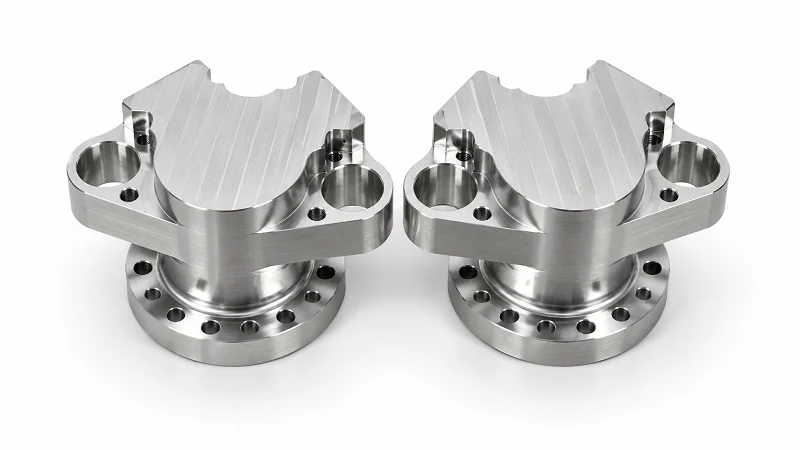
In medical robot parts manufacturing, CNC precision machining is one of the most widely used methods.
CNC machining, which controls the movement of machine tools through computers, can achieve complex structures and high-precision dimensional processing.
Common applications include:
- Robot joint housings
- Robotic arm connectors
- Motor mounts
- Sensor brackets
- Precision shaft components
Rehabilitation exoskeleton robots usually require the precise coordination of multiple parts, so the processing accuracy requirements are extremely strict.
For example:
Precise fit between shafts and bores inside robot joints is essential. Poor fit can lead to:
- Increased motion resistance
- Enlarged mechanical errors
- Reduced positioning accuracy
Through five-axis CNC machining, errors caused by repeated clamping of parts can be reduced, and the consistency of complex structural components can be improved.
Commonly used materials include:
- Aluminum alloy
- Titanium alloy
- Stainless steel
- PEEK engineering plastic
These materials meet the requirements for strength, weight, and corrosion resistance in rehabilitation exoskeleton robots.
1.2 Metal 3D Printing: Achieving Complex Structures and Lightweight Design
With the continuous development of rehabilitation exoskeleton robots towards lightweight designs, metal 3D printing technology has gradually attracted attention.
Traditional processing methods usually require multiple procedures to complete complex parts, while metal 3D printing can directly manufacture complex integrated structures.
It applies to:
- Lightweight robot support structure
- Customized connectors
- Complex internal structural components
For instance, some support structures in exoskeleton robots need to simultaneously meet the following requirements:
- Low weight
- High load-bearing capacity
- Human comfort
Metal 3D printing can maintain sufficient strength while reducing weight by optimizing the internal structure.
Commonly used materials include:
- Titanium alloy
- Stainless steel
- Aluminum alloy
For small-batch products in the research and development stage of rehabilitation exoskeleton robots, 3D printing can shorten the development cycle and accelerate product verification.
1.3 Injection Molding: Meeting Mass Production Needs for Rehabilitation Exoskeleton Robots
When rehabilitation exoskeleton robots enter the commercialization stage, plastic parts typically require injection molding.
Injection molding offers:
- High production efficiency
- Low cost
- Good product consistency
Common applications include:
- Robot housings
- Protective covers
- Sensor housings
- Control panel assemblies
- Lightweight structural components
Commonly used plastic materials for rehabilitation exoskeleton robots include:
- ABS
- PC
- PEEK
- PPSU
Among these, PEEK is widely used in the medical field because it offers:
- High strength
- High temperature resistance
- Chemical resistance
- Good biocompatibility
PEEK is a highly valuable engineering material for parts that need to be in long-term contact with the human body or in high-temperature disinfection environments
1.4 Sheet Metal Fabrication: An Important Method for Manufacturing Robot External Structures
In addition to precision internal parts, rehabilitation exoskeleton robots also require many external structural components.
Sheet metal fabrication is mainly used for:
- Robot body housings
- Chassis structures
- Electrical control cabinets
- Support frames
Common processing steps include:
- Laser cutting
- Bending and forming
- Welding
- Surface treatment
Sheet metal processing is suitable for medium and small batch production.
For rehabilitation exoskeleton robot enterprises in the research and development stage, sheet metal processing can quickly complete prototype manufacturing and support subsequent product optimization.
1.5 Precision CNC Turning: Ensuring Stable Operation of Motion Components
Rehabilitation exoskeleton robots contain many rotating motion structures.
These parts typically require precision turning.
Examples include:
- Drive shafts
- Rotating shafts
- Bearing housings
- Precision connectors
Turning mainly controls:
- Roundness
- Concentricity
- Surface roughness
These parameters directly affect the stability of robot motion.
In rehabilitation robots, motion components need to maintain high precision over long periods, making precision turning indispensable.
1.6 Surface Treatment: Improving Part Longevity and Safety
Rehabilitation exoskeleton robot parts typically require surface treatment to improve:
- Corrosion resistance
- Surface hardness
- Service life
- Appearance quality
Common surface treatment methods include:
1.6.1 Anodizing
Mainly used for aluminum alloy parts.
Effects:
- Enhanced wear resistance
- Improved corrosion resistance
- Better surface quality
1.6.2 Passivation
Mainly used for stainless steel medical parts.
Effects:
- Removal of machining residues and contaminants
- Improved corrosion resistance
1.6.3 Precision Polishing
Suitable for:
- Medical tools
- Contact components
- High-requirement surface areas
Good surface treatment improves the long-term reliability of medical robots.
1.7 Precision Inspection: Ensuring Medical Robot Part Quality
The manufacturing of rehabilitation exoskeleton robots not only requires advanced processing technology but also strict quality inspection.
Common inspection equipment includes:
- Coordinate Measuring Machines (CMM)
- Optical measurement equipment
- Laser inspection equipment
- Roughness testers
Inspection content includes:
- Dimensional accuracy
- Hole position accuracy
- Concentricity
- Flatness
- Surface quality
For critical parts such as robot joint assemblies, strict first-article inspection and in-process control are required.
Only by ensuring consistency of every part can overall machine performance be guaranteed.
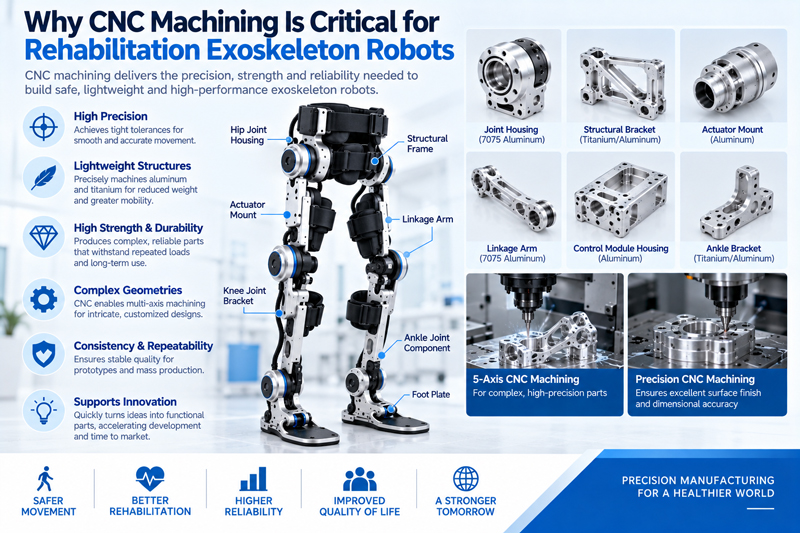
2. Why CNC Machining Is Critical for Rehabilitation Exoskeleton Robots
Robotic medical systems operate under mechanical constraints, a situation rarely encountered in industrial automation:
High cycle, low fatigue failure:
The joint housing and transmission couplings must withstand millions of repeated hinge cycles without causing clearance due to wear.
Biocompatibility and sterilization tolerance:
Instruments that come into contact with patients or during surgery must be capable of withstanding steam autoclaving, gamma-ray irradiation, or vaporized hydrogen peroxide sterilization protocols.
Miniaturization and structural integrity:
Endoscopes and catheter surgical robots require extremely small yet robust components, as well as internal channels for transporting liquids, optical elements, or cables.
Multi-material integration:
A single robotic arm assembly can integrate titanium structural connectors, PEEK insulating gaskets, 316L stainless steel instrument interfaces, and aluminum transport frames.
CNC machining:
Especially five-axis linkage milling, Swiss-type precision turning, and micromachining can provide the geometric degrees of freedom, surface integrity, and batch-to-batch repeatability required for mass production of these parts. Unlike additive manufacturing, precision CNC machining can achieve the strict tolerances and smooth surface finishes required for the mating of bearing housings, sealing surfaces, and sterile instruments without lengthy secondary processing.
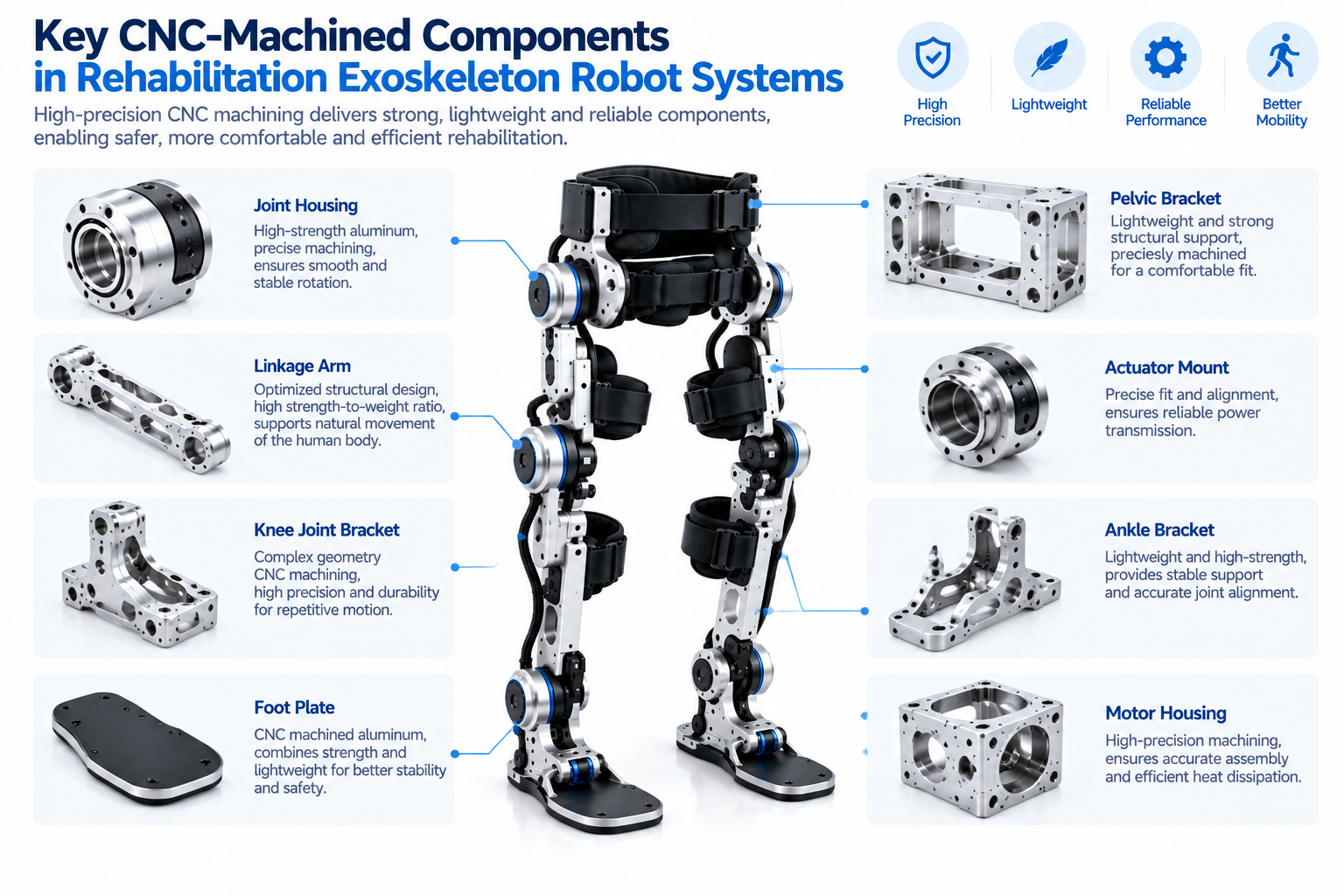
3. Key CNC-Machined Components in Rehabilitation Exoskeleton Robot Systems
3.1 Joint Housings
The joint housing is one of the most complex load-bearing and highly precise components in the exoskeleton system. It not only has to withstand the user’s weight and the impact of walking, but also provide precise installation references for bearings, reducers, encoders, and torque sensors.
Material: 7075/6061 aluminum alloy (titanium alloy for some high-end models)
Machining Key Points:
- Bearing mounting hole concentricity must be within 0.1 mm to ensure motion accuracy
- Wall thickness is typically 2- 3 mm, with some weight-reduction areas as thin as 1.5mm, making deformation likely during machining
- Requires single-setup multi-surface machining to avoid cumulative errors from repositioning
Post-treatment: Hard anodizing for better wear resistance and disinfectant resistance
3.2 Positioning Shafts and Brake Components
The positioning shaft is responsible for the precise positioning and force transmission of joint rotation. During repeated movements, it is subjected to alternating loads and frictional wear.
Materials: 303/304 stainless steel, 42CrMo4 alloy steel
Key points of processing:
- The diameter tolerance is usually controlled within ±0.005mm, and the roundness is no more than 0.005mm
- The shaft shoulder and threaded parts need to be completed in one clamping to ensure the accuracy of the positional relationship
- The key surface roughness requirement is Ra < 0.4 μm, and it needs to undergo a fine grinding process
Post-treatment: Electro-polishing or galvanizing to enhance corrosion resistance
3.3 Lead Screws and Worm Drive Components
The lead screw pair is used to convert the rotational motion of the motor into linear motion (such as adjusting the length of the thigh/calf), and the worm is used for high reduction ratio transmission.
Material: Alloy steel (screw), wear-resistant bronze (nut)
Machining Key Points:
- Lead accuracy must reach C3 grade or higher
- Thread raceways require multiple rough and finish grinding steps; surface roughness Ra < 0.2 μm
- Requires a temperature-controlled workshop(20±1°C) to prevent temperature changes from affecting measurements
Post-treatment: Surface hardening + precision grinding
3.4 Lightweight Frames and Weight-Reduction Structural Components
The frame is the “skeleton” of the exoskeleton, determining the rigidity and weight of the entire machine. Lightweighting is the eternal pursuit of rehabilitation exoskeletons.
Material: 7075-T6 aluminum alloy, carbon fiber composite material (high-end model)
Key points of processing:
- The honeycomb-shaped material scaffolding or window-type weight-reduction hole design is adopted to reduce weight to the greatest extent while ensuring strength
- After rough machining, natural aging for 24 to 48 hours is required to release stress before proceeding to fine machining
- The flatness of the key installation surface should be < 0.02 mm
Post-treatment: Sandblasting + anodizing to achieve a uniform matte texture
3.5 Sensor Mounts
Force sensors, torque sensors, Angle encoders, etc. are the “nerve endings” of exoskeletons, and the accuracy of their installation seats directly affects the quality of the sensing data.
Material: low thermal expansion for Invar alloy, stainless steel, or aluminum alloy
Key points of processing:
The flatness and verticality of the installation surface are extremely important (usually < 0.01 mm).
Materials with a thermal expansion coefficient that matches that of the sensor should be selected to avoid data drift caused by temperature changes
The key installation holes must be 100% inspected by a CMM coordinate measuring machine
Clinical value: An installation base tilted by 0.1° may cause a deviation of more than 5% in the force feedback data.
3.6 Friction Components and Guide Parts
The sliding mating parts of exoskeletons (such as length adjustment mechanisms and joint guide grooves) require low-friction and wear-resistant components.
Materials: POM (acetal steel), nylon, self-lubricating engineering plastics
Key points of machining:
The surface roughness Ra of the key sliding surface is < 0.8 μm
The fit clearance should be controlled between 0.05 and 0.10mm – if it is too tight, it will get stuck; if it is too loose, it will cause shaking
The impact of shrinkage rate on dimensions of injection molded parts needs to be controlled
Post-treatment: Use directly; generally, no additional surface treatment is required
3.7 Key Quality Control Checkpoints
| Inspection Stage | Core Content |
| Incoming Material | Material certificate verification, hardness testing, composition analysis |
| In-Process Control | First-piece + patrol + last-piece inspection, 100% inspection of critical dimensions |
| Final Inspection | CMM full dimensional inspection, surface roughness testing, salt spray testing |
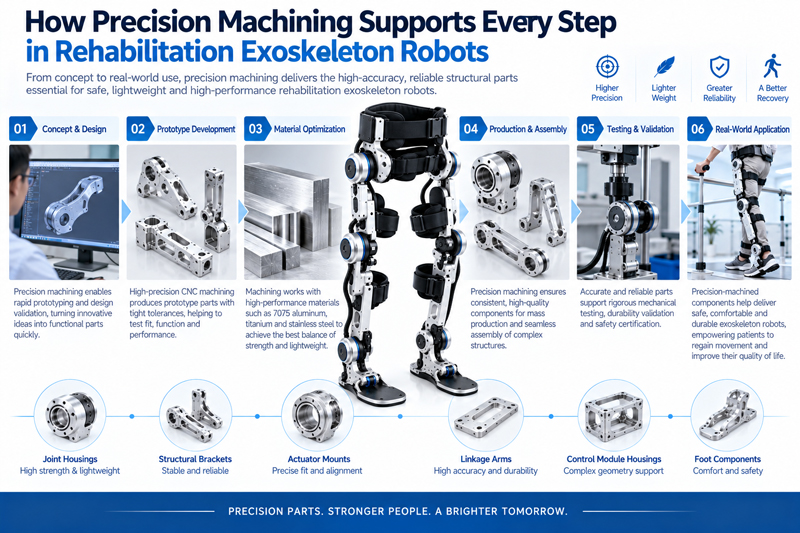
4. How Precision Machining Supports Every Step in Rehabilitation Exoskeleton Robots
When a patient with spinal cord injury wears the FreeGait exoskeleton system and takes the first step after the injury; When a stroke survivor uses an exoskeleton in his hand to pick up a glass of water again – behind these seemingly simple actions, there are hundreds or even thousands of precisely machined parts working in coordination.
Rehabilitation exoskeletons are different from surgical robots. They do not pursue sub-millimeter precision in a single surgery, but rather demand reliability over tens of thousands of repeated movements, the ability to support human weight while remaining sufficiently light, and the guarantee of biocompatibility during long-term skin contact. This poses unique challenges to precision manufacturing.
4.1 Structural Load-Bearing Components: The Constant Goal of Lightweight
Firstly, an exoskeleton is foremost a “device worn on the body”. The physical strength of the wearer is limited, and the self-weight of the device directly determines the user’s fatigue level and rehabilitation effect.
Key components: thigh support arm, calf connecting rod, pelvic module assembly, waist support part.
Core challenge: It must be both lightweight and capable of withstanding repeated swinging, impact, and assembly preload.
Key technical points
- Material: 7075-T6/6061-T6 aluminum alloy is the mainstream choice, taking into account both lightweight and strength
- Wall thickness control: To reduce the weight, the wall thickness of some areas is reduced to 2mm to 3mm, and deep cavity weight reduction is also required in certain areas
- Weight reduction strategy: Adopt methods such as honeycomb pockets and local thin walls for weight reduction, but never over-drain material near the motor installation surface and bearing housing
Processing difficulty: Thin-walled aluminum parts are extremely prone to deformation during the cutting process. During rough machining, the material allowance is quickly removed, internal stress is released, and the parts may warp, the hole spacing may drift, or the installation surface may not fit. The solutions include: retaining a 0.2- 0.5 mm allowance after rough machining to release stress, using vacuum suction cups to disperse clamping force, and employing 5-axis linkage to reduce flipping positioning errors.
4.2 Joints and Transmission Systems: The Source of Motion Precision
Every leg lift, knee bend, and step in an exoskeleton depends on precise coordination of joint and transmission parts.
Key Parts: Hip joint motor housings, bearing assemblies, positioning shafts, brake interfaces, chain lock blocks.
Typical Applications:
- RoboGait system procured about 90% of its mechanical parts through outside suppliers, covering CNC milling, turning, laser cutting, bending, and welding
- FreeGait active exoskeleton adjusts thigh/shin length and hip width for different body types. The precision of each connector directly affects wearing comfort
| Part Type | Material | Post-Treatment |
| Joint Housings | 6061/7075 Aluminum Alloy | Sandblasting + Anodizing, Hard Anodizing |
| Positioning Shafts/Brakes | 303/304 Stainless Steel, 42CrMo4 Steel | Electropolishing, Zinc Plating |
| Friction/Insulation Parts | POM, Nylon, ABS | Used As-Is |
Machining Requirements:
Positioning shafts and joint housings typically need concentricity within ±0.01mm to ensure smooth bearing assembly and prevent wear-related issues.
4.3 Sensor Mounts and Calibration Structures: The “Nerve Endings” of Rehabilitation
Rehabilitation exoskeletons need to sense the user’s intent and state—when to step, what angle the joint is at, how much force is applied—all of which rely on sensors.
Key Parts: Force sensor mounts, encoder brackets, EMG electrode fixtures.
Machining Key Points:
- Mounting surface flatness and perpendicularity directly affect sensor data accuracy
- Materials with thermal expansion matching the sensor (like Invar or stainless steel) are typically used
- Sensor mounts often need single-setup multi-direction machining to ensure positional accuracy between mounting surfaces
Processing requirements:
The positioning shaft and the joint housing often need to have a coaxiality within ±0.01mm to ensure smooth movement of the bearing after assembly and avoid “increased clearance” or “uneven running resistance” caused by uneven wear.
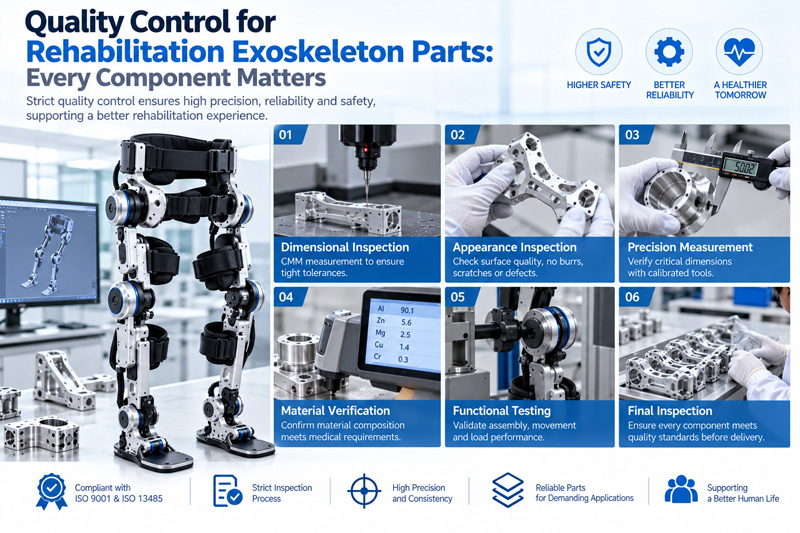
5. Quality Control for Rehabilitation Exoskeleton Parts: Every Component Matters
Rehabilitation exoskeleton parts may not enter the human body like surgical instruments, but they bear the user’s weight and undergo millions of repeated motions.
Key points of processing
- The flatness and verticality of the installation surface directly affect the accuracy of the sensor data
- Materials with a thermal expansion coefficient that matches the sensor (such as Invar alloy or stainless steel) are usually selected.
- The sensor mounting base often needs to be clamped in one go to complete multi-directional processing to ensure the positional relationship between each mounting surface
Assembly Validation:
After parts are installed, joint motion smoothness, backlash, and full-stroke torque must be re-checked
6. Material Selection for Rehabilitation Exoskeleton Robot CNC Components
Material selection for medical robots involves biomechanics, chemistry, and regulations. Below are four major material types commonly used in precision-machined robot parts.
6.1 Titanium Ti-6Al-4V ELI
It is the main material for implantable and long-term reusable rehabilitation exoskeleton robot components. Its high strength-to-weight ratio, excellent corrosion resistance, and proven biocompatibility (in compliance with ISO 5832-3 standards) make it an ideal material for end effectors, structural arms and sterilizable instrument brackets.
Processing precautions:
The low thermal conductivity and rapid work hardening characteristics of titanium require the use of rigid machine tools, high-pressure coolant delivery, and sharp carbide or PVD-coated cutting tools during processing. Heat accumulation must be effectively controlled to prevent surface integrity damage and premature tool failure
6.2 Medical-Grade PEEK
The application of PEEK material in rehabilitation exoskeleton robots is becoming increasingly widespread, especially suitable for components that require X-ray transparency (no visualization under X-ray fluoroscopy), electrical insulation, or reduction of image artifacts in MRI/CT examination environments. Typical applications include: electrical insulating sleeves, lightweight non-metallic structural gaskets, and guiding components that need to keep the imaging examination access unobstructed during rehabilitation training.
Processing precautions:
The low thermal conductivity of PEEK makes it prone to local melting, damage to the crystalline structure and burr adhesion during the cutting process. Rehabilitation exoskeleton parts often involve thin-walled structures and complex curved surfaces, making them more sensitive to thermal damage. Precision CNC machining requires optimizing the feed rate and spindle speed, rationally arranging the annealing cycle to eliminate internal stress, and using dedicated non-metallic tools to avoid particle contamination affecting the biocompatibility of the material – this is particularly important for rehabilitation equipment that is in long-term contact with the skin.
6.3 316LVM Stainless Steel
Vacuum-melted 316L stainless steel offers better machinability than titanium alloys while providing good passivation and sterilization resistance. It is the preferred material for rehabilitation exoskeleton drive shafts, fastener hardware, and applications where cost control is important.
6.4 Aluminum Alloys (6061-T6, 7075-T6)
For structural frames that are not implanted or sterilized, aluminum offers an excellent strength-to-weight ratio with lower material and machining costs. Hard-anodized aluminum can also be used as wear-resistant guides or housings.
7. Tolerances, Surface Finish, and Measurement Standards
Tolerance requirements for rehabilitation exoskeleton robot parts are typically one level stricter than general industrial automation parts:
Dimensional Tolerances: ±0.005mm to ±0.025mm for bearing bores and gear centers.
Geometric Tolerances: True position, concentricity, perpendicularity, and runout are standard requirements for multi-axis assemblies.
Surface Roughness: General mating surfaces Ra 0.4-0.8μm; sliding or sealing surfaces Ra < 0.2 μm.
Burr Control: Strict deburring is required. Metal burrs can affect sterilization, damage packaging, or harm patients.
To meet and check these specifications, in-process CMM verification, First Article Inspection (FAI), and Statistical Process Control (SPC) are needed. Every critical feature must be measurable, recordable, and traceable to material batches and machining records.
8. Regulatory Compliance and Quality Systems by Region
Rehabilitation exoskeleton robot components need strict documentation and quality systems like patient-contact or surgical equipment.
8.1 ISO 13485: Global Quality Standard
Whether for Class II surgical robots or Class I rehabilitation exoskeletons, an ISO 13485-certified Quality Management System is the global standard for component suppliers. It ensures controlled processes, validated production parameters, supplier audits, and complete Device History Records (DHR).
8.2 FDA 21 CFR Part 820 (United States)
For the North American market, CNC suppliers serving rehabilitation exoskeleton OEMs must meet FDA Quality System Regulation requirements, including design traceability, process validation (IQ/OQ/PQ), and complaint handling. Full batch traceability from bar stock to finished assembly is required.
8.3 EU Medical Device Regulation 2017/745 (Europe)
Under European MDR, components integrated into advanced systems need strong technical documentation. CNC shops must provide material certifications, risk management compliance (ISO 14971), and post-market monitoring support for their customers’ regulatory submissions.
8.4 PMDA and MHLW (Japan)
Japan’s PMDA requires foreign manufacturers to register or work through a Japan-based representative. Japanese medical robot OEMs typically require material certifications meeting Japanese Industrial Standards (JIS) and strict inspection processes following domestic quality standards.
8.5 TGA (Australia)
The Australian Medicines Administration recognizes the approval channels of the EU Medical Device Regulation (EU MDR) and the US Food and Drug Administration (FDA), but the sponsor in Australia must ensure compliance with the basic principles. Medical robot distributors in Australia are increasingly demanding that their CNC machine tool suppliers provide biocompatibility summaries, sterilization verification data, and clear qualification certificates.
9. What Rehabilitation Exoskeleton Robot Manufacturers Should Consider When Choosing a CNC Partner
Choosing a manufacturing partner for robotic medical equipment goes far beyond looking at cost per part. A good engineering-focused partner should show:
- Design for Manufacturability (DFM) support early in the robot development cycle
- Material certification management, including test reports, biocompatibility declarations, and RoHS/REACH compliance
- Controlled-environment machining or validated cleaning to remove particles, coolant residues, and cross-contamination risks
- Integrated measurement capabilities, including CMM, optical comparators, and surface roughness testers
- Regional regulatory knowledge—experience supporting EU, FDA, PMDA, and TGA submissions
10. Why choose NOBLE as the manufacturer of Rehabilitation Exoskeleton Robot Structural Parts?
NOBLE helps companies turn concepts into functional prototypes and production ready parts. Unlike suppliers that offer only prototyping services, NOBLE provides one-stop manufacturing solutions ranging from design assistance to final assembly.
NOBLE’s Silicone Rapid Prototyping Capabilities
Silicone rapid prototyping at NOBLE is integrated with other services. Design support is directly incorporated into the manufacturing process. CNC machining produces master molds. Injection molding meets mass production needs. Assembly and surface finishing bring the product to its final form. The entire process is managed by a single supplier.
Quality Standards and Certifications
The quality system has been certified and is well documented.
ISO 9001:2015 covers general quality management. Manufacturing process controls ensure the repeatability of results; inspection procedures verify dimensions and surface quality.
ISO 13485:2016 adds the stringent requirements necessary for the manufacture of medical devices- more rigorous traceability and stricter process validation.
FAQs
Q1: What materials are commonly used in CNC machining for rehabilitation exoskeletons?
Aluminum alloys (6061/7075), stainless steel (303/304), engineering plastics (POM/Nylon/ABS), PEEK, and titanium alloys.
Q2: What are the machining challenges for aluminum alloy parts?
Thin walls are easy to deform. Solutions: separate rough and finish machining, leave allowance for stress relief, use vacuum chucks or special fixtures.
Q3: What should be noted when machining PEEK?
Poor heat conductivity and easy burr formation. Solutions: diamond-coated tools, low cutting speeds, high-pressure cooling, manual or chemical deburring.
Q4: What is the minimum wall thickness achievable?
Typically 2- 3 mm, locally down to 1.5mm. But this needs evaluation based on part structure and loading—thinner is not always better.
Q5: What certifications are required for medical device machining?
Minimum requirement: ISO 13485. For export, FDA registration or CE-MDR certification is also needed.