Insert molding and overmolding are the two most important and most used processes in injection molding. But they are similar in some ways. During part production, engineers and buyers often get confused when choosing between them. They cannot always make the right decision. This guide will break down the differences between insert molding and overmolding from the basic logic.

1. What Is Insert Molding?
Insert molding is an injection molding process. It places a pre-made insert into the mold, then injects plastic to wrap around the insert. After cooling, the plastic and insert become one single part. The purpose of insert molding is to make a single part using two or more materials. Usually, a metal part is combined with a thermoplastic. This creates a product with the properties of both materials. Before the melted plastic is injected, the metal part is placed into the mold cavity. The plastic is molded around these “inserts” and then hardens. Since the metal part is firmly held by the plastic bonded around it, no fasteners are needed.

2. How Does Insert Molding Work?
Insert molding usually follows these steps:
- Insert preparation: First, the insert needs to be prepared. This may include cleaning the insert or even preheating it.
- Insert placement: Next, an operator or robot carefully places the insert into the mold.
- Mold closing: The mold closes and holds the insert firmly in place.
- Plastic injection: Hot liquid plastic is injected into the mold. The plastic flows around the insert.
- Cooling and solidification: The plastic cools and hardens.
- Part ejection: Finally, the mold opens, and the finished part (with the insert now as part of it) is removed.

3. What Are the Advantages of Insert Molding?
Insert molding is versatile because of its many advantages. Here are some reasons to consider this process for your project.
- Insert molding is good for making strong and reusable connections.
- It is cost-effective.
- It can produce thousands of parts per day. This economy of scale can greatly lower the cost per part.
- It helps produce thin-wall, non-tappable housings.
- It removes the need for part assembly.
- It improves part performance by combining metal and plastic parts.
- It is ideal for making products that are dust-proof, moisture-proof, shock-proof, and pull-out resistant.

4. What Are the Disadvantages of Insert Molding?
This process has some serious disadvantages:
-
Numerous manufacturing processes:
Usually, two steps are required. Special metal inserts need to be manufactured through costly processes such as CNC cutting, die casting or metal injection molding. Therefore, its unit cost is higher than that of fully injection-molded plastic parts.
-
Increased Complexity of parts:
Special metal inserts require a deeper understanding of the Design for Manufacturability (DFM) principles of metal and plastic processes, making it more difficult to integrate them into individual functional parts.

5. What Is Overmolding?
Overmolding is a two-step injection molding process. In step one, a base part is molded with one plastic. This part is called the substrate. The substrate can be hard plastic or metal. In step two, the substrate is placed into another mold. A second material is injected. This material is usually soft plastic or rubber. It wraps around the substrate surface and forms a thin outer layer.
The two materials must bond chemically or mechanically. Otherwise, the outer layer can peel, lift, or separate. Common combinations are hard plastic plus soft plastic, or metal plus rubber.
The core purpose of overmolding is to combine the advantages of two materials into one part. The substrate provides structural strength, rigidity, and dimensional stability. The overmold layer provides grip, sealing, cushioning, and a comfortable feel. The final result is a single part that is hard inside and soft outside. It is strong and slip-resistant, and it has the advantages of both materials.
It is widely used in medical devices, power tools, consumer electronics, automotive, and daily consumer goods. Wherever a product needs a “hard structure with a soft surface,” overmolding can add value.

6. How Does Overmolding Work?
Step 1: Mold the Substrate
First, a base part is molded with one type of plastic. This part is called the substrate. The substrate can be hard plastic or metal. After molding, the substrate is removed from the mold.
Step 2: Place into the Second Mold
The cooled substrate is placed into the cavity of another mold. The mold closes and holds the substrate in place.
Step 3: Inject the coating material
Inject the second material, which is usually soft rubber or rubber. This material will be wrapped around the surface of the substrate, forming a thin outer layer. The two materials must be chemically or mechanically bonded; otherwise, the outer layer is prone to fall off.
Step 4: Cooling and demolding
After the coating material cools and solidifies, it forms a firm bond with the substrate. The mold is opened, and the finished product is taken out, resulting in an integral part that is hard inside and soft outside.

7. What Are the Advantages of Overmolding?
7.1 Better Material Flexibility
Overmolding lets designers use the advantages of multiple materials to create complex parts with different properties. It also adds visual complexity.
7.2 Easy Bonding
Overmolding fuses different materials together inside the mold. This removes the need for glues or other special bonding methods. This not only lowers the cost of overmolding projects but also gives a more durable final product.
7.3 New Functions
If your design needs waterproofing, overmolding can be a way to integrate elastic material into the part instead of using a gasket or O-ring. This way, your part has both the needed structure and sealing performance. You do not need to struggle to fit a gasket in the middle of the part during assembly.

8. What Are the Disadvantages of Overmolding?
Although overmolding improves product performance, it also has some disadvantages:
- Multiple Production Steps: Making a part with overmolding needs two steps. This increases the production cycle. Overmolding usually costs more than making a single part in one molding step. Also, because overmolding is a two-step process, it needs more molds than single-shot molding.
- De-bonding: If two different parts are bonded together in an injection mold, there is a risk of separation. This happens when the best temperature range fluctuates. When there is not enough heat to bond the materials successfully, mechanical interlocks must be used.
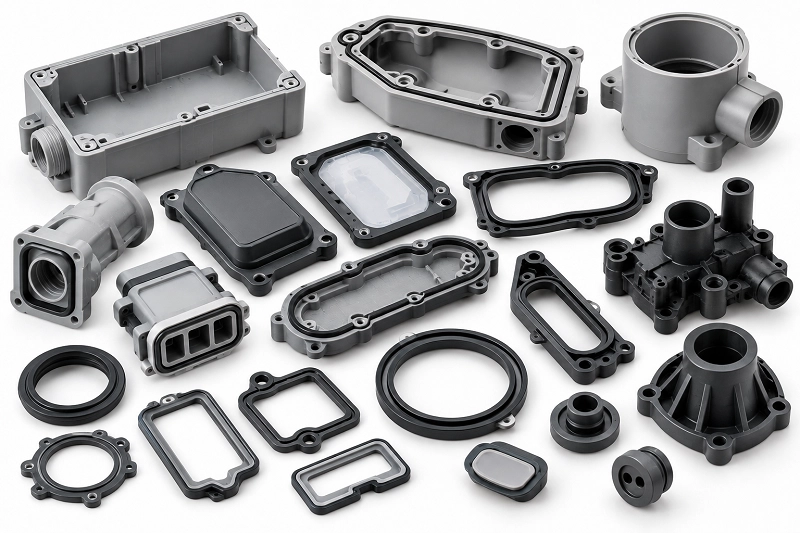
9. Insert Molding vs. Overmolding Comparison
- Insert molding and overmolding are both injection molding processes, but their purposes and methods are different.
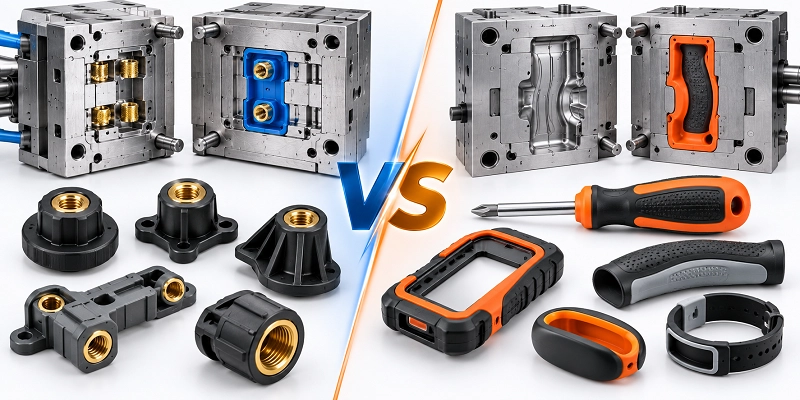
- Different process steps: Insert molding is a one-step process. It places a pre-made insert into the mold, then injects plastic to wrap around the insert, all in one cycle. Overmolding is a two-step process: It first molds a plastic substrate, then places the substrate into another mold and injects a second material to cover the surface.
- Different substrate and outer materials: The insert in insert molding is usually metal, ceramic, or a magnet, and the outer layer is plastic. The substrate in overmolding is plastic, and the outer layer is usually soft plastic or rubber, such as TPE, TPU, or silicone.
- Different core purposes: Insert molding is for providing strength, threads, or conductivity. For example, embedding a brass nut in a plastic part lets screws be assembled and disassembled repeatedly. Overmolding is for providing grip, sealing, or a comfortable feel. For example, coating a tool handle with soft plastic makes it more comfortable to hold.
- Different mold quantity and cost: Insert molding usually needs only one mold. Overmolding needs two molds, or one two-shot mold. Two-shot molds cost more but are suitable for high-volume production.
- Different suitable batch sizes: Insert molding works for small to large batches. For overmolding, manual methods suit small batches, and two-shot molding suits large batches.
- Different bond strength: In insert molding, the plastic wraps directly around the insert, so bond strength is high. In overmolding, bond strength depends on material compatibility. Manual methods give moderate strength, and two-shot methods give higher strength.
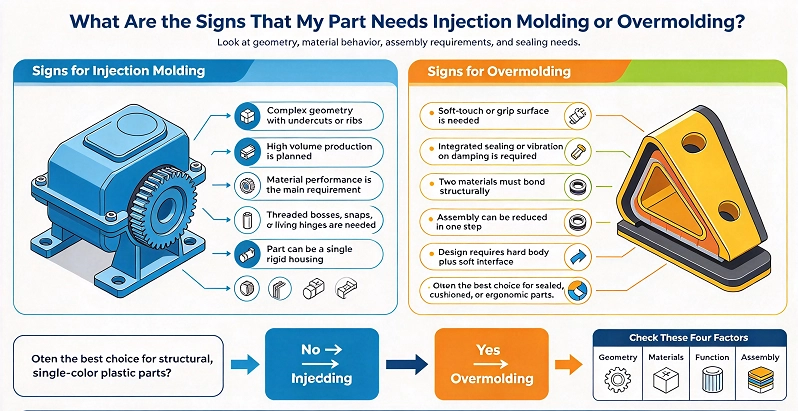
10. What Are the Signs That My Part Needs Injection Molding or Overmolding?
Here is a rule I have summed up: choosing injection molding or overmolding is not about how the drawing looks. It is about what the part actually needs to do.
10.1 Signs You Need Injection Molding:
If the part is a complete plastic part, does not need metal threads, does not need conductivity, and does not need a soft feel, then it is basically standard injection molding. Examples are housings, caps, brackets, and gears. The features are: single material, single color, large batch, and relatively fixed structure. If you find that one plastic alone can meet the strength, insulation, and appearance needs, then injection molding is enough.
10.2 Signs You Need Overmolding:
If the part needs both “hard” and “soft” feelings at the same time, that is a signal for overmolding. Here are the specific signs. First, the grip area needs to be slip-resistant and comfortable, like tool handles and toothbrush grips. Second, the part needs sealing or waterproofing, like a soft plastic ring around the edge of an electronic housing. Third, the product needs a two-color look to appear more premium. Fourth, the part needs shock absorption, like not breaking when dropped. Fifth, it needs an ergonomic design that combines hard and soft, like medical device handles.
One-Sentence Judgment: If the part is just “a plastic part,” choose injection molding. If the part needs “hard inside, soft outside,” choose overmolding.
One More Point: If the part needs metal threads or conductivity, that is insert molding, not overmolding. These three processes are easy to confuse. The key difference is: injection molding is a single material, overmolding is hard plastic plus soft plastic, and insert molding is metal plus plastic.

11. Why Choose NOBLE as Your Manufacturing Partner?
NOBLE is a certified manufacturing company with over 12 years of experience in producing high-quality plastic and metal components. From our location in Shenzhen, China, we provide overmolding and insert molding services for the automotive, robotics, and medical industries. Since 2012, we have acted as a trusted partner for manufacturers, offering a full production path from design support through to finished parts.
What makes us different is our focus on technological innovation and constant improvement. By pairing advanced automation with expert craftsmanship, we ensure every component meets rigorous quality standards. Our facilities are certified to ISO 9001 and ISO 13485, reinforcing our commitment to quality management and medical-grade production.
For overmolding, we help you combine hard and soft materials into one part. For insert molding, we help you embed metal inserts into plastic parts for strength, threads, or conductivity. This gives companies like yours a reliable partner for consistent, high-precision components, complete traceability, and full compliance with international standards. From complex overmolded grips to precision insert-molded parts, our team is equipped to meet your production goals.
FAQs:
1. What is the difference between insert molding and overmolding?
Insert molding is another form of injection molding where a secondary part is formed over a substrate. The differentiating factor between insert molding and overmolding is that insert molding is performed with a pre-existing substrate (base or inner component).
2. Does your part require overmolding or inserts?
Choose inserts if your part needs metal threads, strength, or electrical contacts. Inserts are placed into the mold and plastic wraps around them. Choose overmolding if your part needs a soft grip, sealing, or a better feel. Overmolding adds a soft layer over a hard plastic base. The key difference: inserts add metal functions; overmolding adds soft surface functions.
3. Is insert molding the same as overmolding?
No, they are not the same. Insert molding is a one-step process. A metal insert is placed into the mold, then plastic wraps around it. Overmolding is a two-step process. A plastic base is molded first, then a soft layer is molded over it. Both use injection molding, but the materials and process steps are different.
4. Which process costs more?
Overmolding usually costs more. It needs two molds or a two-shot mold, and two molding cycles. Insert molding needs one mold and one cycle. But insert molding has insert costs and loading costs. For small batches, insert molding is often cheaper.
5. What files are needed for a quote?
Provide CAD, drawings, both material grades, interface geometry, loads, tests, color/texture, annual volume, automation, packaging, and environmental conditions.
Insert molding vs. overmolding comparison: use the interface load, substrate, material compatibility, and validation requirements to select the process before tooling.