1. What Are the Application Scenarios for Humanoid Robot Hand Components?
Humanoid mechanical hands are indispensable in many fields. In industry, they handle assembly and small-parts work. In terms of logistics, they sort and pack. During service, they guide and greet. At home, they fold clothes and wash dishes. In terms of healthcare, they assist with training and childbirth. Each scenario has different requirements, but all demand high precision and high reliability.

2. What Are the Common Materials for Humanoid Robot Hand Components?
Materials are the basis for the assembly of humanoid robot hands. The selection of materials is a fundamental engineering decision that requires a balance to be struck among strength, weight, durability, processability, and cost. Choosing the wrong material can lead to premature failure, excessive energy consumption, or inaccurate movement.
| Material | Density (g/cm³) | Tensile Strength (MPa) | Stiffness-to-Weight Ratio | Machinability | Best For |
| 7075-T6 Aluminum | 2.81 | 572 | Excellent | Excellent | Load-bearing skeletal joints, wrist joints |
| 6061-T6 Aluminum | 2.70 | 310 | Good | Excellent | Non-structural brackets, sensor mounts |
| Magnesium AZ31B | 1.77 | 290 | Superior | Good (flammable chip risk) | Ultra-light cosmetic covers, non-load-bearing limbs |
| Titanium Ti-6Al-4V | 4.43 | 950 | Moderate | Difficult (tool wear) | High-stress joint pins, fasteners |
| 316L Stainless Steel | 8.00 | 580 | Low | Moderate | Actuator housings needing corrosion resistance |
2.1 Aluminum Alloy
Aluminum, especially alloys such as 6061-T6 and 7075, is the main material for humanoid robot frames and structural components. It has an excellent strength-to-weight ratio, is easy to process, corrosion-resistant, and relatively low in price.7075 aluminum alloy is renowned for its aerospace applications. It can provide outstanding strength in critical load-bearing joints or dynamic wrist and finger joints of the hand where high strength is required.
2.2 Titanium Alloy
For the most demanding applications, such as the hand joints of high-stress joints or the hip and knee joints of components subjected to repeated impacts, titanium alloys, such as Ti-6Al-4V, are usually chosen. Titanium alloys have a stronger strength-to-weight ratio than most steels, excellent fatigue resistance, and biocompatibility. However, the processing cost of titanium alloys is higher, and the difficulty is greater, requiring special tools and lower cutting speeds.
2.3 Stainless Steel
Stainless steel, such as 304 or 17-4 PH grade stainless steel, is often used in components that require high wear resistance, high hardness, or high corrosion resistance. Its applications include precision shafts, fasteners, gear components, and end effectors (manipulators) that may interact with various environments. Due to its high density, it is used with caution and is usually only employed in situations where extremely high requirements are placed on its specific performance.
2.4 Engineering Plastics and Composites
Materials such as PEEK, Delrin and UHMWPE have immeasurable value in specific applications. PEEK features high strength, thermal stability and self-lubrication, making it an ideal material for manufacturing bushings, bearings and insulating components. Polyoxymethylene is used to manufacture low-friction gears and housings. CFRP is increasingly being used to manufacture ultra-light and high-rigidity panels and covers, but they usually require specialized molds and techniques to prevent delamination.

3. What Are the Common Machining Processes for Humanoid Robot Hand Components?
Traditional 3-axis CNC machining has reached its limit in handling the complex geometries of modern humanoid robots. Today, advanced technology has become the standard in this field.
3.1 5-Axis CNC Machining
This is arguably the most critical technology. A 5-axis machining center can move the tool or workpiece along five different axes at the same time. This allows complete machining of complex organic shapes in one setup. It can machine deep grooves and contoured surfaces of structural connectors, angled features of joint housings, and smooth continuous 3D curves without repositioning the part. This avoids introducing errors. It greatly shortens the machining cycle and improves overall accuracy.
3.2 Micro Machining and Swiss-Type Lathes
For small, high-precision parts common in hands, wrists, and sensor systems, micro machining centers and Swiss-type lathes are essential. These machines can process parts with diameters under 1mm. Tolerances can reach ±0.005mm or better. Swiss-type lathes are especially good at machining slender shafts and threaded parts for micro actuators. They achieve very high concentricity and surface finish.
3.3 EDM Machining
EDM, especially wire EDM and sinker EDM, is used to machine features that traditional cutting tools cannot reach. It uses electrical sparks to erode material. It can create sharp internal corners, machine very hard materials, and form complex 2D contours without applying tool force. It is often used to make custom gears, injection molds for plastic robot housings, and precision structural features.
4. What Surface Treatments Are Used for Humanoid Robot Hand Components?
Hand component materials are mainly aluminum alloy, titanium alloy, stainless steel, and engineering plastics. Different materials need different surface treatments. Common types include:
4.1 Anodizing:
The most common treatment for aluminum parts. Standard anodizing has a thin film. It mainly provides corrosion resistance and decoration. It can also be dyed. Hard anodizing can reach 25-150 microns. It has high hardness and good wear resistance. It is often used for finger joints, joint seats, and other stressed parts. Note that the oxide film adds size. Mating surfaces need allowance or masking protection.
4.2 Micro-Arc Oxidation:
Suitable for aluminum, titanium, and magnesium alloys. It forms a ceramic film on the surface. It is wear-resistant and corrosion-resistant. It has a matte look, a fine feel, and is fingerprint-resistant. It is good for appearance parts. The downsides are fewer color choices and higher cost.
4.3 Sandblasting, Polishing, Brushing:
These are pre-treatment or appearance treatments. Sandblasting can unify surface roughness and improve coating adhesion. Polishing and brushing mainly improve appearance quality.
4.4 Electroplating and Electroless Plating:
Steel parts often use nickel or chrome plating to improve wear resistance and rust prevention.
4.5 PVD Vacuum Coating and DLC Coating:
These have high film hardness and a low friction coefficient. They are good for tendon guide wheels, pulleys, joint shafts, and other moving friction surfaces.
4.6 Passivation:
A rust-prevention treatment for stainless steel parts. It is low-cost and does not change dimensions.
4.7 Spraying and Electrophoresis:
Used for housing appearance parts. Rich colors and good corrosion resistance.
When choosing surface treatment, consider five factors at the same time: wear resistance, corrosion resistance, insulation, appearance, and dimensional impact.

5. What Are the Critical Dimensions of Humanoid Robot Hand Components?
The hand is one of the smallest and most precision-demanding parts of a humanoid robot. Critical dimensions mainly include:
5.1 Joint Holes and Bearing Seat Dimensions:
The diameter tolerance of knuckle hinge holes and bearing mounting holes usually needs to reach H7 grade or higher. Out-of-tolerance holes cause joint wobble or jamming. This directly affects finger motion accuracy.
5.2 Hole Position and Hole Spacing:
The center distance between finger joint hinge points determines the finger motion path. Hole position deviation causes linkage interference and uneven tendon force. This type of position tolerance is usually controlled at 0.02- 0.05 mm.
5.3 Tendon Channel Dimensions:
In tendon-driven designs, the inner diameter of tendon holes, the width of wire grooves, and the arc radius are all critical. Too small a hole wears the tendon. Too large a hole makes the tendon wobble. The exit also needs a smooth, round edge.
5.4 Wall Thickness Dimensions:
To reduce weight, knuckle and palm wall thickness is often about 1mm. Uneven wall thickness causes deformation and strength problems.

6. What Are the Key Points to Watch During Machining of Humanoid Robot Hand Components
Hand parts are small, thin-walled, and require high precision. During machining, focus on these areas:
6.1Thin-Wall Deformation Control:
Part wall thickness is often less than 1.5mm. Too much clamping force causes deformation. Use soft jaws, step clamping, or process tabs. Separate rough and finish machining. Release stress before finishing to prevent springback.
6.2 Micro Tool Management:
Machining tendon holes and finger inner cavities uses tools under 1mm in diameter. Small tools have poor rigidity and break easily. Use reasonable speed and feed. Monitor tool life and change tools in time.
6.3 Burr Control:
Hand parts directly contact tendons and sensors. Sharp edges and burrs can cut tendons. All hole openings and edges must be rounded and deburred. Manual polishing may be added when needed.
6.4 Cleanliness:
Parts that hold sensors and transmission parts must have no chips or oil in their inner cavities. After machining, they must be cleaned and checked.

7. What Projects Are Suitable for CNC in Humanoid Robot Hand Components
7.1Palm Base and Palm Frame:
This is the core structural part of the whole hand. It integrates joint seats, motor mounting positions, and wiring channels. The structure is complex. It is mostly made by CNC machining of aluminum.
7.2 Finger Joint Parts:
Proximal, middle, and distal phalanx parts are small, thin-walled, and have many holes. Tolerance requirements are strict. They are suitable for CNC precision milling.
7.3 Joint Shafts and Hinge Seats:
Joint shafts need high concentricity and good surface roughness. They often use CNC mill-turn machining. Materials are mostly stainless steel or titanium alloy.
8. Challenges and Solutions in Machining Humanoid Robot Hand Components
Machining parts for humanoid robots faces a series of unique challenges. It pushes traditional manufacturing processes to the limit. The main challenge is balancing high structural integrity with low weight, while handling extremely complex, high-density internal geometries.
Challenge 1: Complex Internal Geometry and Thin Walls
Robot parts are rarely solid blocks. For example, a wrist joint assembly must fit bearings, motor mounts, torque sensors, and electrical and pneumatic passages in a limited space. This leads to internal structures like deep narrow grooves, complex grids for weight reduction, and very thin walls separating functional cavities. Machining these structures is very risky. Cutting forces cause thin walls to vibrate. This leads to poor surface finish, dimensional errors, or even part failure during machining.
Solution: This requires carefully designed machining sequences and advanced tools. Machinists use “trochoidal” or “adaptive” milling strategies. The tool moves along smooth circular paths and cuts material at a constant, small radial depth. This greatly reduces cutting force and heat generation, preserving thin-wall structures. Special long-reach, variable helix end mills with damping coatings are critical. Often, parts need staged machining, leaving support material that is only removed in the final fine operations.
Challenge 2: Multi-Axis Accessibility and Single-Setup Machining
Many robot parts have complex curved surfaces. Critical features on multiple faces must maintain perfect angular alignment. For example, a shoulder bracket with an actuator mounting face at a precise, non-perpendicular angle is a typical case. If this part is machined on a standard 3-axis mill, it needs multiple re-clampings. Each clamping introduces potential alignment errors and increases the machining cycle.
Solution: The industry-standard solution is 5-axis simultaneous CNC machining. A 5-axis machine can rotate the workpiece around two extra axes. This lets the cutting tool reach almost any surface of the part. This allows the entire complex geometry to be machined in one setup. The advantages are significant: eliminating fixture errors, improving accuracy between features, using shorter and more rigid tools for better surface finish, and increasing overall production speed. However, programming and verifying these 5-axis tool paths requires high-end CAM software and deep expertise.
9. What Capability Requirements Apply to CNC Suppliers?
When choosing a CNC supplier, focus on three main areas:
9.1 Machining Capability:
Must stably control geometric tolerances like position, concentricity, and flatness to the 0.02 mm level. Surface finish must meet mating and appearance requirements. Must have process experience with thin-wall and micro parts. Equipment accuracy and tool management must be up to standard.
9.2 Quality Control Capability:
Must have a complete quality system, such as ISO 9001 certification. Must have inspection equipment like CMM and vision measuring machines. Critical dimensions must be fully inspected. Batches must be traceable. Defective parts must be quickly analyzed and corrected.
9.3 Inspection and Delivery Capability:
Must provide complete inspection reports and data. Must have a reasonable production plan. Sample lead time is usually about one week. Mass production lead time must be stable. Must give timely feedback on abnormalities and provide fast after-sales response.
10. What Does a Complete CNC Machining Quotation for Humanoid Robot Hand Components Include?
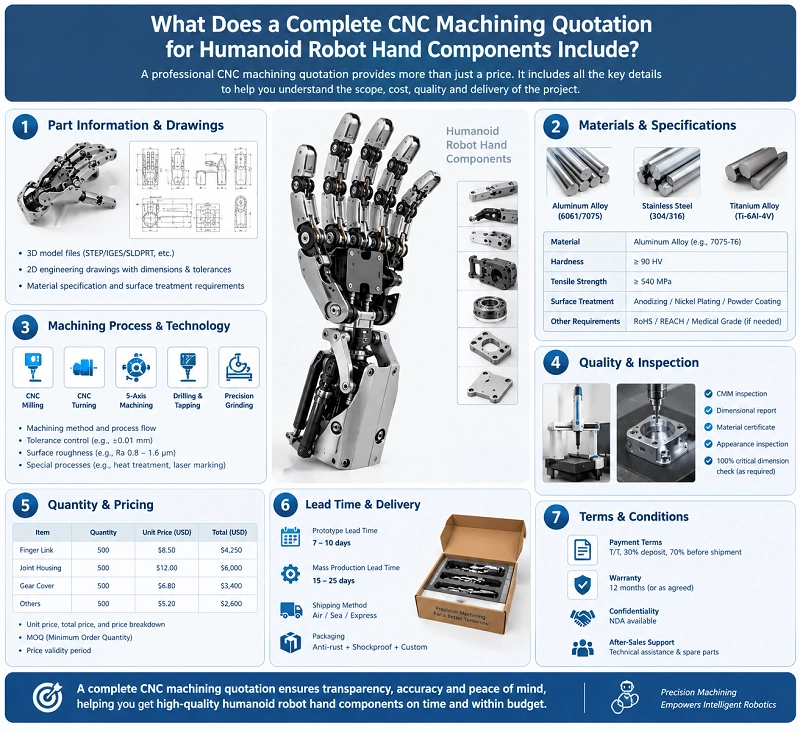
10.1 Part Drawings:
Including 3D models and 2D engineering drawings with dimensions, tolerances, and geometric requirements.
10.2 Material List:
Material grade (such as 6061 aluminum, TC4 titanium, 304 stainless steel), specifications, and quantity per part.
10.3 Process Information:
Machining steps, clamping methods, surface treatment requirements, and whether outsourced.
10.4 Cost Breakdown:
Material cost, machining cost (priced by machine hour), surface treatment cost, and inspection cost listed separately.
10.5 Quotation Terms:
Volume tier pricing, mold or tooling cost, taxes, freight, lead time, and quotation validity period.

11. Why Choose NOBLE as Your CNC Machining Supplier for Humanoid Robot Hand Components?
NOBLE provides CNC machining solutions for humanoid robot parts, backed by our engineering knowledge, manufacturing skills, and high-quality production systems. We serve robot companies, OEM customers, and project teams. We provide reliable manufacturing services for both production and prototyping.
Engineering Support
— Our engineers review CAD files, 3D models, and technical drawings. We assess manufacturability, recommend machining methods, and help optimize part designs for production.
Precision CNC Manufacturing
— With CNC milling, CNC turning, Swiss-type lathe machining, and multi-axis capabilities, NOBLE produces complex robot components with accurate features, repeatable quality, and reliable assembly performance.
Quality Control and Inspection
— We maintain part quality consistency through inspection procedures and quality management systems, including ISO 9001 and ISO 13485. This is supported by dimensional inspection and CMM verification.
Flexible Production Support
— From prototype quantities and small-batch production to repeat manufacturing programs, NOBLE offers scalable solutions for evolving robot development and OEM production needs.