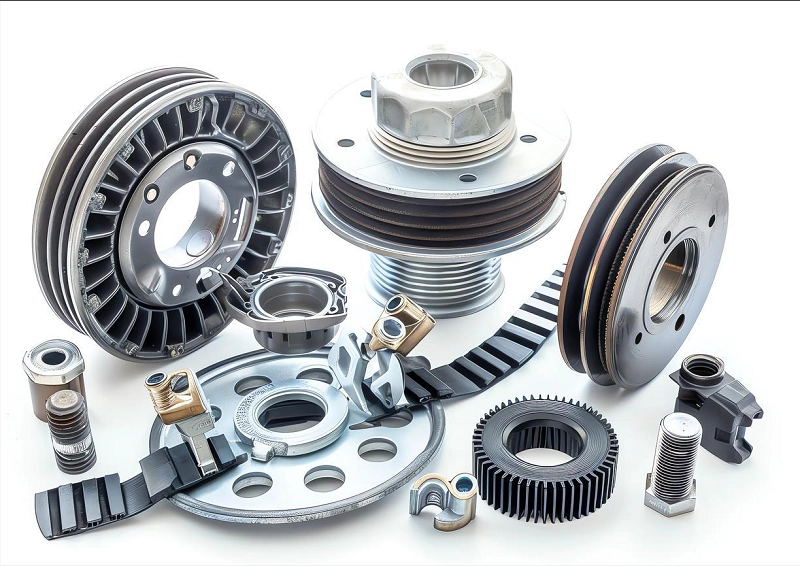
The automotive industry is a major user of machine tools.
Right now, new energy vehicles are growing very fast. This creates a huge demand for precision parts. Examples include chassis, suspension, and steering parts.
Today, cars are moving toward integration and high power density. This makes their core parts very hard to machine.
Machining accuracy, efficiency, and stability directly decide the car’s overall performance. This also brings new demands for machine tools and machining processes.

1. What is Automotive CNC Machining?
CNC uses computers to make metal and plastic car parts. It cuts, mills, drills, and turns materials like aluminum, steel, brass, and titanium. It makes complex parts with tight tolerances and no defects.
Unlike traditional machining, CNC uses CAD/CAM to turn 3D models into tool paths. It is a subtractive process. It removes material to form the final shape.
This automated process is very fast and highly repeatable. Engineers can easily update digital designs for perfect results every time. This makes CNC a top choice for modern automotive manufacturing.

2. Which Auto Parts Can Be CNC Machined?
2.1 Engine and Powertrain Parts
Engine parts are hard to make. Blocks and heads are usually cast. Their internal shapes are too complex to cut from solid metal. But they need CNC for exact features: cylinder bores, valve seats, and oil passages. Casting cannot reach these tight tolerances and smooth surfaces.
2.2 Chassis, Suspension, and Steering Parts
Suspension parts must stay exact under heavy loads. Knuckles, control arm brackets, tie rods, and steering housings use CNC. Mass-market cars use cast or forged parts and then machine them. For racing or custom cars, parts are cut from solid blocks. This needs no molds and allows any shape. Hubs and bearing seats need exact hole sizes. Subframes are stamped steel but machined at key joints.
2.3 Brake, Fluid, and Thermal Parts
Brake calipers are a great CNC example. They need exact piston bores, clean threads, and smooth seals. Custom calipers are cut from aluminum blocks. Stock calipers are cast and then machined. Master cylinders and ABS valves need tight hole tolerances. Fluid fittings and heat exchangers also use CNC.
2.4 Electrical and Sensor Components
Sensors need precise mounting. CNC makes the housings and brackets so the sensor reads correctly. Mounting position and runout are very important. High-voltage connectors, ECU plates, and ground busbars use CNC for prototypes and small batches. This avoids costly injection molds.
2.5 EV Battery, Motor, and Power Electronics
EVs bring more CNC work. Battery trays use different methods but need CNC for sealed surfaces and exact holes. Motor housings are cast but machined for bearing fits and rotor alignment. They also need complex cooling jackets. Power electronics need flat heat surfaces and exact connector spots. As EV volume grows, casting takes over. But CNC is still critical for surfaces that control fit, seals, and heat.

3. When is CNC the Best Choice for Auto Parts?
After many years in manufacturing, customers often ask me: “Can we use a mold or casting for this?” My answer is usually: “It depends on what you need.” Cars need low costs at high volumes. But in many key cases, CNC is the best choice.
Here is when you should use CNC:
3.1 R&D Prototyping and Fast Iteration
New car designs change a lot. Making a steel mold for every version is too slow and costs too much. CNC needs no mold. Load a 3D file and cut the part in days. This speeds up testing and saves time.
3.2 Very Low Volume or Custom Cars
For supercars, race cars, or custom builds, the volume is tiny. Paying for a mold is too costly. CNC is very flexible. Making 1 or 100 parts costs about the same. It is the best economic choice for custom parts.
3.3 Safety-Critical and High-Stress Parts
Engine internals, brake calipers, and suspension arms are safety-critical. They must be very strong. CNC cuts parts from solid aluminum or titanium. The metal grain stays continuous. There are no air holes like in castings. These parts do not break easily in extreme conditions.
3.4 Complex Precision Parts with Tight Tolerances
EV battery ports and high-pressure fuel valves are complex. They have thin walls and tight tolerances (under ±0.01mm). 5-axis CNC cuts multiple sides in one setup. This avoids stacking errors. Molds cannot easily reach this precision.
3.5 As a “Secondary Finishing” Step for Casting or Forging
Many parts are not made by CNC alone. For example, engine blocks are mass-produced by casting. But casting is not precise enough. CNC is the required next step. It mills the seals, bearings, and threads.

4. What CNC Processes Are Used for Auto Parts
4.1 CNC Milling
Most common process. Good for housings and brackets. 3-axis does normal shapes. 5-axis does deep pockets or angled parts. 5-axis saves setups and keeps accuracy.
4.2 CNC Turning
Best for round parts like shafts and pistons. Modern lathes drill and mill in one setup. This is how they make precise pistons and crankshafts.
4.3 Drilling, Boring, and Tapping
Cars have lots of holes (oil lines, threads). Boring makes precise bearing holes. Thread quality is key. Bad threads cause leaks or strip easily.
4.4 4-Axis and 5-Axis Machining
4-axis is good for slots and holes around a shaft. 5-axis is for complex parts on many sides. It saves setups and improves precision. But simple parts are cheaper on 3-axis or 3+2-axis machines.

5. What Materials Are Used for Auto CNC Parts
5.1 Aluminum
6061-T6 is standard for brackets. 7075-T6 is for high stress and racing. EV motor and battery cases need more complex aluminum parts.
5.2 Steel and Stainless Steel
Used for high-strength and wear parts (cranks, gears). 4140/4340 for alloy steel. 409 for exhaust. 304/316 for high rust resistance and looks.
5.3 Brass and Copper
Brass cuts well. Good for fittings and tubes. Copper is for EV busbars and heat management. It conducts electricity and heat very well.
5.4 Engineering Plastics
POM for gears and sliding parts. PEEK for high heat. Nylon for chemical resistance. Used for insulators, bushings, and interior prototypes.
6 . Tolerance and Surface Finish Requirements
Tolerances and finishes depend on the part’s job.
6.1 Dimensional and Geometric Tolerances
Fit areas need exact size and shape. Bearing holes must be straight. Cylinders must be round. If not, brakes wear badly, or engines vibrate. Drawings use GD&T to control hole positions.
6.2 Surface Finish
Only seals and bearings need very smooth surfaces (like Ra 0.2-0.8). Normal brackets just need to fit. Over-polishing wastes time and money.
6.3 Choose Tolerances Based on Function
Start with the real need. Do not over-specify. Tight tolerances on non-critical areas cost money. They do not improve the part. They just add work time and scrap.

7. Why is Precision So Important in the Auto Industry
Cars cannot cut corners. Parts must have tight tolerances and repeat well. CNC machines make parts in large batches with very few errors. This keeps parts high quality and cars safe.

8. What Factors Affect Auto CNC Cost?
8.1 Material Cost and Machinability
It is not just the metal price. It is how easy it is to cut. Aluminum is fast and cheap. Titanium and stainless steel are hard. Tools wear out fast and machines must run slowly. This doubles the machine time cost.
8.2 Part Complexity and Tolerances
Simple parts on 3-axis machines are cheapest. Complex curves and deep pockets need 5-axis machines. These cost more. Tighter tolerances (under ±0.01mm) need better machines and raise scrap rates.
8.3 Programming and Setup Time (Batch Size)
Before cutting, you need 3D programming, fixtures, and a test part. For a single part, you pay all this setup cost. For a large batch, the setup cost is spread out. This lowers the unit price.
8.4 Surface Treatment and Inspection
Anodizing, plating, and heat treatment cost extra. Auto parts often need CMM reports or PPAP files. Strict quality checks are hidden costs.
9. Auto CNC Process Flow: From Design to Production
- CAD Modeling: Make a 3D model of the car part.
- CAM Programming: Engineers use software to plan the tool paths.
- Setup: Load the raw material into the machine using fixtures.
- Machining: Cut the part using milling, turning, drilling, and tapping.
- Inspection and Finishing: Remove burrs, finish the surface, and check sizes.
- Assembly and Testing: Put parts together. CNC makes sure parts are accurate, repeatable, and on time.

10. What Makes a Good Auto CNC Supplier
10.1 Machining Capacity and Range
Check machine capacity and axes. Complex parts need 4 or 5 axes. A prototype shop cannot do mass production. A mass producer may be too slow for prototypes. Make sure their daily work matches your needs.
10.2 Quality Control and Inspection
Look at CMM, first-piece checks, and traceability. For OEM auto parts, get IATF 16949 or ISO 9001. For aftermarket or racing, the actual inspection method matters more than the paper.
10.3 Materials, Surface Finishing, and Engineering Support
Check if they know 7075 aluminum, alloy steel, and titanium. If they do surface finishing in-house, it saves time. Good suppliers check your drawings and point out bad tolerances. They do not just take any order.

11. Why Choose NOBLE as Your Automotive CNC Machining Supplier?
NOBLE is a certified manufacturing company with over 12 years of experience. We provide full support for automotive CNC machining projects. From rapid prototyping to mass production, we help you build high-quality car parts.
11.1Full Machining Capabilities
We offer 3-, 4-, and 5-axis CNC milling, turning, and drilling. We work with automotive materials like aluminum (6061, 7075), alloy steel, stainless steel, and titanium. We handle both simple brackets and complex engine or suspension parts.
11.2Automotive Quality and Precision
We focus on tight tolerances and repeatability. Our facilities have ISO 9001 and ISO 13485 certifications. We use CMM equipment for strict inspection. Every part is fully traceable from raw material to finished product.
11.3 Engineering Support
Our engineers review your CAD files and give early DFM feedback. We help you spot over-toleranced features or complex geometry before cutting metal. This saves you time, reduces scrap, and lowers your total cost.
11.4 One-Stop Service
We manage the whole process. This includes material sourcing, machining, surface finishing (like anodizing or plating), and final assembly. You do not need to deal with multiple suppliers.
11.5 Flexible Production
We support small batches for custom or racing cars, and we scale up smoothly for OEM production. Whether you need 1 piece or 10,000 pieces, we keep the quality consistent.
With NOBLE, you get a reliable partner for precision, speed, and cost control.
FAQs
1. Which automotive parts can be made with CNC machining?
CNC machining is often used for high-precision car parts. Examples include engine blocks, cylinder heads, pistons, gear shafts, control arms, brake calipers, battery cases, and motor housings. These parts benefit from CNC machining because it can achieve tight tolerances and complex shapes.
2. Why do car prototypes and low-volume production prefer CNC machining?
CNC machining has short lead times (usually 2-5 days), high repeatability, and works well with many materials. This makes it perfect for prototypes and small batches. Companies like Boona Prototypes focus on delivering functional CNC parts fast.
3. What materials are usually used for CNC auto parts?
CNC auto parts are usually made from these materials:
Aluminum alloys (like 6061, 7075) for lightweight and heat resistance.
Steel and stainless steel for strength and durability.
Titanium alloys for high performance and lightweight uses.
Plastics (like POM, ABS, nylon) for internal parts or housings.
4. What tolerances can CNC machining achieve for auto parts?
CNC machining can reach a tolerance of ±0.005 mm. This is very important for engines, drivetrains, and safety-critical parts. Boona Prototypes offers precision machining that meets strict automotive standards.
5. How does 5-axis CNC machining benefit car manufacturing?
5-axis CNC machining can make complex parts in one setup. This improves accuracy, saves time, and allows finer shapes. It is especially important for parts like cylinder heads, suspension steering knuckles, and turbine housings.