Nylon injection molding is the high-volume route to parts that stay strong, resist wear, and hold their shape at temperatures where commodity plastics soften. Molten polyamide is forced into a closed steel mold, packed while it crystallizes, and ejected as a finished or near-finished component — bosses, snap fits, living hinges and all — in a cycle measured in seconds.
That description makes the process sound simpler than it is. Nylon is a family of semi-crystalline polyamides, not a single resin, and its members differ in melting point, moisture uptake, stiffness and cost by margins that decide whether a part works. The resin also absorbs water from the air, which makes drying a production precondition rather than a housekeeping detail, and it shrinks substantially as it solidifies, which means the mold must be cut oversize to compensate.
This guide is written for design engineers and product developers choosing a material and a process. It follows the work in the order you will meet it: what the process is and why nylon suits it, how a production run is actually staged, why drying decides the outcome, how to shortlist a grade, how nylon compares with competing resins and with 3D printing, machining, die casting and extrusion, where the material is used, and which failure modes recur across projects. The final sections cover how NOBLE supports nylon programs and answer the questions buyers ask most often.
What Is Nylon Injection Molding?
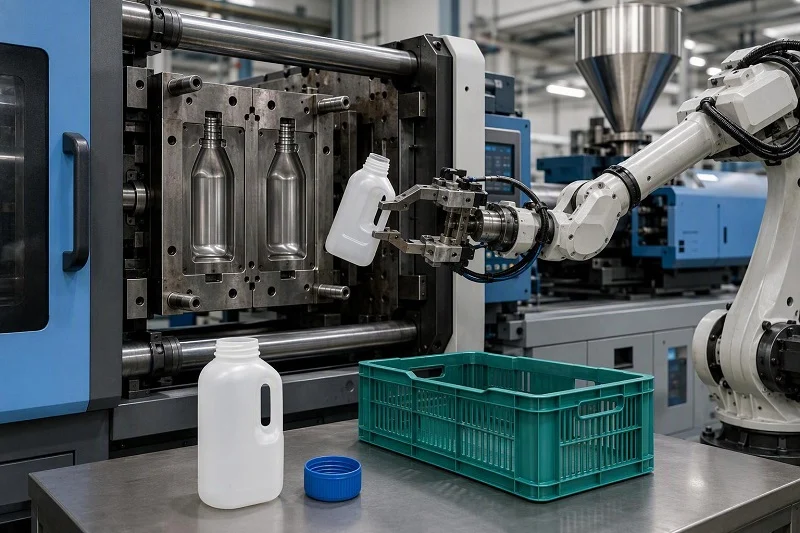
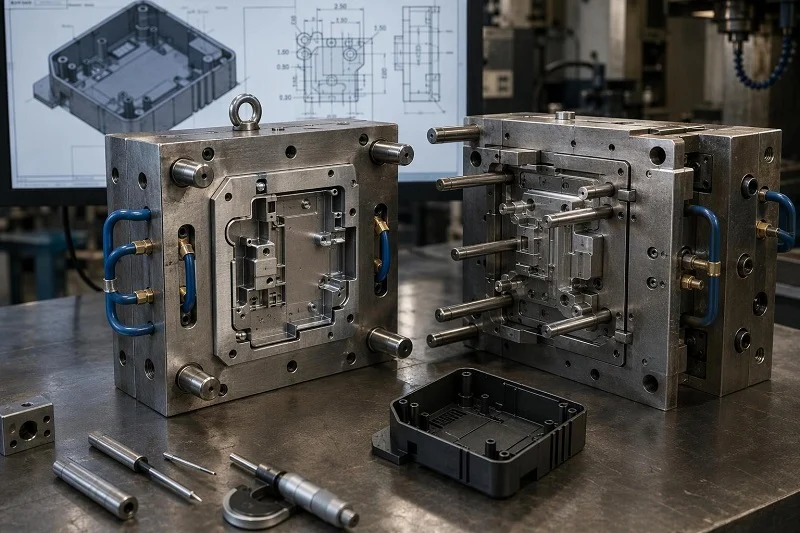
Nylon injection molding is the process of melting polyamide pellets, injecting the melt into a closed, temperature-controlled mold cavity under pressure, holding that pressure while the part solidifies, and ejecting the solid part. The mold is normally steel, the machine reciprocates a screw that both melts and injects, and the cycle repeats with little variation from shot to shot.
Three properties make nylon distinctive as a molding resin, and each has a consequence downstream:
- Nylon is a semi-crystalline polymer. Its molecular chains fold into ordered regions as the melt cools, and that ordering produces a larger and more grade-dependent volume change than amorphous resins show. Mold dimensions, gate positions and cooling layout all have to account for it.
- Moisture sensitivity. Polyamide chains attract water. Pellets left open to the air take up moisture, and molding wet resin causes surface defects, internal voids and a loss of mechanical strength. Drying is therefore a precondition, not an option.
- Property dependence on conditioning. Even a correctly molded part continues to absorb moisture in service, which plasticizes the polymer — lowering stiffness and strength while raising toughness and elongation. Design values must state whether they refer to the dry-as-molded state or a conditioned one.
Nylon is a family, not a grade. PA6, PA66, PA610, PA612 and PA12 behave differently enough that a datasheet comparison, not a generic assumption, should drive selection.
Polyamide Chemistry in Brief
Polyamides are built from repeating amide linkages — the same chemical group found in proteins — joining monomer units into long chains. The number in a grade name identifies the monomer or monomer pair: PA6 is built from a six-carbon unit, PA66 from a six-carbon diamine and a six-carbon diacid, PA610 from a six-carbon diamine and a ten-carbon diacid, and PA12 from a twelve-carbon unit.
Chain length drives the properties a designer reads off a datasheet. Longer-chain grades space the water-attracting amide groups further apart, so they absorb less moisture and hold dimensions and electrical properties better in humid service, at the cost of lower strength, stiffness and melting point. Shorter-chain workhorses — PA6 and PA66 — sit at the high-strength, high-heat end and absorb the most water. Crystallinity, meanwhile, sets the shrinkage behavior and the sharp melting transitions that make nylon mold cycles fast.
Why Nylon Is Molded Rather Than Fabricated
Machining nylon from rod or slab is a legitimate route for prototypes and short runs, but it wastes material and cannot produce certain features economically. Injection molding forms complex geometry in a single shot: ribs, bosses, snap fits, living hinges, molded-in threads and textured surfaces all come out of the tool. Cycle times are short and repeatable because crystalline nylon sets up quickly, so per-part cost falls steeply as volume rises.
Reinforced grades strengthen the case. Glass- and mineral-filled nylons deliver large gains in stiffness and creep resistance, but they are abrasive and difficult to machine cleanly from stock; molding them to shape avoids both the waste and much of the tool wear associated with cutting.
What earns nylon its engineering-plastic status is the combination: toughness, low friction and abrasion resistance, resistance to oils, greases and many solvents, and useful strength at elevated temperature. Few other thermoplastics cover that spread of requirements at nylon’s cost level.
The Nylon Injection Molding Process, Step by Step
A nylon molding project runs through five stages, and decisions made early constrain everything that follows. Treat each stage as a gate rather than a formality.
Design for Manufacturability and Mold Design
Before steel is cut, the part and the tool are settled together. A DFM review examines wall-thickness uniformity, draft angles, gate location, cooling layout and ejection strategy, and it is where most cost and defect risk is fixed — a part redesigned after the tool is built is expensive; the same change made on paper is nearly free.
Shrinkage compensation belongs here. Nylon is a crystalline polymer and exhibits substantial volume shrinkage as it solidifies, so cavity dimensions must be cut larger than the finished part. Because shrinkage varies with wall thickness, flow direction and gate location, the tool designer works from grade-specific shrinkage data and builds in adjustment where the tolerances are tightest. Gate position matters twice over: it sets the fill pattern and it determines where weld lines land.
Material Drying Before Molding
Drying is a non-negotiable precondition for nylon, and it is covered in full in the next section. The short version: molding-grade pellets should reach a water content of no greater than 0.15–0.2% before they enter the barrel. Pellets from a sealed, undamaged moisture-resistant bag can be used immediately after opening; once the bag is open, the pellets begin absorbing moisture from the air.
Melting, Injection, Packing, and Cooling
The cycle itself is where the process window is held. Nylon’s melt viscosity is highly dependent on temperature, so barrel temperatures must be controlled closely — too cool and the melt will not fill thin sections, too hot and the resin degrades. Injection speed and pressure are set to fill the cavity before the melt freezes off, and hold or packing pressure is applied to offset the shrinkage that occurs as the part solidifies.
Cooling time is driven mainly by wall thickness. Thick sections are the difficult case: parts with sections of roughly 6 mm or more are more prone to internal voids and surface sink marks, and they need extra compensation in packing and cooling. Where a design allows it, uniform walls and cored-out thick regions solve the problem more cheaply than process tweaks.
Post-Processing, Assembly, and Inspection
After ejection, parts are degated and runners separated. Where the specification calls for it, parts are annealed to relieve molded-in stress or moisture-conditioned to reach a stable service state. Secondary operations — machining of critical features, surface finishing, ultrasonic welding, adhesive bonding, assembly — follow, then dimensional and appearance inspection.
A capable molder should be able to tell you which of these steps it performs in-house and which it sends out, because each handoff adds lead time and a place for tolerance stack-up to accumulate.
Why Drying Makes or Breaks Nylon Injection Molding
Moisture is the single most common cause of nylon molding defects, and it is the gap that catches newcomers most often. The mechanism is straightforward, the symptoms are visible, and the controls are well established — which makes wet resin an avoidable failure rather than an unavoidable risk.
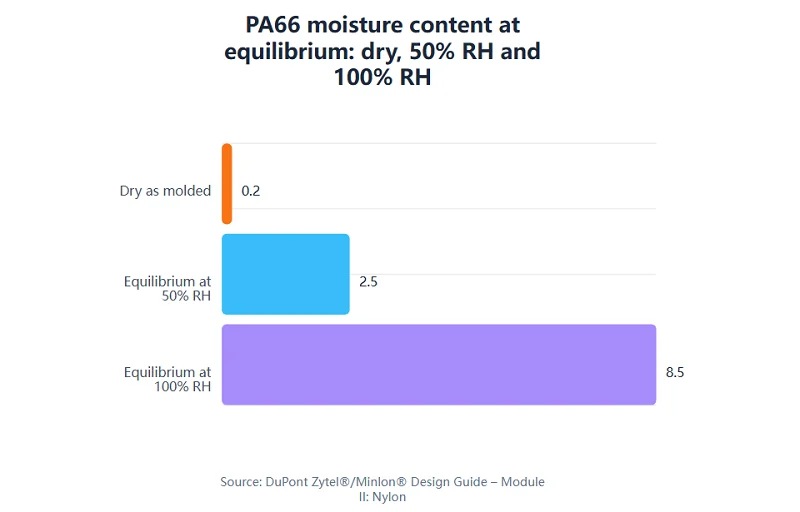
Equilibrium moisture content of PA66 at 23 °C, dry-as-molded versus conditioned in 50% and 100% relative humidity. Values are equilibrium levels from a legacy design guide; actual uptake depends on grade, wall thickness and exposure time.
How Nylon Absorbs Moisture
After a bag is opened, nylon pellets absorb water from the air. The rate of uptake and the equilibrium level depend on the type of nylon, the amount of reinforcement such as glass fiber, the pellet shape, and the air temperature and humidity. Uptake is fast in hot, humid conditions, and reinforced grades equilibrate at lower water content per unit weight because the reinforcement displaces some of the moisture-absorbing polymer.
Two handling details follow. In winter, condensation can form when cold pellets are brought into a warm room, so let them sit in the warm space before molding. And because absorption is continuous, an open bag left in the hopper is not a neutral state — it is an active drying problem in reverse.
Defects Caused by Wet Pellets
Molding nylon above the moisture target produces three distinct failures:
- Silver streaking on the surface of the molded part, caused by water vaporizing in the melt.
- Internal voids, as the same vapor expands inside the section.
- Loss of mechanical properties, because water at melt temperature drives hydrolysis, reducing molecular weight.
These are appearance and performance failures, not cosmetic nuisances. A part with silver streaks may also have lost molecular weight, and the property loss may not show up until the part is in service.
Drying Methods and Practical Controls
Vacuum drying is the most effective route for nylon. Typical conditions are 80–120 °C under vacuum for 10 to 48 hours, depending on the starting moisture content. The cooldown matters: transferring pellets straight from a high-temperature dryer into a container can cause oxidation or discoloration, so reduce the temperature to below about 70 °C under vacuum before transfer.
Hot-air and hopper dryers are practical but humidity-dependent. Because they draw ambient air, the achievable dryness varies with the weather, and drying can even add moisture to already-dry pellets on a humid day. Drying temperature is generally capped around 80–90 °C to limit oxidation and discoloration, which in turn limits how fast heavily wetted pellets can be brought back into specification. Dehumidifying dryers remove moisture from the intake air and are preferred where consistency matters, though their capacity to strip moisture is finite.
Handling rules close the loop:
- Use opened bags promptly and reseal leftovers in a clean, sealable container.
- Keep hopper residence short — roughly 30–60 minutes in high-humidity conditions and 3–4 hours in low humidity — by loading only the amount needed per hour.
- Store recycled sprues and runners dry, or dry them before reuse.
Nylon Grades and How to Choose Among Them
Choosing a nylon grade is a shortlisting exercise, not a search for the single best resin. Work through the questions your application actually asks — how hot, how wet, how stiff, how tough, how much it can cost — and the field narrows quickly.
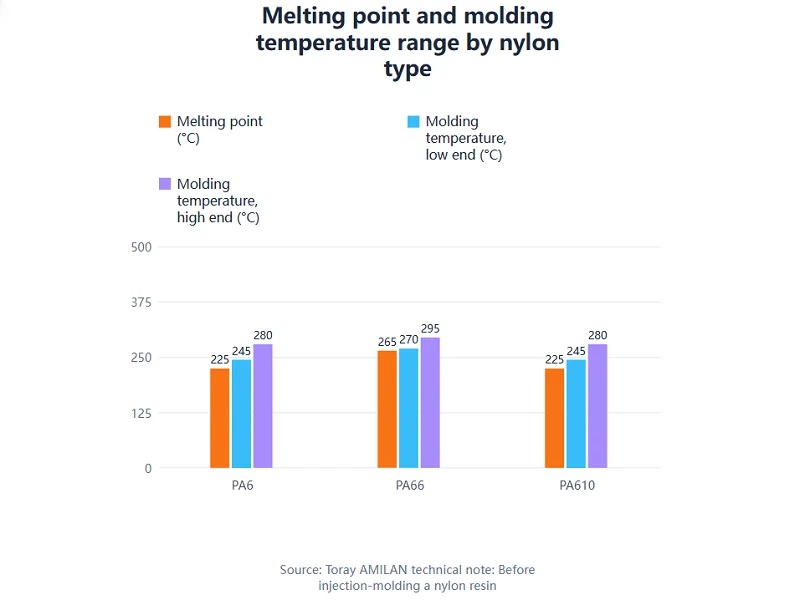
Melting point and typical molding temperature window for three common polyamides. Molding temperatures are supplier process starting points, not specifications; confirm against the current grade datasheet and molding trials.
PA6 vs. PA66: The Workhorse Grades
PA66 and PA6 dominate volume. PA66 melts at about 265 °C against about 225 °C for PA6, and it offers higher strength, stiffness and creep resistance. PA6 counters with a broader processing window and good toughness. Typical molding temperatures run roughly 270–295 °C for PA66 and 245–280 °C for PA6.
Both absorb appreciable moisture, and both are available unfilled, glass-filled, impact-modified, heat-stabilized and flame-retardant. If your application is dry, warm and strength-critical, PA66 is the default starting point; if it needs easier processing or greater toughness, PA6 is the alternative.
PA12, PA610, and Low-Moisture Grades
Longer-chain nylons trade strength and heat resistance for dimensional and electrical stability in humid conditions. PA610 and PA12 are the reference points. Their lower moisture absorption means parts hold tolerance and dielectric properties better in wet or humid service, and property retention — rather than peak strength — is their main selling point.
Reach for these grades when a part must hold a precision dimension across seasons, when electrical performance cannot drift with humidity, or when the service environment is persistently damp. Confirm the trade-off against the specific grade’s datasheet rather than assuming it from the family name.
Glass-Filled and Reinforced Nylon
Glass-fiber and mineral reinforcement deliver large gains in strength, stiffness and creep resistance. The trade-offs are real: elongation and impact behavior change, properties become anisotropic because fibers orient with flow, and the abrasive filler accelerates wear on screws, barrels and molds. Mineral fillers give stiffness and heat deflection with less warpage than glass, at some cost in strength.
Reinforced grades also dilute moisture uptake per unit weight, since the filler does not absorb water. When reinforced material is reground, fiber damage during crushing and re-melting tends to show up first as a loss of impact strength.
Specialty Grades: Impact-Modified, Heat-Stabilized, and Flame-Retardant
Three specialty families cover most remaining needs:
- Impact-modified (toughened) grades raise elongation and notched impact resistance, with some reduction in strength and stiffness. Ask for them when drop performance or low-temperature toughness is the governing requirement.
- Heat- and hydrolysis-stabilized grades retard embrittlement in sustained high-temperature service and in hot-wet environments. They are the standard choice for under-hood and fluid-exposed parts.
- Flame-retardant grades meet electrical-equipment flammability ratings, often in glass-filled or mineral-filled versions. Ask for them when the part must pass a flammability standard, and confirm the rating at the wall thickness your design uses.
How Nylon Compares with Other Engineering Plastics
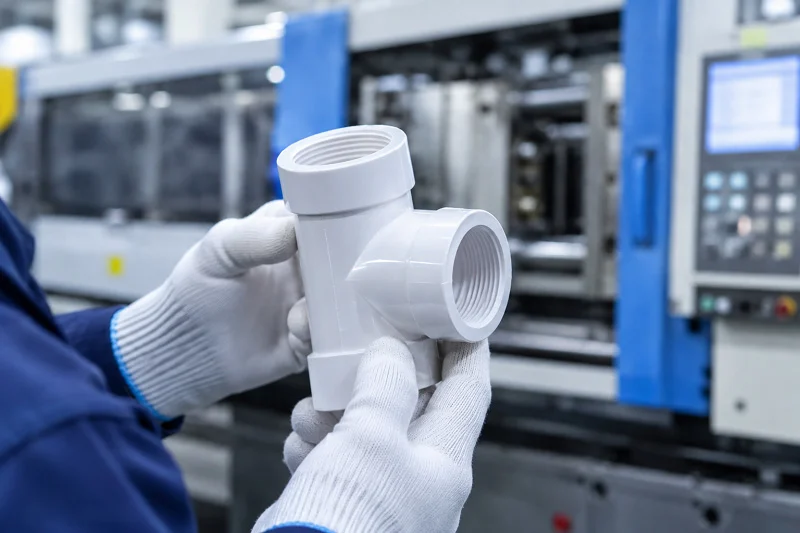
Nylon rarely competes in a vacuum. The shortlist usually includes one or two other engineering resins, and the decision turns on a handful of consistent dimensions: strength and stiffness, toughness, heat resistance, moisture behavior, chemical resistance and cost position.
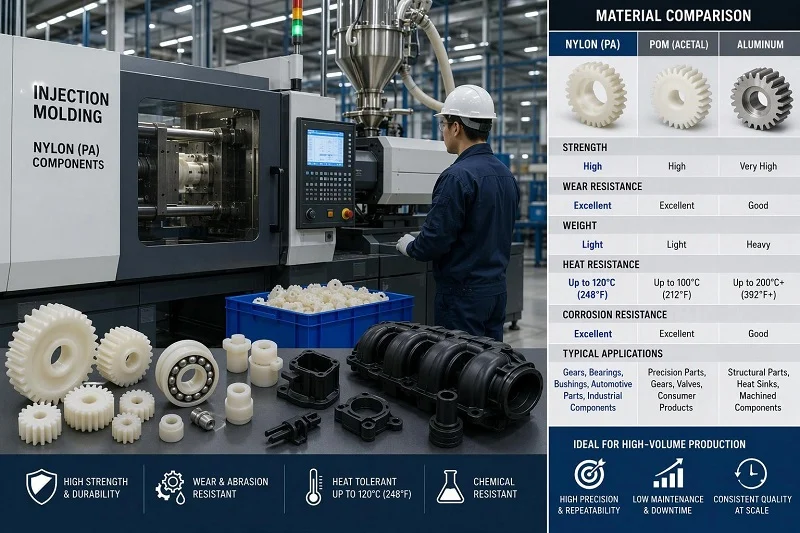
Nylon vs. POM (Acetal)
POM offers excellent dimensional stability, very low moisture uptake, good machinability and strong friction and wear behavior. Nylon counters with higher strength and heat resistance and better toughness. The choice usually turns on environment and tolerance: in a humid plant or a wet application, POM’s stability is hard to beat; where the part runs hot or must absorb impact, nylon has the edge. For sliding-wear parts, both are credible, and the deciding data are friction and wear under your actual load, speed and surface finish.
Nylon vs. PBT and PET Polyesters
Polyesters are far less hygroscopic than nylons, so PBT and PET hold dimensions and electrical properties more predictably across humidity swings. That stability wins in precision connectors and electrical components. Nylon keeps the running where toughness and abrasion resistance dominate, or where the part must survive impact and flexing. Heat resistance is broadly comparable between glass-filled grades, so moisture behavior is usually the deciding factor.
Nylon vs. ABS and PC
These are different tiers of performance and price. ABS is inexpensive and easy to process but limited in heat resistance and strength; nylon is the stronger, hotter-running choice at a higher material cost. Polycarbonate brings outstanding impact strength and clarity, while nylon brings chemical resistance, lubricity and better performance in contact with oils and fuels. Where a housing needs to look good and take a hit, PC may win; where it needs to survive grease, heat and wear, nylon does.
Nylon vs. PP and PEEK
Polypropylene bookends the comparison from below: low cost, good chemical resistance, low moisture uptake, but limited strength and a much lower temperature ceiling. Where nylon’s heat resistance and strength are unnecessary, PP is the economical answer. PEEK bookends it from above: far higher temperature capability and cost. Nylon’s practical operating envelope sits between them — above the commodity resins on heat and strength, below the high-performance polymers on temperature ceiling and price.
Industries and Parts That Rely on Nylon Injection Molding
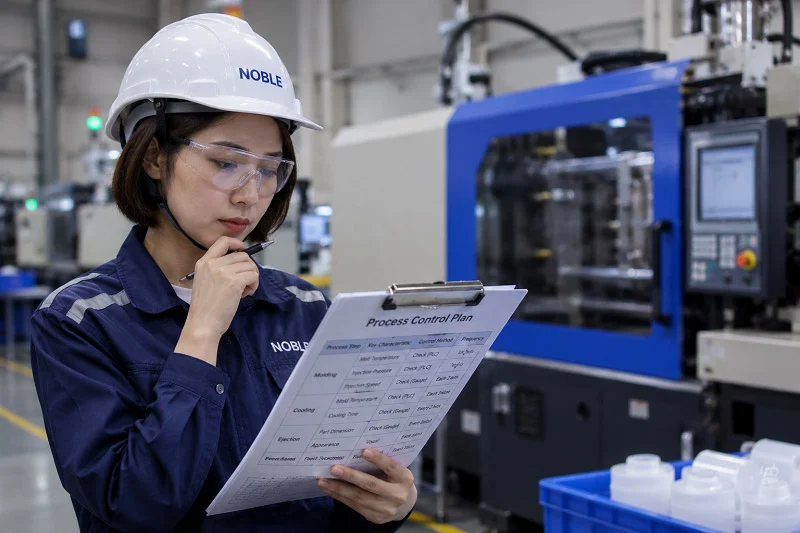
Nylon’s property combination — toughness, lubricity, heat resistance and chemical resistance — maps onto a wide set of parts. The examples below are representative part types rather than specific products.
Automotive and Transportation Components
Under-hood and structural-adjacent parts are the largest application family: intake components, brackets, clips, cable ties, covers and fluid-handling parts. Heat resistance, toughness and weight reduction versus metal drive the choice, and heat- and hydrolysis-stabilized grades are common where sustained temperature and fluid exposure are involved. Glass-filled grades supply the stiffness that brackets and covers need.
Medical Devices and Healthcare Equipment
Housings, connectors, fluid-path components and device internals use nylon for toughness, cleanability and compatibility with sterilization methods. Medical programs add requirements beyond molding: a quality management system aligned to ISO 13485, design and development documentation, traceability and risk-based process controls. Those requirements should be settled with the manufacturing partner before tooling, not after.
Industrial, Robotics, and Automation Parts
Gears, bearings, wear pads, bushings, cable management and structural brackets exploit nylon’s lubricity, abrasion resistance and fatigue behavior. In many cases nylon replaces metal or supplements it where weight, corrosion and noise matter. Unreinforced grades generally give longer wear in rubbing contact, while glass-reinforced grades suit high-stress, limited-duty applications.
Consumer Products and Electrical Components
Power-tool housings, appliance parts, connectors, switches and fasteners use flame-retardant and glass-filled grades. Consumer-facing parts add durability and finish considerations — color stability, texture and resistance to household chemicals — that should be specified alongside the mechanical requirements.
Nylon Injection Molding vs. Other Manufacturing Processes
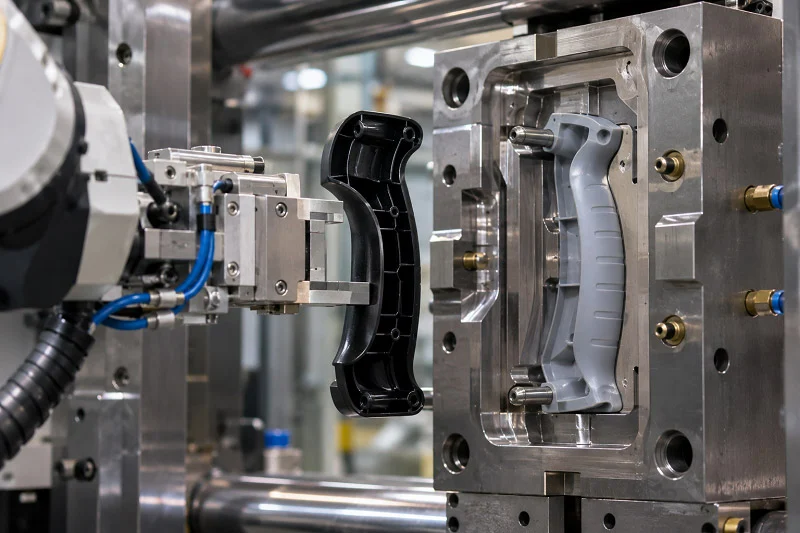
Process selection turns on volume, tooling cost, geometry freedom, material range, tolerance and lead time. Nylon injection molding wins on some of these and loses on others.
Injection Molding vs. 3D Printing
Additive processes offer speed and geometry freedom without tooling, which makes them the right bridge for early prototypes and very low counts. Injection molding offers per-part economics that additive cannot match at volume, plus material property fidelity — the part is made of the actual production resin, with the actual crystallinity and fiber orientation — and a surface finish that printed parts approximate only with extra work. The usual pattern is to print for form and fit, then mold for function and production.
Injection Molding vs. CNC Machining
Machining needs no tooling and holds tight tolerances readily, which makes machined nylon a legitimate route for low volumes, large parts and simple geometries. Molding wins as quantities climb and geometry complexity rises, because cycle time replaces cutting time and features that would each need a separate machining operation come out of the tool in one shot. For bridge volumes between the two, rapid tooling is often the economical middle path.
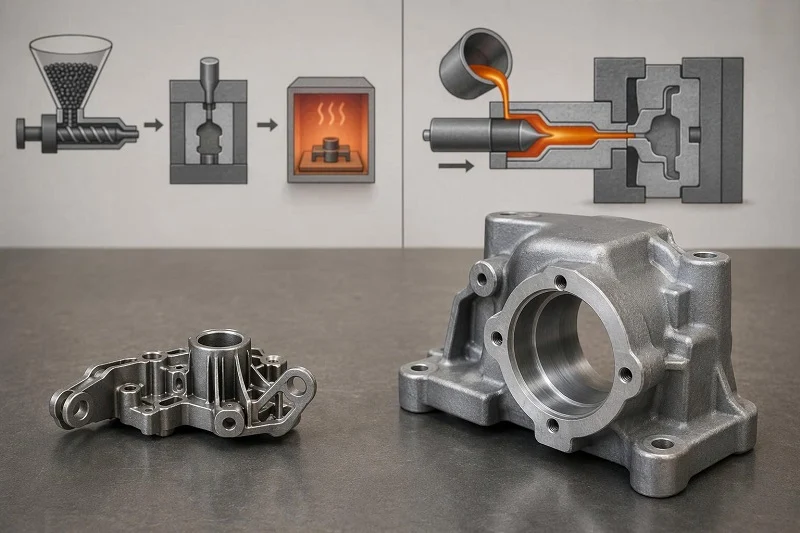
Injection Molding vs. Die Casting and Metal Injection Molding
Metal processes retain the strength and temperature ceiling where metal is genuinely required. Against them, nylon offers weight reduction, corrosion resistance, electrical insulation and often a lower cost per part, along with the design freedom of a polymer. The decision is usually settled by the service temperature and load: if the part must carry structural load at high temperature, metal wins; if it must insulate, resist corrosion and save weight, nylon is the candidate.
Injection Molding vs. Blow Molding and Extrusion
These processes make different part forms rather than competing for the same one. Blow molding makes hollow, thin-walled containers; extrusion makes continuous profiles, sheet, film and filament; injection molding makes discrete, dimensionally complex parts. Nylon is used in all three, so the choice is about the shape you need, not whether the material is available.
Design and Processing Pitfalls to Avoid in Nylon Injection Molding
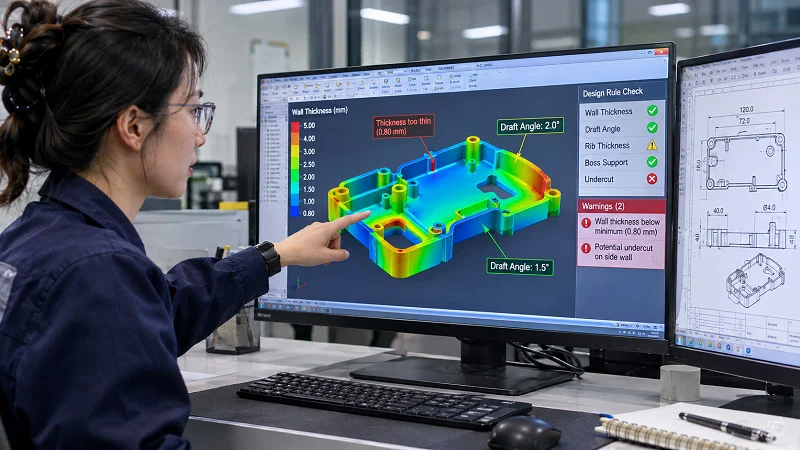
Most nylon molding problems trace back to a small set of causes. Knowing them in advance is cheaper than diagnosing them in production.
Shrinkage, Warpage, and Thick Sections
Crystalline shrinkage is significant in nylon, and uneven cooling turns that shrinkage into warpage and sink. Thick sections amplify the problem: the core cools later than the skin, packing pressure cannot reach it, and voids or sink marks follow. The design levers are uniform wall thickness, generous fillets, cored-out thick regions and a cooling layout that removes heat evenly from both faces. The process levers are a packing profile that stays effective while the gate is still open and a cooling time long enough to eject a dimensionally stable part.
Weld Lines, Voids, and Surface Defects
Weld lines form where two flow fronts meet, and they are structurally weaker than the surrounding material — a particular concern in glass-filled grades, where fiber orientation at the weld is unfavorable. Gate location and flow simulation are the controls. Voids come from wet resin or insufficient packing; the fix is drying and packing pressure, not cosmetic rework. Silver streaks point directly at moisture, and splay, burn marks and flash each have a specific process cause that should be traced rather than masked.
Recycled Content and Property Trade-offs
Regrind — sprues, runners and rejects — is usable within controlled limits, provided it is stored dry or dried before reuse. It carries thermal history, and in reinforced grades the fibers are damaged by shearing during molding and crushing. The general pattern is that mechanical strength declines first, with impact strength in reinforced grades typically the most sensitive, while electrical, sliding and chemical-resistance properties hold up better. Non-reinforced regrind generally retains most properties apart from tensile elongation; glass-reinforced regrind typically retains the bulk of its properties at moderate recycled content, with impact strength the exception.
Two controls matter. Fine particles from the granulator can contaminate regrind and destabilize molding, especially in compact electrical components, so they must be removed. And regulated or certified applications may cap recycled content — UL-certified materials, for example, may contain in-process recycled material up to 25% by weight, with higher levels requiring confirmatory testing. Set the recycled-content limit from the product’s required properties and its certification status before production, not after.
Choose NOBLE For Your Nylon Injection Molding Project
NOBLE is a Sino-British joint venture and a government-recognized National High-tech Enterprise, with more than 10 years of experience in parts machining and manufacturing. Our service depth and in-house machining capabilities are built to help customers move efficiently from prototype to batch production of nylon parts — and to shorten the handoffs that usually stretch a project timeline.
We hold ISO 9001:2015 and ISO 13485:2016 certification. The first underpins our general quality management system; the second is the medical device quality standard, which matters when a nylon component is destined for a healthcare application and the program needs documented design controls, traceability and risk-based process management alongside the molding itself.
Our scope runs from design to assembly, not just production. In practice that means:
- Design and DFM support — reviewing wall sections, draft, gate placement and shrinkage compensation before tooling is committed, so cost and defect risk are settled on paper.
- Prototyping — producing representative parts so form, fit and function can be verified before a production tool is cut.
- Tooling and molding — building molds and running production, with drying, process control and in-process inspection treated as part of the process rather than an afterthought.
- Secondary operations and finishing — machining critical features, surface finishing and the post-molding steps a nylon part typically needs.
- Assembly and inspection — bringing components together and verifying them against your specification before shipment.
Quality control follows a complete IQC, IPQC and FQC/OQC inspection sequence, supported by in-house test and measurement equipment, so that each stage of a project is checked rather than assumed. Quotes are typically returned within 24 hours of a complete RFQ, and our engineering team supports projects from first concept through to production.
If you are weighing a nylon grade, a tooling approach or a move from prototype to batch production, send us your drawings and requirements. We will review the design, flag the risks we see, and tell you what the part will take to make.
FAQs of Nylon Injection Molding
What moisture content should nylon pellets have before molding?
Molding-grade nylon pellets should be dried to a water content of no greater than 0.15–0.2%. Above that level, water vaporizes in the melt and causes silver streaking on the surface and voids inside the part, while hydrolysis reduces molecular weight and mechanical strength. Pellets from a sealed, undamaged moisture-resistant bag can be used immediately after opening; once the bag is open, absorption begins and drying becomes necessary.
Which nylon grade should I choose for a hot, humid application?
There is a genuine trade-off. PA66 offers the higher melting point and greater strength, stiffness and creep resistance, but it absorbs more moisture. Longer-chain grades such as PA610 and PA12 absorb less and therefore hold dimensions and electrical properties better in humid service, at some cost in strength and heat resistance. The right answer depends on which requirement governs — peak temperature or dimensional stability — so confirm property retention for the specific grade against its datasheet rather than relying on the family name.
How much shrinkage should I expect from nylon parts?
Shrinkage in nylon is significant because the polymer is semi-crystalline, and the exact value depends on the grade, wall thickness, flow direction and molding conditions. That is why tool dimensions are built with grade-specific shrinkage compensation rather than a single universal figure. Reinforced grades shrink differently from unfilled ones, and glass-filled parts also show directional differences because fibers orient with flow. Ask your molder for the shrinkage data used to cut the tool.
Can I use recycled nylon in injection molding?
Yes, within controlled limits. Regrind must be stored dry or dried before reuse, and it carries thermal history; in reinforced grades the fibers are damaged during processing. Mechanical properties — impact strength in reinforced grades in particular — typically decline first, while electrical and chemical resistance hold up better. Certified applications may cap recycled content, so confirm the limit for your product’s certification before setting a regrind ratio.
When is nylon injection molding the wrong process choice?
It loses in three situations. At very low volumes, tooling cost dominates and machining or 3D printing is usually cheaper. For extremely large or simple parts, extrusion or machining may serve better. And where the application exceeds nylon’s temperature or chemical envelope — sustained high heat, or contact with chemicals that attack polyamides — a different material is required regardless of process. Nylon resists oils, greases and many solvents well, but strong acids and some salts at elevated temperature are known to attack it.
How do I move a nylon part from prototype to production?
The typical path runs: prototype in a representative process or material to verify form and fit; DFM review to settle wall sections, draft, gating and shrinkage compensation; tool build; trial shots with dimensional and appearance checks; validation against the specification, including any conditioning the part will see in service; then ramp to production. The handoffs between these stages are where time is lost, so a partner with design, tooling, molding, finishing and assembly under one roof shortens the path — and keeps the lessons from each stage attached to the next.