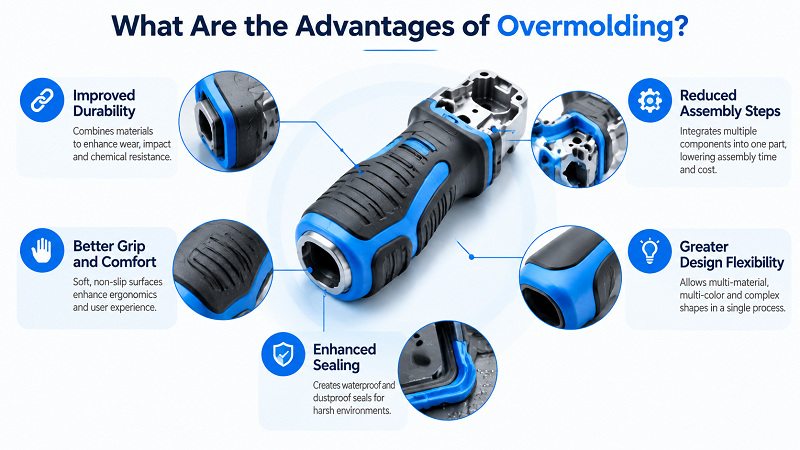
Overmolding is a common process in plastic part manufacturing. It combines different materials into one part. Each material keeps its own strengths. It also improves sealing, waterproofing, and product value. But in daily work, engineers often confuse overmolding with other processes. This is because they are not clear about its advantages. This article will explain the advantages of overmolding in full. It will help you avoid wrong turns in the future.

1. Какво е свръхформоване?
Overmolding is a multi-material injection molding process that wraps the base material with a second material. The base material can be metal, plastic, or other materials, while the coating layer endows the material with specific properties, such as a soft grip, water resistance, or shock absorption. Overmolding is widely used in industries that require rapid prototyping and custom parts manufacturing. It combines materials such as plastic, rubber, and metal to enhance their functionality.

2. Какви са предимствата на преформоването?
Overmolding has several advantages over other processes.
2.1 Better Product Performance
Overmolding helps engineers improve product performance. It makes parts stronger against impact, chemicals, and harsh environments. It also lets one part use more than one material. For example, a plastic tool handle can be overmolded with a thermoplastic elastomer. This makes it more comfortable to use.
2.2 Less Labor Time and Lower Cost
Overmolding technology enables manufacturers to eliminate time-consuming or costly secondary processing procedures such as bonding or assembly, thereby shortening production time and reducing the production cost of the final product. For instance, by manufacturing an integrated component, manufacturers can reduce overall production time and related labor costs.
The overmolding process can offer greater design flexibility:
This process enables designers to create parts with more complex geometries and more unique functions, which cannot be achieved by other manufacturing methods. By using different materials and colors, overmolded products can not only enhance their visual appeal but also offer additional functional features – for instance, product shells can be overmolded in multiple colors and materials, thus achieving a more aesthetically pleasing design.
2.3 Fewer Secondary Steps
Overmolding removes secondary steps like gluing or assembly. This saves a lot of time and cost. By making one integrated part instead of two or more parts, manufacturers save production time and labor cost.
Overmolding has many advantages for plastic parts. It works best for products that need higher performance, more design freedom, and lower cost.
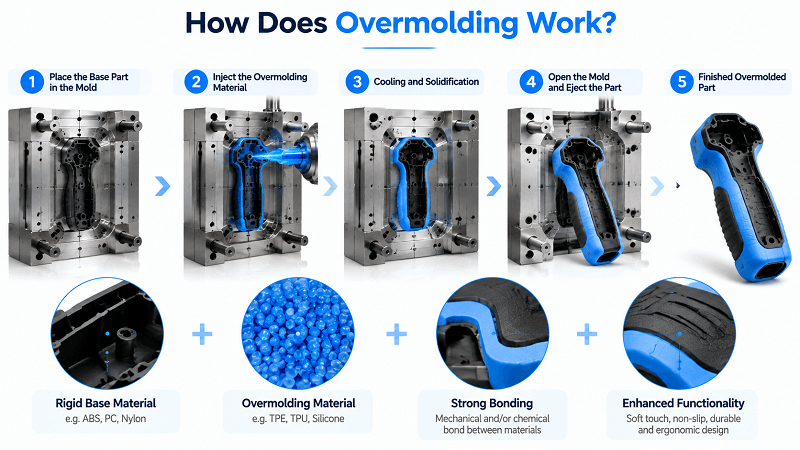
3. How Does Overmolding Work?
Overmolding is a two-step injection molding process. The first step is to injection mold a basic part from a type of plastic, and this part is called the base material. The base material can be either hard plastic or metal.
The second step is to place the base material into another set of molds and inject the second material, which is usually soft rubber or rubber. This material will be wrapped around the surface of the substrate, forming a thin outer layer. The two materials must be chemically or mechanically bonded; otherwise, the outer layer is prone to fall off. The common combinations are hard plastic and soft rubber, or metal and rubber. The final result is an integral part that is hard inside and soft outside, which is both sturdy and anti-slip, and combines the advantages of both materials.
4. Why Is Material Selection Important in Overmolding?
4.1 It Decides Bond Strength
The two materials must bond chemically or mechanically. Otherwise, the outer layer can peel, lift, or separate. If the materials do not match, the product will not last. Good molds and processes cannot fix this. This is the first key point for overmolding success.
4.2 It Decides Function
The substrate gives strength and support. The overmold layer gives grip, sealing, feel, and wear resistance. The wrong material can affect looks and feel. In serious cases, it can cause the product to fail. For example, a product that needs chemical resistance must use a matching overmold material.
4.3 It Affects Size Stability
The two materials should have close thermal expansion rates. Otherwise, the part may warp after cooling. Processing temperatures must also match. This stops the substrate from softening or deforming during the second injection.
4.4 It Affects Long-Term Reliability
The material pair also decides how the product works over time. Materials with poor heat, weather, or aging resistance can fail early outdoors or in hot places.
4.5 It Decides Cost and Processing Window
Different materials have different processing windows, temperatures, and cycles. These affect production speed and scrap rate. Material choice also decides if extra mechanical locks, surface texture, or support structures are needed.
Резюме:
Material selection is not just “hard plus soft.” It must match the use, the environment, and the process. Choose the right materials, and overmolding works well.
5. What Is the Main Purpose of Overmolding Material Technology?
5.1 Combine the Good Points of Two Materials
Put a hard structure and a soft functional layer into one part. The substrate gives strength, rigidity, and size stability. The overmold layer gives grip, sealing, cushioning, and a comfortable feel. One part then has both “hard” and “soft” abilities.
5.2 Подобряване на потребителското изживяване
Soft overmolding makes the product more comfortable to hold. It is less likely to slip. It also reduces fatigue during long use. It works well for handheld products like tool handles, sports equipment, and medical devices. It meets ergonomic needs.
5.3 Add More Functions
The overmold layer can seal, waterproof, absorb shock, or insulate. The soft outer layer fits tightly to the substrate. It keeps moisture, dust, or chemicals out. It also absorbs impact and vibration. This protects the inner structure.
5.4 Simplify Production and Improve Consistency
One or two injection steps combine the hard structure and the soft layer. This removes the later step of putting on a soft cover. It reduces part count and assembly steps. It lowers labor cost and inventory work. It also improves product consistency.
5.5 Increase Product Value
Different colors and hardness levels can be overmolded. This creates two-color looks or local soft-grip effects. It improves product quality and appearance. It also makes the product more competitive.
Резюме:
The main goal is to let one part have strength, comfort, sealing, and good looks. It is easy to use and lasts long.
6. What Are the Wide Material Choices for Overmolding?
Material choice determines bonding, feel, flexibility, chemical resistance, heat resistance, color, and processing window. Soft-touch TPE may act differently on substrates like ABS, nylon PA, PP, POM, or PEEK. The substrate and overmold material should be chosen together, not bought separately.
Some material pairs can form chemical bonds under the right process conditions. Other pairs may need mechanical locks, holes, ribs, grooves, surface texture, or assembly structures. This is because chemical bonding is weak. Buyers should clarify what the second material is for. It may be for soft touch, sealing, grip, electrical insulation, impact absorption, shock reduction, or color marking.
| Материал | Точка | съдържание |
| TPE / TPU | функция | Soft-touch grips, sealing rings, grip layers, cushion pads |
| Риск | Peeling, flash, tackiness, color change | |
| Разследване | Hardness, color, surface texture, adhesion testing | |
| ABS / ABS-PC | функция | Rigid substrate for housings and handles |
| Риск | Heat deformation, sink marks, appearance mismatch | |
| Разследване | Substrate grade, visible surfaces, dimensional tolerances | |
| Найлон ПА | функция | Structural substrate with strength and wear resistance |
| Риск | Moisture sensitivity, dimensional change, bonding variation | |
| Разследване | Drying conditions, glass fiber content, operating environment | |
| PP / POM / PEEK | функция | Functional substrate where chemical or thermal properties are critical |
| Риск | Bonding difficulty, shrinkage mismatch, processing window | |
| Разследване | Material grade, bonding method, validation requirements |
7. How Does Overmolding Improve Your Injection Molding Project?
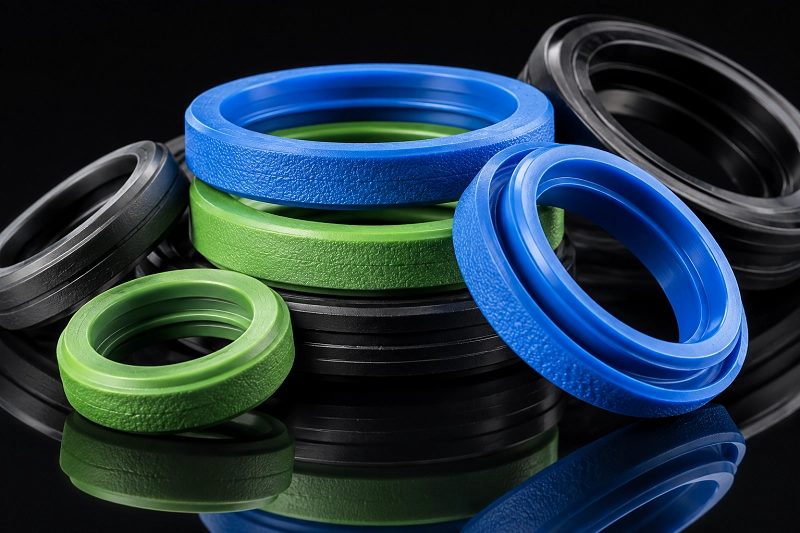
7.1 Better Grip and Ergonomics
After overmolding with soft material, the surface is softer and has more friction. It is more comfortable to hold and less likely to slip. It works well for tool handles, sports equipment, and medical devices. It also reduces fatigue during long use.
7.2 Sealing and Protection
The overmold layer fits tightly to the substrate. It can seal electronic parts or protect precision parts from impact, dust, and moisture. It works well for outdoor electronics and housings for medical instruments.
7.3 Shock Absorption and Cushioning
Soft overmold material absorbs vibration and impact. It makes tools and electronics more comfortable to use. It also cushions drops or collisions. This extends product life.
7.4 Simpler Assembly and Lower Cost
Overmolding combines two steps into one. It reduces part count and assembly steps. It lowers labor cost and inventory work. The overmold layer forms a chemical or mechanical bond with the substrate. Bond strength is much higher than soft materials glued on later. It does not peel or separate easily over long use.
8. What Functions Can Overmolding Technology Achieve?
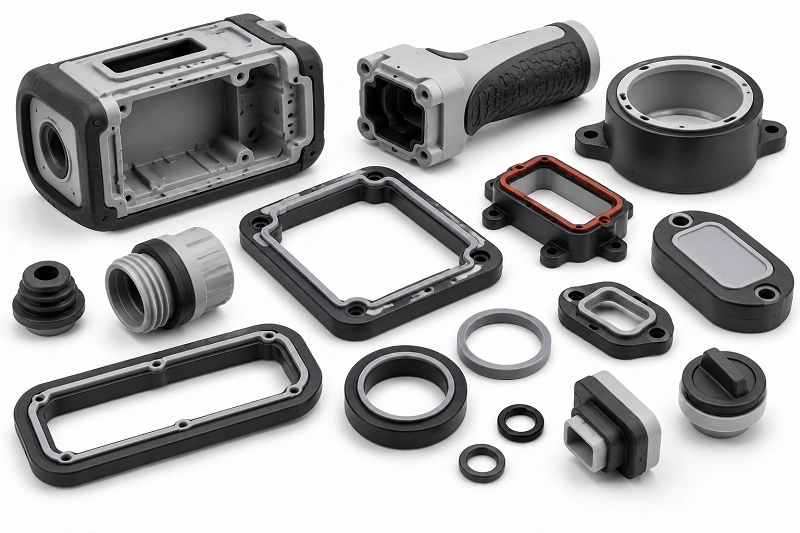
Overmolding can achieve many functions. They are mainly shown below.
8.1 Better Grip Comfort and Slip Resistance
By overmolding a soft material on the outer layer, the surface feels softer and has more friction. Users can hold it without slipping easily. It also reduces fatigue during long use.
8.2 По-добро уплътняване и хидроизолация
The soft outer layer fits tightly to the substrate and forms a good seal. It keeps moisture, dust, or chemicals out. This is useful for products that need waterproofing or dust protection, such as outdoor electronics and medical instrument housings.
8.3 Two-Color Appearance and Local Soft-Grip Effects
Различни цветове и нива на твърдост могат да бъдат отливани върху основата. Това създава двуцветен вид или локални ефекти с меко захващане. Свободата на дизайна е по-голяма. Продуктът изглежда и се усеща по-добре.
8.4 Impact and Vibration Absorption
The soft outer layer absorbs impact and vibration. It protects the hard inner structure. It cushions drops or collisions. This extends product life.
8.5 Fewer Parts and Simpler Assembly
Traditional methods need a separate soft cover made and then assembled. Overmolding combines two steps into one. This reduces part count and assembly steps. It lowers labor costs and inventory work.
8.6 Strong Bond
The overmold layer forms a chemical or mechanical bond with the substrate during molding. Bond strength is much higher than soft materials glued or slipped on later. It does not peel, fall off, or separate easily over long use.
8.7 Better Feel and Ergonomics
The soft outer layer improves the product’s feel and grip comfort. It makes the product more ergonomic. This is good for handheld products and wearable devices.
9. What Are the Advantages of Overmolding in Different Industries?
9.1 Медицински изделия
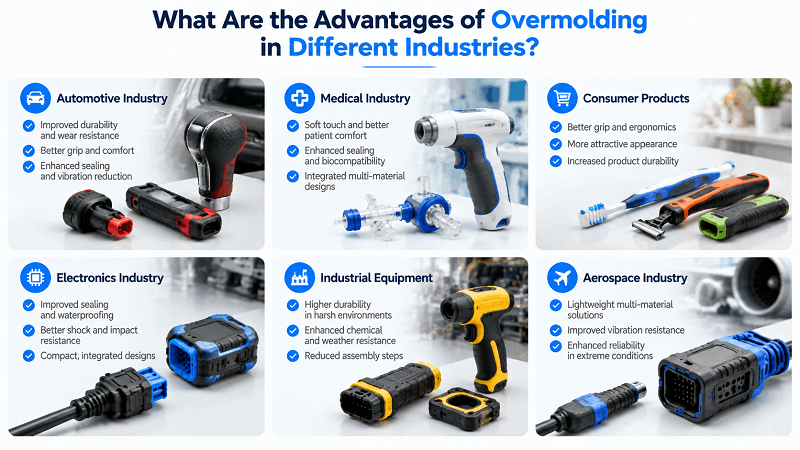
Soft overmolding improves grip comfort and slip resistance. Silicone overmold layers are biocompatible. They can handle high-temperature sterilization. They work well for surgical instrument handles and endoscope grips.
9.2 Електрически инструменти
A hard plastic substrate with TPE soft overmolding gives grip, shock absorption, and insulation. It improves operating safety. This is a common solution for drills, angle grinders, and other tools.
9.3 Потребителска електроника
Overmolding creates two-color looks and a soft touch. It also improves waterproof and dustproof performance. It is common in phone cases, earphone housings, and smartwatch bands.
9.4 Автомобилна индустрия
Parts like steering wheels, gear shifters, and seals use overmolding. This improves feel, reduces noise, and enhances sealing.
9.5 Стоки за ежедневна употреба
Toothbrush handles, razors, and cookware grips use soft overmolding. This improves comfort and slip resistance.
9.6 Промишлено оборудване
Control panels, instrument grips, and industrial handles use overmolding. This improves durability and operating safety.

10. Защо да изберете NOBLE за производител на покрития за формоване
NOBLE предоставя пълна поддръжка за проекти за формоване с покритие. Ние помагаме с преглед на дизайна и избор на материали. Даваме обратна връзка по метода на DFM (Design-Feed Process - технологично производство), за да подобрим дизайна на частите. Изграждаме прецизни форми както за субстрат, така и за формоване с покритие. Предлагаме ръчно и двукомпонентно формоване с покритие. Също така предоставяме инспекция на линията, за да проверим качеството на свързването. Нашият екип обработва малки партиди и масово производство. Водим пълни записи на процеса за проследимост. Това отговаря на изискванията на ISO 13485 за медицински проекти. От прототип до производство, ние подкрепяме целия процес.
FAQs of Overmolding:
1. Какво е свръхформоване?
Overmolding is a manufacturing process that molds one material over an existing part to create a multi-material component with improved function and appearance.
2. What are the main advantages of overmolding?
The main advantages include improved product durability, better grip and comfort, enhanced sealing, reduced assembly steps, and greater design flexibility.
3. How does overmolding improve product performance?
Overmolding combines different materials to add features such as impact resistance, vibration reduction, waterproof sealing, and better user comfort.
4. Can overmolding reduce manufacturing costs?
Yes. Overmolding can reduce costs by integrating multiple parts into one component and minimizing secondary assembly processes.
5. What materials are commonly used in overmolding?
Common materials include TPE, TPU, silicone, rubber, ABS, PC, nylon, and other engineering plastics selected based on product requirements.