5-axis CNC machining is an advanced manufacturing technology that enables manufacturers to produce complex and high-precision components while enhancing flexibility, efficiency, and machining accuracy.
By combining three linear axes with two rotational axes, this technology enables the tool to approach the workpiece from multiple directions, reducing the need for repetitive setup and complex fixtures.
This comprehensive guide explores the principles, machine types, benefits, applications, materials, design considerations, precision capabilities, and the cost of 5-axis CNC machining, hoping to help everyone understand this process.
1. What Is 5-Axis CNC Machining?
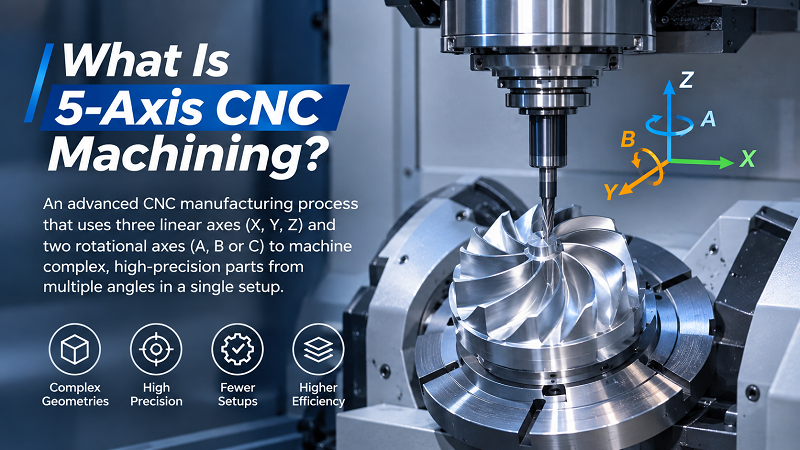
5-axis numerical control machining is an advanced subtractive processing technology. It utilizes a computer numerical control system to move in coordination along three linear axes and two rotational axes, enabling the cutting tool to enter the complex workpiece surface from multiple directions during precise manufacturing operations.
Traditional 3-axis CNC machining mainly controls the movement of the tool along the X, Y, and Z axes, while 5-axis machining introduces additional rotational positioning functions, expanding the accessibility of machining and reducing the number of Settings required for complex components.
This technology is particularly valuable for manufacturing components with complex contours, angular holes, curved surfaces, inner cavities, and various precision features; otherwise, these components would need to be repeatedly repositioned on traditional CNC machines or special fixtures.
Manufacturers typically apply 5-axis CNC machining to high-value components in aerospace, medical equipment, automotive engineering, robotics, and precision tools, where geometric complexity, dimensional accuracy, machining consistency, and production efficiency are crucial for successful manufacturing.
2. How Does 5-Axis CNC Machining Work?
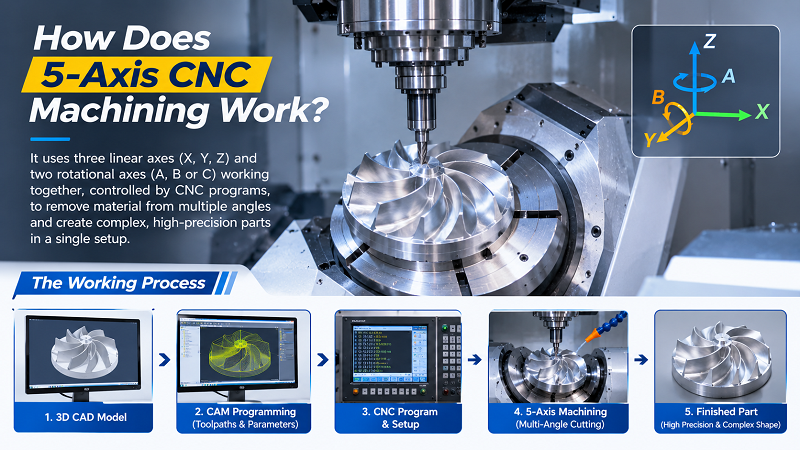
5-axis CNC machining positions the tool relative to the workpiece on three linear axes and two rotational axes through computer-controlled movement, thereby achieving material removal from different angles without the need for repeated removal and repositioning of components.
The machining process usually begins with a 3D CAD model, which engineers import into dedicated CAM software to generate cutting strategies, tool paths, machining parameters, and instructions that are compatible with the specific axis configuration and control system of the machine tool.
During the production process, the CNC controller coordinates the movement of the linear axis and the rotary axis, while the spindle rotates the tool at a programmed speed to remove material according to the required geometry, tolerance, and surface finish specifications.
Depending on the complexity of the components and production requirements, manufacturers can use index positioning or simultaneous multi-axis movement, allowing for 5-axis machining to adapt to everything from multi-sided mechanical housings to highly complex free-form surfaces and precision engineering industrial components.
3. What Are the Five Axes on a CNC Machine?
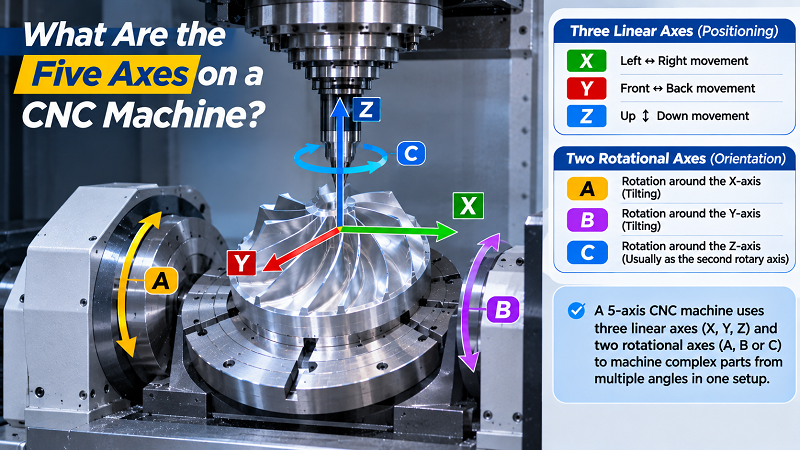
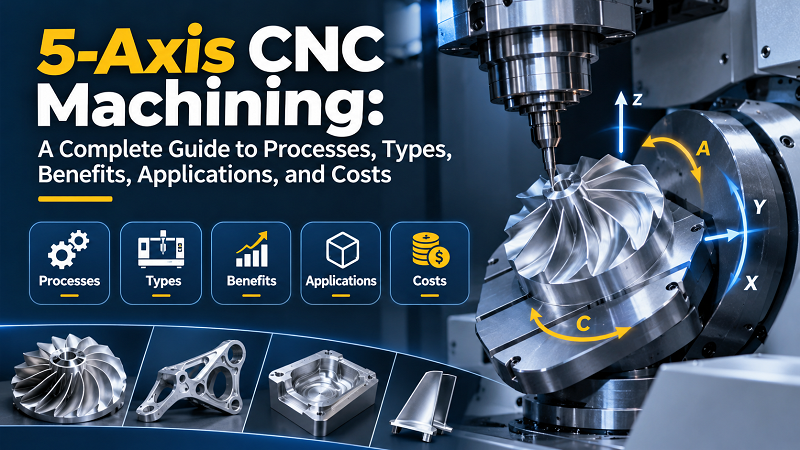
A typical 5-axis CNC machine tool uses three linear axes, known as X, Y, and Z, as well as two rotational axes selected from A, B, and C, providing a variety of motion combinations according to the machine structure and manufacturing requirements.
The X-axis typically controls movement from left to right, the Y-axis controls movement from front to back, the Z-axis controls vertical movement, and the rotational axis enables the tool or workpiece to change direction around the defined machine coordinate direction.
The A-axis represents rotation around the X-axis, the B-axis represents rotation around the Y-axis, and the C-axis represents rotation around the Z-axis, although a specific machine usually only contains two of these three rotation axes.
By combining linear positioning with controlled rotational motion, 5-axis CNC machines can achieve angled surfaces, process multiple surfaces, maintain favorable cutting directions, and process complex geometries that are difficult or inefficient to manufacture using traditional 3-axis equipment.
4. What Are the Main Components of a 5-Axis CNC Machine?
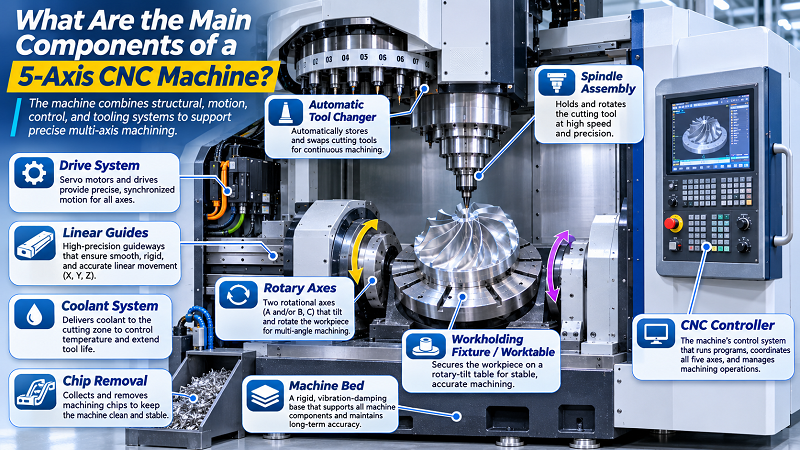
The main components of a 5-axis CNC machine tool include the machine bed, spindle assembly, linear guides, rotating shafts, drive system, workpiece holding equipment, tool changing mechanism, and CNC controller.
The spindle provides cutting power and tool rotation, while the precision motion system controls linear and rotational movements, enabling the machine to maintain appropriate tool orientation and positioning accuracy during complex cutting operations spanning multiple workpiece surfaces.
The 5-axis machining center also integrates complex CNC control software, position feedback systems, thermal compensation functions, and advanced tool management functions to enhance machining consistency and reduce errors caused by mechanical movement or temperature changes.
Other systems, including coolant delivery, chip removal, automatic tool changers, detection equipment, and machine monitoring technology, help manufacturers maintain reliable production conditions, support efficient processing cycles, and manage complex components with strict quality requirements.
5. What Are the Different Types of 5-Axis CNC Machines?
There are several configurations of 5-axis CNC machine tools, including ear table machine tools, double rotary table machine tools, rotary head machining centers, and machine tools that combine a rotary table with a rotating spindle head. Each type of machine tool offers different motion characteristics and workpiece accessibility.
Ear shaft machines typically use inclined turntables to position workpieces, making them suitable for many smaller precision components, while rotary head machines can accommodate larger or heavier workpieces by moving the cutting spindle in different directions.
The dual turntable configuration provides rotational positioning through the workpiece holding system, while the headstock combination distributes rotational motion between the spindle and the workpiece, creating different advantages in terms of machine stroke, rigidity, processing envelope, and interference control.
6. What Is the Difference Between 3-Axis, 3+2-Axis, and Simultaneous 5-Axis Machining?
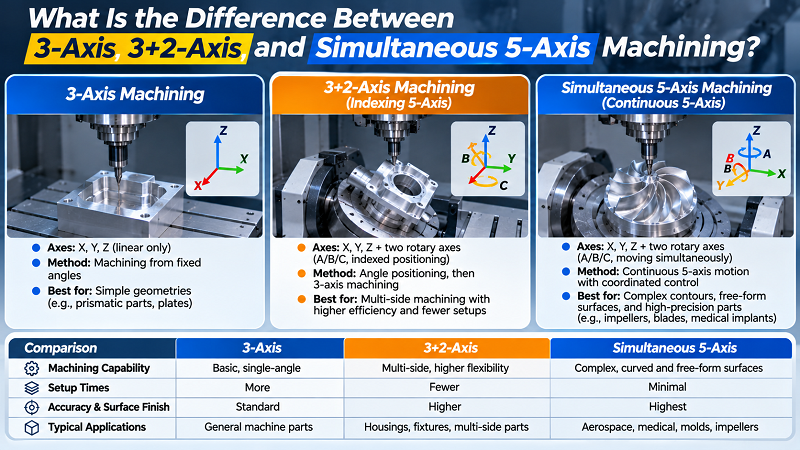
In 3+ 2-axis machining, also known as index 5-axis machining, the rotating axis usually remains stationary in a separate cutting operation, allowing manufacturers to process multiple angled surfaces while retaining the relatively direct three-axis cutting strategy.
At the same time, 5-axis machining coordinates linear and rotational movements during the cutting process, allowing the tool direction to continuously change. It is particularly suitable for complex free geometries, engraved surfaces, impellers, turbine components, and other applications that require precision.
Although simultaneous machining offers greater geometric flexibility, it usually requires more complex CAM programming, collision avoidance, and machine calibration, while index machining may provide a more economical solution for components that do not require continuous multi-axis tool movement.
7. What Are the Benefits of 5-Axis CNC Machining?
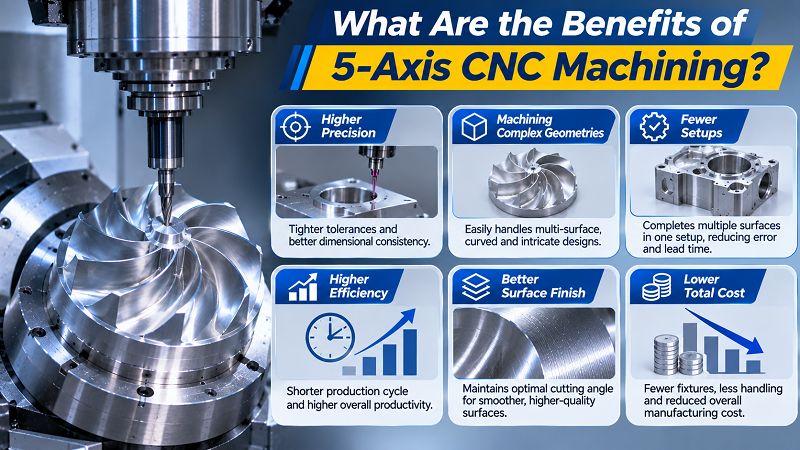
One of the main advantages of 5-axis CNC machining is that it can manufacture complex components with fewer Settings, reduce repetitive workpiece processing, fixture replacement, and cumulative positioning errors, while improving overall workflow efficiency and production consistency.
The additional rotational flexibility enables the cutting tool to approach the difficult surface at a more favorable Angle, thus making it possible to achieve shorter and more rigid tools, thereby reducing vibration, improving cutting stability, and supporting better dimensional accuracy and surface finish.
5-axis machining can also enhance manufacturing flexibility by supporting complex shapes, compound angles, curved profiles, and precision features that are difficult to effectively process with traditional equipment without additional fixtures or multiple machining operations.
These advantages can be translated into shorter production cycles, improved component quality, reduced manual intervention, and more efficient manufacturing processes, especially for aerospace components, medical devices, special tools, and other high-value precision engineering products.
8. What Are the Limitations of 5-Axis CNC Machining?
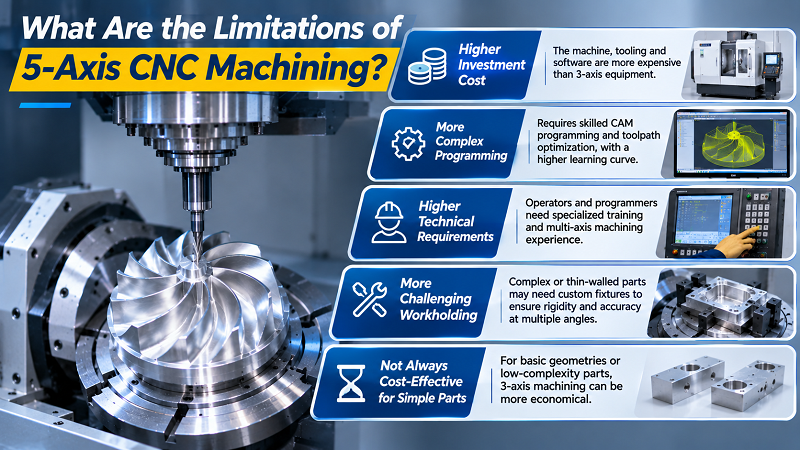
5-axis CNC machining has some limitations, including higher equipment investment, more demanding machine maintenance, and complex CAM programming requirements, etc.
Programming the synchronous movement of cutting tools requires careful consideration of machine kinematics, tool accessibility, collision risk, cutting conditions, and workpiece holding arrangements. This makes process planning more complex than traditional processing and may increase the preparation time for new components.
The accuracy of machine tools can also be affected by the calibration of the rotating axis, thermal expansion, mechanical stiffness, tool wear, and positioning errors, which requires manufacturers to implement regular inspections, preventive maintenance, and appropriate quality control procedures.
For relatively simple components with accessible features, it is important to assess whether the additional processing flexibility truly enhances manufacturing performance or merely increases production costs.
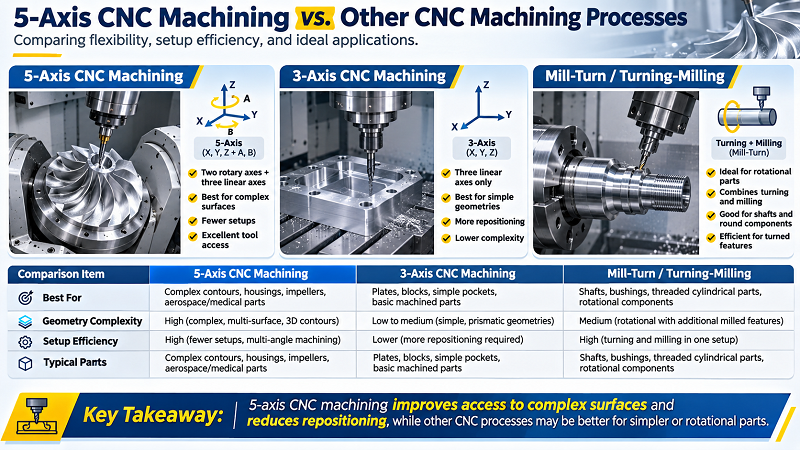
9. 5-Axis CNC Machining vs Other CNC Machining Processes
5-axis CNC machining offers additional rotational degrees of freedom, improves access to complex surfaces, and reduces the need for repositioning, although both methods rely on computer-controlled cutting tools to remove material from the workpiece.
Milling machining centers combine turning and milling operations, making them particularly suitable for rotating parts that require additional processing characteristics. 5-axis milling centers are typically used for geometrically complex parts that benefit from advanced tool positioning.
When choosing between processing methods, it is necessary to evaluate the geometry of the component, material properties, required tolerances, production quantity, setup requirements, and manufacturing costs, rather than assuming that machines with more axes always provide better results.
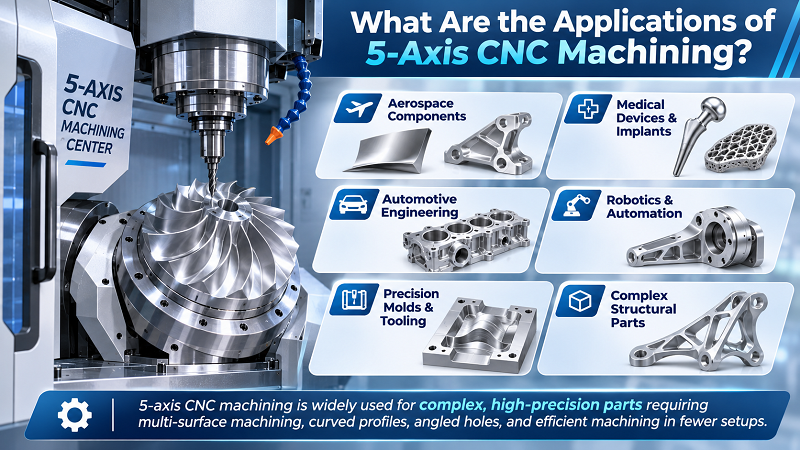
10. What Are the Applications of 5-Axis CNC Machining?
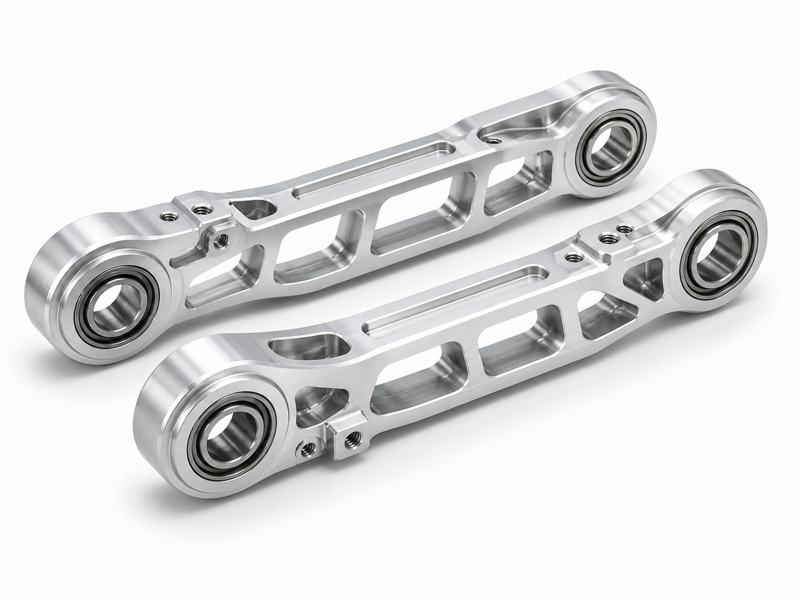
5-axis CNC machining is widely used in the manufacturing of complex mechanical components, such as impellers, turbine blades, aerospace brackets, precision housings, medical implants, special molds, and complex structural parts that require precise machining across multiple surfaces.
Its ability to change the direction of the tool makes it particularly suitable for processing curved profiles, inclined holes, complex pockets, and geometries that require multiple Settings or specially designed fixtures in traditional cutting methods.
In prototype development, engineers use 5-axis machining to produce functional components from production-level materials, allowing for design verification, assembly testing, dimensional verification, and performance evaluation before proceeding to larger-scale production.
For production applications, this technology supports repeatable processing procedures, precision component manufacturing, and efficient processing of challenging geometries, making it valuable for industries that require manufacturing flexibility and consistent engineering quality.
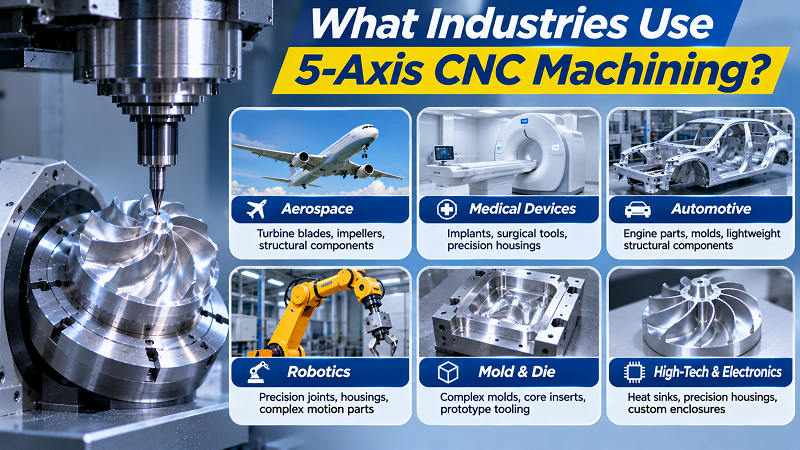
11. What Industries Use 5-Axis CNC Machining?
The aerospace industry uses 5-axis CNC machining to produce turbine components, structural brackets, aircraft engine parts, and other complex lightweight structures.
Medical equipment manufacturers apply this technology to surgical instruments, orthopedic implants, diagnostic device components, and robotic medical systems, while automakers use it for engine parts, performance components, prototype development, and professional production tools.
Energy and industrial equipment manufacturers also benefit from 5-axis machining when producing impellers, turbine components, precision mechanical assemblies, and custom parts that require complex cutting strategies or multiple surfaces.
Other applications have expanded to robotics, defense manufacturing, molds and mold production, scientific instruments, and advanced automated equipment, demonstrating the versatility of 5-axis machining in industries with demanding mechanical and dimensional requirements.
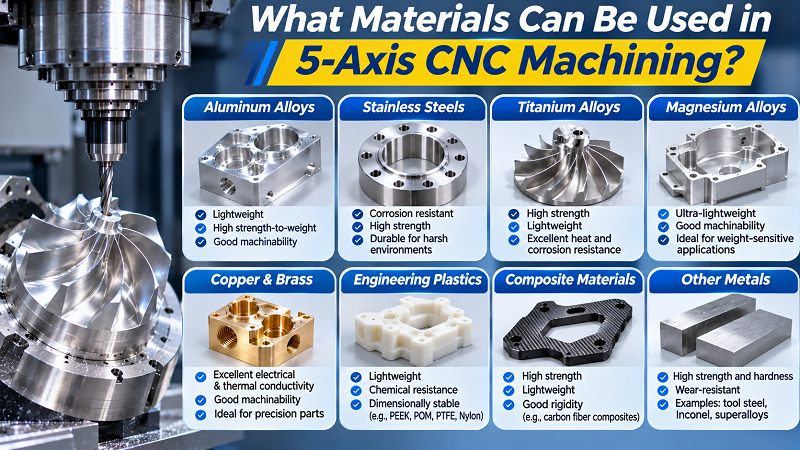
12. What Materials Can Be Used in 5-Axis CNC Machining?
5-axis CNC machining supports a variety of engineering materials, including aluminum alloys, stainless steels, titanium alloys, and other materials, as well as selected high-performance materials used in harsh industrial environments.
Engineering plastics, such as POM, PEEK, ABS, nylon, and polycarbonate, can also be processed with appropriate cutting tools and processing parameters, especially for lightweight structural components, precision fixtures, insulating parts, and specialized medical or electronic applications.
Due to the varying responses of different materials to cutting forces, heat generation, tool engagement, and processing conditions, manufacturers must carefully select spindle speed, feed rate, tool, coolant strategy, and workpiece holding method to maintain quality and efficiency.
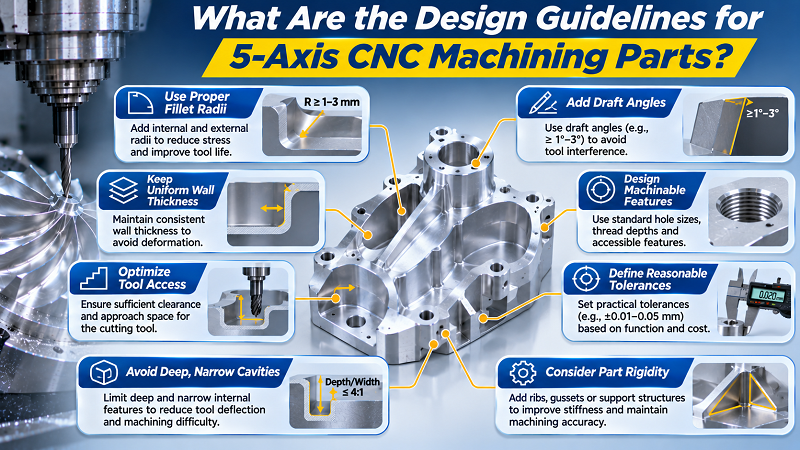
13. What Are the Design Guidelines for 5-Axis CNC Machining Parts?
Designing parts for 5-axis CNC machining requires engineers to consider tool accessibility, machining direction, wall thickness, corner radius, hole positioning, cavity depth, and workpiece holding requirements to ensure that the expected geometric shapes can be produced efficiently and accurately.
Appropriate dimensional tolerances, actual surface finish specifications, suitable material selection, and sufficient clamping surfaces help improve manufacturability while reducing unnecessary processing operations and quality control challenges in the component production process.
By applying manufacturing-oriented design principles in the early stage of product development, engineers and processing suppliers can optimize the geometry of components, select appropriate cutting strategies, reduce production risks, and achieve a better balance between performance requirements and manufacturing costs.
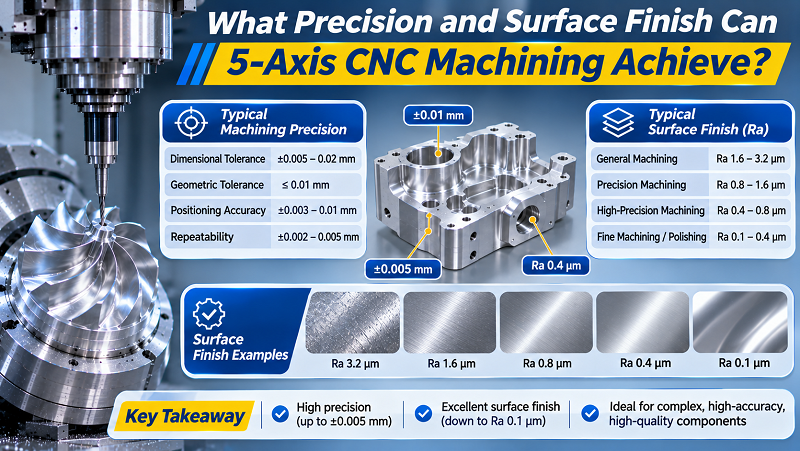
14. What Precision and Surface Finish Can 5-Axis CNC Machining Achieve?
5-axis CNC machining can produce high-precision components with strict dimensional tolerances and smooth surface finishes.
Under appropriate control conditions, certain precision features can achieve tolerances of ±0.01 mm or stricter, and surface roughness values such as Ra 0.8-1.6 μm can be achieved through appropriate finishing operations and optimized cutting strategies.
However, due to deep cavities, long tools, thin walls, difficult-to-machine materials, and complex free-form surfaces, different tolerance specifications or additional finishing may be required.
Manufacturers enhance machining accuracy by using equipment such as three-coordinate measuring machines and precision measuring instruments, through machine calibration, thermal management, tool path optimization, stable workpiece holding, tool selection, and dimensional inspection.
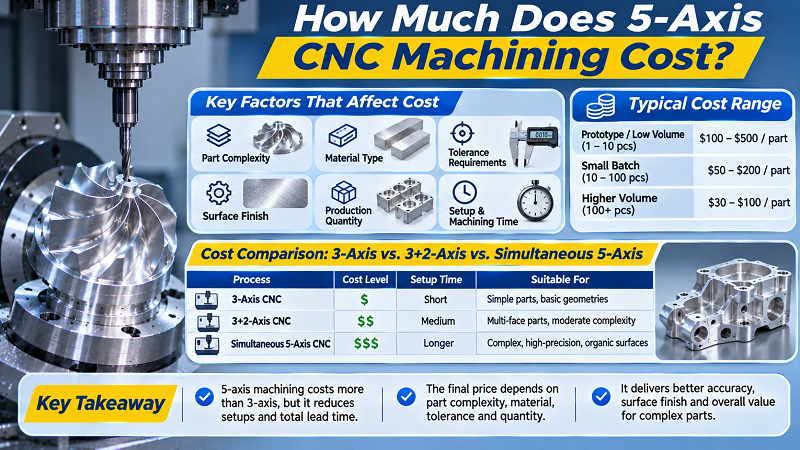
15. How Much Does 5-Axis CNC Machining Cost?
The cost of 5-axis CNC machining varies depending on requirements such as the geometry of the component, the type of material, and the size of the raw material.
Complex components require advanced tool paths, strict tolerances, special materials, or extensive dimensional checks, which may involve higher programming and production costs. Repeat orders and larger manufacturing volumes can allocate initial preparation costs to more finished parts.
To accurately assess the manufacturing cost, the buyer should provide complete CAD files, engineering drawings, material specifications, tolerance requirements, expected surface finish, and estimated quantities, so that the supplier can recommend appropriate processing strategies and prepare reliable quotations.
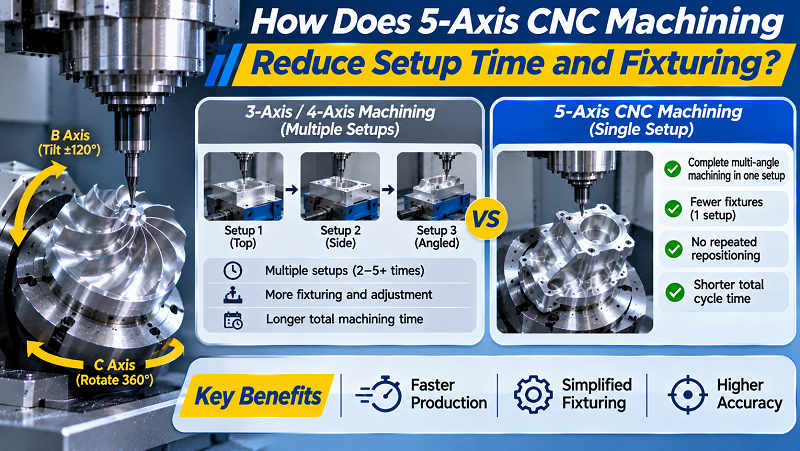
16. How Does 5-Axis CNC Machining Reduce Setup Time and Fixturing?
5-axis CNC machining, by controlling rotational positioning, allows cutting tools to access multiple sides of the workpiece, thereby reducing installation requirements and minimizing the need to disassemble, reposition, and manually readjust components between individual machining operations.
Traditional machining may require several fixtures or separate setups to create features on different surfaces, while suitable 5-axis machining can accomplish many of these operations using a single workpiece fixture arrangement.
Reducing the installation frequency can enhance manufacturing efficiency, shorten non-cutting time, decrease the involvement of operators, and limit dimensional changes caused by repeated clamping, although some complex components still require multiple installations or special fixtures.
These advantages are particularly valuable for precision components that contain multiple Angle holes, machined surfaces, and interconnected geometric features, where consistent positioning and precise relationships among various features are crucial for successful assembly.
17. How Is Quality Control Performed in 5-Axis CNC Machining?
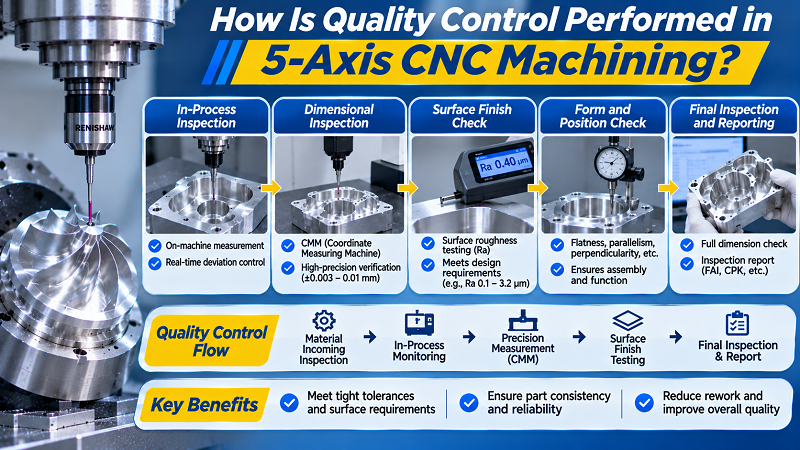
The quality control of 5-axis CNC machining includes machine calibration, process monitoring, dimensional inspection, and surface quality verification to ensure that the finished components meet the specified engineering requirements, especially when it involves complex geometries and strict tolerances.
Three-coordinate measuring machines, optical measuring systems, micrometers, precision gauges, and surface roughness instruments can be used to inspect key features, verify dimensional relationships, and assess whether the machined surfaces meet relevant quality specifications.
Manufacturers can also carry out first-piece inspection, process measurement, tool wear monitoring, and final quality inspection to identify potential deviations before they affect production batches or damage component functionality.
Effective quality management requires documented inspection procedures, calibrated measuring equipment, appropriate traceability, and clear communication between engineering and manufacturing teams to help maintain consistent part quality in prototype and production projects.
18. How to Choose the Right 5-Axis CNC Machining Service Provider?
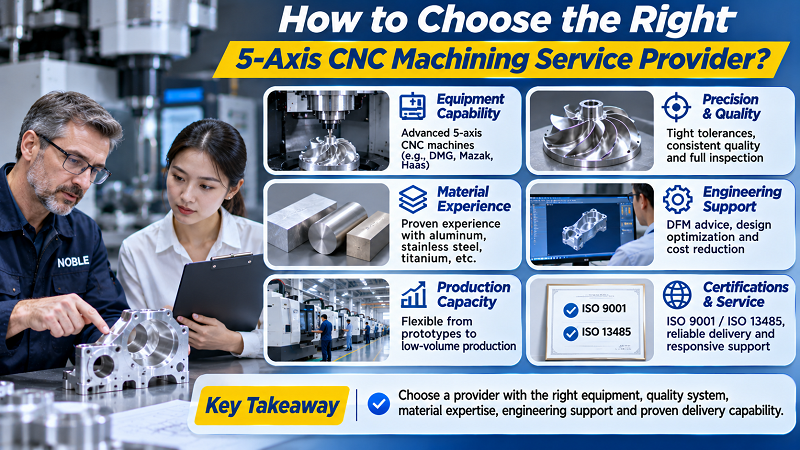
Choosing a reliable 5-axis CNC machining service provider requires available processing equipment, supporting materials, manufacturing experience, engineering capabilities, and other aspects.
The buyer shall evaluate the quality management system, inspection equipment, production capacity, programming ability and experience with similar components, and review the relevant certifications applicable to the project, such as ISO 9001 or ISO 13485.
An experienced supplier should also provide feedback designed for manufacturing, identify potential processing difficulties, recommend suitable materials and tolerances, and communicate clearly regarding production plans, inspection requirements, and cost optimization opportunities.
When purchasing complex precision machined components, comparing suppliers based on total manufacturing value rather than unit price can help the purchasing team assess quality consistency, technical support, delivery reliability, and long-term cooperation potential.
19. What Is the Future of 5-Axis CNC Machining?
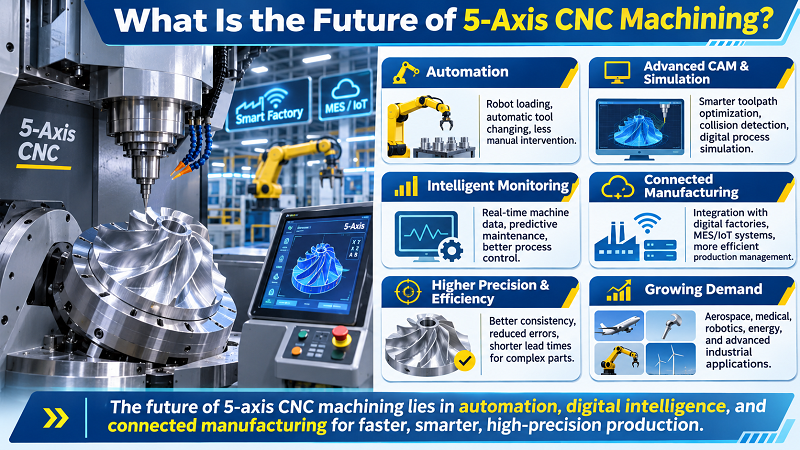
The future of 5-axis CNC machining will increasingly be linked to manufacturing automation, digital process simulation, advanced CAM programming, intelligent machine monitoring, and improved CNC control technology to support more efficient and predictable precision manufacturing operations.
Developments in tool path optimization, collision detection, machine connection, and automatic detection can help manufacturers reduce programming errors, improve processing consistency, monitor equipment performance, and minimize unplanned disruptions in complex production processes.
Integration with robot loading systems, digital manufacturing platforms, and data-driven production management can further enhance equipment utilization and support more flexible manufacturing environments, especially for companies that produce complex components in different batches.
With the continuous growth in demand for lightweight structures, precision medical equipment, advanced robots, aerospace systems, and complex industrial components, 5-axis machining is expected to remain a valuable manufacturing technology for applications that require geometric flexibility and high-quality results.
20. Why choose NOBLE as your 5-axis machining manufacturer
NOBLE is a Sino-British joint venture awarded by the government as a “National High-tech Enterprise”. We have two major business directions: “Smart Manufacturing” and “Care Products”. The “Smart Manufacturing” business specializes in providing customers with project-support services, including parts machining and manufacturing.
More than 10 years of professional manufacturing and five-axis machining experience. Our efficient team provides strong support for your new projects to 100% realize your requirements; Standardized management brings strict quality control of parts & products; a reasonable workflow results in lower costs with the same quality.
After years of hard work and development, NOBLE has gradually transformed from a precision parts machining and manufacturing enterprise with complete industrial chain supporting service capabilities to a service-oriented enterprise that provides full support for customers’ entire projects.
NOBLE is your trusted one-stop custom manufacturing solution, from prototype design to manufacturing, with huge manufacturing resources, suitable technology, streamlined processes, expert guidance, and a perfect quality inspection process to turn your ideas into reality.
NOBLE has the following qualification certificates:
ISO 9001: 2015 – Robust quality management for general manufacturing. Consistent processes. Documented control. Traceable inspection.
ISO 13485: 2016 – Stricter quality standards for medical device parts. Rigorous process validation. Full traceability. Required for implantable and surgical parts.
21. Conclusion
5-axis CNC machining offers an advanced manufacturing solution for producing complex precision components, featuring improved tool accessibility, greater machining flexibility, and the potential to reduce setup compared to traditional CNC methods.
Its application scope covers aerospace, medical equipment, automotive engineering, robotics, energy equipment, and precision tools, and its effectiveness depends on appropriate machine configuration, suitable materials, optimized design, precise programming, and comprehensive quality control.
Although 5-axis machining may involve higher equipment and programming costs, its ability to handle challenging geometries and integrate manufacturing operations can bring substantial benefits to technically demanding components.
Understanding its process, advantages, limitations, precision capabilities, and cost factors enables engineers and procurement professionals to select the appropriate processing methods and collaborate more effectively with experienced precision manufacturing suppliers.