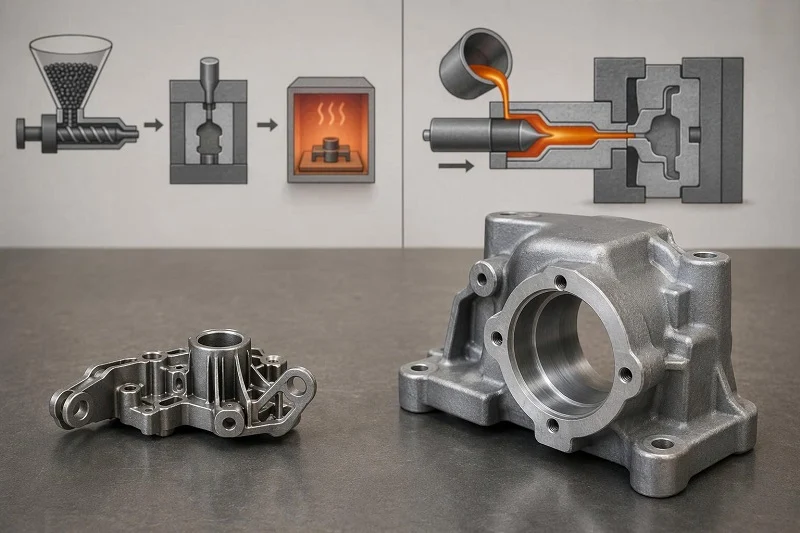
Both metal injection molding and die casting turn a CAD model into a finished metal part without carving it from a block, and both are sold on the promise of net-shape output at volume. That surface similarity is why so many sourcing conversations start with a price comparison and end in the wrong process. The two routes diverge on the question that decides most projects before cost is even relevant: which alloys each can run. Die casting lives in lower-melting non-ferrous metals; metal injection molding lives in fine powder and high-temperature sintering, which opens stainless steels and other ferrous systems.
This comparison is organized around the criteria a buyer actually evaluates — alloy compatibility, part size and geometry, tolerance and finish, tooling and volume economics, mechanical properties, and post-processing — rather than around process names. A summary matrix comes first for readers close to a decision, followed by each criterion in turn, the alternatives when neither process fits, how NOBLE supports programs in both routes, and answers to the questions that come up most often.
Paghubog ng Metal Injection vs Die Casting at a Glance
| Saligan | Metal injection molding (MIM) | mamatay paghahagis |
| Pamilya ng haluang metal | Fine metal powder plus binder; stainless steels, low-alloy steels, specialty systems including titanium and cemented carbide in research and production development | Lower-melting non-ferrous alloys: aluminum, zinc, magnesium, copper/brass, lead and tin-based alloys |
| Karaniwang laki ng bahagi | Small, complex components; the process is described as offering nearly unlimited shape and feature capability, but the cited references do not state a comparable size ceiling | From a fraction of an ounce to about 16 oz (454 g) in miniature practice; up to roughly 20 lb (9 kg) in general practice |
| Tipikal na pader | Not specified in the cited MIM references | Aluminum nominal 0.080–0.120 in (2–3 mm), 0.050 in (1.2 mm) practical on small parts; zinc 0.040–0.060 in (1–1.5 mm) nominal, 0.030 in (0.75 mm) achievable |
| Pagpapaubaya | Net-shape process with good dimensional tolerance control; specific published figures in the supplied material are titanium-MIM research values, not a general MIM standard | NADCA standard linear tolerance ±0.010 in (±0.25 mm) on the first inch plus ±0.002 in per additional inch for aluminum; precision tooling roughly halves it |
| ibabaw tapusin | Sintered surface; Ti-MIM research notes a rougher finish than other MIM approaches because of larger particle size | Roughly 32–63 µin Ra (0.8–1.6 µm) as cast from a new die, coarsening as the die heat-checks |
| pagkamakina | Multi-cavity tooling enables high production rates; green parts are molded oversize and shrink during sintering | Hardened H13 die assembly; roughly 10–16 weeks to build and sample |
| Economic volume band | Positioned for mass production of complex shaped parts; the cited material gives no MIM break-even volume | Tooling rarely pays back below about 5,000 parts per year; single- or two-cavity dies normal from 10,000 to 100,000; multi-cavity above 250,000 |
| Bilis ng siklo | Conventional injection molding machine; cycle time not stated in the cited MIM references | 15–60 seconds per shot; gate fill in 20–100 milliseconds |
| Nakakamit na heometriya | Nearly unlimited shape and geometric-feature capability; undercuts and cross holes can be added to the green part by machining | Intricate contours with cast-in bosses and ribs; draft required, side actions add tooling cost and cycle time |
| Post processing | Coining, machining, heat treating, coating and other secondary operations for tighter tolerances or enhanced properties | Trimming, machining of critical bores, deburring, vibratory finishing, impregnation and coating |
One caution before using the table: the two columns are not measured the same way. Die casting tolerance and finish figures come from NADCA standards and process references written for production die casting. The MIM tolerance figures available in the cited material come from a research review of titanium MIM, whose author notes that tolerance capability there is not yet up to other MIM technologies. Treat the MIM row as directional and confirm the numbers that matter with the supplier quoting your part.
Evaluation Criteria: How to Compare Metal Injection Molding and Mamatay Casting
Five criteria do most of the work in a metal injection molding vs die casting decision, and they should be applied in order.
Pagkakatugma sa haluang metal comes first because it is a gate, not a score. If the part must be stainless steel, conventional die casting is out on melt temperature, and no amount of tooling optimization changes that. If the part is an aluminum housing, MIM is not the natural route. Settle the alloy question before comparing anything else.
Sukat ng bahagi at geometry sets the physical envelope. Die casting has published size ranges and wall-thickness rules; MIM’s strength is shape freedom at small scale, and the cited references do not give a comparable size ceiling. A part that is too large for one process or has features the other cannot mold is decided here.
Pagpaparaya at pagtatapos ng ibabaw determines how much secondary work the part needs. As-cast or as-sintered dimensions rarely satisfy every feature, so the real question is which features must be machined and what that adds.
Tooling and volume economics converts the above into money. Both processes carry a substantial fixed tooling cost and a low per-part cost at volume, which is why the volume band matters as much as the unit price.
Mechanical properties and post-processing decides whether the finished part behaves as required — density, porosity, weldability, heat treatability — and what finishing steps the application demands.
Running the criteria in this order avoids the common mistake of quoting two processes for a part that only one of them can physically produce.
Alloy and Material Compatibility
Die casting is built around alloys whose melting points the machine and the die can survive. Most die castings are made from non-ferrous metals — zinc, copper, aluminum, magnesium, lead, pewter and tin-based alloys — and the machine architecture follows the melt temperature.
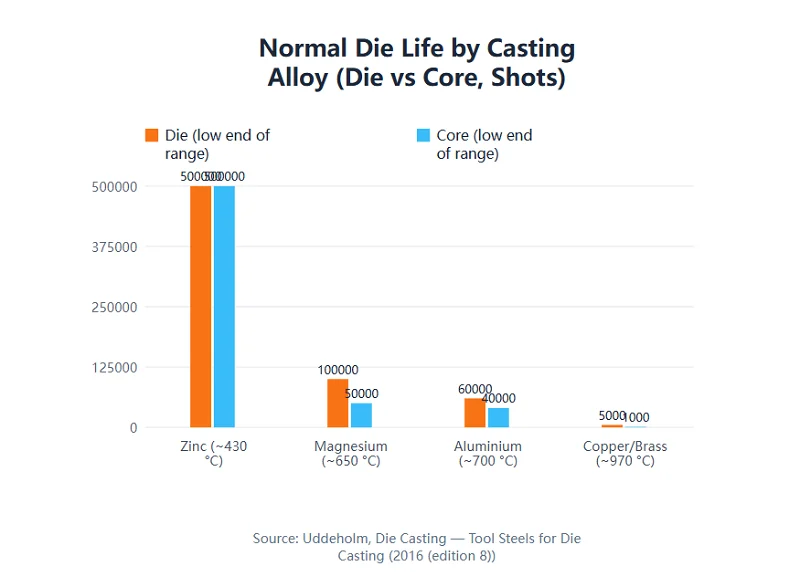
Normal die life by casting alloy, from the Uddeholm die-casting guide. Values are typical ranges for production dies and cores; actual life depends on die material, heat treatment and process control, and is not a guarantee.
Hot-chamber machines keep the injection cylinder submerged in the melt. They run zinc, magnesium and lead alloys, whose melting points are low enough not to attack the steel plunger; Zamak 3 melts near 730 °F (390 °C). Cold-chamber machines keep the furnace separate and ladle a measured shot into an unheated sleeve each cycle. Aluminum, poured at roughly 1,150–1,250 °F (620–675 °C), would dissolve a submerged hot-chamber cylinder, so aluminum is always cast cold chamber.
Metal injection molding starts from a different premise. Very fine elemental or prealloyed metal powders — generally under 30 micrometres — are mixed hot with a thermoplastic binder until every particle is coated, then granulated into feedstock pellets. Binders typically make up 40% by volume of the feedstock. The part is molded on a conventional injection molding machine, debound, and sintered in a controlled atmosphere at approximately 85% of the metal’s melting temperature. A stainless-steel part might be heated to 1,350–1,400 °C.
That sintering route is what lets MIM reach alloys die casting cannot practically run. The trade-off is a multi-step process — mixing, molding, debinding, sintering — where debinding is described in the literature as the most critical step, because it determines whether the process succeeds or fails.
Why Die Casting Does Not Normally Run Stainless Steel
Stainless steel’s melting range sits far above what a submerged hot-chamber system tolerates, and even a cold-chamber shot at that temperature would impose severe thermal load on the die steel. The die-life data show the direction clearly. In aluminum cast at about 700 °C, heat checking, cracking, erosion and indentation limit normal die life to roughly 60,000–200,000 shots on the die and 40,000–150,000 on the core. In copper/brass at about 970 °C, the same mechanisms cut normal life to 5,000–50,000 shots on the die and 1,000–5,000 on the core. Stainless steel melts well above both.
The constraint is practical rather than absolute: die life falls as casting temperature rises, and at stainless-steel temperatures the economics of a hardened die collapse. This is why the process is described as running non-ferrous alloys and why steel castings are listed as not applicable to die casting in process-comparison tables.
What Metal Injection Molding Can Do with Ferrous and Specialty Alloys
MIM’s material space centers on ferrous systems — stainless steels and low-alloy steels — plus specialty materials. Cemented tungsten carbide (WC-Co) has been produced by MIM, with research focused on sintering routes such as microwave sintering that limit grain growth and preserve hardness. Titanium MIM is an active research frontier: Ti-6Al-4V is by far the most common alloy, and the review notes that with hot isostatic pressing, Ti-6Al-4V has delivered 975 MPa tensile strength with 14% elongation, similar to wrought material, while sintered titanium in the best reported case reached 920 MPa with 11% elongation at 98% density. Fatigue and fracture toughness were typically lower than the comparable wrought product.
Keep the scope honest: those titanium figures come from a review of Ti-MIM specifically, and the same review states that tolerance capability in Ti-MIM is not yet up to par with other MIM technologies, with a rougher sintered surface finish because of the larger particle size.
Part Size, Wall Thickness and Geometry
Die casting has well-documented size ranges. General practice covers parts from a few grams up to about 20 lb (9 kg); miniature die casting covers parts from a fraction of an ounce to about 16 oz (454 g). Wall thickness follows alloy: aluminum die castings run a nominal wall of 0.080–0.120 in (2–3 mm), with 0.050 in (1.2 mm) practical on small parts, while zinc goes thinner at 0.040–0.060 in (1–1.5 mm) nominal and 0.030 in (0.75 mm) achievable. Thick sections are worse than thin ones here, because heavy sections solidify last and hold shrinkage porosity; any section more than about 1.5× the nominal wall should be cored out.
MIM is described as offering a nearly unlimited shape and geometric-feature capability, with high production rates possible using multi-cavity tooling. The cited references do not give a comparable size ceiling for MIM, so this comparison cannot supply one. What can be said is that MIM’s advantage is complexity at small scale, not envelope size.
Draft, Ribs and Cored Features in Die Casting
Die casting design rules shape the part before the tool is cut. Aluminum needs roughly 1° of draft on outside walls and 2° on cored internal surfaces; zinc, which grips the core less aggressively, gets by with about half that, and deep cores need more. Minimum fillet radius is about 0.060 in (1.5 mm), and a fillet equal to the adjacent wall is better — sharp internal corners are stress risers in the casting and heat-check initiation sites in the die. Ribs should run about 0.6× the nominal wall so they do not sink, with 1–2° of draft per side. Minimum cored diameter is around 0.10 in (2.5 mm) in aluminum and 0.060 in (1.5 mm) in zinc, with core depth kept under about 4× diameter; small or deep holes are cheaper drilled after casting than cored.
Parting lines carry a tolerance penalty. Dimensions that cross the parting line depend on how tightly the die halves close and carry a larger tolerance than dimensions contained within one die half, and moving die components add their own allowance on top of the linear tolerance.
Undercuts, Cross Holes and Features Added After Molding
MIM reaches geometric freedom by a different route. If additional design features are not feasible during molding — undercuts or cross holes, for example — they can be added to the green part at that stage by machining or another secondary operation, before debinding and sintering. The green part is still soft and fully formed, so this is a practical way to get features the mold could not release.
Die casting handles the same problem with side actions: slides and cores that pull in a direction other than the main die opening. Every side-action mechanism adds tooling cost, cycle time and a maintenance point, which is why die-casting design guidance puts cutting the number of slides near the top of the cost-reduction list. Reorienting the part or moving a feature onto the parting plane is often cheaper than adding a slide.
Pagpaparaya, Surface Tapos at Pag-uulit
Die casting tolerance is standardized. The NADCA standard linear tolerance for aluminum is ±0.010 in (±0.25 mm) on the first inch, plus ±0.002 in for each additional inch; zinc and magnesium carry the same standard values, while copper is looser at ±0.014 in (±0.36 mm). Precision tooling and tighter process control roughly halve those figures. As-cast surface finish runs roughly 32–63 µin Ra (0.8–1.6 µm) from a new die, and coarsens as the die heat-checks, because the thermal-fatigue crack pattern transfers onto the part surface.
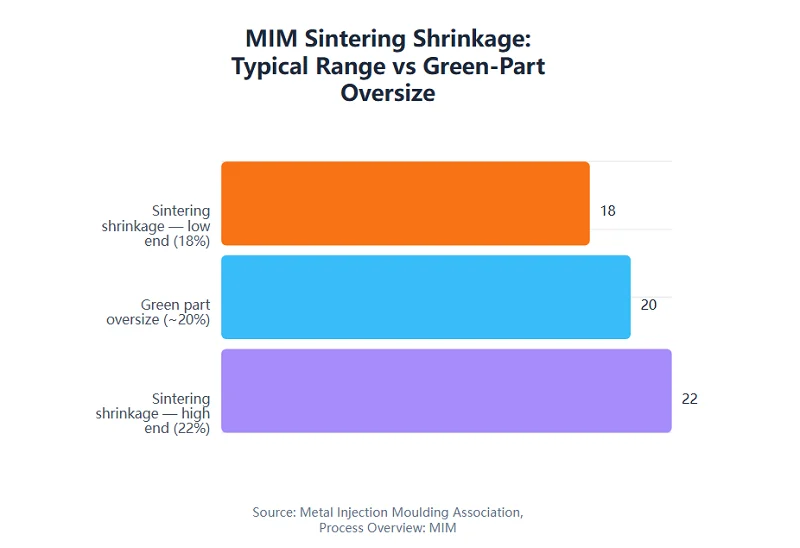
Sintering shrinkage reported for metal injection molding. The green part is molded oversize and shrinks isotropically during sintering; the exact value is binder-volume dependent, so the tool is cut to compensate rather than the drawing being adjusted.
MIM is described as a net-shape process with good dimensional tolerance control, but the specific numbers in the supplied material are titanium-MIM research values: a coefficient of variation of 0.1% in one reported case, and 0.08%–0.65% in less-detailed reports, alongside mass variations from 0.5% to over 1%. Those are not a general MIM standard, and the review itself says Ti-MIM is potentially closing in on other MIM approaches rather than matching them. For a production MIM part, the tolerance to design to is the one your supplier commits to.
Shrinkage: Designing the Tool for the Finished Dimension
Shrinkage is the defining tooling consideration in MIM. The green part is approximately 20% larger in all dimensions than the finished part, binder volume dependent, and sintering shrinkage is typically 18%–22%, also binder volume dependent, with the part shrinking isotropically to its design dimensions as pores are eliminated and metal particles fuse. The tool is therefore cut oversize so the part lands on the drawing after sintering.
Die casting handles the same physics with a contraction factor — a multiplier applied to casting dimensions to obtain die dimensions, accommodating the different coefficients of thermal expansion of the die steel and the alloy plus the die operating temperature.
In both processes the compensation belongs to the toolmaker, not the customer. The part drawing stays at finished dimensions; the mold or die cavity carries the shrinkage allowance. What the customer must supply is a clear drawing with tolerances and critical features, and what the supplier must supply is a tool designed so the as-produced part meets it.
Secondary Operations to Tighten Tolerances
Neither process holds every feature to final tolerance as-molded. MIM parts go through coining, machining, heat treating, coating and other secondary operations when tighter tolerances or enhanced properties are needed. Die castings go through trimming, machining of critical bores, deburring, vibratory finishing, resin impregnation for pressure-tight parts, and coating.
These operations are routinely underestimated in cost. In die casting, trimming, machining, deburring and impregnation frequently add more than the casting cycle itself, so a quote that compares only the casting step is not comparing the parts you will actually install.
Tooling, Dami and Cost Economics

The cost structures differ in where the money is committed, not just how much.
Die casting is dominated by the die. A production die is a hardened H13 assembly that takes roughly 10–16 weeks to build and sample, with 2–4 weeks per production release thereafter. Below roughly 5,000 parts per year the tooling rarely pays back, and investment casting, sand casting or machining from billet wins instead. From 10,000 to 100,000 parts, a single- or two-cavity die is normal; above 250,000, multi-cavity dies and higher-tonnage machines cut per-part machine time proportionally. Tooling cost is on the order of 10–20% of the total cost of a finished aluminum die casting, and the die steel itself accounts for only 5–15% of the die cost — the rest is machining, heat treatment and build.
MIM’s economics rest on multi-cavity tooling enabling high production rates, which is why the process is positioned for mass production of complex shaped parts. The cited material does not give a MIM volume break-even, so the honest statement is directional: MIM carries tooling and feedstock fixed costs and a low per-part cost at volume, and it improves as volume rises and geometry complexity increases.
Where the Money Goes in Each Process
In die casting, per-part cost is machine seconds plus alloy weight plus secondary operations. Machine time is short — 15–60 second cycles, with gate fill in 20–100 milliseconds — so the casting step is rarely the expensive part. The secondaries are: trimming, machining, deburring and impregnation frequently add more than the casting cycle itself. Alloy choice also moves the number, since zinc dies outlast aluminum dies by roughly an order of magnitude and cycle faster, often offsetting higher metal cost on small parts.
In MIM, the cost drivers are feedstock, thermal processing and secondaries. Feedstock is fine powder plus binder, with binder typically 40% by volume. Debinding and sintering consume furnace time and controlled atmosphere, and sintering is a long, precisely monitored temperature profile rather than a fast cycle. Secondary operations — coining, machining, heat treating, coating — add on top. Where die casting’s fixed cost is concentrated in a machined steel die, MIM’s is spread across tooling, powder and furnace throughput.
Choosing a Volume Band
Directionally: low volume favors machining, investment casting or sand casting, where tooling is small or absent; mid volume favors a simple die or MIM depending on alloy, since a single- or two-cavity die is normal from 10,000 to 100,000 parts and MIM tooling amortizes over a similar order of magnitude; high volume favors multi-cavity tooling in either process. These are directional bands drawn from the cited sources, not universal thresholds — part size, alloy, tolerance and cavity count all shift the crossover, and a quote is the only reliable number for a specific part.
Mechanical Properties and Post-Processing
MIM parts reach 96%–99% of theoretical density when sintered in a controlled atmosphere, and the resulting metal is described as having mechanical and physical properties similar to annealed parts made by conventional metalworking — similar to parts machined from bar stock. When higher properties are needed, secondary operations such as heat treating extend the range.
Die castings have a different structure. Solidification begins at the die surface and progresses inward, producing a fine-grain, low-porosity skin typically 0.015–0.020 in (0.38–0.50 mm) thick, with porosity concentrated in the core between the skins. Skin thickness is relatively constant and is not a function of total wall thickness, so thin-wall sections can actually be stronger and more consistent than thick sections. The practical consequence is that conventional high-pressure die castings generally cannot be welded or T6 heat treated, because entrapped gas expands at temperature and blisters the part. Vacuum die casting, which reduces cavity pressure to 50 millibar or less, and pore-free variants reduce entrapped gas enough to allow both, at a process premium. If welding or T6 heat treatment is required, say so before the die is designed.
Can Die Cast Parts Be Machined and Assembled?
Yes, and both are routine. Die castings go through trimming, machining of critical bores, deburring, vibratory finishing, resin impregnation for pressure-tight parts, and coating. Die casting is also described as offering major opportunities for assembly advantages: cast-in bosses, ribs and self-fixturing features can reduce part count, and bearing surfaces can sometimes be incorporated into the casting to eliminate separately fabricated and assembled bearings.
The caution is machining depth. Allow about 0.010–0.030 in (0.25–0.75 mm) on machined surfaces, and no more than necessary. The chill skin is the densest, pressure-tight metal in the casting; cutting deeply through it exposes subsurface porosity, which is the usual cause of leaks in machined sealing faces. Where pressure tightness matters, select machined surfaces carefully and specify the areas, extent and depth of secondary machining before die construction begins.
Applications: Where Each Process Fits
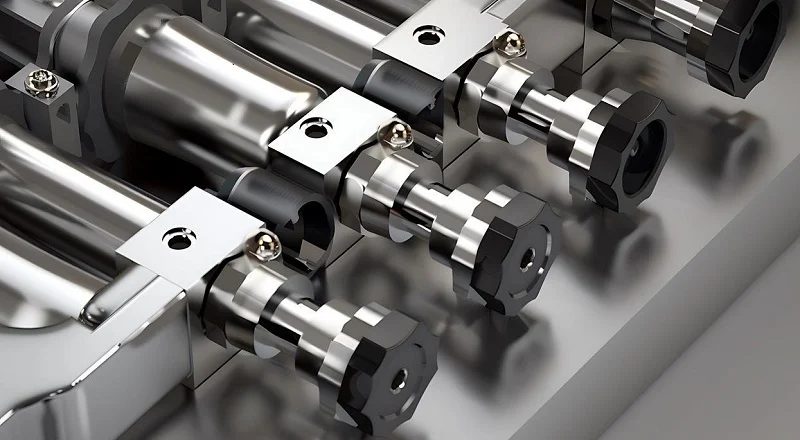
Die casting’s application map follows its alloys and its rate. Typical parts are housings, gearbox cases, brackets, connector shells and hardware, from a few grams up to about 20 lb (9 kg). Aluminum A380 dominates by volume; zinc alloys such as Zamak 3 and 5 allow thinner walls, finer detail and far longer die life; magnesium AZ91D buys weight savings at higher metal cost. Die castings appear across agricultural machinery, automotive vehicles, building hardware, electrical and electronic equipment, hand tools, home appliances, industrial products, instrumentation, lawn and garden equipment, office furniture and machines, portable power tools and recreational equipment.
MIM components are used through the medical and dental, aerospace, defense, automotive and agricultural markets, among others, plus cemented carbide cutting and wear parts. The lists overlap, and that overlap is the point: neither industry belongs exclusively to one process. Material selection, not industry label, drives the choice.
Automotiw at Kagamitang Pang-industriya
The automotive and industrial volume work — thin-wall non-ferrous housings, brackets, gearbox cases, connector shells — suits die casting because the parts are large enough to need a die, simple enough to release, and numerous enough to amortize one. Where the same sectors need small, complex, higher-melting components, MIM fits: the shape freedom and net-shape tolerance control matter more than envelope size, and the alloy can be a stainless or low-alloy steel that die casting cannot run.
Medikal, Dental and Precision Instruments
Small stainless-steel and specialty-alloy components in medical and dental devices point toward MIM, which is why medical and dental is one of the markets the process serves. Die-cast housings still appear in device enclosures where an aluminum or zinc housing with cast-in features does the structural job. Again, the material requirement decides before the industry does: a stainless instrument component and an aluminum enclosure are not competing for the same process.
Alternatives When Neither Metal Injection Molding nor Die Casting Fits
When the alloy rules out die casting and the volume or geometry rules out MIM, the answer is usually one of five alternatives. They overlap rather than rank in a fixed order.
Pagmachining ng CNC mula sa billet wins at low volume, when tolerances are tight, and when no tooling budget exists. It has near-zero tooling and high per-part cost, and it delivers parts before any tool is cut.
investment paghahagis wins for steel, stainless and superalloys, for lower volumes, and for geometries with undercuts or zero draft that a steel die cannot release. It can produce walls as thin as about 0.25–1 mm (0.010–0.040 in) depending on alloy, and its tooling cost sits well below die casting’s.
Paghahagis ng buhangin wins for large, simple, low-volume parts, with the lowest tooling of the casting routes and secondary operations driving cost where precision is needed.
Powder metallurgy press-and-sinter wins for simpler geometries at volume, where a die can press the shape directly and the shape freedom of MIM is not needed.
Paghubog ng plastic iniksyon wins when the part does not need to be metal at all.
Machining and Investment Casting as Bridge Options
Machining plays a specific role in a casting or MIM program: it delivers parts before tooling exists, so the design can be tested and revised while the production tool is being quoted or built. Once the design is stable, the machined part can be replaced by a casting or MIM process. Die-casting guidance makes the same point from the other side — where design questions must be resolved first or lead times are short, prototyping alternatives such as gravity casting or machining from stock are used to approximate the die-cast end product.
Investment casting covers the alloy range die casting cannot and the geometry MIM tooling may not justify at low volume. It is the natural bridge when a part must be stainless or a superalloy, the volume is below the MIM tooling threshold, and the geometry has undercuts or zero-draft surfaces.
Plastic Injection Molding When Metal Is Not Required
If the function permits a polymer, plastic injection molding shares the injection-molding machine architecture with MIM but removes the debinding and sintering steps and the metal powder cost. That makes it worth asking, before any metal process is quoted, whether the part must be metal at all — and if it must, whether the metal requirement is structural, thermal, electrical or cosmetic, because each answer points to a different process.
Choosing NOBLE to Support Your Metal Injection Molding and Die Casting Projects
NOBLE is a China-based contract manufacturer and a Sino-British joint venture, recognized by the government as a “National High-tech Enterprise.” Our service depth and process expertise help customers move efficiently from prototype to volume production on metal injection molding and die casting programs — and on the machining, finishing and assembly work that surrounds them.
A MIM or die-casting program is rarely just a molding step. It needs design-for-manufacturability input before the tool is cut, tooling coordination, secondary machining to bring critical features into tolerance, surface finishing, inspection against the drawing, and assembly if the part ships as a subassembly. NOBLE’s role is to cover that full scope so the program does not fragment across vendors, with each handoff adding time and tolerance stack-up.
Mula Prototype hanggang sa Produksyon ng Batch
The path runs through design review and manufacturability analysis, quoting, sampling, then volume production, with the same quality system applied at every stage. In practice that means uploading CAD files and submitting an RFQ with the information needed, receiving design analysis and transparent pricing, then moving into manufacturing and delivery. NOBLE’s rapid prototyping and low-volume manufacturing services are built to bridge the gap between a first article and final production, so a design can be verified before volume tooling is committed.
Quality Systems and Full-Scope Service
NOBLE holds ISO 9001:2015 and ISO 13485:2016 certification. For a buyer, ISO 9001:2015 means a documented quality management system governing how parts are planned, produced and checked; ISO 13485:2016 adds a medical-device-oriented quality system, which matters when the part feeds a regulated device program. In production, NOBLE runs a complete IQC, IPQC and FQC/OQC inspection process, with in-house test and measurement equipment used to verify components against specification.
The full-scope offer runs from design to assembly — not production alone. For a MIM or die-casting project, that means one partner for DFM input, tooling coordination, secondary machining, finishing, inspection and assembly, which reduces the number of handoffs between vendors and keeps accountability in one place. To start a project, share your drawings, alloy, volumes and quality requirements, and NOBLE’s team will respond with manufacturability feedback and pricing.
FAQs of Metal Injection Molding vs Die Casting
Which process should I choose for a small, complex stainless-steel part at tens of thousands per year?
Stainless steel rules out conventional die casting on melt temperature, so the real comparison is MIM against machining and investment casting. At tens of thousands per year with complex geometry, MIM’s tooling amortizes over the volume, and its shape freedom and net-shape tolerance control favor it. Machining remains the low-tooling fallback, and investment casting covers low volume or zero-draft geometry. Confirm the tolerance and finish requirements with the supplier before committing, since those drive how much secondary machining the part needs.
Why can die casting not normally produce stainless-steel parts?
Hot-chamber machines run only low-melting zinc, magnesium and lead alloys. Aluminum at roughly 620–675 °C must be cast cold chamber because it would dissolve a submerged cylinder. Stainless steel melts far above that, and the thermal load would exceed what H13 die steel tolerates — die life already drops from roughly 60,000–200,000 shots in aluminum at about 700 °C to 5,000–50,000 in copper/brass at about 970 °C. At stainless-steel temperatures the die economics collapse, which is why the process is treated as a non-ferrous route.
At what production volume does metal injection molding become economically preferable to machining or investment casting?
There is no fixed number. MIM carries tooling and feedstock fixed costs but a low per-part cost at volume, so it improves as volume rises and geometry complexity increases. Machining has near-zero tooling and high per-part cost; investment casting sits between. The crossover depends on part size, alloy, tolerance and cavity count, and a quote for your specific part is the only reliable figure.
How much shrinkage must be designed into a MIM tool, and who compensates for it?
The green part is approximately 20% larger in all dimensions than the finished part, and sintering shrinkage is typically 18%–22%, binder-volume dependent and isotropic. The toolmaker compensates in the mold cavity so the sintered part meets the drawing. You supply finished dimensions; the tool carries the allowance.
Can die cast parts be machined and assembled into a finished assembly?
Yes. Die castings routinely go through trimming, machining of critical bores, deburring, vibratory finishing, impregnation and coating, and cast-in bosses, ribs and self-fixturing features can reduce part count in assembly. Allow about 0.010–0.030 in (0.25–0.75 mm) of machining stock and avoid cutting deeply past the chill skin, which exposes subsurface porosity and causes leaks in sealing faces.
What are the alternatives when neither MIM nor die casting fits?
- Pagmachining ng CNC mula sa billet — low volume, tight tolerance, no tooling budget.
- investment paghahagis — steel, stainless and superalloys; lower volumes; undercuts or zero-draft geometry.
- Paghahagis ng buhangin — large, simple, low-volume parts.
- Powder metallurgy press-and-sinter — simpler geometries at volume.
- Paghubog ng plastic iniksyon — when the part does not need to be metal.
What should I prepare before requesting a quote for a MIM or die cast project?
- 3D CAD and 2D drawings with tolerances and critical features marked
- Alloy and material specification
- Annual and peak volumes
- Surface finish at mga kinakailangan sa post-processing
- Assembly scope, if the part ships as a subassembly
- Quality and certification requirements
- Takdang panahon ng target
The items that most affect tooling cost are geometry complexity and side actions in die casting, and part size and feature count in MIM; volume and tolerance requirements drive the per-part comparison in both.