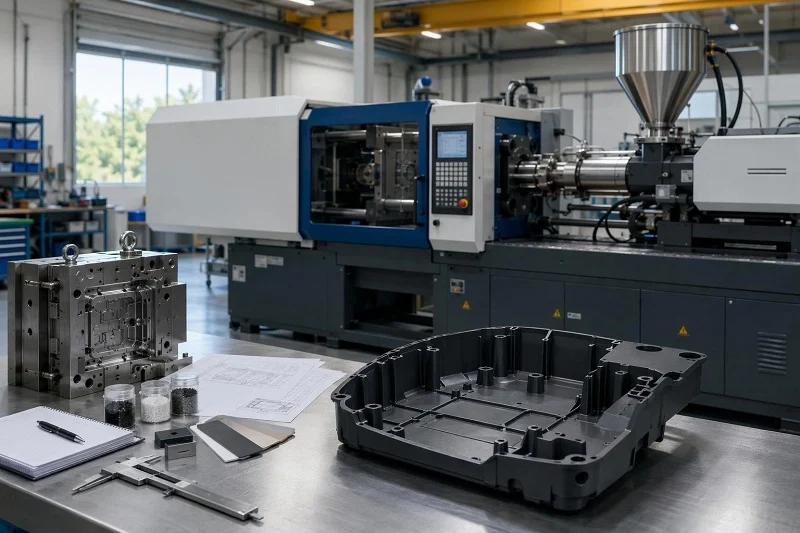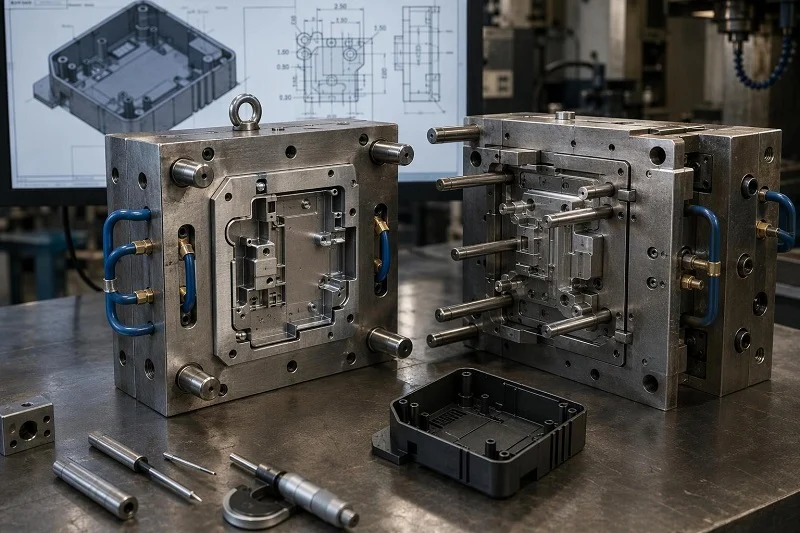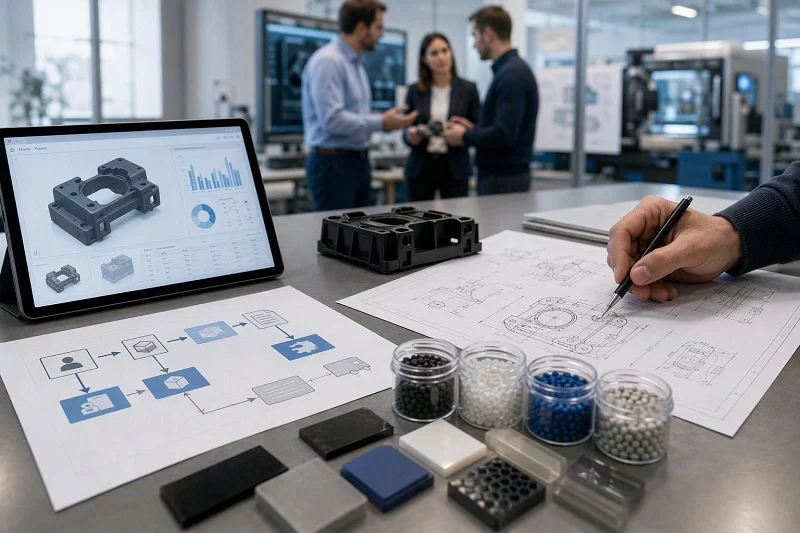
A design becomes production-ready custom injection molded parts only when the tooling, the resin and the process have all been decided against the same set of numbers. Most of the cost and delay in a molding program is locked in before the first steel chip is cut — in the completeness of the data package, the timing of the design freeze, and the honesty of the volume forecast. This guide follows that sequence: what to send before you request a quote, how the workflow runs at NOBLE from RFQ to shipment, how resin choice constrains draft and tolerance, and when an engineer would tell you that molding is the wrong process for your part.
Anong Pasadya Injection Molded Parts Require Before You Request a Quote
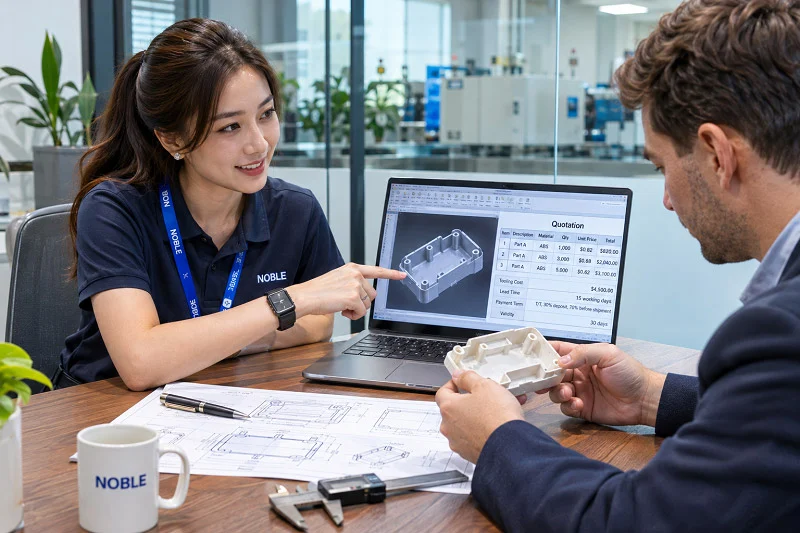
A molder prices three things: the tool, the part, and the risk. Only the first two can be quoted from geometry alone. The third — whether the tool will need rework, whether the part will hold its critical dimensions at T1, whether the cosmetic surfaces will pass — depends on how much the data package tells the molder about what the part must actually do. A thin RFQ does not make a program cheaper; it moves the cost to change orders later.
The Core CAD and Drawing Package
Send a 3D model in a native or neutral format (STEP and Parasolid are the usual neutral choices), and a 2D drawing wherever dimensions, tolerances or datums must be controlled. The model defines the shape; the drawing defines what is acceptable.
The most useful single item in the package is a short critical-dimension list — typically the two to five features that locate, seal, mate or assemble. These get explicit callouts; everything else can sit under a general tolerance note. A drawing that tolerances every dimension equally tells the molder nothing about where to spend effort, and it usually forces one of two bad outcomes: a quote padded to cover the tightest callout everywhere, or a part that passes the drawing and still fails to assemble. If your critical list runs past about five items, that is itself worth a DFM conversation — the design may be over-constrained.
Volume, Cavitation and Program Life
Cavity count is an economic decision, not a technical one, and it cannot be made without your numbers. Give annual volume, total program quantity, and expected program life in years. From these the molder derives total shots, which sets the tool life target and the steel specification, and then the cavity count that balances tool cost against per-part cost.
More cavities lower the cost per part twice over: the mold cost is amortized across more pieces, and machine cost per part falls because cycle time is divided by cavity count. But each added cavity raises mold complexity and cost, and there are physical limits on how many cavities a mold can carry. A program of a few thousand parts and a program of a few million parts should not be quoted the same way. If the volume is genuinely uncertain, say so and give a range — a molder can quote a low-cavity bridge tool and a production tool side by side, which is far more useful than a single number built on a guess.
Tolerances, Cosmetic Grade and Functional Requirements
Molded parts shrink as they cool, so tolerance is not a single fixed value — it scales with dimension and depends on the resin. As a working reference, commercial tolerances run around ±0.1 mm on small features (up to roughly 25 mm) and scale to about 0.5% of nominal on larger dimensions; fine or precision work runs near 0.2%, with values down to about ±0.025 mm realistic only on small features in low-shrink resins with a tuned tool. General-tolerance systems such as DIN 16742 (which superseded DIN 16901, alongside ISO 20457) let you call out a tolerance group on the drawing instead of tolerancing every dimension by hand, and they distinguish mold-fixed dimensions from non-mold-fixed dimensions that cross the parting line or run on moving cores, which carry a larger allowance. Confirm the group is achievable in your chosen resin before release.
Cosmetic requirements need the same specificity. Mark which surfaces are Class A and which are functional or hidden. State whether gate vestiges, ejector pin marks and knit lines are acceptable, and where. Gate and ejector locations should be proposed in the molder’s DFM and approved by you, not discovered on the first sample. If the part carries load, snaps, threads or a seal, describe that function — it changes wall thickness, gate position and resin choice.
Color, Finish, Packaging and Delivery Destination
Color: give a masterbatch reference or a Pantone target, and say whether the match is visual or measured. Finish: specify texture grade or bead-blast level, and note that texture depth interacts directly with the draft angle you can use. Packaging and labeling: state bagging, tray, ESD or cleanroom requirements and any barcode or label format. Delivery: give the ship-to destination and the Incoterms you expect, because export documentation and freight arrangements affect the landed cost as much as the unit price does.
How the Custom Injection Molded Parts Workflow Runs at NOBLE

The sequence below is the route a molding program takes at NOBLE. The important thing to notice is where the cost of a change sits at each stage: a geometry change costs almost nothing in CAD, a moderate amount after tool design, and a great deal once steel has been cut.
RFQ Review and Quotation
The data package is reviewed for completeness and for manufacturability before anything is priced. This is where an incomplete package shows itself — a missing critical-dimension list, an unspecified resin, an undefined cosmetic surface. NOBLE can return a professional quote within 24 hours of receiving a complete RFQ, which is why the input section above matters: the clock is best spent on engineering, not on chasing missing information.
The quotation separates tooling cost from unit price, and should state the cavity count and tool life it assumes. Ask for that breakdown explicitly if it is not shown; it is the basis for every later volume decision.
DFM Feedback and Design Freeze
Design-for-manufacturability review covers the features that decide whether the tool works: draft on all vertical walls, wall-thickness uniformity, undercuts and how they will be released, gate location, ejector placement, and likely sink or warp risk. Draft is the cheapest insurance in the program — a wall without it drags on the cavity during ejection, scuffing the surface and accelerating mold wear, and textured surfaces make this worse because the texture itself creates micro-undercuts that lock the part in place. Typical practice is a minimum of about 3° of draft for a light bead-blast finish and 5° for a medium one, with more for deep walls and coarse textures.
Resolve these findings in CAD and freeze the design before tool design begins. A draft change made in the model costs an hour; the same change after the cavity is cut can mean re-machining, re-polishing and a new trial cycle.
Disenyo ng tool, Build and Trial Shots
Mold design fixes the parting line, cavity layout, runner and gate type, cooling layout, ejection strategy and steel selection. Steel choice follows the program: pre-hardened P20-type steel is common for rapid tooling, bridge production and medium-volume molds because it machines without a separate hardening step; harder grades and inserts are used where abrasion from filled resins or high cycle counts demand it; corrosion-resistant, highly polishable grades suit medical parts, clear lenses and optical or high-gloss cosmetic surfaces. Approve the mold specification — steel, cavity count, expected service life — rather than a grade name alone.
Trial shots follow: T1 to establish that the tool fills and ejects and to reveal the first dimensional and cosmetic results, then further trials as needed to tune process settings and confirm any tool corrections. Samples are measured against the drawing, not judged by eye.
First-Article Inspection and Approval
First-article inspection verifies the first production units from the actual production tool against the ballooned drawing — dimensions, material and functional tolerances — and is typically documented in a first-article report with CMM data. Cosmetic evaluation is done against the approved sample and the agreed defect standard. You sign off on the golden sample before production is released. This is the gate that prevents an entire batch from being molded with a flaw that cannot be corrected downstream.
Production, Assembly and Shipment
Production runs under a documented process window with in-process inspection, so that drift in dimensions or appearance is caught during the run rather than at final inspection. Secondary operations — trimming, ultrasonic welding, insert installation, printing, painting — and assembly can be handled in the same program, which removes a handoff and a set of tolerance stacks between suppliers. Shipment documentation, packaging and labeling follow the requirements agreed at RFQ.
Choosing a Resin for Custom Injection Molded Parts
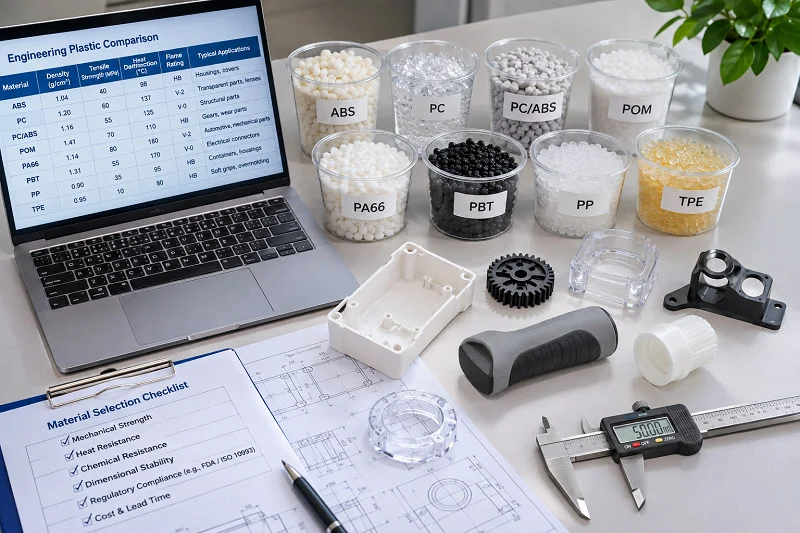
Material choice should be fixed early, because it sets part performance, shrink behavior, draft requirements and the tolerance you can realistically hold. Changing resin after the tool is designed means recutting shrinkage compensation into the cavity — effectively a new tool.
Amorphous vs. Semi-Crystalline Resins
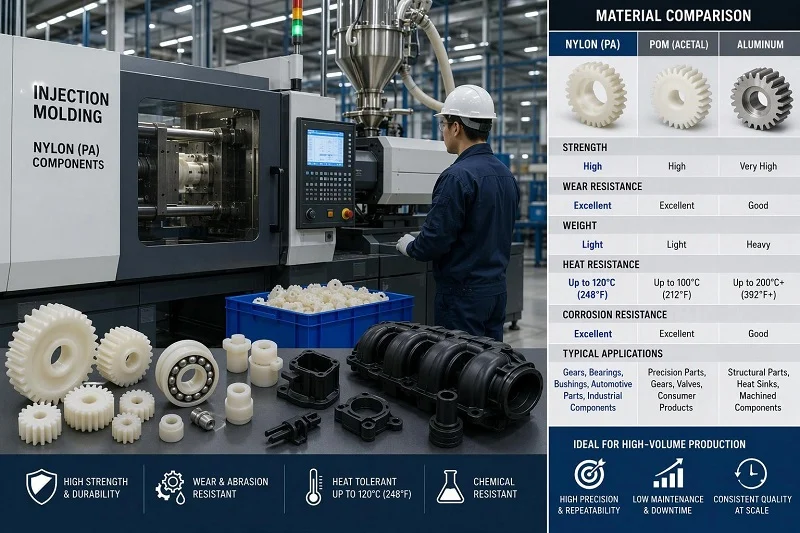
The two families behave differently in the mold. Amorphous resins — ABS and polycarbonate are the common examples — shrink less and more predictably, typically in the range of about 0.4% to 0.8%, and therefore hold tighter tolerances. Semi-crystalline resins — polypropylene, nylon and acetal — shrink considerably more, roughly 1.5% to 2.5% for PP and acetal and about 0.7% to 1.5% (up to around 2%) for PA6/PA66, and less predictably, so they hold looser tolerances. These are typical ranges; actual shrink depends on grade, wall thickness, gate location and process, and should be confirmed against the resin data sheet and, for close-tolerance parts, against molded samples.
Common Engineering Resins and Where They Fit
ABS is the general-purpose choice for housings and enclosures: easy to mold, good surface, moderate cost. Polycarbonate brings impact strength and clarity but needs higher melt temperatures and well-controlled drying. Nylon offers toughness, wear resistance and chemical resistance, at the cost of moisture sensitivity and higher shrink. Polypropylene is the low-cost, chemically resistant, living-hinge material, with the highest shrink of the common families. Acetal (POM) is dimensionally stable in service and good for precision mechanical parts, but it is notch-sensitive and has high mold shrink. Glass-filled grades reduce shrink — often to roughly 0.2% to 0.5% in the flow direction — but make it directional, because fibers orient along the flow path. That anisotropy increases warp risk wherever walls are uneven or ribs are asymmetric, so glass-filled parts need more careful wall and gate design, not less.
How Resin Choice Changes Draft, Shrinkage and Tolerance
Three design consequences follow from the resin decision. First, draft: higher-shrink resins grip the core harder as they cool, and textured or deep walls need more draft to release cleanly. Second, shrinkage compensation: the cavity is cut oversize by the expected shrink, so a resin with a wide shrink range leaves a wider residual variation in the finished part. Third, tolerance budget: because that residual variation scales with dimension, the same drawing callout may be comfortable in ABS and marginal in PP.
For close-tolerance parts, prototype in the intended resin before committing to production tooling. A short run quantifies the real shrink of that grade in that geometry, which is more reliable than any table. Uniform wall thickness is the other lever — non-uniform walls cool at different rates and warp, widening the effective tolerance no matter what the drawing says.
When Injection Molding Is the Wrong Process: An Engineer’s Comparison
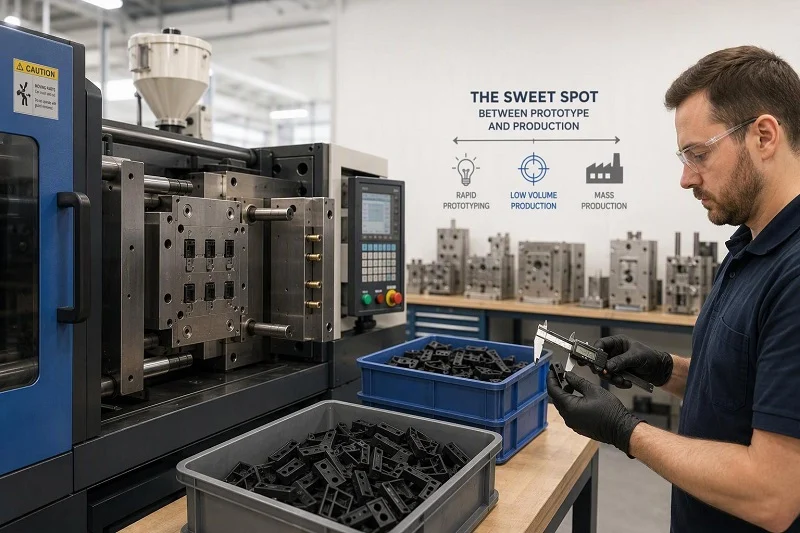
Custom injection molded parts are the right answer at the right volume and geometry, and an honest engineering review will say so. The comparison below is a planning reference; actual values vary with part complexity, material, supplier and program requirements.
| Factor | Pag-molde ng iniksyon | CNC machining | 3D pag-print | Paghahagis ng urethane | mamatay paghahagis |
| Pinakamahusay na hanay ng volume | ~1,000 to millions | 1 hanggang 5,000+ | 1 sa 500 | 1 sa 300 | 10,000 + |
| Gastos sa kagamitan | ~$5,000–$100,000+ | Wala | Wala | ~$500–$2,000 | ~$10,000–$80,000+ |
| Per-part cost at volume | Napakababa | Katamtaman hanggang sa mataas | Katamtaman | Katamtaman | Napakababa |
| Oras ng pangunguna, unang bahagi | ~2–12 na linggo | 1-5 araw | 1-3 araw | 1-2 na linggo | ~6–12 na linggo |
| Karaniwang pagpaparaya | ±0.05–0.2 mm | ± 0.025 mm | ±0.1–0.3 mm | ±0.2–0.4 mm | ±0.1–0.25 mm |
| Saklaw ng materyal | Thermoplastics | Exceptionally broad | Limited, growing | Mga polyurethane resin | Mga haluang metal na Al, Zn, Mg |
Dami and Tooling Economics
The breakeven logic is simple arithmetic: tooling cost divided by volume gives the tooling contribution to each part. At 75 units, a mold costing tens of thousands of dollars adds hundreds of dollars to every part before a single unit is validated, while a tooling-free process delivers production-representative parts at a fraction of that. At 50,000 units, the same tooling amortizes to cents and molding’s low per-part cost dominates. Low-volume programs therefore usually favor tooling-free processes, and the crossover point moves with part size, cavity count and material.
Tolerance and Material Constraints
Machining is cut to size, so its tolerance is set by the machine and inspection — typically around ±0.025 mm — and it covers virtually any machinable metal, engineering plastic, composite or ceramic in standard stock. Molding is formed in a cavity and then shrinks, so its tolerance is set by resin and geometry, and it is limited to thermoplastics. Tooling-based processes are material-constrained in a way machining is not: if a part requires a specific certified alloy, machining is almost always the default. Die casting covers aluminum, zinc and magnesium alloys at high volume but with its own draft and wall constraints.
Lead Time at Bilis ng Pag-ulit
A machined or printed first part arrives in days; a molded first part takes weeks because the tool must be designed, built and trialed. That gap matters most during iteration: every design change before the design freeze is cheap in CAD and expensive in steel. When first-part lead time is constrained to under two weeks, machining, 3D printing and tool-less fabrication apply across all volume bands until tooling can be completed.
This is where a bridge process earns its place. Machining or printing a small pilot batch validates fit, function and customer response while the production tool is built, and it de-risks the mold by proving the design before the design freeze. NOBLE engineers will recommend an alternative process when the volume does not justify tooling, when the geometry cannot be molded without excessive cost, when the required material is outside the thermoplastic range, or when the schedule cannot absorb a tool build.
Quality Documentation and Inspection for Custom Injection Molded Parts
A molding program should produce documentation, not just parts. On a NOBLE program, the quality package is built around the following elements, framed by the company’s ISO 9001:2015 and ISO 13485:2016 certifications:
- First-article inspection (FAI): the first production units from the production tool are measured against the ballooned drawing, covering dimensions, material and functional tolerances, with CMM data recorded in a first-article report.
- Dimensional reports: measured data on the critical dimensions, taken at agreed intervals during the run, so drift is visible before it becomes scrap.
- Cosmetic inspection: evaluation against the approved golden sample and a written defect standard, with lighting and viewing conditions defined — important for high-gloss, transparent and textured surfaces where reflections can hide or exaggerate defects.
- Materyal na traceability: resin grade, lot and certificate records, so the part in the box can be tied to the data sheet it was specified against.
- Kontrol sa proseso: a documented process window for melt temperature, injection speed, hold pressure, cooling time and venting, rather than settings arrived at by trial and error.
- Mold records: steel specification, hardness and heat-treatment records for cavity, core and major inserts, plus a maintenance and spare-insert plan.
For regulated products, the same records support design-history and supplier-quality requirements; confirm the specific documentation set your quality system needs at RFQ, so it is built into the program rather than assembled afterward.
Why Choose NOBLE for Custom Injection Molded Parts
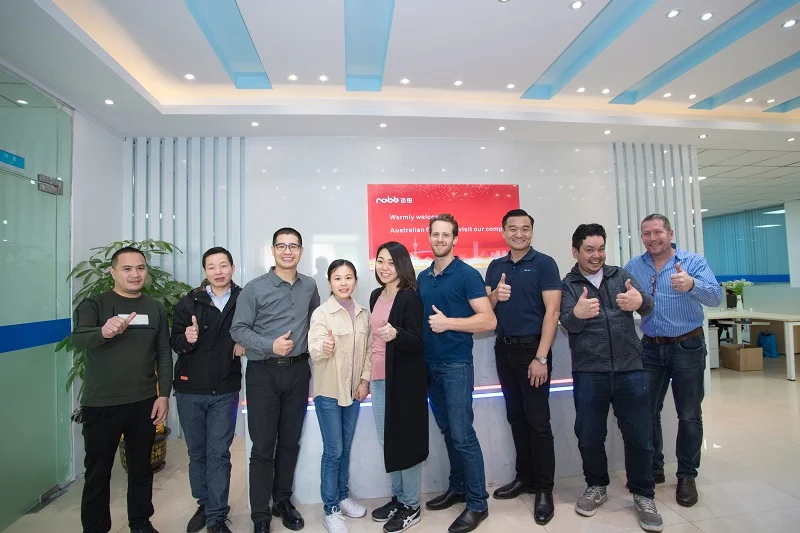
NOBLE is a Sino-British joint venture and an outstanding contract manufacturer in China, recognized by the government as a National High-tech Enterprise. Our service capability and professional processing help customers complete prototyping and mass production efficiently — from a single bridge batch to a full production program.
We are certified to ISO 9001:2015 and ISO 13485:2016. Those certifications are the framework behind the inspection and documentation described above, and the ISO 13485:2016 certification is particularly relevant to customers in medical devices and other regulated fields.
Our scope runs from design to assembly, not production only. That means DFM review and mold design, tooling, molding, secondary operations, assembly, inspection and shipment handled within one program — so tolerances are not lost at a handoff between suppliers, and one engineering team owns the result from concept to delivered part.
With more than 10 years of experience, NOBLE offers a trusted one-stop custom manufacturing solution from prototyping to manufacturing, delivering complex and high-quality parts efficiently. A professional quote can be returned within 24 hours of a complete RFQ, and a full set of inspection equipment and an overall quality-control system support the accuracy of prototypes and components. If you are weighing molding against another process, our engineers will tell you which one fits your volume and geometry — including when the answer is not molding.
FAQs About Custom Injection Molded Parts
What files should I send for a quote on custom injection molded parts?
A 3D model in STEP or Parasolid, a 2D drawing with your critical dimensions called out, the resin or performance requirements, annual and total volume, target tolerances, color and finish, functional and assembly details, packaging needs and the delivery destination. A complete package is what allows a quote within 24 hours.
How do volume and cavity count change the price?
More cavities lower the cost per part, because the mold cost is spread over more pieces and machine cost per part falls with cycle time divided by cavity count. But each cavity adds mold cost and complexity. Give annual volume, total program quantity and expected program life so the cavity count can be chosen on economics rather than assumption.
How long does a molding program take?
It depends on part complexity, tooling scope and material. As a planning reference, first parts from an injection mold typically take about 2 to 12 weeks from tooling release, with trial shots and first-article approval in between. Machined or printed pilot parts can arrive in days if you need to validate the design while the tool is built.
Which resin should I choose?
Start from function: strength, impact, clarity, heat and chemical resistance, and cost. Then check the design consequences — ABS and PC shrink less and hold tighter tolerances; PP, nylon and acetal shrink more and hold looser; glass-filled grades shrink less but directionally, which raises warp risk. Confirm shrink against the data sheet and, for close-tolerance parts, against molded samples.
When is injection molding the wrong process?
When volume does not justify tooling, when the geometry cannot be molded without excessive cost, when the material is outside the thermoplastic range, or when the schedule cannot absorb a tool build. In those cases machining, 3D printing or urethane casting is usually the better answer, and a bridge process can carry you until tooling is ready.
What quality documentation should I expect?
A first-article report with CMM data, dimensional reports on critical features, cosmetic evaluation against an approved sample and written defect standard, material traceability records, in-process control records and mold steel and maintenance records. Tell us at RFQ if your quality system requires a specific document set.