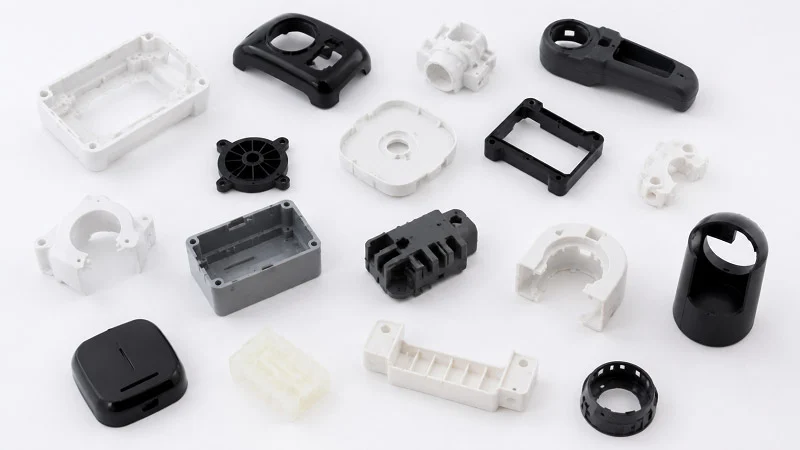
Before producing parts, we usually create a CAD model. It can clearly show the part’s shape and data on a screen. However, a design that looks correct on the screen may not always work well in real applications. Product testing requires physical parts, and this is where plastic rapid prototyping becomes important.
Plastic rapid prototyping is a bridge between design and production. It turns digital models into real objects quickly and efficiently while allowing repeated design improvements. Parts are manufactured, tested, and then optimized based on test results.
This article will introduce the technologies, material options, advantages and disadvantages, and applications of plastic rapid prototyping. It will help you choose the most suitable plastic rapid prototyping solution at different stages of your project.
What Is Plastic Rapid Prototyping?
Definition of Plastic Rapid Prototyping
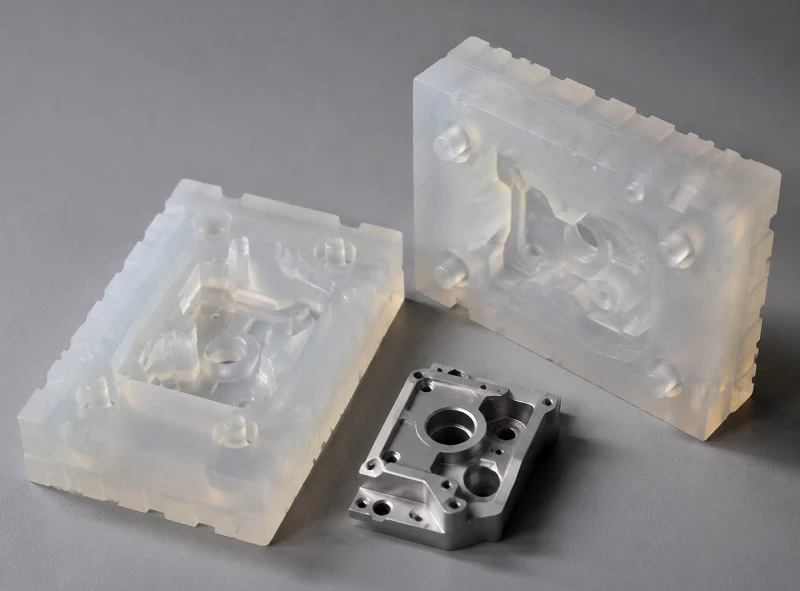
Plastic rapid prototyping is the process that creates physical plastic prototypes directly from digital models. No tooling is required. The part is produced in hours or days, not weeks or months.
Traditional manufacturing requires molds or dies. Those take time and money to produce. Plastic rapid prototyping bypasses that step. The design gets validated before the tooling investment.
Why Plastic Is Widely Used for Rapid Prototyping
Plastic materials offer practical advantages.
Lightweight properties mean parts are easy to handle and transport. Cost-effectiveness makes iteration affordable. Wide material selection allows matching properties to application requirements—stiff, flexible, transparent, or heat-resistant. Easy processing means parts can be printed, machined, or cast quickly. The ability to simulate final production parts enables realistic testing without production tooling.
Role of Plastic Rapid Prototyping in Product Development
Prototypes serve different important functions during product development.
Product appearance can be evaluated through prototypes. Before finalizing the design, the shape, color, texture, and surface finish can be reviewed. Structural designs can be tested to verify whether features such as ribs, bosses, and wall thickness meet load requirements. Assembly compatibility can be confirmed by checking the fit and function of mating parts. Functional performance can be measured based on design requirements. At the same time, product usability can be evaluated through ergonomic testing and user experience testing.
Plastic rapid prototyping provides feedback early in the development process, allowing issues to be identified when changes are still low-cost. The design can then be continuously improved before moving into mass production.
Common Plastic Rapid Prototyping Technologies
FDM (Fused Deposition Modeling) 3D Printing
A plastic filament feeds into a heated nozzle. The nozzle moves in three axes. The material melts and is deposited layer by layer, building the part from the bottom up.
FDM offers several practical advantages. Its low cost makes it easy to access. Fast production allows parts to be completed in hours instead of days. The large build size can support prototypes up to about one meter in size.
Common applications include concept models, assembly verification, and early functional prototypes. ABS, PLA, PETG, and nylon are commonly used materials. Due to its low cost and fast production speed, plastic rapid prototyping often starts with FDM technology.
SLA (Stereolithography) 3D Printing
A laser cures liquid resin into solid plastic. The build platform moves down into the resin tank, and the laser scans the cross-section of the part to cure the resin layer by layer. After one layer is completed, the platform rises and the next layer begins.
SLA provides high accuracy. It can achieve tight dimensional tolerances, smooth surface finishes, and very fine or nearly invisible layer lines. Its excellent detail reproduction can create small features such as text, threads, and sharp edges.
Suitable applications include visual models, master patterns for vacuum casting, and parts requiring a smooth finish. It uses photopolymer materials rather than the thermoplastics commonly used in mass production. Compared with CNC-machined or SLS parts, SLA prototypes generally have lower strength and durability.
SLS (Selective Laser Sintering) 3D Printing
A laser selectively fuses plastic powder. The powder bed is heated, and the laser scans the part cross-section to sinter the powder into solid plastic. The build platform then lowers, a new layer of powder is applied, and the process repeats.
No support structures are needed. The surrounding powder supports the part during build. Complex geometries are straightforward. Internal channels and undercuts are easy. Parts are strong and functional—near injection-molded properties.
Nylon is the most common material. Glass-filled and carbon-filled grades are available. SLS is used for functional testing, hinge mechanisms, and snap-fit assemblies. It is a core technology in plastic rapid prototyping for mechanical parts.
CNC Machining for Plastic Prototypes
A plastic block is fixed on the machine, and rotating cutting tools remove excess material to create the final shape.
CNC machining offers clear advantages. High precision holds tolerances to ±0.05 mm. Excellent surface finish looks like a production part. Production-grade materials are used—the same grades as injection molding.
Common CNC-machined plastics include ABS, polycarbonate, acetal, nylon, PEEK, and acrylic. The process suits functional testing, precision assemblies, and parts with tight tolerances. Material waste is higher than additive methods, but the part properties match final production.
Vacuum Casting for Plastic Prototypes
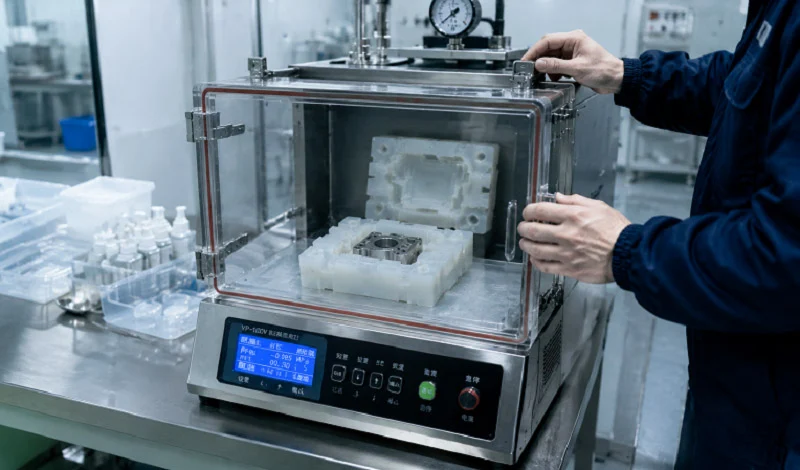
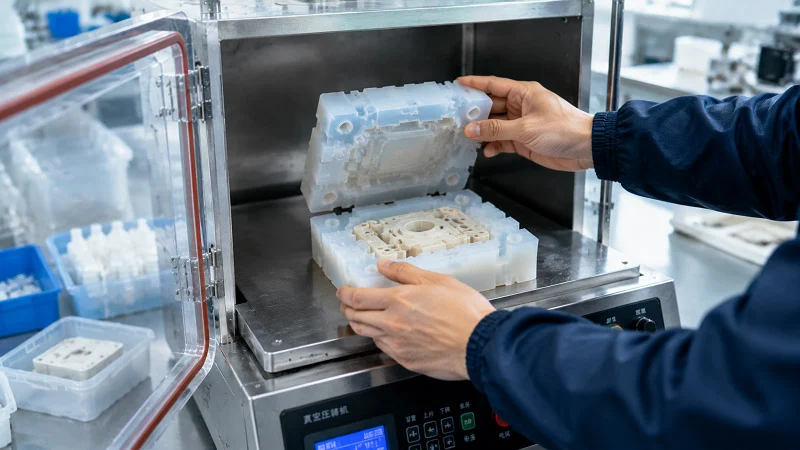
A master pattern is created—usually printed or machined. Silicone is then poured around the master pattern. After the silicone cures, the master is removed to create a mold cavity. Liquid resin is poured into the cavity under vacuum and cured. The final part is then removed from the mold.
A single mold can produce small batches, usually around 10 to 50 parts. The surface quality can accurately replicate the master pattern. Multiple prototype copies can be produced quickly from one mold.
Typical applications include pre-production samples, market testing parts, and bridge production for initial product launches. The materials are polyurethane resins—ABS-like, PP-like, or rubber-like properties. This extends the range of plastic rapid prototyping beyond additive and subtractive methods.
Plastic Materials Commonly Used in Rapid Prototyping
ABS Rapid Prototyping
ABS is a popular choice for good reason.
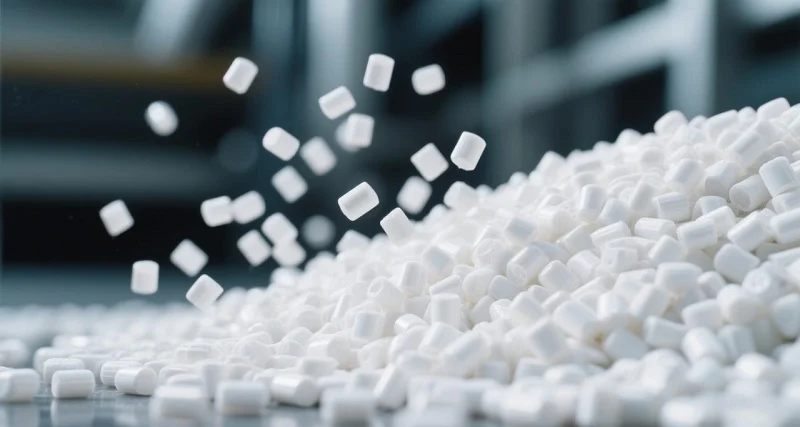
It resists impact which does not shatter under sudden loads. It machines cleanly—cutting tools do not gum up or overheat. Dimensional stability means it holds its shape after processing.
Common applications include housings, enclosures, and consumer products. For plastic rapid prototyping, ABS is often the first material considered because it is forgiving and widely available.
Nylon Rapid Prototyping
Nylon offers mechanical advantages that matter.
High strength supports significant loads. Wear resistance suits sliding interfaces and bearing surfaces. Fatigue resistance allows repeated cyclic loading without failure.
Applications include functional parts, gears, and mechanical components. SLS-printed nylon is common for moving prototypes. CNC-machined nylon is used for high-load assemblies.
Polycarbonate (PC) Rapid Prototyping
High impact resistance means it survives drops and rough handling. Transparency allows visual inspection of internal features or fluid flow. Heat resistance permits use in elevated temperature environments.
Applications include protective covers and optical components. Lenses, windows, guards, and transparent housings are typical.
Engineering Plastics for Functional Prototypes
Standard materials are not always enough. Advanced plastics fill the gap.
POM (acetal) provides low friction and high stiffness. PEEK offers high temperature resistance and chemical resistance. PPS handles aggressive chemical environments. PEI (Ultem) provides high strength and flame resistance. Glass-filled nylon adds stiffness and creep resistance.
These materials are used in demanding applications. High temperature resistance suits under-hood automotive and electronic components. Chemical resistance supports medical and industrial equipment. Mechanical strength supports structural parts.
Using engineering plastics for plastic rapid prototyping enables companies to perform functional testing in real operating environments. Prototypes are no longer just visual models for appearance evaluation. They become functional parts that can more accurately predict the performance of final production products.
Advantages of Plastic Rapid Prototyping
Faster Product Development
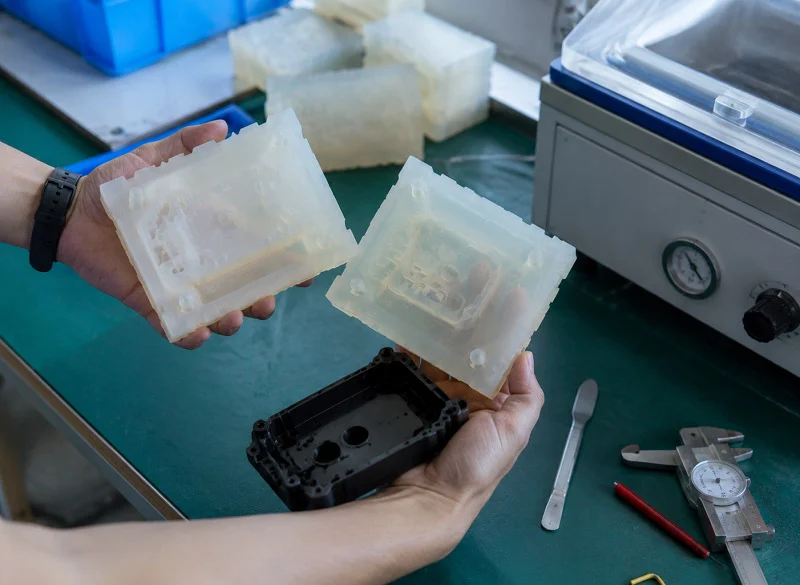
Speed is the primary advantage of plastic rapid prototyping. It shortens design cycles and allows parts to be produced in hours or days without waiting for weeks.
Companies test and improve designs faster. Multiple iterations are possible in the time it used to take for one. The development schedule compresses, and the product reaches market sooner.
Reduced Development Costs
Cost savings come from catching problems early. Prototypes identify design issues before tooling and mass production. A change to a CAD file is cheap, while a change to a mold is expensive.
Fewer design revisions are needed because issues are discovered and fixed in the prototype stage. The overall development budget stays under control.
Greater Design Flexibility
Flexibility is built into the process. Complex geometries that cannot be machined can be printed. Lightweight structures with internal lattices are possible. Customized designs are easy—each part can be different without additional tooling cost. Functional prototypes are produced, not just visual models.
Plastic rapid prototyping removes the limitations of traditional manufacturing methods. Engineers can design based on product functions instead of making compromises to fit tooling or machining requirements.
Improved Product Validation
Physical prototypes provide data. Fit and assembly are verified. The prototype is assembled into the product. Interference and clearance are checked.
Performance is measured. The part is loaded, cycled, and tested. Ergonomics are assessed. Does it feel right? Is it comfortable? User requirements are confirmed against the physical part.
Validation happens early. Issues are fixed before production. The final product works as intended.
Plastic Rapid Prototyping Services at NOBLE

NOBLE is a professional manufacturer specializing in plastic and metal prototype production. The company provides a complete service process, from design support to final prototype delivery, covering every stage of product development.
Our capabilities include plastic CNC machining, plastic 3D printing, vacuum casting, surface finishing, and assembly services. The process goes beyond simple part manufacturing. We deliver complete prototypes that are ready for testing or presentation.
Advanced Manufacturing Processes and Quality Control
Quality management certifications support the claim. ISO 9001:2015 covers general quality management. ISO 13485:2016 adds the rigor required for medical device prototyping. Inspection processes verify dimensions and surface quality. Engineering support is available for prototype validation.
Why Choose NOBLE for Plastic Rapid Prototyping?
Experienced engineering team. Flexible manufacturing capabilities. Wide range of plastic materials. Fast prototype turnaround. Support for different industries and project requirements.
These are the practical reasons. The engineering team solves problems. The manufacturing capabilities match the method to the need. The material range covers standard and advanced plastics. The turnaround meets project deadlines. The experience spans industries—medical, automotive, industrial, consumer.
FAQs About Plastic Rapid Prototyping
What Is Plastic Rapid Prototyping Used For?
Design verification, functional testing, and product development. The prototype answers questions before production tooling is committed. Does it fit? Does it work? Does it look right? These are the questions answered.
What Plastics Are Commonly Used for Rapid Prototyping?
ABS for general housings and consumer products. Nylon for strength and wear resistance. Polycarbonate for impact resistance and transparency. POM (acetal) for low friction and stiffness. TPU for flexible components. Engineering plastics like PEEK, PEI, and PPS for demanding environments. The material selection depends on the application. Plastic rapid prototyping uses the same grades that will be used in production.
Which Plastic Rapid Prototyping Technology Is Best for My Project?
he best method depends on prototype purpose, required accuracy, material requirements, quantity, and surface finish requirements.
FDM is fast and cheap. SLA provides smooth surfaces. SLS gives strong functional parts. CNC machining delivers high accuracy. Vacuum casting produces multiple production-like copies. The right method matches the project needs.
How Long Does Plastic Rapid Prototyping Take?
Lead time depends on four factors. Prototype complexity affects build time. Manufacturing method determines speed. Material availability affects procurement time. Finishing requirements add post-processing time.
FDM parts can be ready in 24 hours. CNC machining may take 3 to 5 days. Vacuum casting requires mold creation, which adds 5 to 10 days. The timeline is set by the requirements, not a fixed schedule.
Can Plastic Rapid Prototypes Be Used for Functional Testing?
Yes. Many plastic prototypes are suitable for functional testing. Assembly testing confirms fit and clearance. Mechanical testing measures strength and stiffness. Ergonomic evaluation assesses comfort and usability. Real-world performance validation simulates actual use conditions.
The right material and process produce a prototype that behaves like the production part. Plastic rapid prototyping supports these tests directly.
What Is the Difference Between Plastic Rapid Prototyping and Injection Molding?
Tooling requirements are the main difference. Rapid prototyping requires no tooling. Injection molding requires hard steel or aluminum molds.
Production volume follows. Rapid prototyping suits single parts to hundreds. Injection molding suits thousands to millions.
Cost structure differs. Rapid prototyping has lower upfront cost and higher per-part cost. Injection molding has high upfront cost and low per-part cost.
Development stage determines the choice. Rapid prototyping is used during development and validation. Injection molding is used for production.
Can NOBLE Provide Custom Plastic Rapid Prototyping Services?
Absolutel yes! NOBLE provides customized solutions based on customer CAD files, material requirements, and application needs. The engineering team reviews the design, recommends the manufacturing method, and produces the prototype. Finishing and assembly are included as required. Plastic rapid prototyping at NOBLE is tailored to the project, not offered as a standard service.