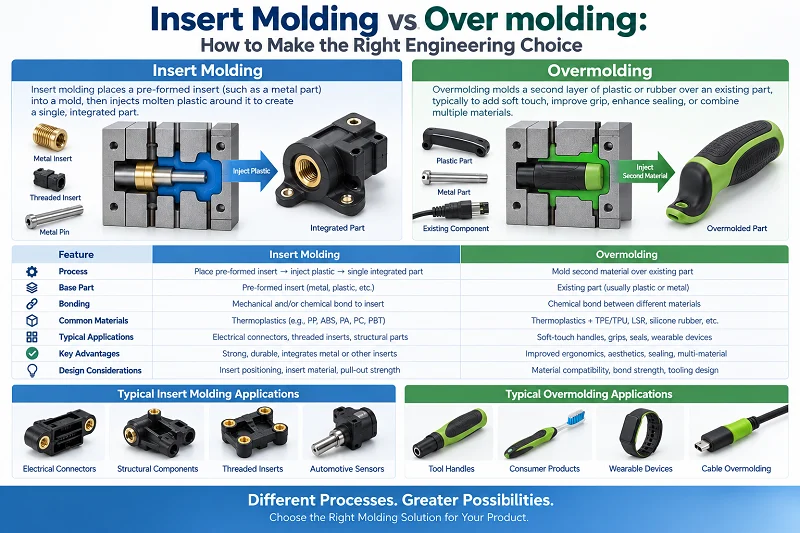
Insert molding and overmolding are the two most common processes in part manufacturing. They are used for medical device parts and robot joint parts. Both processes belong to injection molding. This often causes confusion for engineers when choosing between them. The wrong choice can lead to parts that do not meet requirements. This can cause rework or even a full remake. This guide starts with the basic concepts of both processes. It then explains the differences between them. It also covers when to choose which process. It will answer all your questions.
1. Insert Molding
1.1 What Is Insert Molding
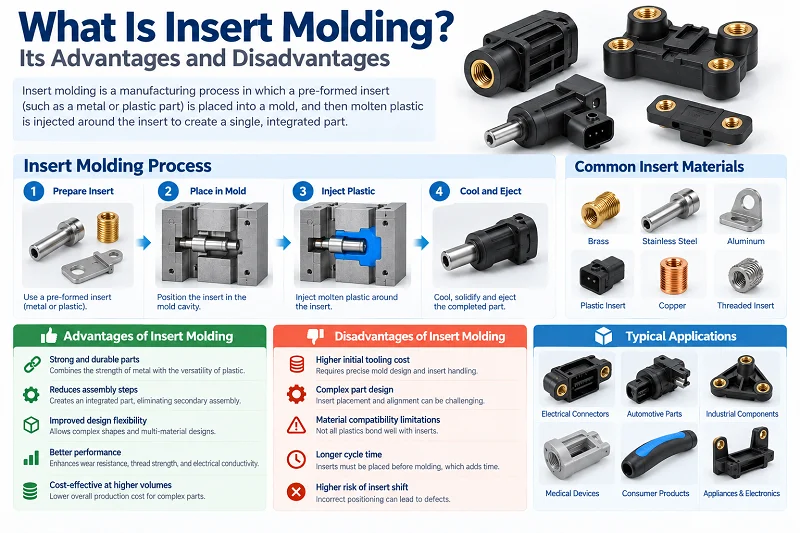
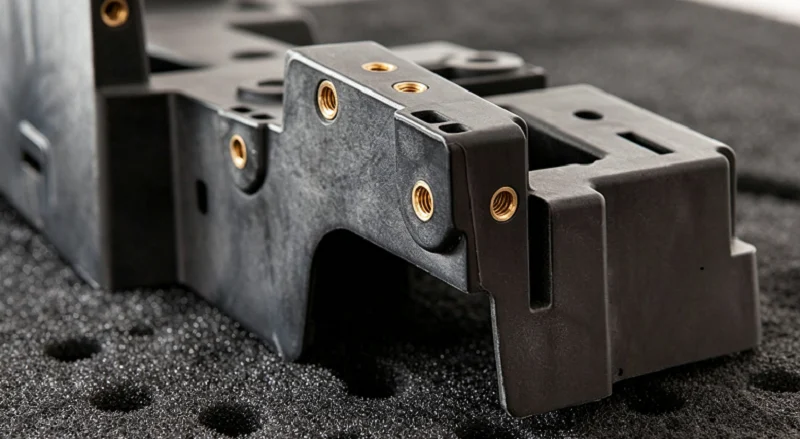
Insert molding is an injection molding process. A pre-made insert is placed into the mold. Then plastic is injected to wrap around the insert. After cooling, the plastic and insert become one single part. The insert is usually metal. It can also be ceramic or a magnet. Common examples are brass nuts, metal contacts, and precision shafts.
1.2 Advantages of Insert Molding
Simplified production. It combines manufacturing and assembly into one step. This removes secondary steps like welding and riveting.
Strong connection. The plastic wraps directly around the insert. The insert does not loosen or fall out easily. It has good pull strength and torque resistance.
Accurate positioning. The insert is held by locating pins in the mold. Positions are consistent. This is good for precision parts.
Lightweight design. Metal provides strength. Plastic provides insulation and low weight. Extra parts are reduced.
Good sealing. The plastic fits tightly around the insert. This can form a moisture-proof and dust-proof structure.
Low overall cost. In high-volume production, it saves labor and time. It also lowers the defect rate.
1.3 Disadvantages of Insert Molding
The insert must withstand high temperatures. Otherwise, it may deform during molding.
Mold design is complex. Locating pins and sliders increase cost.
Manual placement can cause misalignment or missing inserts. This can damage the mold.
The molding cycle is relatively long. This affects efficiency.
Defective parts are hard to rework. The insert and plastic cannot be separated.
Insert size is limited. Very large or odd-shaped inserts are hard to fit into the mold cavity.
2. Overmolding
2.1 What Is Overmolding
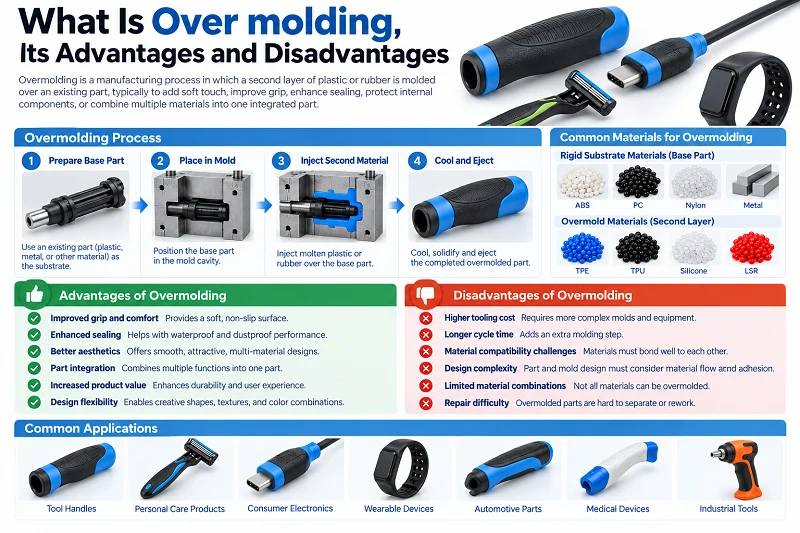
Overmolding is essentially a type of insert molding. But unlike insert molding, overmolding means covering plastic over another molded part. The first part is made in an injection mold. Then it is placed into a second mold for overmolding. This technique can combine multiple plastics for practical or visual purposes. For example, plastics of different hardness can be used. A softer plastic can cover a harder plastic to make the part easier to grip. Using multiple colors in an overmolded part can also make a product stand out from other brands. Overmolding is often used for handles of tools like screwdrivers, drills, or toothbrushes.
2.2 Advantages of Overmolding
Overmolding is a versatile process with many advantages:
2.2.1 Better Material Flexibility
Overmolding lets designers use the strengths of multiple materials. They can create complex parts with different properties, added visual complexity, or better tactile feel.
2.2.2 No Adhesives Needed
Overmolding fuses different materials in the mold. This removes the need for glue or other permanent bonding methods. It improves overall part durability and lowers assembly cost.
2.2.3 Built-In Seals
Overmolding can mold soft seals into the part. For example, electronic housings that need an IP rating often have a groove for an O-ring. But molding the seal permanently as one part is more cost-effective and more reliable.
2.3 Disadvantages of Overmolding
Although overmolding has many advantages, there are some disadvantages to consider before choosing this process.
2.3.1 Multi-Step Process
Overmolded parts need a two-step process. This increases the production cycle. So it costs more than a single-shot molded part without overmolding. Overmolding also needs two molds, or a complex two-shot mold. This increases upfront cost. However, if the alternative is making two separate molded parts and then assembling them, overmolding becomes a value-added solution.
2.3.2 De-bonding
Bonding two different materials in an injection mold carries the risk of de-bonding. This usually happens when the temperature is not in the best range for the specific material combination. In some cases, when materials cannot be reliably bonded by heat, mechanical interlocks may be needed.

3. Why Do Engineers Confuse Insert Molding with Overmolding?
Overmolding and insert molding both aim to improve product durability and function. Engineers sometimes think these two processes are interchangeable. This is because both combine multiple components into one molded part. This confusion can lead to costly mistakes.
3.1 Both Are Injection Molding Processes
Both place a pre-existing part into the mold. Then plastic is injected. The actions look very similar.
3.2 Both Involve Two Materials
Insert molding is metal plus plastic. Overmolding is hard plastic plus soft plastic. Engineers may simply think “both combine two materials.”
3.3 The Names Overlap
In overmolding, the plastic substrate being covered acts like an “insert” during the second injection. So in a way, overmolding includes the logic of insert molding.
3.4 Industry Terms Are Not Consistent
Different companies and regions use these terms differently. Some suppliers call two-shot molding “overmolding.” Others treat overmolding as a type of insert molding.
3.5 Different Core Purposes, But Similar Results
Insert molding aims to provide strength, threads, or conductivity. Overmolding aims to provide grip, sealing, or a comfortable feel. But the final part is “two materials combined into one.” It is hard to tell them apart by appearance.
3.6 How to Tell Them Apart?
Remember one key point—insert molding is a one-step process. Overmolding is a two-step process. The insert is metal or non-plastic. The overmold layer is soft plastic. If you remember this, you will not get confused.

4. How Each Process Works: Insert Molding and Overmolding
4.1 Insert Molding (One-Step Process):
- Prepare the insert: Clean the metal insert.
- Place into mold: Put the insert into the mold cavity by hand or robot.
- Close and inject: Inject melted plastic to wrap around the insert.
- Cool and eject: After the plastic hardens, open the mold and take out the finished part.
4.2 Overmolding (Two-Step Process):
- First shot: First, mold a hard plastic substrate.
- Remove substrate: Take the substrate out of the mold.
- Place into second mold: Put the substrate into another mold.
- Second shot: Inject soft plastic to cover the substrate surface.
- Cool and eject: After cooling, take out the finished part.
5. What Is the Real Difference Between These Two Processes?
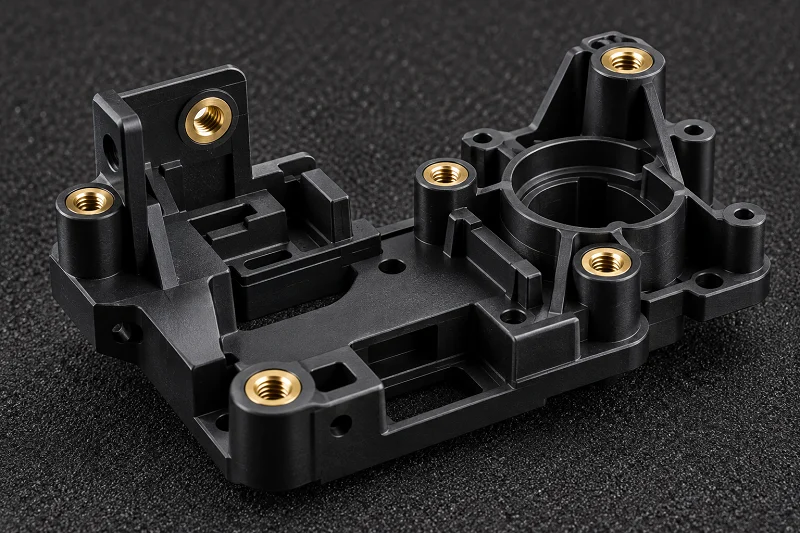
Insert molding places a pre-made part into the mold. Plastic is formed around selected areas. The insert can provide threads, conductivity, wear resistance, weight, fastening, or other functions that resin alone cannot easily achieve. The process only works if the insert can be positioned, fixed, protected, and verified during molding.
Overmolding adds a layer of material onto a substrate or first molded part. It is often used to improve grip, feel, sealing, shock absorption, edge protection, or visual distinction. The term “overmolding” does not guarantee a strong bond. Material compatibility, surface condition, mechanical retention, geometry, and the use environment all affect the final result.

6. How to Choose the Process of Insert Molding and OverMolding?
6.1 Look at Function Needs.
If you need metal strength, threads, or conductivity, choose insert molding. If you need grip, sealing, or a soft feel, choose
overmolding.
6.2 Look at Batch Size.
For small batches and many product types, choose manual overmolding or manual insert molding. Mold investment is low. For large batches and high consistency, choose two-shot molding or automated insert molding. Efficiency and consistency are high.
6.3 Look at Cost Budget.
If the budget is limited or you are in early validation, choose a simpler mold first. For mass production, evaluate mold investment, labor cost, and defect rate together. Choose the option with the best total cost.
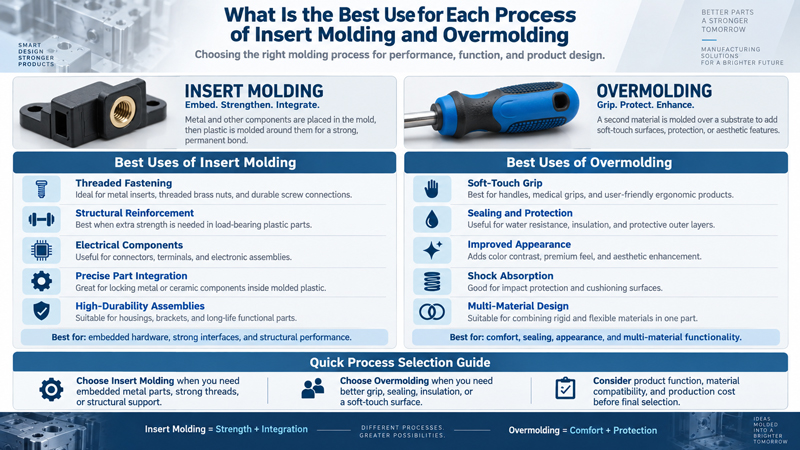
7. What Is the Best Use for Each Process of Insert Molding and OverMolding?
| Process Type
|
Best-Fit Scenario | Typical Applications | Core Advantage |
| Insert Molding | Parts needing metal strength, threaded connections, or conductivity | Connectors, threaded inserts, sensor housings, automotive electronic terminals | Combines metal rigidity with plastic insulation in one part |
| Overmolding | Parts needing a soft feel, grip, or sealing | Power tool handles, toothbrush grips, medical device handles, steering wheels | Soft outside, strong inside |
| Manual Overmolding | Small batches, complex products | R&D samples, niche custom parts | Low mold investment, flexible |
| Two-Shot Molding | Large batches, high consistency | Consumer electronics housings, automotive parts | High efficiency, good consistency |
8. How to Choose the Right Production Sequence of Insert Molding and OverMolding?
Choosing the production sequence mainly depends on three things: material properties, structural requirements, and batch size. You can judge from these three points:
8.1 Check if the insert or substrate can withstand high temperatures.
If the insert is metal or high-temperature plastic, you can make the insert first, then inject plastic around it. If the substrate is ordinary plastic, you need to mold the substrate first, let it cool,
then do the overmolding. This avoids substrate deformation during the second injection.
8.2 Check the bond strength requirement.
If you need a strong bond between the outer layer and substrate, choose two-shot molding first. The overmolding happens before the substrate fully cools, so bond strength is higher. If you choose manual overmolding, the substrate must cool completely before being placed into the mold. Bond strength is relatively lower.
8.3 Check batch size and cost.
For small batches and many types, choose manual overmolding or manual insert molding. Mold investment is low and flexible. For large batches and high consistency, choose two-shot molding or automated insert molding. Efficiency and consistency are high.
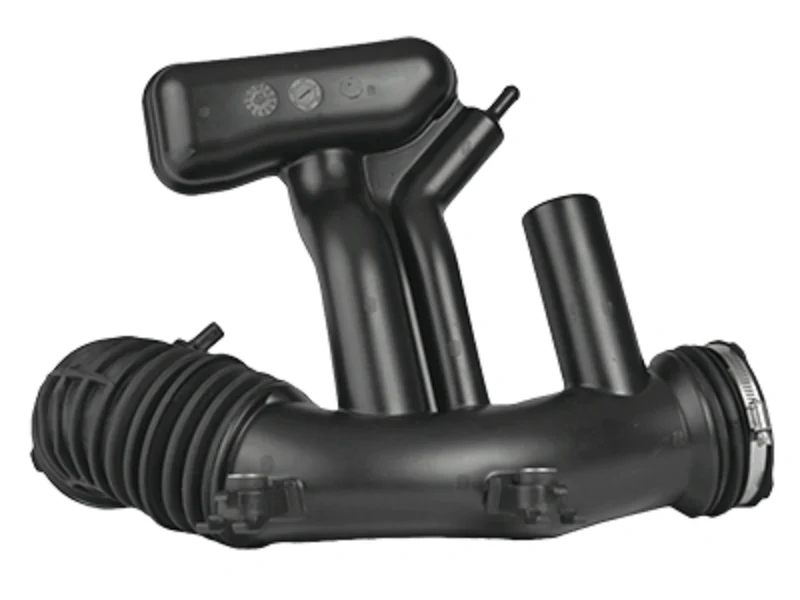
9. What Is the Difference in Material Use Between the Two of Insert Molding and OverMolding?
In overmolding, bond strength must be determined before mold design. The substrate and overmold resin must have enough chemical compatibility. This ensures the melted second material can wet the substrate surface and partially interdiffuse during injection. SyBridge Technologies’ multi-material compatibility guide lists three proven combinations for engineering applications:
9.1 ABS or PC/ABS Substrate + TPU or TPE Over mold
The most common combination in consumer electronics and handheld devices. It forms a strong chemical bond at standard processing temperatures.
9.2 Nylon (PA66) Substrate + TPV Over mold
The top choice in automotive applications. Automotive needs chemical resistance and high-temperature performance, plus grip or sealing.
9.3 Polypropylene Substrate + PP-Compatible TPE
Used for medical consumables and consumer packaging. Because PP has low surface energy, bonding is more sensitive to processing conditions. Resin selection must be done carefully.
When chemical affinity is not enough for a strong bond, mechanical bonding through substrate geometry is a reliable alternative. As stated in Protolabs’ design guide for overmolding and insert molding, adding through-holes to the substrate—especially dovetail-shaped holes that widen toward the far end—lets the overmold material flow through and form a mechanical lock, even when chemical bonding is weak. Wrapping the overmold material around the substrate edges similarly increases interface area and peel strength.
9.4 For Insert Molding, Material Compatibility Mainly Depends on Thermal Expansion Coefficient, Not Chemical Properties.
Brass is the most common insert material. Its thermal expansion coefficient (17-19 × 10⁶/°C) is closer to most engineering thermoplastics than stainless steel. This minimizes stress at the plastic-metal interface during thermal cycling. Stainless steel inserts are used when corrosion resistance or non-magnetic requirements are more important than thermal expansion differences.
10. Cost and Volume Analysis Between the Two
The economics of multi-material injection molding change significantly with annual volume. The table below simulates a typical 50mm × 80mm consumer electronics handle assembly at 500,000 units per year. Data comes from Mold Minds’ 2025 multi-material cost analysis report.
| Process | Mold Cost | Cost Per Part (500K/year) | Cycle | Best Volume Range |
| Insert Molding | $14,000-$28,000 | $0.81 | 22-28 sec + 8-12 sec insert loading | All volumes; ideal below 100K/year |
| Overmolding | $18,000-$38,000 | $0.74 | Substrate 22-28 sec + overmold 24-35 sec | Best below 50K/year; up to 300K/year |
| Two-Shot Molding | $45,000-$95,000 | $0.43 | Single cycle: 28-40 sec total | Economical above 300K/year |
In insert molding, operator labor cost is a critical but often overlooked cost driver. Assuming a labor rate of $22/hour and an insert loading cycle of 30 seconds, manual insert handling adds $0.044 per part in direct labor cost. At 500,000 units per year, that adds up to $22,000. Robotic insert loading removes this variable cost but adds capital investment and fixture engineering costs.
At 500,000 units per year, two-shot molding saves $0.38 per part compared to manual insert molding. This means the $45,000-$95,000 mold premium can be paid back in 12 to 18 months. For projects below 50,000 units per year, neither two-shot molding nor a second overmolding can be effectively amortized. In that case, insert molding or single-step overmolding with a low-cost second mold is the right choice.
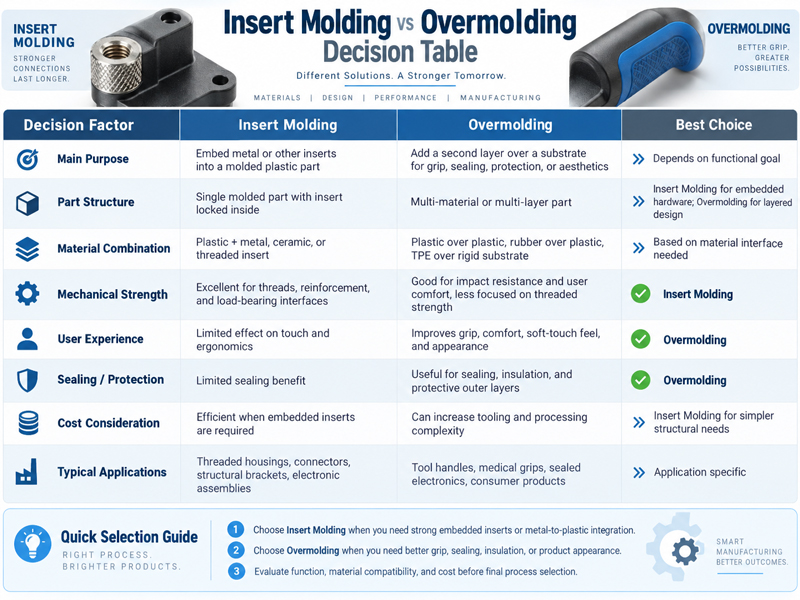
11. Insert Molding vs Overmolding Decision Table
| Decision Factor | Insert Molding | Overmolding |
| Process Steps | One step | Two steps |
| Substrate Type | Metal, ceramic, magnet, or other non-plastic insert | Plastic substrate (hard plastic) |
| Outer Material | Plastic | Soft plastic, rubber (TPE/TPU/silicone) |
| Core Purpose | Provide strength, threads, and conductivity | Provide grip, sealing, comfortable feel |
| Number of Molds | 1 set | 2 sets (or 1 two-shot mold) |
| Manual Involvement | Low (can be automated) | High for manual; low for two-shot |
| Production Cycle | Short | Long for manual; short for two-shot |
| Bond Strength | High (plastic wraps insert) | Moderate for manual; high for two-shot |
| Suitable Batch Size | Small to large batch | Manual for small batch; two-shot for large batch |
| Mold Investment | Medium | Low for manual; high for two-shot |
| Defective Part Rework | Hard | Hard |
| Typical Applications | Connectors, threaded inserts, sensor housings | Tool handles, toothbrushes, medical device grips |
| Selection Advice | Choose when metal function is needed | Choose when a soft outer layer is needed |
12. Why Choose NOBLE as Your Insert Molding & Overmolding Manufacturer?
NOBLE is a certified metalworking company with over 12 years of experience in manufacturing high-quality metal components.
From our locations in Shenzhen, China, we provide sheet metal processing and precision mechanical components for the automotive, robotics, and medical industries. Since 2012, we have acted as a trusted partner for manufacturers of components for industrial vehicles and Robot parts, offering a full production path from initial processing through to finished parts.
What makes us different is our focus on technological innovation and constant improvement. By pairing advanced automation with expert craftsmanship, we ensure every component satisfies rigorous quality standards. Our facilities are certified to ISO 9001 and ISO 13485, reinforcing our commitment to quality management, environmental responsibility, and workplace safety.
This gives companies like yours a reliable partner for consistent, high-precision components, complete traceability, and full compliance with international standards. From complex sheet metal fabrications to mechanical components for demanding uses, our team is equipped to meet your production goals.
FAQs
1. What is the difference between insert molding and overmolding?
Insert molding is a one-step process. A metal insert is placed in the mold, then plastic wraps around it. Overmolding is a two-step process. A plastic base is made first, then a soft layer is molded over it.
2. What are the disadvantages of insert molding?
Inserts must resist high heat. Mold design is complex and costly. Manual placement can cause errors. Defective parts are hard to rework.
3. Does your part require overmolding or inserts?
Choose inserts for metal threads, strength, or electrical contacts. Choose overmolding for soft grips, sealing, or better feel.
4. What are the key differences between dual molding and overmolding?
Dual molding uses one machine and one rotating mold to make two materials in one cycle. Overmolding uses two separate molds and two molding cycles.
5. What are some examples of overmolded parts?
Power tool handles, toothbrush grips, medical device handles, phone cases, steering wheels, and electrical connectors.