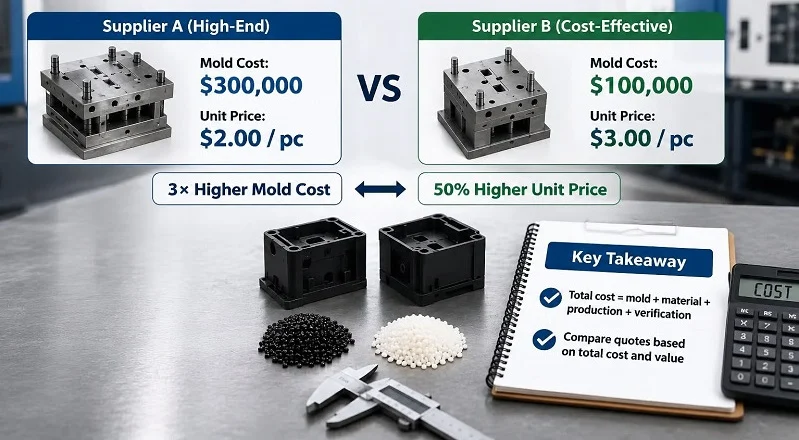
Two suppliers quote the same part in the same resin, and the mold price differs by a factor of three while the unit price differs by half. Neither number is wrong. Each quote is pricing a different set of assumptions about steel, cavitation, cycle time and validation, and most of those assumptions are never written down.
The cost of injection molding is not a single figure. It is a group of variables that constrain one another: a cheaper mold usually means lower-grade steel or fewer cavities, and a cheaper unit price often means a compressed cycle or a skipped validation step. Neither saving is free; both move risk to a later stage of the program, where it is more expensive to fix.
This guide breaks the quote into its real components, identifies what low quotes tend to leave out, and gives you a line-by-line method for comparing two quotes for the same part.
The Four Cost Buckets
Most molding quotes resolve into a few recurring buckets: what the part is made of, what the tool costs, what the machine costs to run, what happens after the part leaves the mold, and the margin on top. Suppliers differ mainly in how they distribute cost between the one-time tooling figure and the recurring piece price, and in how much of each bucket they disclose.
What the quote is actually made of
A complete quote is built from these components:
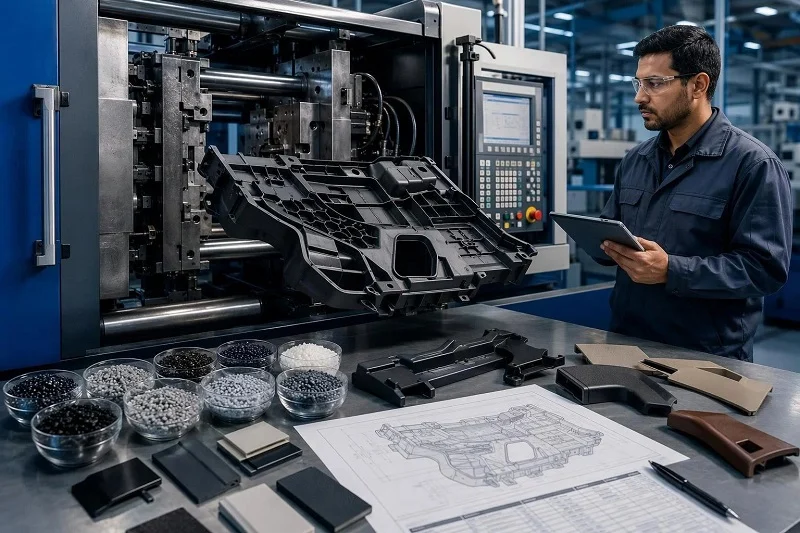
- Material cost — resin price multiplied by shot weight, including sprue and runner loss plus the scrap rate. Material typically accounts for 20–40% of total part cost.
- Mold cost — a one-time investment, amortized across the production volume rather than charged per part.
- Machine time — machine hourly rate multiplied by cycle time, divided by the number of cavities. This is usually 30–50% of total cost.
- Post-processing and inspection — degating, deburring, printing, assembly, and dimensional or cosmetic checks, typically 5–20%.
- Overhead and profit — the supplier’s operating cost and margin, which vary with region, capacity utilization and program risk.
When a quote collapses these into one blended piece price, you lose the ability to see which line is driving the difference.
Why Quotes Differ
Three variables explain most of the gap between two quotes for the same drawing:
- Mold steel grade. P20 is pre-hardened at roughly 28–32 HRC and machines easily at lower cost; H13 reaches about 48–52 HRC after heat treatment and costs more to buy, heat treat and grind. The steel choice alone can move the tooling figure substantially.
- Cavitation strategy. A single-cavity tool is the cheapest to build but produces one part per cycle; a multi-cavity tool raises the tooling figure while spreading machine time across more parts. The two costs move in opposite directions.
- Scope of validation. Whether written DFM feedback, trial reports and first-article inspection are included changes both the price and the risk you carry afterward. A quote that omits them is not necessarily cheaper — it is less complete.
Dimension 1 — Mold Cost vs. Unit Price
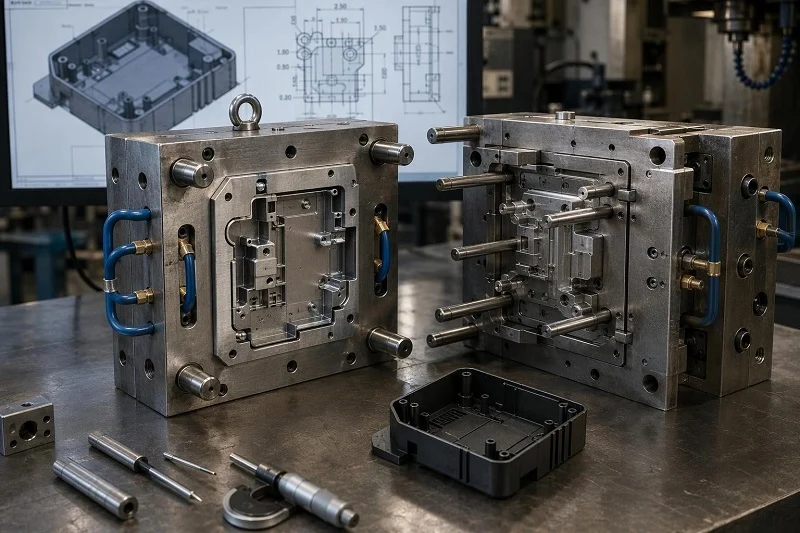
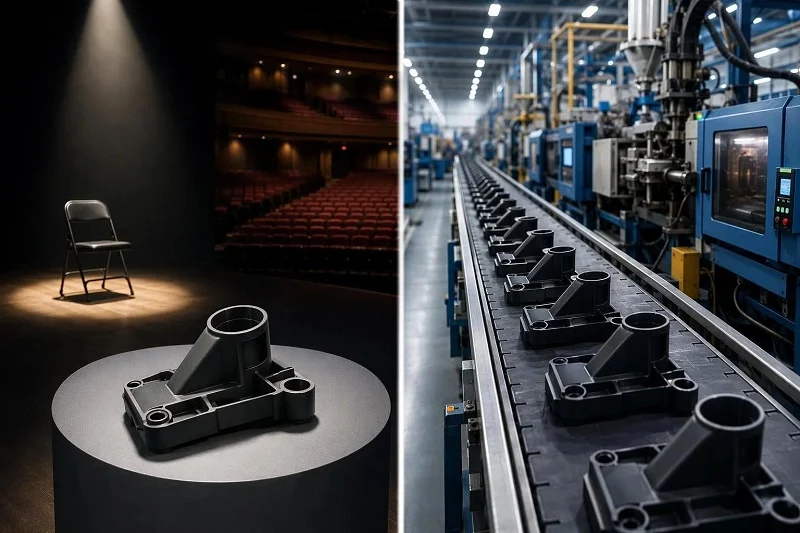
Tooling and piece price trade against each other, and cavitation is the lever that sets the exchange rate. Reading only one of the two numbers hides the decision: a mold that costs three times as much can still produce the cheaper program if the volume is high enough to amortize it.
Cavitation Shifts the Cost
A single-cavity mold has the lowest upfront cost, but one part per cycle means the machine time is never diluted — every part carries the full cycle. A multi-cavity mold costs more to build while cutting per-part processing cost significantly. As a reference point, a 4-cavity mold typically costs about 2.6 to 3 times a single-cavity mold while producing four parts per cycle.
The table below uses illustrative figures for one part at a fixed volume to show how the trade-off resolves. Substitute your own quoted numbers; the arithmetic holds.
| Metric | Single cavity | 4 cavities | 8 cavities |
| Mold cost (illustrative) | $10,000 | $28,000 | $48,000 |
| Parts per cycle | 1 | 4 | 8 |
| Machine cost per part (illustrative) | $0.40 | $0.10 | $0.05 |
| Total unit price (illustrative) | $1.05 | $0.78 | $0.74 |
| Break-even volume vs. single cavity | — | ~62,000 parts | ~69,000 parts |
Note that the 8-cavity tool does not automatically win: the extra mold cost must still be recovered, and clamp force roughly doubles, which may require a larger press.
The 10,000-Part Threshold
Once target volume passes roughly 10,000 parts, the effect of cavitation strategy on total cost begins to outweigh the difference in mold price itself. Below that level, tooling dominates and a simpler mold is usually the rational choice; above it, the per-part processing saving compounds with every additional part.
The practical rule is to judge cavitation by total program volume, not by the mold quote in isolation. A supplier who proposes a single-cavity tool for a 200,000-part program is optimizing the number you sign for, not the number you pay.
Dimension 2 — Mold Steel Lifespan
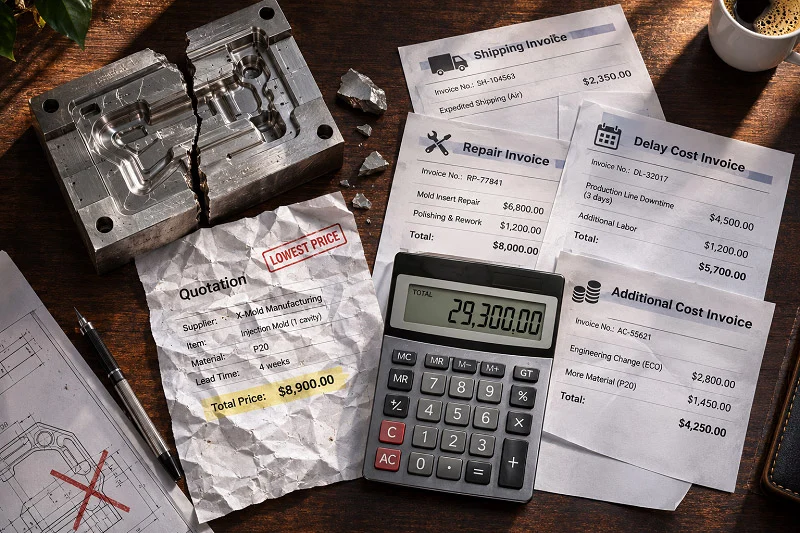
Steel grade sets how many shots a mold can survive before wear shows up as flash, dimensional drift or surface damage. Because a mold failure lands mid-production, the cost of an underspecified tool is not the price difference — it is the downtime and the second tool.
P20 vs. H13
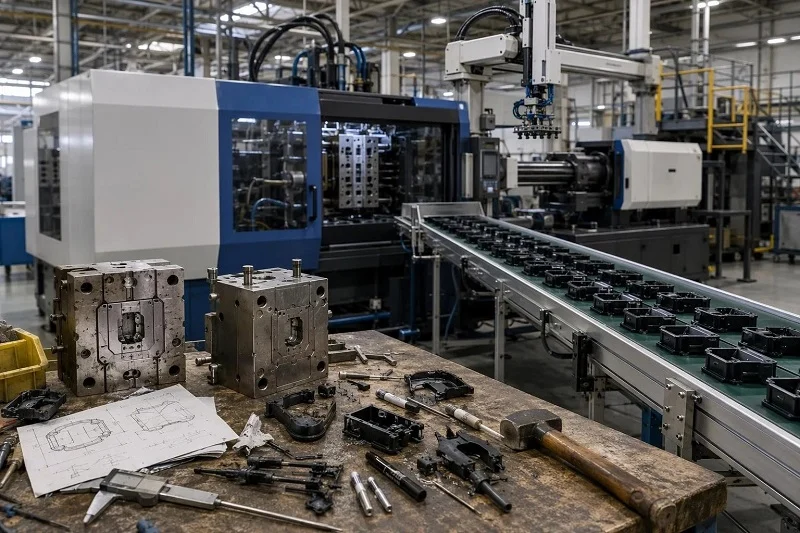
Aluminum and P20 steel molds cover a broad low-to-mid range: aluminum is typically rated for a few thousand to around 10,000 shots, while P20 is commonly rated at roughly 100,000–500,000 shots depending on grade, resin and maintenance. Both suit prototyping and small-to-medium batches. H13, hardened to about 48–52 HRC, is typically rated at 500,000 to over 1 million shots and suits mass production and abrasive or high-temperature resins.
The mismatch to watch for is a P20 quote on a program planned at 500,000 parts. It looks cheaper upfront, but the tool may wear out mid-production, and the downtime plus re-tooling cost far exceeds the initial saving. Abrasive glass-filled and corrosive resins pull every one of these figures down.
The Lifespan Formula
Target volume ÷ mold rated lifespan = number of molds needed.
If the result is greater than 1, the steel grade is likely mismatched to the program. A 600,000-part target against a 250,000-shot tool means you are budgeting for at least three tools, whether or not the quote says so.
Ask the supplier: “What is the rated shot life for this steel grade, and does that figure refer to shots or finished parts? Can you provide a written commitment?” The shots-versus-parts distinction matters on multi-cavity tools, where one shot yields several parts.
Dimension 3 — What Low Quotes Leave Out
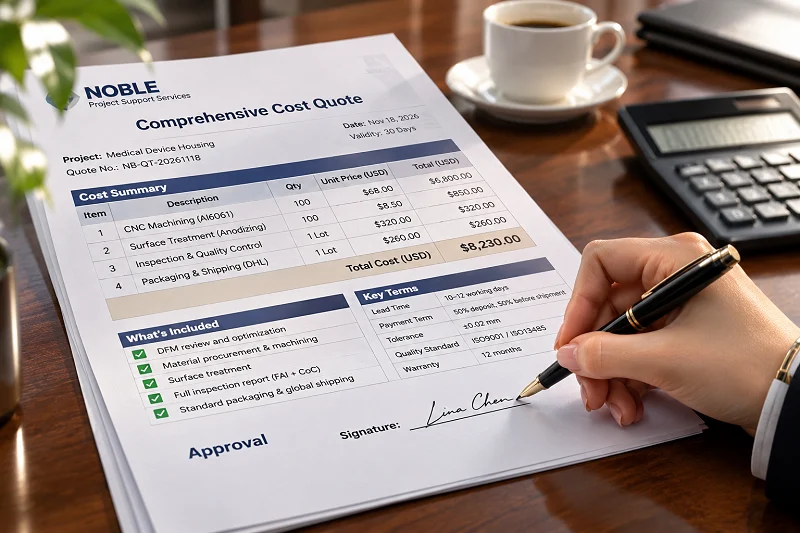
A low quote is usually not a cheaper version of the same scope — it is a narrower scope. The gap shows up as missing engineering, missing commitments and missing assumptions, and each one converts into a change order later.
Missing DFM Feedback
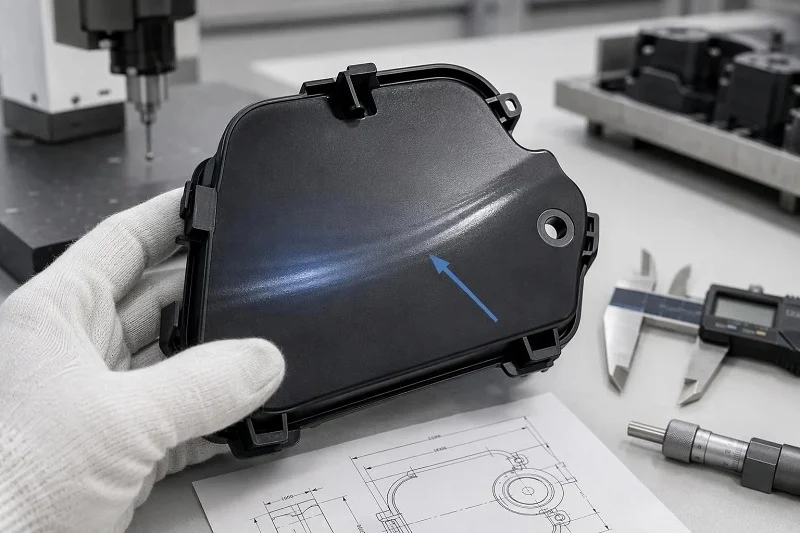
A low quote often arrives without written DFM feedback. Design issues then surface during trial runs, when mold modifications are billed separately and the schedule has already been committed.
Ask: “Does the quote include a DFM review, and can you provide the written feedback?” A supplier that performs DFM at the engineering stage catches problems before steel is cut; one that does not is passing that cost to you.
Unspecified Steel and Life
A quote that says only “P20” — with no specific grade, hardness or shot-life commitment — leaves room for non-standard material substitutes that meet the name but not the durability.
Ask: “Which specific steel grade and hardness, and what is the guaranteed shot life?” Request the material certification and hardness test report if the program depends on it.
Unstated Cycle Time
Cooling accounts for roughly 50–70% of cycle time, and cooling time scales with the square of wall thickness — so uneven wall thickness extends cooling and raises unit cost disproportionately. A quote that never states its cycle-time assumption has no engineering basis behind the piece price.
Ask the supplier to state the assumed cycle time and maximum wall thickness in the quote. If they cannot, the number is a guess.
The Quote Checklist
Before comparing two quotes, confirm each of these appears in writing:
- Material grade and resin assumption
- Mold steel grade and hardness
- Cavitation (parts per cycle)
- Cycle time assumption and maximum wall thickness
- Mold life commitment in shots
- DFM feedback included
- Trial rounds and first-article inspection included
- Post-processing and finishing notes
Any blank line is a cost you have not yet been quoted.
Dimension 4 — Total Cost of Ownership

Total cost of ownership answers the question a unit price cannot: what will this part actually cost across the whole program? A quote that looks 30% cheaper per part can lose that advantage the moment the mold needs rebuilding, a trial round is billed extra, or a secondary operation turns out to be excluded. TCO pulls the one-time tooling, the recurring part price, and the risk of mid-production failure into a single comparison at your real volume.
Cost-per-Part Formula
A workable build-up is:
Cost per part = (mold cost ÷ expected total volume) + material cost + (machine rate × cycle time ÷ cavitation) + post-processing cost
The tooling term is the one buyers most often get wrong, because it is divided by a forecast rather than a fact. A $20,000 mold spread over 100,000 parts adds $0.20 per part; the same mold spread over 20,000 parts adds $1.00. That is a 5x swing in per-part impact from an identical invoice, driven entirely by the volume assumption underneath it.
So when you compare quotes, check that both use the same volume, the same cavitation, and the same cycle time assumption. If they do not, convert both to cost per part at your volume before you compare anything.
When Higher Is Cheaper
A higher quote can be the cheaper program. It may carry harder steel with a written shot-life commitment, a complete DFM review, trial rounds and first-article inspection, and secondary operations priced in rather than bolted on later. Each of those reduces the chance of an unplanned event during production.
The asymmetry matters. Savings on a mold are collected once, at purchase. The consequences of a mold that fails mid-program are paid repeatedly: lost output, expedited replacement tooling, re-validation, and delayed shipments. Where a program is large enough that a tool failure would interrupt supply, the higher quote with the longer rated life and fuller validation is usually the lower-risk purchase, even though its invoice is larger.
Talking to NOBLE for Your Injection Molding Project
NOBLE is a Sino-British joint venture and a government-recognized National High-tech Enterprise, working as a contract manufacturer across prototyping and volume production. Our in-house capabilities run from design and prototyping through to mass production of parts, supported by a full set of inspection equipment and an overall quality control system. We hold ISO 9001:2015 and ISO 13485:2016 certification, and we provide a complete service from design to assembly rather than molding alone.
For an injection molding project, that means the quote you receive can be built on the same engineering basis this article describes: a stated material grade, a named mold steel with a rated shot life, a defined cavitation strategy, and a cycle time assumption tied to your part geometry. Where a design has wall thickness variation or tolerance choices that will drive cost, we would rather raise them at the DFM stage than discover them at T0.
If you are weighing two quotes and want an engineering view of which one holds up, send us the part drawing and your volume forecast. We can review the design for manufacturability and quote the tooling and part price against your actual program size.
FAQs about Cost of Injection Molding
This section collects the questions buyers ask most often about the cost of injection molding when quotes for the same part come back far apart. Each answer names the cost driver at work and states how that driver moves the number. The figures behind these answers are structural — how tooling amortizes across volume, how steel life divides into production quantity, how cycle time enters the part price — rather than quoted prices, so they stay useful whatever your part, resin or order quantity happens to be.
Why is injection molding tooling so expensive?
Tooling price reflects steel grade, cavity count, tolerance and finish requirements, and how much validation is included. A hardened H13 tool with four cavities, a DFM review and first-article inspection costs more than a single-cavity P20 tool. The mold is a one-time investment, so its cost per part falls as volume rises.
Is a cheaper mold always more expensive in the long run?
Not always, but often. A low-grade tool has a shorter rated life, so a program that outruns that rating needs a second mold or a mid-production rebuild. Downtime, expedited tooling and re-validation can exceed the initial saving. The risk grows with volume: the more parts you plan, the less a short-life tool fits.
How does production volume affect the cost of injection molding?
Volume sets how the one-time mold cost amortizes and whether a multi-cavity tool pays back. A $20,000 mold adds $0.20 per part across 100,000 parts, but $1.00 across 20,000. Past roughly 10,000 parts, cavitation strategy starts to outweigh the mold price difference; the exact crossover depends on your part and cycle time.
What should I check before comparing two injection molding quotes?
Confirm both quotes state the same material grade, mold steel grade and hardness, cavitation, cycle-time assumption, and mold life commitment in shots. Check whether DFM feedback, trial rounds and first-article inspection are included, and what post-processing the piece price covers. Then convert both to cost per part at your volume.
Can I lower the cost of injection molding without sacrificing quality?
Yes. Make wall thickness uniform and as thin as the part allows, since cooling time scales with the square of wall section. Relax tolerances on non-critical features, and resolve design problems at the DFM stage, before steel is cut. Those changes usually save more than pressuring a supplier on price.