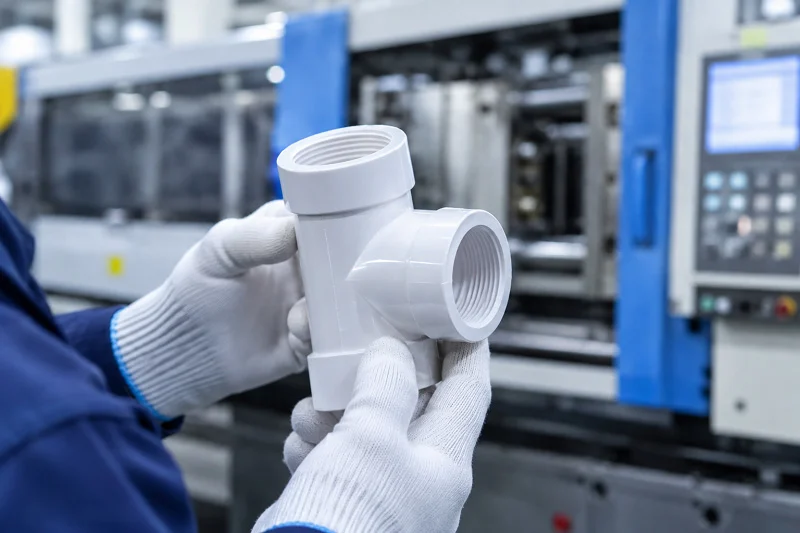
PVC injection molding is the high-volume route to rigid, chemical-resistant, electrically insulating parts — pipe fittings, valve bodies, window hardware, electrical housings and medical components — but it is also one of the least forgiving thermoplastics to run. Polyvinyl chloride degrades when it is held too long at melt temperature or pushed through a restricted gate, and the hydrochloric acid released in that breakdown attacks both the part and the mold. That single characteristic shapes almost every decision in this guide: how the machine is set up, which grade is specified, how the tool is designed and how the process is maintained between runs.
The sections below cover the molding cycle stage by stage, the practical differences between rigid PVC-U, modified PVC-M, plasticized PVC and CPVC, and how unfilled PVC grades compare with ABS, polyolefins, polycarbonate, nylons and PEEK on the properties that usually decide a material call. The guide then sets PVC injection molding against CNC machining, blow molding, extrusion and thermoforming, works through the defects that trace back to heat and shear, and closes with the design rules that keep a part moldable. A section on NOBLE’s prototyping and production support and a set of reader FAQs follow.
What Is PVC Spuitgieten?
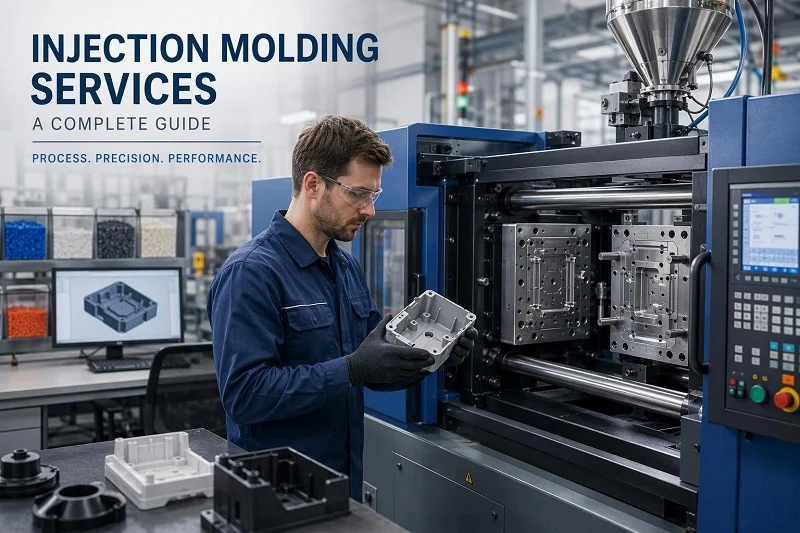
PVC injection molding is a manufacturing process in which a compounded polyvinyl chloride formulation is melted in a reciprocating-screw barrel and forced into a closed steel mold, where it cools into a finished part.
PVC itself is a commodity thermoplastic produced in very large volumes, and it is unusual among commodity plastics in that most of its mass comes from salt rather than petroleum: roughly 57% of the resin derives from common salt, with the balance from hydrocarbon feedstock. The polymer leaves the reactor with low thermal stability and high melt viscosity, so it is almost never molded as raw resin. Heat stabilizers, plasticizers, impact modifiers, fillers, flame retardants, UV protectants and pigments are compounded in to make it processable and to set its end properties.
That compounding is why “PVC” is not one material. The commercial family includes rigid unplasticized PVC (PVC-U), modified rigid PVC (PVC-M) with improved impact behavior, chlorinated PVC (CPVC) with a higher chlorine content and a higher service temperature, and flexible or plasticized PVC in which plasticizers supply elasticity and softness. Each of these has its own processing window, and a formulation tuned for a thick-walled pipe fitting will not necessarily fill a thin, complex housing.
The defining constraint on the process is the material’s sensitivity to heat and shear. PVC melt can degrade if it sits at processing temperature for an extended period or meets high shear in restricted gates, runners or thin part walls. Melt delivery — the injection unit, the runner system and the gates — therefore has to be streamlined, with no stagnant areas or dead spots, and free of highly restricted flow channels. Molders who follow those rules routinely produce rigid PVC parts in complex shapes and a wide range of sizes.
Why PVC Injection Molding Matters for Part Designers
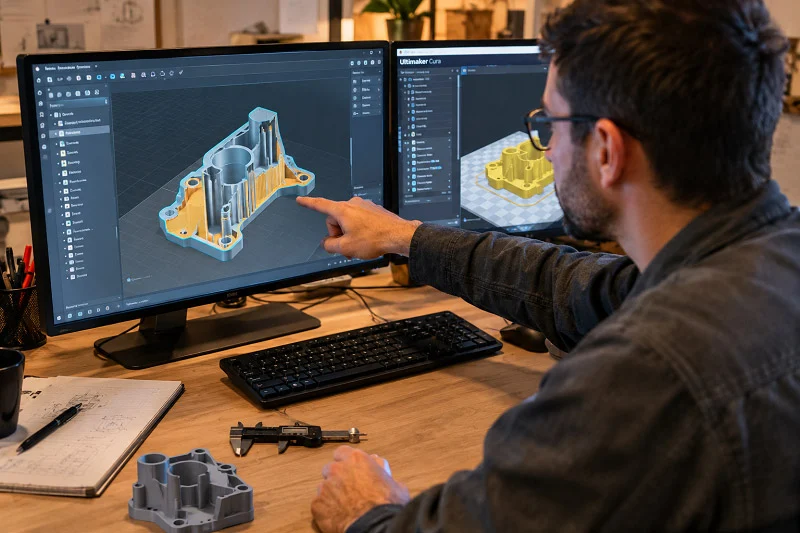
PVC earns its place in a design when the part needs chemical resistance, electrical insulation and flame behavior at commodity-plastic cost — and when the service temperature stays modest.
On cost, unfilled rigid PVC-U sits at 4/5 on a relative cost scale where 5 is the lowest cost per kilogram among common molding plastics, level with ABS and PA66 and below PC, PBT and the high-performance polymers. Its acid resistance is rated 5/5, the top of that scale, and it resists many bases, salts, fats and alcohols as well as diesel fuel and nitric acid below 70% concentration. Strong concentrated acids above about 60°C can attack it. PVC also behaves as an electrical insulator and is described as flame-resistant because it is self-extinguishing, which is why equipment housings and electrical components are a natural fit.
The limits are equally specific. PVC resists service temperatures up to about 60°C and begins to degrade on exposure to high heat; above roughly 82°C it can deform under load. Overheating decomposes the material into by-products including hydrochloric acid, which is corrosive to tooling and aggressive to the people and equipment around it. Flexible grades can lose mechanical properties over time, and rigid PVC without UV resistance degrades in sunlight — clear PVC may yellow with long-term sun exposure, although painting can add a protective coating.
Those properties map onto recognizable industries. Building and construction consumes molded PVC as pipe fittings, valves, window profiles and gutters. Electrical and industrial applications use it for housings and enclosures. Healthcare uses plasticized and rigid compounds for tubing, anesthesia masks, oxygen masks and catheters. Consumer goods draw on it for handles, enclosures, furniture components and light shades. What goes wrong in each of these is usually the same failure: a design or a process that treats PVC like a generic commodity resin and ignores its thermal ceiling.
The PVC Injection Molding Process, Step by Step
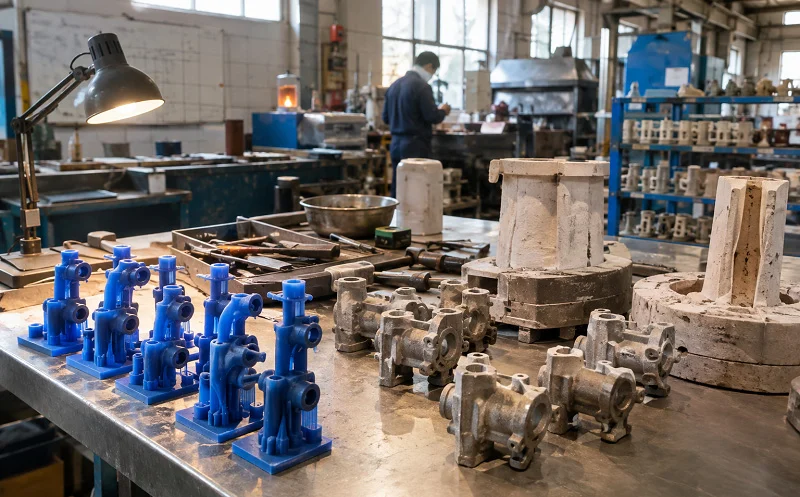
PVC injection molding follows the standard molding cycle — prepare, melt, inject, pack, cool, eject — but with tighter control of temperature, shear and residence time than most commodity plastics demand. The stages below are where that control is won or lost.
Ontwerpoorsig en Materiaalkeuse
Before a mold is cut, the part geometry, the grade (rigid, modified, CPVC or flexible), the shrinkage allowance and the gate and vent locations are settled together, because they constrain one another. PVC shrinkage is relatively low compared with many plastics — commonly quoted at 0.2% to 0.5% — but the exact value depends on the grade and on processing conditions, so the tool should be designed around the specific compound’s data rather than a generic figure. Gate position matters more than usual here: it determines where weld lines form and how much shear the melt sees on the way in.
Drying and Material Preparation
Rigid PVC does not usually require drying, because the resin does not readily absorb moisture. Surface moisture can still collect on pellets in hot, humid conditions, and if it is not removed the parts may show cosmetic defects. Where drying is needed, processing guidance calls for a low-temperature, short-duration cycle — roughly 49–66°C for about two hours — and storing material covered in a cool, dry place reduces the need for it altogether. Flexible and CPVC compounds may carry different recommendations and should be checked against the compound datasheet.
Machine Setup and Barrel Considerations
Barrel capacity ratings are quoted in ounces of polystyrene, which has a specific gravity of about 1.0, while rigid PVC typically runs 1.3 to 1.4. A barrel rated at 80 ounces of polystyrene therefore holds roughly 105 ounces of PVC, and shot weight should generally use 50% to 80% of capacity — a low shot weight on a long cycle leaves material sitting in the barrel and degrading. A bimetallic barrel, with a chemical- and wear-resistant inner layer over a stronger steel sleeve, gives better protection than a single-layer nitrided barrel, though properly maintained nitrided barrels are commonly used. Temperature controllers should be proportional solid-state units capable of holding setpoints precisely; variable transformers and on/off relay control are not adequate for rigid PVC.
One rule overrides all others: PVC and acetal must never meet at processing temperature. Small amounts of acidic vapor from PVC catalyze rapid depolymerization of acetal, generating formaldehyde gas, which in turn produces more hydrochloric acid in an accelerating reaction that can end in a violent release of gas. The two materials belong on separate machines; if that is impossible, purge thoroughly with general-purpose ABS, acrylic or another recommended purging compound and mechanically clean the barrel and screw.
Melting, Injection and Packing
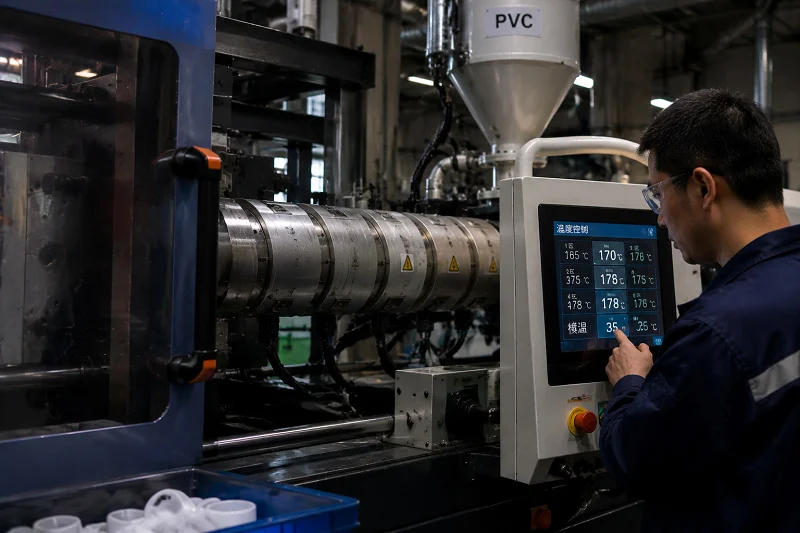
The target is the highest feasible melt temperature that does not degrade the compound. For rigid molding formulations, published guidance puts the ideal melt range at roughly 199–207°C, with other sources citing melt temperatures up to about 195°C depending on grade. Verify the actual melt with a calibrated needle-probe pyrometer on an air shot rather than trusting the controller: a smooth, glossy melt indicates a good homogeneous temperature, a dull melt suggests it is too cold, and a rough surface points to excessive temperature or moisture. Injection should run at moderate speed, and packing at the minimum pressure that fills out mold detail. Over-packing with excessive hold pressure or time raises molded-in stress, which is detrimental to physical properties. A small cushion of material must be maintained ahead of the screw to compensate for shrinkage as the part cools under hold pressure.
Cooling, Ejection and Post-Processing
Rigid PVC formulations are usually run with mold heater-coolers between 4°C and 49°C. Higher mold temperatures generally improve surface appearance, material flow, weld-line integrity and part stress; cooler molds shorten the cycle. Running the B half of the mold cooler than the A half usually makes ejection easier. High pumping rates with minimal line and coupler restrictions improve temperature control in the tool.
Clean runners, trim and short shots can be reground and blended with virgin material. A regrind range of 10% to 25% is recommended, although higher percentages up to 100% are used in non-UL applications. Grinding generates significant heat, so regrind should be cooled below 66°C before storage to prevent degradation.
Purging and Shutdown
A machine should never be shut down with rigid PVC in the barrel, because the material degrades on prolonged exposure to processing temperature without moving. Pull the injection unit back from the mold and purge with natural general-purpose ABS, styrene, acrylic regrind or an approved purging compound. Polyethylene and polypropylene are not suitable: they are immiscible with PVC and cause delamination in finished parts. If a cycle interruption is expected to last longer than about 15 minutes, pull the unit back and make occasional air shots to keep material moving.
Hot runner systems need the same discipline. Channels should be streamlined with minimal flow-direction changes, the melt volume in the runners should stay below the part volume, and the system must be purged on any interruption or shutdown. The press should be capable of purging through the hot runner with the mold open, and the manifold and drop temperatures should be verified with a handheld pyrometer.
Choosing the Right PVC Grade: Rigid, Flexible and CPVC

Grade selection follows from three questions in order: what temperature the part must survive, what chemicals it must resist, and how much stiffness or flexibility the application needs. Cost and processing capability come after those.
Rigid PVC (PVC-U) and Modified PVC (PVC-M)
Rigid PVC is dense, hard and impact-resistant, with good chemical resistance and the highest strength in the family. PVC-U has an ultimate tensile stress of around 52 MPa at 20°C and is typically used up to about 60°C, though the real limit depends on stress and environment. Modified grades (PVC-M) trade some stiffness for impact performance, which is the usual choice where a part must survive handling or field damage. Typical work includes pipe fittings, valves, window profiles and housings.
Flexible (Plasticized) PVC
Plasticizers reduce the forces between polymer chains and increase chain mobility, which is what turns a rigid compound into a soft, elastic one. Across PVC grades generally, the property range this produces is very wide: tensile strength at yield spans roughly 3.45 to 73.1 MPa and elongation at break 2% to 330%. The trade-off is durability. Flexible PVC can lose material properties over time, and the plasticizer system affects both the feel of the part and its long-term performance, so the compound datasheet matters more here than in any other PVC family.
CPVC (Gechlorineerde PVC)
Chlorination raises the chlorine content and with it the heat ceiling. CPVC processes at roughly 170–200°C, against about 150–180°C for PVC, and the higher thermal load demands more robust stabilization to prevent dehydrochlorination and discoloration. Heat deflection figures are usually quoted in the context of piping cell classes under ASTM D1784: generic CPVC with a 23447 cell class carries a heat deflection temperature of 212°F (100°C), while a higher 24448 cell class reaches 230°F (110°C), with a typical maximum operating temperature around 200°F. Those are cell-class figures for pipe compounds, not a blanket rating for every CPVC molding grade. CPVC’s resistance to corrosive fluids makes it a common choice in chlor-alkali service — ultrapure brine, sodium hypochlorite, anolyte and catholyte handling — where metal piping is incompatible with the process fluid.
Pas Graad by Toepassing aan
Work through the requirements in sequence. Start with the maximum service temperature and the chemical exposure list; that alone usually separates PVC-U from CPVC. Then set the stiffness and impact requirement, which decides between rigid, modified and plasticized grades. Then confirm that the chosen compound can actually be molded into the part geometry — thin, complex walls may need a high-flow formulation that not every supplier stocks. Cost comes last, because a grade that fails in service is expensive at any price. Representative unfilled values are a starting point for comparison, never a substitute for the compound datasheet.
How PVC Compares With Other Injection Molding Plastics
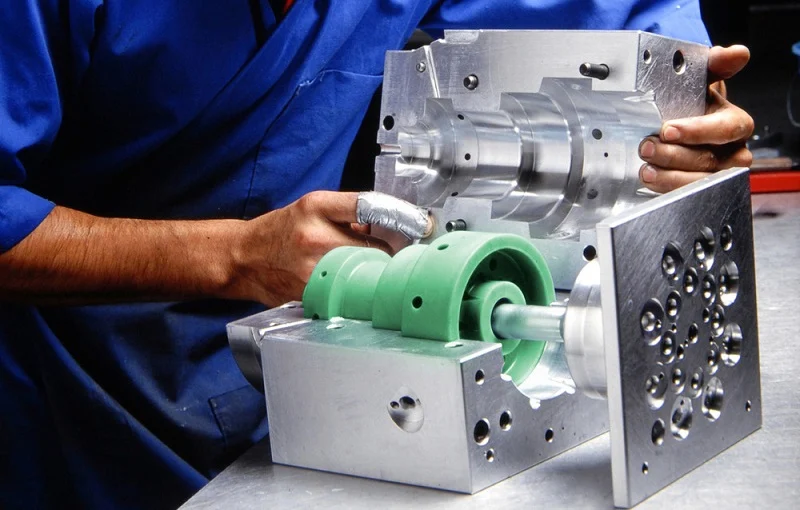
PVC’s position is best read on a like-for-like basis: unfilled injection molding grades compared on density, tensile strength, heat deflection, chemical resistance, moldability and relative cost. The table below draws on representative midpoints for unfilled grades; filled, reinforced, foamed or specialty grades differ significantly, and the compound datasheet governs any actual selection.
| materiaal | Digtheid (g / cm³) | Treksterkte (MPa) | HDT by 1.8 MPa (°C) | Suurweerstand | Vormbaarheid | Relatiewe koste |
| PVC-U (rigid) | 1.38-1.40 | 55 | 70 | 5/5 | 3/5 | 4/5 |
| ABS | 1.02-1.06 | 45 | 80 | 3/5 | 5/5 | 4/5 |
| PP (homopolymer) | 0.899-0.92 | 35 | 60 | 4/5 | 5/5 | 5/5 |
| HDPE | 0.941-0.965 | 28 | 55 | 5/5 | 4/5 | 5/5 |
| PC | 1.19-1.22 | 65 | 130 | 3/5 | 3/5 | 3/5 |
| PA66 | 1.13-1.15 | 82 | 90 | 2/5 | 4/5 | 4/5 |
| LOER | 1.30-1.32 | 100 | 160 | 5/5 | 2/5 | 1/5 |
Representative midpoints for unfilled injection molding grades. HDT measured at 1.8 MPa load (ISO 75). Acid resistance rated 1–5, where 5 is best. Values are typical for common grades and differ for filled, reinforced or specialty compounds; the compound datasheet governs selection.
Representative midpoints for unfilled injection molding grades. HDT measured at 1.8 MPa load (ISO 75). Resistance, mouldability and cost rated 1–5, where 5 is best and 5 on cost means lowest cost per kilogram among the materials listed. Filled and specialty grades will differ.
Against the polyolefins, PVC is denser and slightly more expensive per kilogram than PP or HDPE, but it brings markedly better flame behavior and, for rigid grades, higher tensile strength — 55 MPa against 35 MPa for PP and 28 MPa for HDPE. Acid resistance is comparable at the top of the scale. Where a part is a simple, low-cost, chemically exposed container, a polyolefin is often the more economical answer; where flame resistance and rigidity matter, PVC’s premium is easier to justify.
Against ABS, the comparison turns on cost and fire. Both sit at 4/5 on relative cost, but PVC-U has the higher acid rating (5/5 versus 3/5) and self-extinguishing behavior, while ABS is easier to mold (5/5 versus 3/5) and has a somewhat higher heat deflection temperature (80°C versus 70°C). For an enclosure that must resist chemicals and not sustain a flame, PVC has the edge; for a cosmetic housing with complex geometry and no chemical exposure, ABS is the simpler process.
Against engineering and high-performance plastics, PVC loses on heat and gains on cost. PC deflects at 130°C, PA66 at 90°C and PEEK at 160°C, against 70°C for PVC-U, and PEEK also matches PVC’s 5/5 acid rating while adding 5/5 solvent resistance and a 250°C service temperature. PEEK costs far more (1/5 on relative cost) and is harder to mold (2/5). The decision is rarely close: PVC is for parts that live at modest temperatures, and a high-temperature or solvent-heavy environment should push the design toward an engineering or high-performance polymer regardless of PVC’s cost advantage.
Against CPVC, the difference is a temperature ceiling rather than a category. CPVC buys roughly 40–50°C of additional thermal headroom in piping compounds, at the cost of a narrower and more demanding processing window. Where hot corrosive fluid is involved, that headroom is the whole point; where it is not, standard PVC is easier to run and usually cheaper.
PVC Injection Molding vs Other Manufacturing Processes
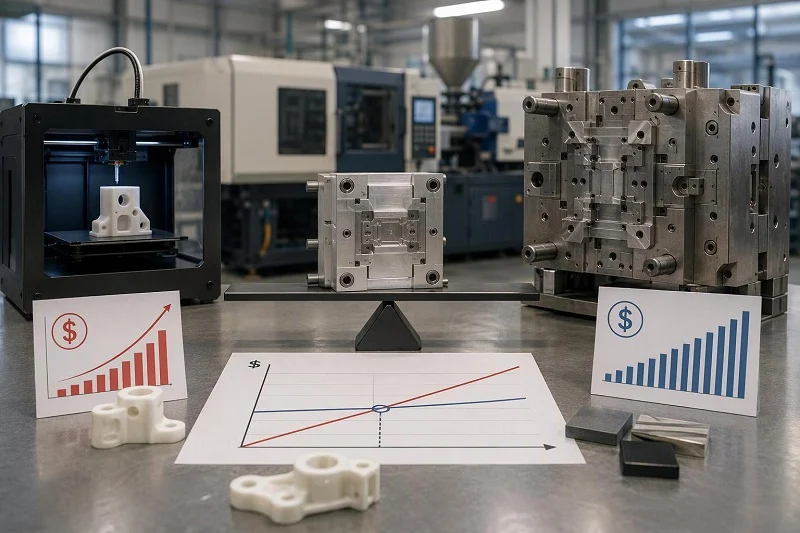
The process choice depends on annual volume, part geometry, wall uniformity and tolerance — not on which process is intrinsically better. PVC can be formed by several routes, and each one wins in a different regime.
PVC Injection Molding vs CNC bewerking
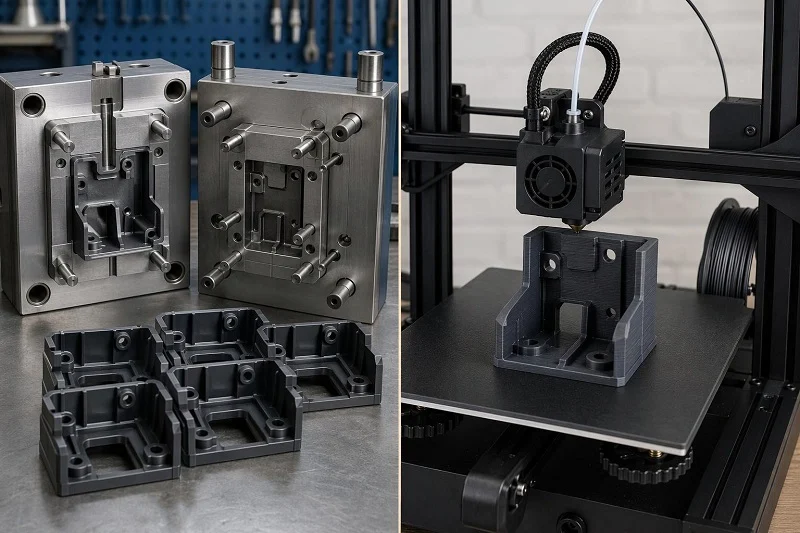
Machining cuts a part from solid stock with no tooling investment, which makes it the faster and cheaper route at very low volumes, for large simple shapes, and for prototypes that will change. It is limited by the shapes a cutter can reach and by the cost of removing material from every part. Injection molding requires a steel mold, but that investment is amortized across the production run, and the process reproduces complex detail, integrated features and tight repeatability that machining cannot match at volume. For a PVC part that will be made in the thousands, molding is usually the lower total cost; for ten pieces, machining usually is.
PVC Injection Molding vs Blaasvorming
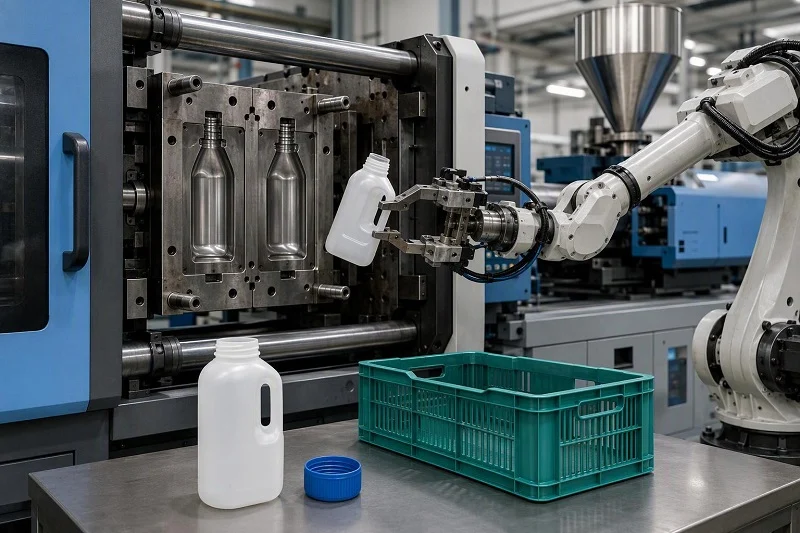
Blow molding forms a hollow part by inflating a tube of melted resin inside a mold cavity. It is the right process for bottles, containers and other thin-walled hollow bodies. Injection molding produces solid, detailed components — fittings, housings, valve bodies, precision parts — with wall sections, bosses and features that a blown parison cannot form. A hollow PVC container belongs in blow molding; a PVC fitting with a threaded bore and a molded-in stop belongs in injection molding.
PVC Injection Molding vs Extrusion
Extrusion pushes melt continuously through a die to produce a constant cross-section: pipe, profile, sheet, tubing. It cannot produce a discrete three-dimensional part with varying section along its length. Injection molding produces exactly that. The two processes are often partners rather than competitors in PVC work — a pipe system typically combines an extruded pipe with injection-molded fittings, each made by the process that suits its geometry.
PVC Injection Molding vs thermo
Thermoforming heats a plastic sheet until it is pliable and forms it over or into a mold. Tooling can be inexpensive enough to amortize over a short run, which makes it attractive for large panels and low-to-medium volumes, and it handles parts that would need an impractically large injection mold. Injection molding delivers tighter tolerances, integrated features such as bosses and snap fits, and better economics at high repeat volumes. A large, simple, shallow PVC cover may be cheaper to thermoform; a small, feature-dense, high-volume component is a molding job.
'n Praktiese Seleksie-raamwerk
Ask five questions in order. What is the annual volume — enough to amortize a mold? How complex is the geometry — does it need side actions, bosses, undercuts or fine detail? How uniform are the walls, and can the design be adjusted toward uniformity? What tolerances and surface finish does the part actually need? And what tooling budget is available up front? The answers usually point to one process without much debate; when they conflict, volume and geometry normally decide.
Preventing Common PVC Injection Molding Defects
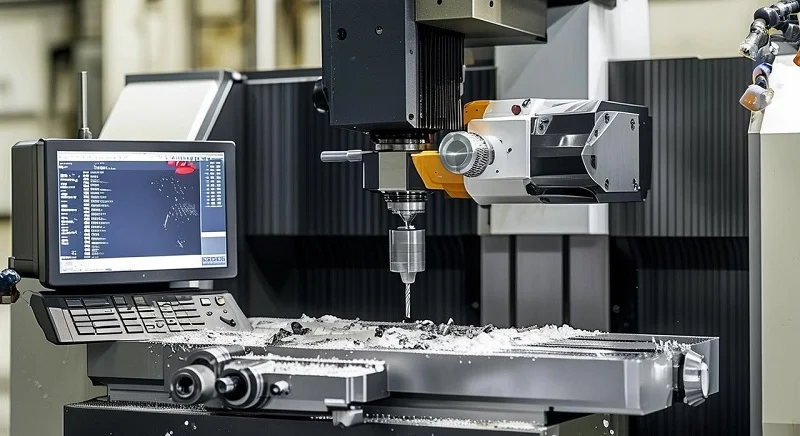
Most PVC molding defects trace back to one of two causes: thermal degradation from excessive heat or residence time, or shear from restricted flow. The specific defects below are the common expressions of those two problems.
Brandmerke en verkleuring
Overheated or over-sheared PVC dehydrochlorinates, releasing hydrochloric acid and discoloring the part. The usual causes are excessive melt temperature, long residence time in the barrel, restricted gates and runners, and hot spots in the heating system. Controls start with verification: pull an air shot and measure the melt with a calibrated needle-probe pyrometer rather than trusting the controller setpoint. Streamline flow paths to eliminate dead spots, keep shot weight within the recommended share of barrel capacity, and purge on any interruption. A smoking or frothy melt during air shots is an early warning that the melt temperature is too high.
Short Shots and Incomplete Fill
A short shot means the cavity did not fill, and the causes are usually insufficient injection pressure to overcome resistance in thin areas, injection speed that is too slow, melt temperature that is too low, trapped air, or a wall so thin the material solidifies before it arrives. Thin-walled complex parts may need a higher-flow formulation than a standard fitting compound. Sink-mark location is a useful diagnostic: sink marks away from the gate generally indicate that more injection pressure or time is needed, while sink marks near the gate point to more hold pressure or time.
Sink Marks, Warpage and Molded-In Stress
Sink marks, warpage and molded-in stress all come from the relationship between packing, cooling and shrinkage. Insufficient material, low injection pressure, low packing and hold pressures, short packing and hold times, and short cooling times each produce sink. Over-packing is not the fix: excessive hold pressure or time on second-stage injection raises molded-in stress and can damage physical properties. Once the gates have frozen off, hold pressure should be reduced. Design-side prevention means uniform wall thickness, gradual transitions and a sensible rib-to-wall ratio.
Weld Lines and oppervlak
Weld lines form where melt fronts meet, and their quality depends on melt temperature, mold temperature, injection speed, venting, packing pressure and gate location. Higher mold temperatures generally improve weld-line integrity and surface appearance, and adjusting gate positions can move a weld line away from a cosmetic or structural surface. Poor venting shows up as both weak knit lines and burn marks, so vents belong on the maintenance checklist.
Corrosion and Mold Maintenance
Hydrochloric acid residue from processing corrodes molds, whatever their metallurgy. Spraying the mold cavity surfaces with a low-moisture neutralizer is inexpensive and is the best defense: for best overall tool life, neutralize once per 24-hour day, and any tool must be neutralized at least once a week. Spray all mold surfaces and runner blocks, paying particular attention to the sprue bushing and hard-to-reach spots; the neutralizer also protects against fingerprint acids and other corrosive agents in the molding environment. Vents must be cleaned thoroughly and kept free of rust preventative, dirt and material build-up before every run, and water flow through the tooling should be checked at the same time.
Design Rules for PVC Injection Molding Parts
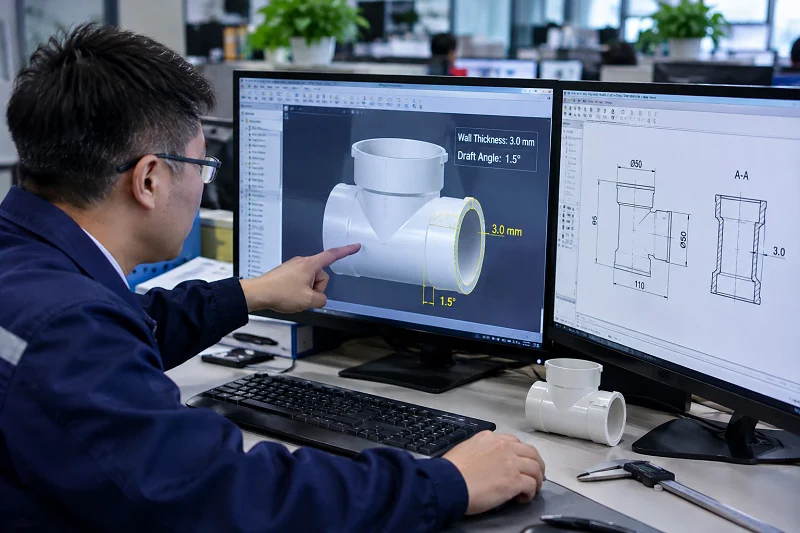
PVC follows standard design-for-manufacturing rules, with extra attention to wall uniformity and heat management because the material punishes both thick sections and restricted flow.
Wall Thickness and Transitions
Keep wall thickness as uniform as the part allows. Where a thicker section is unavoidable, transition gradually from thin to thick — transitions greater than 10% to 15% of nominal wall thickness are best avoided. Commonly cited minimum wall thickness for injection-molded PVC falls in the range of roughly 1.27 to 6 mm, with other guidance putting the practical ideal between 1.2 and 3.5 mm. These are general practice ranges rather than a PVC-specific requirement; thick walls invite sink marks, warping and long cycles, while walls that are too thin risk weak parts or incomplete filling.
Ontwerphoeke en uitwerping
Draft is the taper applied to vertical walls so the part releases cleanly. Commonly cited draft for PVC parts is 0.5% to 1%, with a minimum of 1–2 degrees on vertical surfaces and 3–5 degrees where surfaces are textured; the longer the part, the more draft it needs. Polished mold surfaces ease ejection and reduce the draft required, and running the B half of the mold cooler than the A half further helps release.
Radii, Fillets and Stress Concentration
Sharp corners are harder to mold and concentrate stress, which can lead to part failure in service. Apply radii to inside and outside corners of at least 25% of wall thickness, and use a radius equal to about 75% of wall thickness where maximum part strength matters.
Gates, Runners and Vents
Gate and runner design controls shear, and shear is the particular concern with PVC. Restricted gates, long restrictive nozzles and abrupt flow-direction changes all raise shear heating and the risk of degradation, so the melt delivery system should be streamlined with generous gate diameters and no stagnant areas. Venting deserves equal attention: trapped air produces burn marks and short shots, and blocked vents are a common cause of both. Gate location also sets where weld lines land, which matters for both cosmetics and strength.
Shrinkage, Tolerances and Material Data
PVC shrinkage is relatively low — commonly quoted at 0.2% to 0.5% — but the exact value depends on grade and processing conditions, and uneven cooling causes warpage. Reducing wall thickness and gate area helps limit the risk. Tolerances are a cost driver: tighter or finer tolerances require stricter mold and processing requirements and therefore cost more. For design values, work from the specific compound datasheet rather than generic tables, and confirm shrinkage with the molder before the tool is cut.
Choose NOBLE for Your PEEK Injection Molding Project
NOBLE is a China-based contract manufacturer and a Sino-British joint venture that has been recognized by the government as a “National High-Tech Enterprise.” Our “Smart Manufacturing” division specializes in providing project support services for parts machining and manufacturing. With over a decade of experience, NOBLE helps customers efficiently complete the entire process—from prototyping to mass production—through one-stop, customized manufacturing solutions.
For injection molding projects involving high-performance polymers such as PEEK, as well as machining needs for other materials like PVC, NOBLE’s service capabilities and specialized machining expertise can help you advance your projects efficiently. We are certified to ISO 9001:2015 and ISO 13485:2016, with a quality management system that covers every stage from prototyping to mass production.
NOBLE offers a full range of services from design to assembly—not just production. Our comprehensive capabilities span design, prototyping, and mass production of parts, supported by a complete set of inspection equipment and an integrated quality control system to ensure prototypes and components are manufactured with high precision and in full compliance with specifications. Regarding lead times and quotes, thanks to our advanced CNC software and team of experienced engineers, parts can be produced quickly within 7–10 days; Once you submit an RFQ containing the necessary information, we can provide a professional quote within 24 hours.
If your project involves PEEK injection molding or other high-performance materials, please feel free to discuss specific specifications, tolerances, and production volume requirements with us. We will evaluate feasible process routes and delivery solutions based on your actual needs.
FAQs of PVC Injection Molding
Can PVC actually be injection molded, and what makes it difficult?
Yes — rigid PVC is injection molded in large volumes, but it is one of the more demanding commodity thermoplastics because it degrades when held too long at melt temperature or subjected to high shear. Successful production depends on streamlined melt delivery, verified melt temperatures around 199–207°C for rigid molding compounds, moderate injection speeds, and purging on any interruption.
Should I specify rigid, flexible or CPVC for my part?
Start with temperature and chemical exposure, then stiffness and impact. Rigid PVC-U gives the highest strength and good chemical resistance up to about 60°C; PVC-M trades some stiffness for impact; flexible PVC adds elasticity but can lose properties over time; CPVC raises the heat ceiling to roughly 100–110°C heat deflection in higher piping cell classes and suits corrosive fluids such as those in chlor-alkali service.
How does PVC compare with ABS, PP and PEEK on the properties that matter?
On representative unfilled grades, PVC-U has higher acid resistance than ABS (5/5 versus 3/5) and is self-extinguishing, while ABS is easier to mold and deflects at a higher temperature (80°C versus 70°C). PP and HDPE are cheaper and easier to mold but have lower tensile strength and no comparable flame behavior. PEEK outperforms PVC on heat (160°C HDT, 250°C service) and solvent resistance but costs far more and is harder to mold.
When should I choose molding over machining, blow molding, extrusion or thermoforming?
Choose injection molding when volume can amortize a steel mold and the part needs complex, repeatable three-dimensional detail. Machining suits low volumes and simple shapes; blow molding is for hollow containers; extrusion is for continuous constant-cross-section profiles such as pipe; thermoforming suits large, shallow parts and short runs where tooling cost dominates.
How do I prevent burn marks, discoloration and short shots?
Burn marks and discoloration come from thermal degradation and shear: verify melt temperature with a needle probe, streamline runners and gates, keep shot weight within 50–80% of barrel capacity, and purge on interruptions. Short shots usually mean insufficient pressure or speed, cold melt, trapped air or walls that are too thin — check venting and consider a higher-flow formulation for thin, complex parts.
What design rules apply to walls, draft, fillets, gates and vents?
Keep walls uniform within roughly 1.27–6 mm and transition gradually (no more than 10–15% of nominal wall). Use 0.5–1% draft, or 1–2 degrees minimum, with 3–5 degrees on textured surfaces. Apply corner radii of at least 25% of wall thickness, and about 75% for maximum strength. Size gates generously to limit shear, and keep vents clean and open to prevent burn marks and incomplete fill.
What does NOBLE offer for prototyping and volume production?
NOBLE is a China-based contract manufacturer, a Sino-British joint venture recognized as a National High-tech Enterprise, certified to ISO 9001:2015 and ISO 13485:2016. We provide a full service chain from design to assembly rather than production alone, with rapid lead times of 7–10 days and quotes returned within 24 hours of a complete RFQ — including support for projects involving high-performance polymers such as PEEK alongside PVC work.