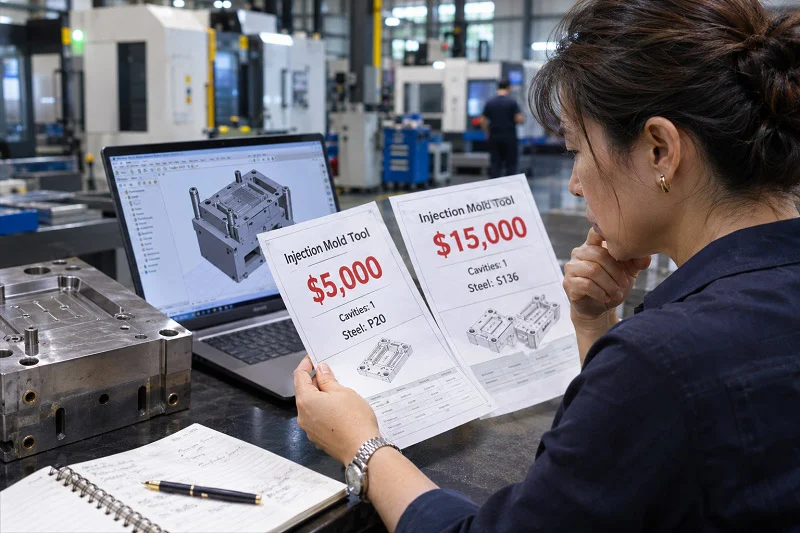
A mold quote that comes in 40 percent below the others usually isn’t a bargain, and the supplier with the thickest brochure isn’t automatically the safest pair of hands. Most buyers learn this the hard way — after the tool is cut, the parts are late, and the tolerances have drifted in a way nobody can quite attribute. The problem is rarely bad intent. It’s that the evaluation was made on presentation rather than evidence.
This guide is written for the buyer who has to make that call: the product developer sourcing a mold for a new program, the OEM moving from prototype into production, or the engineer handed a shortlist and told to “pick one.” It covers the four things that actually determine whether a mold p roject succeeds — capability, cost, quality and supplier fit — and shows how to test each one with evidence you can obtain before you sign.
Hoekom Inspuiting Mould Quotes Differ So Much — and How to Normalize Them
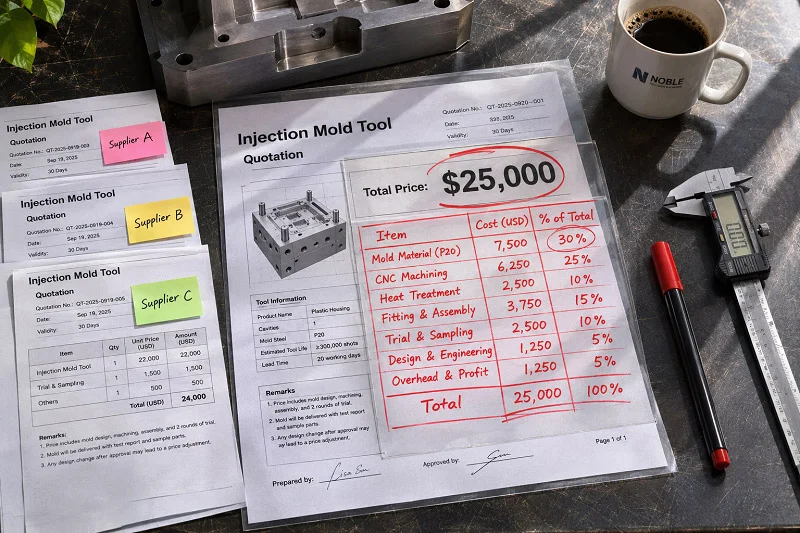
Two quotes for the same part can differ by a factor of three or more, and in most cases neither supplier is being dishonest. The gap usually reflects different scopes: a tool built for a few thousand trial parts and a tool built for a million-shot program are different products that happen to share a drawing. Before treating a wide spread as evidence of overcharging, buyers should identify what each price actually buys, then normalize the quotes so the remaining difference is real.
The Main Cost Drivers Behind a Mold Quote
Cavitation and mold size come first. Going from a two-cavity to an eight-cavity mold rarely quadruples the price, because the base, plates and engineering are shared across cavities; a common rule of thumb puts the increase at roughly 2.2 to 2.8 times the two-cavity cost. Steel grade and hardness are the next lever: moving from a standard pre-hardened grade such as P20 to a harder grade such as S7, or to stainless, can shift steel and machining cost by roughly 25 to 40 percent. Hot-runner systems, side actions and lifters each add cost of their own, commonly in the range of USD 4,000 to 15,000 per feature depending on complexity.
Complexity beyond the basic open-and-close tool — slides and lifters, collapsing cores, unscrewing mechanisms, three-plate or hot-manifold systems, sequenced ejection — adds design and machining hours that a simple tool does not carry. Surface finish and polishing requirements, tight part tolerances and the inspection burden they create, the number of trial iterations and correction loops allowed for, and the engineering hours assigned to DFM review and mold flow analysis all move the price as well. Each of these drivers also moves performance: a cheaper tool typically buys a shorter life, a less forgiving process window, or fewer correction rounds before the supplier starts charging for changes.
Using SPI Mold Classes to Compare Like with Like
The Society of the Plastics Industry — now the Plastics Industry Association — established mold standards and classifications in the late 1970s to give purchasers a common reference and to level the playing field among toolmakers. The system is still widely cited in RFQs to specify minimum levels of tool construction and to compare competing offers.
| Vormklas | Verwagte vormlewe | Produksievlak | Tipiese gebruik |
| Klas 101 | 1,000,000 XNUMX+ siklusse | Uiters hoog | Long-term, very high-volume production |
| Klas 102 | Tot 1,000,000 siklusse | Medium–hoog | High-volume production, abrasive resins, close-tolerance parts |
| Klas 103 | Onder 500 000 siklusse | Medium | Algemene produksieprogramme |
| Klas 104 | Onder 500 000 siklusse | Laagte | Limited-volume production |
| Klas 105 | Tot 500 siklusse | Prototipe | Prototype and development tooling |
Two limits matter when using the table. First, the cycle figures are approximate and for comparison only; mold life cannot be guaranteed because part design and molding conditions vary. Second, the SPI classifications are not design standards. They do not dictate gating, runner systems or specific materials of construction, and they do not by themselves constitute a guarantee of quality or workmanship. A Class 102 tool from one shop and a Class 102 tool from another can still differ in execution, so the class is a starting point for comparison, not a substitute for assessing the toolmaker.
A Quote Normalization Checklist
Normalization means putting every quote on the same basis before comparing totals. Work through the following items for each quote:
- Part revision and drawing. Confirm every supplier quoted the same drawing revision, material and tolerance callouts.
- Same number of cavities, stated explicitly.
- Mold class and steel. Same SPI class, same steel grade and hardness.
- Runner system. Same hot-runner versus cold-runner scope, including controller and manifold responsibility.
- Oppervlakafwerking. Same polish specification and texture standard.
- Trial and FAI deliverables. Same number of trial rounds, same first-article inspection package, same sample quantity.
- Design responsibility. Who performs DFM, mold flow analysis and mold design, and whether that work is included.
- Versendingsvoorwaardes. Same Incoterms and delivery point.
- Betalingsvoorwaardes. Same milestone structure, since financing affects the price a supplier can offer.
- Warranty and spare parts. Same warranty period and same scope for spare inserts, wear parts and maintenance support.
When two quotes are placed on this common basis, most of an apparent gap usually closes. What remains is the genuine difference in price for equivalent scope — and that is the number worth negotiating over or using to decide which injection mold manufacturers to shortlist.
Comparing Injection Mold Manufacturers by Region: Cost and Quality Trade-offs
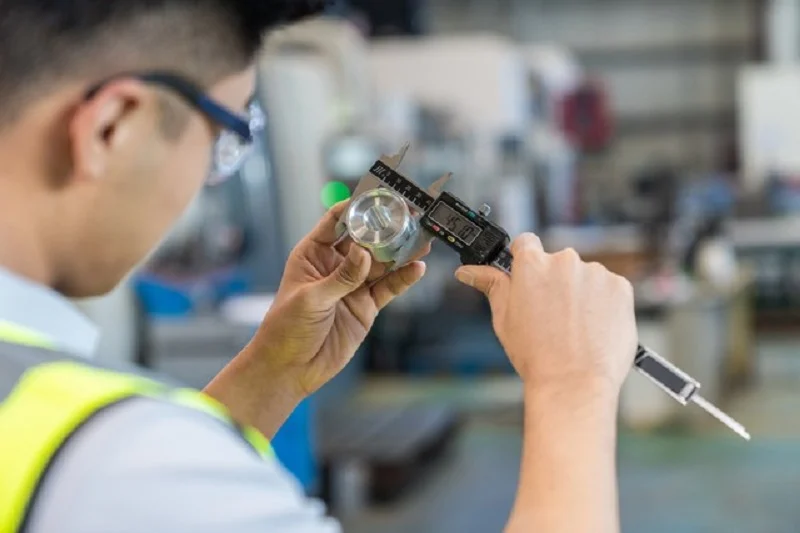
Region tells you something about the cost structure an injection mold manufacturer is likely to operate within. It tells you much less about whether a specific plant can hold your tolerances, document its work and deliver on schedule. Use regional comparison to set expectations and narrow a shortlist, then let evidence from individual injection mold manufacturers decide the award.
What Drives Regional Cost Differences
Mold pricing is built from a handful of structural inputs, and regions differ in how those inputs combine rather than in any single dominant factor.
Bekwame arbeid. Mold making depends on toolmakers, programmers, EDM and grinding operators, and mold-trial technicians. Where a deep pool of these skills exists, wages are set by competition for that pool; where it is thin, injection mold manufacturers either pay a premium or train internally at their own cost. Both outcomes appear in the quote.
Steel and component supply. Mold bases, cavity steel, hot-runner systems, ejector components and standard parts are internationally traded, so the raw material line in a quote is often similar across regions. What differs is availability and lead time. A supplier near a dense tooling cluster can source a mold base or a replacement insert in days; a supplier far from one carries more inventory or waits, and either way the cost lands somewhere.
Energy and floor space. Machining centers, EDM and heat treatment draw significant power, and mold shops need floor area for assembly, spotting presses and trial machines. Regions with lower industrial energy and property costs can run these operations more cheaply, which shows up in overhead recovery rather than in any single line item.
Tooling-cluster depth. The most consequential difference is whether a supplier sits inside a cluster of mold makers, heat treaters, texturing shops, polishing specialists and trial-molding services. Cluster depth lowers transaction costs, shortens correction loops and makes it easier to subcontract a single operation without losing schedule control. It also raises the local wage floor, so the two effects partly offset.
Logistics and distance to the customer. Freight, insurance, customs clearance and travel for audits and trial attendance are real costs. For heavy tooling, ocean freight and handling can be a meaningful share of the tooling budget, and air freight for a late mold is far more expensive than the schedule slip it is trying to fix.
As one illustration of how large wage differences can be, average hourly earnings of production and nonsupervisory employees in U.S. manufacturing were $30.43 in October 2026, seasonally adjusted, according to the U.S. Bureau of Labor Statistics series published via FRED. That figure covers a broad manufacturing category at national level. It is not a mold-making wage, it says nothing about productivity or overhead, and it should not be used to estimate any individual supplier’s cost. Its only use here is to show that labor is priced very differently across regions, which is one reason identical drawings attract different quotes.
Matching Region to Project Type: Prototype, Medical, Automotive, High-Volume
The right regional profile depends on what the tool has to do.
Prototype and Bridge Tooling
Speed and low tooling cost dominate. A supplier that can quote quickly, cut a single-cavity tool in a low-cost region and ship parts by air may be the cheapest route to a design decision. The trade-off is that prototype tooling is often built to a lower SPI class with shorter life, so it should not be assumed to carry into production. Confirm the intended cycle life before treating a prototype quote as a production baseline.
mediese
Certification scope and traceability outweigh tooling price. ISO 13485:2016 is tailored to the regulatory and safety requirements of the medical device industry and places greater emphasis on risk management and process validation than ISO 9001, according to ISO’s description of the standard. A supplier whose quality system covers mold making but not the molding of your device components may still be a poor fit. In the United States, the Quality Management System Regulation that took effect on February 2, 2026 incorporates ISO 13485:2016 by reference, per the FDA’s QMSR page, so the standard’s relevance to U.S. market access has increased rather than diminished. Region matters here mainly through the density of injection mold manufacturers who already operate under that discipline.
Automotive
Program management, PPAP discipline and change control carry more weight than a few percent on tooling price. Suppliers accustomed to automotive program cadence will have documented trial milestones, capability studies and a formal corrective-action process. A low-cost region with thin automotive experience can erase its price advantage in launch delays.
Hoëvolume produksie
Mold life, maintenance access and total cost of ownership dominate. A tool built to a high SPI class in a region with good spare-parts and service access will usually outperform a cheaper tool that requires long-distance repair. Cycle time also matters more at volume, because a small difference in cycle compounds across millions of parts.
In every case, region is a proxy, not a verdict. A well-run plant in a low-cost region can outperform a poorly run plant in a high-cost one. The regional comparison narrows the list; the audit and the trial decide it. The later section on OEM/ODM supplier selection sets out how to weigh these factors formally.
Total Cost of Ownership Versus Unit Price
Comparing regions on tooling price alone systematically favors distant, low-cost injection mold manufacturers and then surprises the buyer later. A defensible comparison puts every cost that varies by region into one model.
| Koste-element | Wat om in te sluit | Why region changes it |
| Tooling price | Mold, hot runner, texture, spares | Labor and overhead structure |
| Onderdeelprys | Material, cycle time, scrap rate, packaging | Labor, energy, machine rates |
| Vrag en versekering | Inbound and outbound, mode, consolidation | Distance and weight |
| Duty and fees | Tariff classification, applicable duties, brokerage | Oorsprong van die goedere |
| Voorraaddrakoste | Pipeline and safety stock | Veranderlikheid van transitotyd |
| Travel and communication | Audit trips, trial attendance, time-zone overlap | Distance and working hours |
| Rework and downtime risk | Expected scrap, correction loops, line stoppage | Process capability and response speed |
| End-of-life transfer | Packing, freight, refurbishment of the tool | Distance and tool condition |
Two of these deserve particular attention.
Eerstens, origin treatment. Country-of-origin marking and origin rules can change landed cost and compliance obligations, so confirm how your destination market will treat the goods before you compare quotes. U.S. non-preferential origin rules, for example, use a substantial-transformation test for goods made from materials originating in more than one country, as described by the Internasionale Handelsadministrasie, and U.S. imports are subject to country-of-origin marking requirements under 19 CFR Deel 134. A mold cut in one country from steel sourced in another, with parts molded in a third, can raise questions that a simple price comparison never surfaces. Confirm the treatment that applies to your product and destination rather than assuming it.
Tweede, volume assumptions. Tooling cost per part depends heavily on the quantity over which it is amortized. A tool priced at $90,000 spread over 3,000,000 parts contributes $0.03 per unit, but the same tool over 300,000 parts contributes $0.30, according to an analysis of tooling economics. That arithmetic is a straightforward division and holds regardless of region, which is exactly why a regional comparison built on optimistic volumes is unreliable. Anchor amortization to committed quantities or a conservative share of forecast, and state the assumption in the comparison so a shortfall is visible rather than silent.
Once tooling, part price, freight, duty, inventory, travel and risk are in one model, regional differences often shrink. The remaining gap is usually explained by capability, schedule reliability and the cost of managing distance — which is precisely what the audit and contract sections address.
How to Audit Injection Mold Manufacturers: Documents Versus the Shop Floor
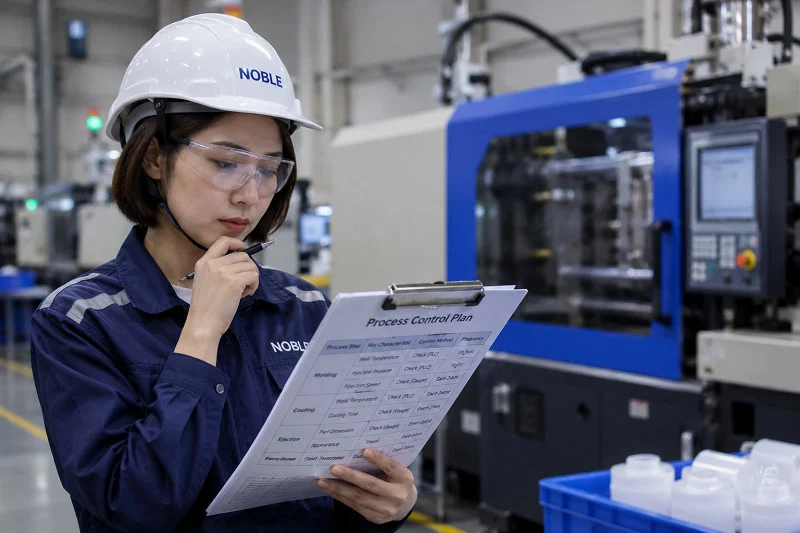
An audit of injection mold manufacturers works best as two tracks that check each other. The document track establishes what the supplier says its system is: which processes are controlled, which sites are covered, how calibration and corrective action are recorded. The shop-floor track establishes what actually happens on a given Tuesday. Run only the first, and you reward good paperwork; run only the second, and you may miss systemic gaps that a single clean walk cannot reveal. The sequence that holds up is: request documents before the visit, walk the process on site, verify measurement capability with a live demonstration, and close with an interview that reconciles what you saw against what you were sent.
Documents to Request Before the Visit
Ask for the pre-visit set early enough to read it, not skim it in the lobby. The core package:
- Certificates with full scope statements and site lists. A certificate is only meaningful for the activities, products and sites it names. ISO’s own auditing guidance is explicit that a customer must be able to discern the certification scope, and that this scope should define the types of products and services provided and the main operational processes — design, manufacture, packaging, delivery — as applicable at each physical site (ISO/IAF guidance). If your molds will be cut at a plant not listed, the certificate does not cover that work.
- A quality manual summary and process map, so you know which processes the supplier claims to control and where inspection sits in the flow.
- 'n Organisasiekaart with named quality, engineering and program-management contacts, and the reporting line of quality.
- A machine list with tonnage, tie-bar spacing, platen size and controller type for each press, plus the same for EDM, CNC, wire and grinding equipment.
- Kalibrasie rekords for the gauges and CMMs used on your critical dimensions, with current status and due dates.
- Sample first-article inspection (FAI) reports from comparable jobs, ideally with the drawing or model they refer to.
- Corrective-action examples — two or three real 8D or equivalent records showing root cause and verification of effectiveness, not just containment.
- An approved-supplier list for critical subcontractors: heat treatment, texturing, plating, polishing, steel supply.
- Sample PPAP or FAI packages if your industry requires them, so you can judge documentation depth before committing.
What to Observe on the Shop Floor
The walk is where documents are corroborated or contradicted. Watch for signals that are hard to fake at short notice:
- Housekeeping and material segregation. Steel stored on racks with legible identification tying each block to a job; inserts and electrodes kept apart; no mixed resin or regrind bins without labels.
- Maintenance tags on machines. A press with a current tag and a visible maintenance log suggests a schedule exists. A press with a tag dated two years ago suggests the schedule is decorative.
- Calibration stickers and dates on gauges. Check the sticker against the calibration record you were sent. A gauge in daily use with an expired sticker is a finding.
- In-process inspection stations. Are there defined checkpoints with written criteria, or does inspection happen only at final?
- Hot-runner controllers. Look at setpoints, alarms and whether controllers are matched to the tool; sloppy thermal management shows up later as cosmetic defects.
- Steel storage and identification, including traceability from the mill certificate to the block.
- EDM and polishing areas. Electrode management, burn parameters and polishing benches tell you how much of the finish work is in-house.
- Nonconforming-part segregation. A locked or clearly marked red area with a log is a good sign; nonconforming parts sitting on a bench next to good ones is not.
Verifying Measurement Capability in Person
Documents can list a CMM; only a demonstration shows whether it is available, staffed and used for the dimensions you care about. During the audit:
- Ask for a live measurement of a known feature on a part or artifact you bring, or on one of their tools with a drawing you can read. Watch the setup, the alignment and the report generation.
- Check gauge calibration status on the specific instruments used for your critical dimensions, and confirm the calibration lab or provider is identified.
- Review CMM programs and reports for a comparable job: probe qualification records, alignment method, and whether the report states the datum scheme and tolerance.
- Confirm availability and staffing. Ask who runs the equipment on each shift, whether it is shared with production, and what the queue looks like. A CMM that exists but is booked for weeks is not capacity you can rely on.
Close the audit by reconciling findings with the supplier and agreeing which items become contractual commitments — a topic covered in the contract section below.
Contract Terms That Protect the Buyer

A mold contract is not a purchase order with extra pages. It is the document that decides who owns the tool, who pays when a trial fails, and what happens when you want to move the mold to another molder in three years. Most disputes in tooling projects do not arise from bad faith; they arise from clauses that were never written because both parties assumed the other understood the arrangement the same way. The terms below are the ones that carry the most weight, and each should be drafted so that it can be enforced in practice, not merely cited after a problem appears.
Enforceability, remedies and the formalities required for a valid assignment vary by jurisdiction. The guidance here is jurisdiction-neutral and describes what the contract should address; a local attorney should confirm how those terms will be treated under the governing law you select.
Tooling Ownership, Marking and Transfer
The contract should state plainly that the buyer owns the mold, including the mold base, cavities, cores, hot-runner system, inserts and any fixtures built specifically for the program. Ownership should be established at the point of payment for the tooling, not at the end of the program, and it should survive termination of the supply relationship for any reason.
Ownership language alone is weak protection. What makes it real is a transfer procedure. Specify that the mold carries a permanent identification plate with the buyer’s name, the mold number, the cavity count and the date of manufacture, and that the molder will not remove or obscure it. Require that on request the molder delivers the tool together with the records that make it usable elsewhere: final mold drawings, a cavity layout, the steel certificates, the hot-runner controller settings, the process sheet from the approved trial, and any mold-flow or simulation files produced for the project. Define the conditions of transfer — notice period, settlement of outstanding invoices, a defined packing and shipping standard, and who bears freight and insurance. A transfer clause that does not say who pays to move a two-ton mold, or in what condition it must arrive, leaves the buyer negotiating from weakness at the worst possible moment.
IP, Confidentiality and Design Data
Separate two questions that are often merged: who owns the product design, and who owns the manufacturing data. The buyer should retain ownership of product designs, drawings, CAD models, specifications and any simulation outputs commissioned for the project. The molder should retain ownership of its own generic know-how and standard tooling designs, but not of project-specific mold designs created for the buyer’s part.
Confidentiality obligations should cover drawings, volumes, pricing and the existence of the project, and should extend to the molder’s subcontractors and employees. Include an express prohibition on using the buyer’s tooling, designs or cavity inserts to produce parts for any other customer, and on displaying the buyer’s parts in marketing material without written consent. On termination, require return or certified destruction of design data, with a written confirmation, and address backup copies and any data held by subcontracted shops.
Payment Milestones, Acceptance and Warranty
Tie each payment to a deliverable the buyer can verify rather than to a calendar date. A workable structure is a deposit on order, a payment on design freeze and steel receipt with documentation, a payment on approval of trial samples, a payment on first-article inspection acceptance, and a final balance on shipment or on receipt of the tool at the buyer’s facility. Each milestone should name the evidence that releases it.
Acceptance criteria belong in the contract, not in a later email. Reference the drawing revision, the dimensional report, the cosmetic standard, the SPI mold class and the trial sample approval. State what happens when a trial fails: who bears the cost of the correction, how many trial rounds are included, and what constitutes a reasonable limit before the parties revisit scope. Warranty terms should distinguish the tool from the parts — a typical tooling warranty covers workmanship and materials for a defined period or cycle count, while a part warranty covers conformance to specification. Address downtime and rework explicitly: if a mold failure stops the buyer’s line, the contract should say whether the molder bears expediting costs, and within what limits.
Maintenance, Spare Parts and Change Control
Define who performs preventive maintenance, at what interval, at whose cost, and what records are kept. A mold that runs for years without a documented maintenance schedule will fail earlier than its class suggests, and the buyer will have no basis to attribute the failure. Specify the terms for replacement inserts, wear parts and spare cavities, including lead times and pricing basis, so that a worn core does not become a renegotiation.
Change control is where tooling budgets most often break. Establish a written engineering change process: a change request, a quoted cost and schedule impact, written approval before work begins, and a re-qualification step that defines which inspections and trial samples are repeated. State who bears the cost of a change caused by the buyer’s design revision and who bears it when the change corrects a molder error. Without that distinction, every change becomes a negotiation, and the schedule absorbs the delay.
Choosing Injection Mold Manufacturers for OEM/ODM Projects from Prototype to Mass Production
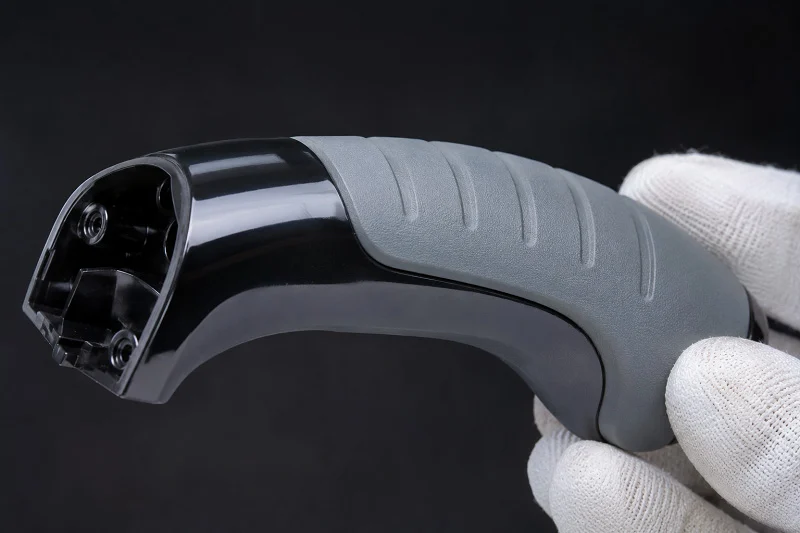
An OEM/ODM program asks more of a mold supplier than a single tool order does. The supplier you choose at the prototype stage will still be in the picture when the product reaches volume, so the decision has to be made on the supplier’s ability to carry the program, not just on the mold it can build this quarter. The practical approach is to screen for program-level capability first, score the shortlist on evidence rather than brochures, and then plan the prototype-to-production transition as a managed handoff with its own acceptance criteria.
Criteria Beyond Mold-Making: DFM, Documentation and Scalability
Mold-making skill is necessary but not sufficient. Three additional capabilities determine whether an OEM/ODM supplier can carry a program from prototype to mass production.
DFM support before tool design. Design-for-manufacturing feedback is most valuable before the tool is cut, when a wall thickness, draft angle, gate location or parting-line decision can still be changed cheaply. Mold flow analysis serves this purpose: it connects product design, DFM review, tooling development and mass production, and it is far less costly than correcting a problem after the production mold is complete, when fixes may require additional machining, welding, polishing or even tooling redesign (vormvloei-analise). Ask a prospective supplier what DFM output you will receive, who reviews it, and whether the review happens before or after the quotation is fixed. A supplier that only quotes the drawing you sent has not yet added engineering value.
Documentation discipline across stages. OEM/ODM programs accumulate documents: DFM reports, tool design reviews, trial reports, dimensional data, process settings, change records. The risk is not that documents are missing at any one stage but that the prototype record and the production record do not connect. Ask to see a sample program file and check whether the same part number, revision and critical-dimension list run through it. If the prototype was documented against one drawing revision and the production tool against another, the transition will be built on an unrecorded design change.
Scalability without re-learning the part. A supplier that can run bridge or prototype tooling and then production tooling in the same facility keeps the part knowledge in one place. That matters because process settings, gating decisions and dimensional history developed on the prototype tool inform the production tool. Where the two stages sit with different injection mold manufacturers, that knowledge has to be transferred explicitly or it is lost.
A Weighted Selection Scorecard
A scorecard turns the criteria in this guide into a comparable decision. Score each shortlisted supplier from 1 to 5 in each category, weight the categories for your program, and multiply. Complete it only with evidence gathered from the RFQ response, the audit and reference checks — not from marketing material.
| kategorie | What the score reflects | Bewysbron |
| Vermoë en kapasiteit | Machine envelope, cavitation, mold size range, in-house versus subcontracted operations | RFQ response, shop-floor audit |
| Precision and metrology | Stated tolerances, CMM and inspection equipment, FAI report quality | Sample FAI report, in-person measurement check |
| aflewering | Lead-time breakdown, trial milestone plan, track record on comparable programs | Quoted schedule, references |
| Certification and quality system | Certificate scope and sites, relevance to your industry | Certificate copy, independent verification |
| Kommersiële terme | Quote normalization, tooling ownership, payment and warranty terms | Quotation, draft contract |
| Programbestuur | Named contact, DFM process, change control, reporting cadence | Audit interview, references |
| Totale koste van eienaarskap | Tool life, maintenance, spare parts, transfer cost, unit price at volume | Quote analysis, maintenance terms |
Weighting should follow the program. A medical device program should weight certification and metrology heavily, because ISO 13485 is specifically tailored to the regulatory and safety requirements of the medical device industry and emphasizes regulatory requirements, risk management and process validation more than ISO 9001 (Die ISO 13485: 2016). A high-volume consumer program should weight tool life and total cost of ownership, since a Class 101 mold is rated for 1,000,000+ cycles while a Class 105 prototype mold is rated for up to 500 (SPI-vormklassifikasies). A program with an aggressive launch date should weight delivery and program management. Record the weighting before scoring so the result is not reverse-engineered to a preferred supplier.
Managing the Transition from Prototype Tooling to Production Tooling
The handoff between prototype and production tooling is where OEM/ODM programs most often lose time. Four risks account for most of the damage.
Design changes between stages. Prototype testing frequently produces a design change. If the change is not formally released before the production tool is designed, the tool will encode the old design. Freeze the design revision, document every change with a date and approver, and confirm that the production tool design review references the frozen revision.
Tool-life differences. A prototype tool and a production tool are built to different standards and different expected lives. The SPI classes make the gap explicit: Class 105 is intended for prototype and development tooling with an expected life of up to 500 cycles, while production classes run from under 100,000 cycles at Class 104 to 1,000,000+ at Class 101. Note that mold life cannot be guaranteed because it varies with part design and molding conditions, and the cycle figures are approximate rather than a warranty. Treat the class as a specification of construction intent, and confirm the expected life for your part and resin in writing.
Process settings that do not transfer. Settings developed on the prototype tool — injection speed, hold pressure, cooling time, melt temperature — are tied to that tool’s geometry and cooling layout. They are a starting point for the production tool, not a validated process. Plan a fresh process development and validation cycle on the production tool.
Re-qualification requirements. The production tool needs its own first-article inspection and, where the program requires it, capability data. Build re-qualification into the schedule and budget rather than assuming the prototype approval carries over.
A transition checklist keeps the handoff visible:
- Frozen design revision confirmed and referenced in the production tool design review
- All changes since prototype documented with date, approver and effect on the tool
- Production tool class and expected life stated in writing
- Prototype process settings handed over as reference data, not as a validated process
- Production tool FAI and capability study planned with acceptance criteria agreed in advance
- Tool ownership, marking and transfer terms confirmed before the production tool is ordered
- Spare parts, maintenance schedule and change-control procedure agreed for the production phase
If you would rather run prototyping, tooling and production through a single partner rather than manage this handoff between injection mold manufacturers, the section that follows sets out how NOBLE supports injection mold projects from design through assembly.
Choosing NOBLE to Support Your Injection Mold And Manufacturing
The earlier sections of this guide describe how to test a supplier’s equipment, precision claims, delivery commitments, certifications, pricing logic and contract terms. This section applies that same framework to NOBLE, so you can judge whether we fit your program rather than take the introduction on trust.
NOBLE is a Sino-British joint venture, recognized by the government as a “National High-tech Enterprise,” with more than 10 years of experience in custom manufacturing and rapid prototyping. Our “Smart Manufacturing” business provides project-support services covering parts machining and manufacturing. For buyers comparing injection mold manufacturers, the relevant question is whether that experience translates into a partner who can carry a program from design intent through to assembled, inspected parts.
Een Vennoot van Ontwerp tot Montering
Most OEM and ODM programs lose time at handoffs: the design house finishes, the toolmaker starts, the molder takes over, and an assembly vendor receives parts that no longer match the original intent. Each transfer creates a new set of drawings, a new interpretation of tolerances and a new party to hold accountable when something drifts.
NOBLE is structured to reduce those transitions. We provide a full scope of service from design to assembly — not production alone. In practice, that means design support, prototyping, machining and manufacturing, and assembly can sit within one workflow with consistent documentation and one point of accountability. When a dimensional issue appears at first article, the same organization that reviewed the design and built the tool is the one resolving it, rather than a chain of injection mold manufacturers negotiating responsibility.
For programs moving from prototype tooling to production tooling, this continuity matters most. The process knowledge gathered during prototyping — shrinkage behavior, gate and runner decisions, tolerance risk areas — stays with the project instead of being relearned by a new vendor at T0.
Certification and Quality System Support
NOBLE holds ISO 9001:2015 and ISO 13485:2016 certification. The two certificates serve different purposes, and it is worth being precise about each.
ISO 9001:2015 is the general quality management standard, applied across manufacturing, aerospace, pharmaceuticals and other sectors. Certification involves an audit by an independent certification body that evaluates the organization’s management system against the standard. It indicates a documented, auditable approach to process control, corrective action and continual improvement.
ISO 13485:2016 is written for organizations involved in the design, production, installation and servicing of medical devices and related services. It is the quality management system standard referenced for regulatory purposes in that field, and since February 2, 2026 the U.S. Quality Management System Regulation has incorporated it by reference, aligning FDA CGMP requirements with the international standard.
Two practical notes follow from the verification guidance earlier in this guide. First, a certificate’s scope statement defines which activities, products and sites are covered; confirm that your specific process — toolmaking, molding, assembly, or all three — falls inside it. Second, certificates can be checked independently through the issuing certification body or the IAF CertSearch database. We expect serious buyers to do both, and we will supply current certificates and scope details on request.
Beyond certification, our quality control relies on in-house test and measurement equipment and IQC, IPQC and FQC/OQC inspection stages in production, applied according to customer requirements.
How to Start: RFQ and Quotation Process
A quotation is only as useful as the information behind it. To price a mold and molded parts accurately, we need:
- Drawings or 3D models with critical dimensions and tolerances marked, plus any surfaces or features that are cosmetic rather than functional.
- Materiaal spesifikasie, including grade and any regulatory or flammability requirements.
- Verwagte volumes — annual forecast, committed quantity and expected program life, since these determine the appropriate mold class and cavitation.
- Teikentydlyn, including when you need first articles versus production quantities.
- Dokumentasie vereistes — first-article inspection reports, capability data on critical dimensions, material certificates, or traceability records.
With a complete RFQ, NOBLE can typically provide a professional quotation within 24 hours. Our in-house engineering and CNC capability supports rapid turnaround, with many parts completed in 7–10 days. Those figures describe our standard capability; your actual lead time depends on part complexity, tooling scope and current capacity, and will be confirmed in the quote.
If your project involves injection molds, molded components or a program that must run from prototype through assembly, send the drawings and volume assumptions through our RFQ channel at uprojectspartner.com. We will tell you plainly whether the work fits our capabilities — and if it does not, we will say so rather than stretch the scope.
FAQs about Injection Mold Manufacturers
How do I turn “high precision” into measurable acceptance criteria in an RFQ and on a first-article report?
Start by listing the characteristics that actually govern fit, function and assembly, then assign each one a tolerance, a measurement method and an acceptance rule. “High precision” becomes usable only when it reads like this: bore diameter 12.000/12.018 mm, measured on a coordinate measuring machine at 20 °C, three sections per bore, all readings within limits. Name the instrument class, the datum scheme and the sampling plan in the RFQ so that every bidder prices the same inspection burden.
The first-article inspection report should then close the loop. Require a ballooned drawing in which every numbered characteristic maps to a measured value, the instrument used, and a pass or fail judgment. Ask for the material and color certificates, the process sheet from the trial, and a signed statement of any characteristic that was not measured. A report that lists only nominal and actual values without the drawing balloons cannot be audited, and a supplier who resists ballooning is telling you something about how the tool will be documented later.
How do I normalize two mold quotations that appear to cover different scopes?
Build a comparison sheet with one row per scope element and fill it from each quote rather than from the cover price. The rows that most often explain an apparent gap are: part drawing revision and material, cavitation and mold class, steel grade and hardness for cavity and core, hot-runner brand and whether it is included, side actions and lifters, surface finish standard, trial samples and corrections included, first-article documentation, design responsibility, mold flow analysis, packaging, Incoterms, payment schedule and warranty period.
Where a quote is silent, mark it as excluded rather than assumed included, and send a clarification request that asks the bidder to confirm the element and its price separately. Once both quotes are expressed against the same revision and the same mold class, the residual difference is the real commercial gap — and it is usually smaller than the headline numbers suggested.
Which cost drivers explain a large gap between the lowest and highest mold quote?
Cavitation and mold size come first, because more cavities mean more steel, more machining hours and a larger base. Steel grade and hardness follow: a hardened tool steel for a long-run cavity and core can add a substantial share to steel and machining cost compared with a general-purpose grade. Hot-runner systems, side actions and lifters each add both components and engineering time. Surface finish requirements, especially high-polish or textured cavities, add hand work that is difficult to automate.
Then come the softer drivers: engineering hours for DFM and mold flow, the number of trial iterations included, inspection depth, and the documentation package. A low quote frequently reflects a lower mold class, a smaller cavitation count, or a reduced scope — fewer trials, no flow analysis, minimal documentation — rather than greater efficiency. Ask each bidder to state the SPI class and the included deliverables; that single question usually explains most of the spread.
How should regional cost and quality differences be weighed for prototype, medical, automotive and high-volume projects?
Weight the region against the project type rather than treating it as a single ranking. For prototypes and bridge tooling, speed of communication, tooling cost and the willingness to run low volumes matter most, and a nearby supplier with fast trial turnaround can outweigh a lower headline price. For medical work, the deciding factors are the certification scope, traceability and the ability to support validation documentation; the region matters only insofar as it affects those. For automotive programs, quality-system discipline, program management and change control carry more weight than unit price. For high-volume production, mold life, maintenance access and the cost of service visits over several years dominate.
In every case, a specific plant’s demonstrated capability outweighs its region. Two injection mold manufacturers in the same country can differ more than two injection mold manufacturers in different countries, so use regional averages only to set expectations and then verify the individual factory.
What should I verify in documents versus observe on the shop floor during a factory audit?
Documents answer whether the system exists and is maintained: certificates with their scope statements and site lists, calibration records and certificates for the gauges used on your part, corrective-action records with root causes and closure evidence, first-article reports from comparable jobs, and maintenance logs for the machines that will run your tool. Read a sample rather than a summary, and check dates and signatures.
The shop floor answers whether the system is actually used. Look at housekeeping and material segregation, maintenance tags on machines, calibration stickers on gauges with dates that match the records, in-process inspection sheets being filled in at the press, and a clearly marked area for nonconforming parts. The two tracks must corroborate each other: a calibration certificate for a gauge that carries an expired sticker, or a corrective-action record for a defect you can still see in the scrap bin, is a more useful finding than either document or observation alone.
Which contract clauses protect tooling ownership, IP, maintenance and payment milestones?
Tooling ownership should be stated explicitly, together with the marking of the tool with your identifier, the conditions under which the tool may be moved, and the procedure and cost of transfer to another molder. IP and confidentiality clauses should cover drawings, CAD data, mold flow results and any process knowledge generated during the project, and should survive the end of the contract. Maintenance clauses should set the interval, who performs it, what spares are held, and how wear parts are replaced and charged.
Payment milestones work best when each one is tied to a verifiable deliverable: design freeze, steel order, trial sample approval, first-article acceptance, and final buy-off. Pair them with written acceptance criteria and a warranty period that starts at production approval rather than at shipment. Add change control, so that any drawing revision triggers a documented quotation and approval, and an exit provision covering data return and tool transfer. Enforceability depends on the governing law and jurisdiction, so have the final wording reviewed locally.
How do I choose a mold supplier for an OEM/ODM project that must run from prototype through mass production?
Work through the decision in sequence rather than trying to compare injection mold manufacturers on impression. Define the requirements first: annual and lifetime volumes, mold class, critical tolerances, documentation and certification needs, and the target date for production approval. Issue a normalized RFQ so that every bidder answers the same questions, then audit the shortlisted factories against both documents and shop floor.
Score the survivors against weighted criteria that reflect your project — mold-making capability, DFM and engineering support, quality system and documentation, delivery record, communication, and the cost of ownership over the program life. Check references on comparable programs, then negotiate the contract terms covering tooling ownership, IP, maintenance and milestones. Finally, plan the transition from prototype tooling to production tooling explicitly: who owns the prototype tool, whether the production tool is built from the same design data, and how the process is validated between the two. Suppliers who can carry documentation and process knowledge across that transition are the ones worth committing to for the full program.