Introduction
As many people know, fast cutting usually kills precision. High quality drives cost through the roof. It feels like a trade-off every time. Waterjet cutting just doesn’t play that game. It gives you both. A pump pushes water to extreme pressure—up to 90,000 psi. Then it blasts through a tiny hole. You add garnet abrasive to that stream. That mixture cuts through any metal like a hot knife through butter, but without the heat. No melted edges. No hardened zones. That’s why shops use it everywhere now.
Let’s be direct. If you make metal components for robots, cars, or factory machines, this method solves real problems. You keep the material’s original structure intact. You hold tight tolerances, part after part. You switch from thin shims to a six-inch steel plate without changing tools. That versatility is hard to beat.
How Abrasive Waterjet Cutting Works for Metals
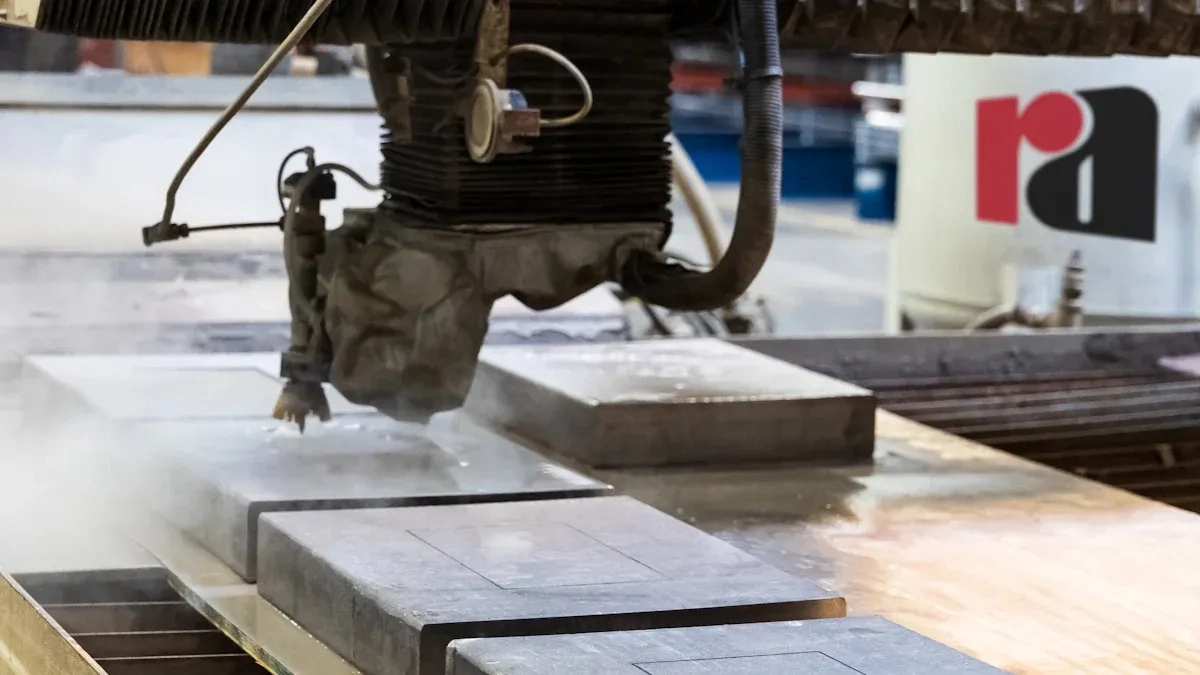
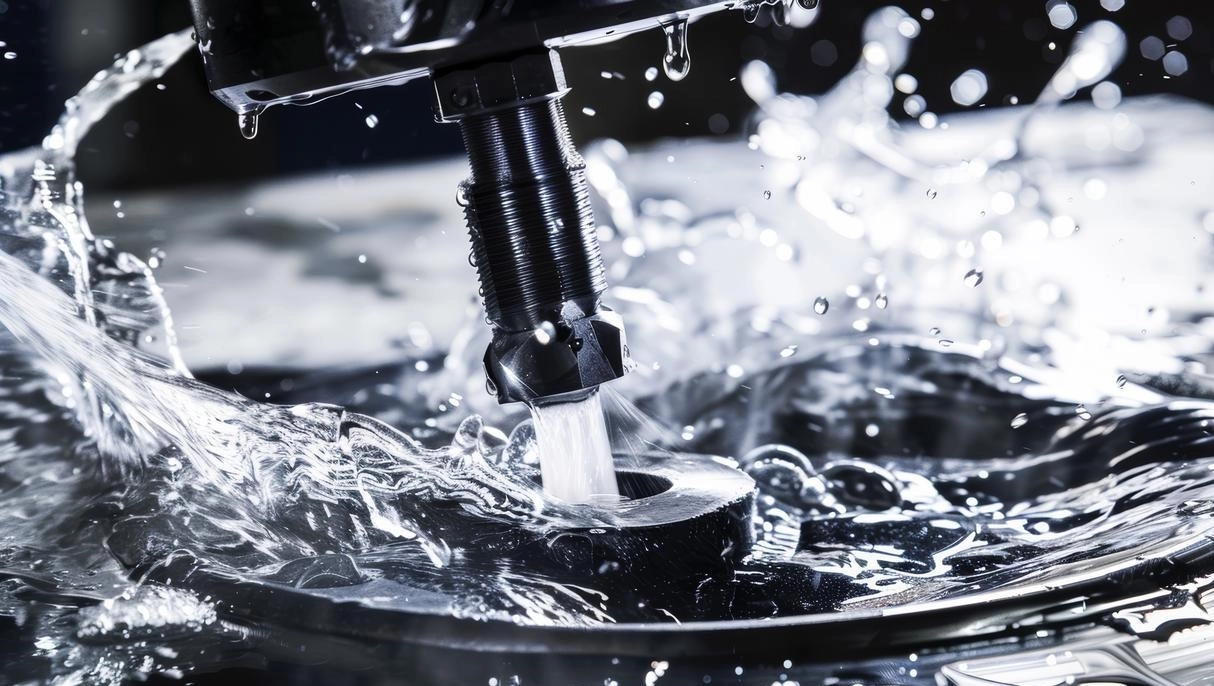
Here’s how the machine actually cuts metal. A pump pushes water to insane pressure—between 60,000 and 90,000 psi. That water shoots through a tiny orifice, maybe 0.01 inches wide. Then, the garnet abrasive gets pulled into the stream inside a mixing tube. The water accelerates those sharp particles. What hits the metal isn’t water. It’s a high-speed sandblaster moving at twice the speed of sound.
The cutting action is pure erosion. Each abrasive particle takes off a microscopic chip. No heat builds up. No melting occurs. The metal’s internal structure stays exactly as it was before the cut started.
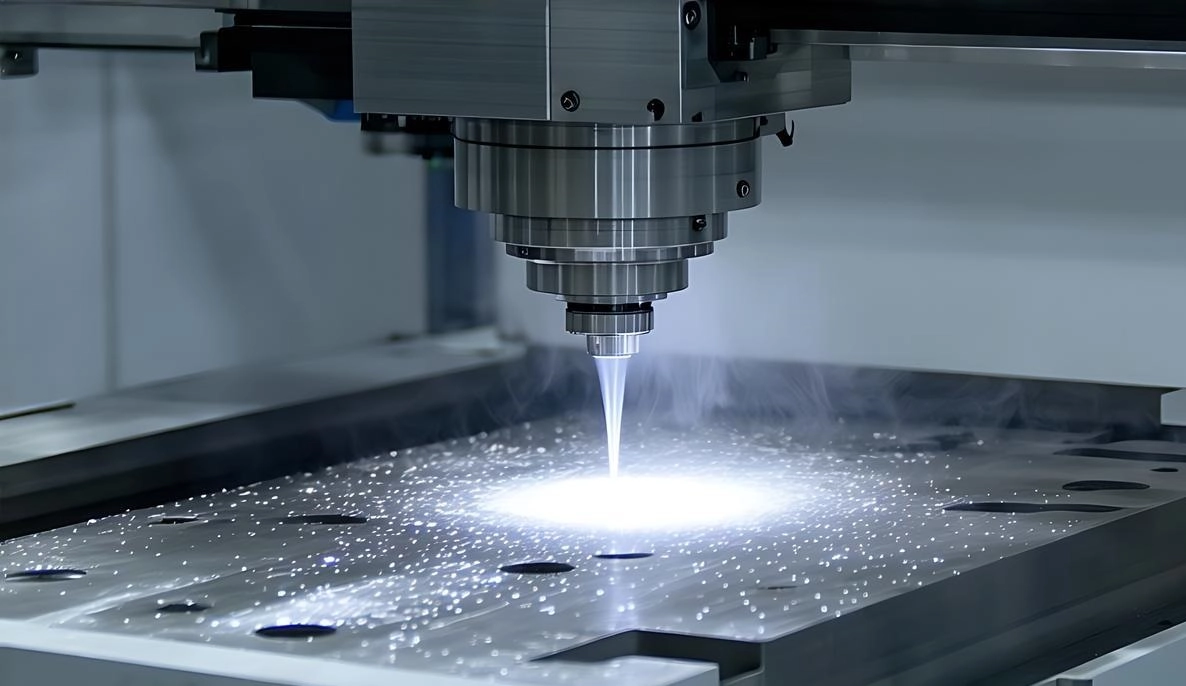
Now look at the alternatives. Laser cutting uses a focused beam of light. It melts through the material. That heat creates a heat-affected zone, or HAZ. The edges get hard and brittle. Sometimes you have to rework them.
Plasma cutting is faster on a thick plate, but the finish is rough. You get significant HAZ as well. The edge might need grinding before welding.
CNC milling gives you precision. No argument there. But for a large plate, it’s slow. The tool travels back and forth, cutting a narrow kerf. You also wear out end mills. A waterjet just keeps going through the same nozzle for hours.
Key Advantages for Metal Component Manufacturing
Let’s get into the real advantages. These matter on the shop floor.
No Heat Affected Zone
Lasers and plasma generate heat. That heat causes problems. Thin metals warp. Hardened steels lose their temper. Micro-cracks form along the cut edge. You might not see them, but they’re there.
Waterjet avoids all of this. The cutting action is pure mechanical erosion. A particle hits the metal and removes a tiny chip. No heat builds up. The material’s internal structure—grain boundaries, hardness, temper—stays exactly as it was before the cut started.
This matters for real parts. Think about an aerospace bracket. Or a robotic arm link, or any component that needs welding after cutting. A heat-affected zone creates weak points. Waterjet leaves nothing to worry about.
Cuts Any Metal
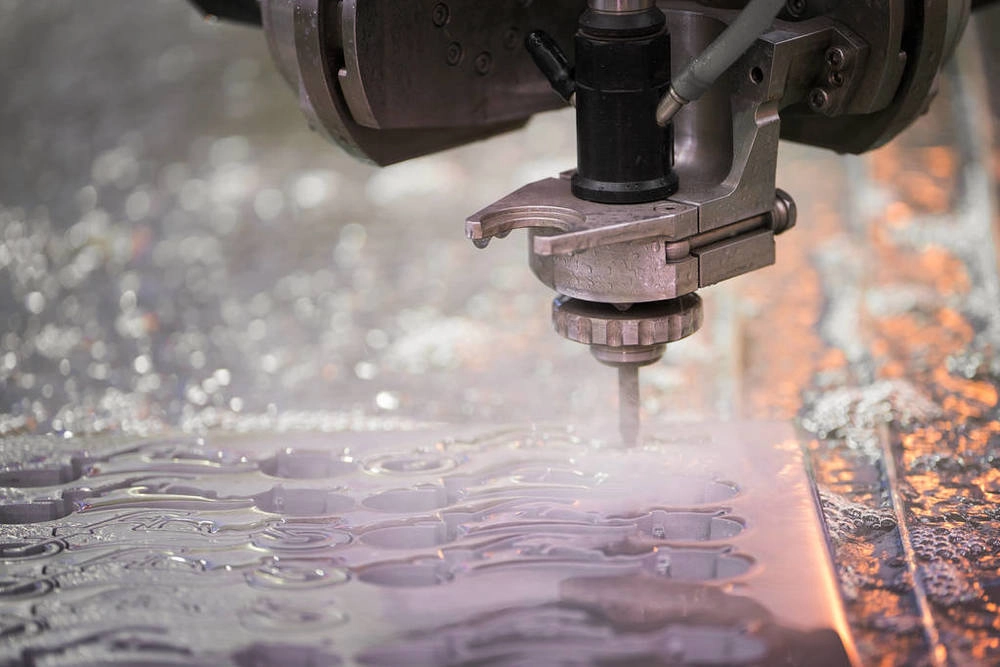
You name it, this machine cuts it.
Soft metals like aluminum, brass, and copper cut clean. No melting. No burrs dragging behind the cut.
Hard metals like stainless, titanium, Inconel, and tool steel? No problem. Thicknesses up to six or even ten inches. The same nozzle cuts thin shims and thick plates without changing anything.
Exotic alloys for aerospace or medical robotics? Works perfectly. Material certifications aren’t an issue. The process doesn’t alter the chemistry or structure.
Precision and Repeatability
Hold tolerances between plus or minus one to three thousandths of an inch. That’s real-world accuracy on a thick plate.
The kerf—the width of material removed—is tiny, maybe 0.03 inches. This lets you nest parts close together on the sheet. Waste drops significantly. When you’re cutting expensive metals like titanium or Inconel, those savings add up fast.
No Burrs, No Secondary Finishing
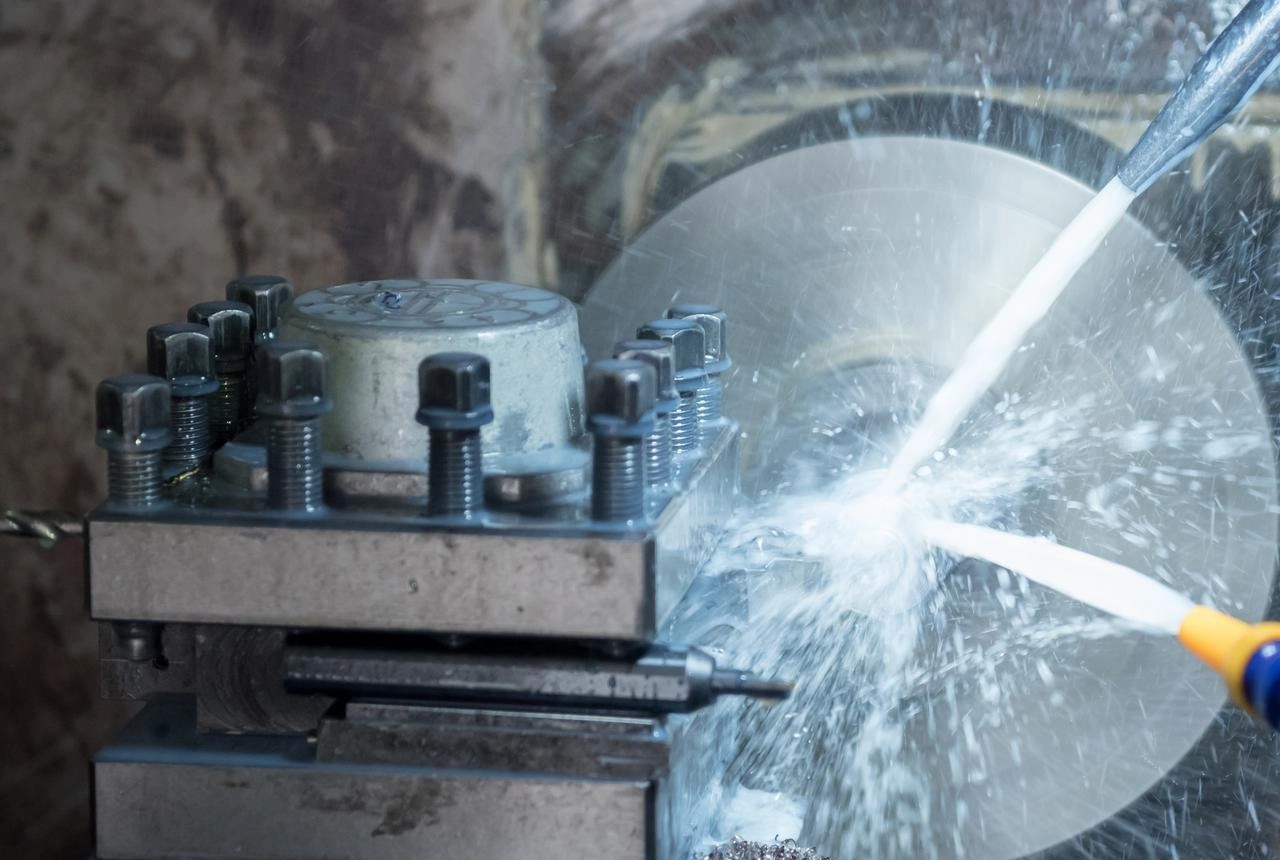
The edge quality is smooth right off the machine. No burrs. No jagged lines. No rough spots.
This eliminates deburring. It cuts down grinding time. You often skip secondary machining entirely. The part goes from the waterjet to the next operation or straight to assembly. That’s real cost savings, not just talk.
Metal Components Ideal for Waterjet Cutting
Here is a practical breakdown. Different parts, different metals, same machine.
| Component Type | Common Metals | Why Waterjet Excels |
| Structural Frames & Base Plates | Aluminum, Stainless, Steel | Cuts a thick plate without introducing heat. The part stays flat. No warping means it assembles the first time correctly. |
| Robot Arms & Links | Aluminum, Titanium, Carbon Fiber | Thin-walled structures are sensitive to heat. Waterjet avoids that entirely. No distortion. No delamination on composites. |
| Gear Blanks & Sprockets | Hardened Steel, Stainless | You can cut material that’s already heat-treated. The teeth come out clean. Often, you skip post-machining heat treatment entirely. |
| Brackets & Mounting Plates | Various metals | Need a custom bracket fast? No hard tooling. No waiting for a laser programmer. Load the file, cut the part, ship it. |
| Heat Sinks & Enclosures | Aluminum, Copper | Heat is the enemy here. A laser would degrade the thermal conductivity at the cut edge. Waterjet leaves the material properties untouched. The surface finish stays clean. |
| Shims & Spacers | Spring Steel, Stainless | Thickness control is everything. A burr on a shim throws off the stack-up. Waterjet produces a clean edge. No secondary filing or tumbling. |
Waterjet vs. Other Cutting Methods for Metals
Here is the direct comparison. Look at the factors that actually drive your decision on the shop floor.
| Factor | Waterjet Cutting (Abrasive) | Laser Cutting | Plasma Cutting | CNC Milling |
| Heat Affected Zone | None. Zero. The cut is mechanical erosion. | Yes. Significant on thicker materials. | Yes. Large HAZ. Changes metal properties. | Minimal, but tool friction generates some heat locally. |
| Max Thickness (Steel) | Up to 10 inches. Same nozzle. | About 1 inch for a clean cut. Drops off fast. | Up to 2 inches, but the edge gets rough and beveled. | Unlimited in theory. But feed rates become painfully slow. |
| Edge Quality | Excellent. Smooth. Ready for welding. | Excellent on thin gauge. Drops on a thick plate. | Rough. Slag on the bottom edge. Needs cleanup. | Excellent. Machined finish. |
| Material Waste | Low. Narrow kerf, tight nesting. | Low. Similar kerf width. | High. Wider kerf, rougher nesting. | Moderate to high. Chip removal removes material. |
| Tooling Cost | No tooling. Same nozzle for everything. | No tooling. Gas and lens consumables. | No tooling. Consumable electrodes. | High. Fixtures, vises, end mills, tool holders. |
| Speed (Thin Metal) | Slower. Acceleration is limited. | Faster. Very fast on sheet metal. | Faster. Quick for rough cuts. | Slow. Programming and toolpath time. |
| Speed (Thick Metal) | Faster. It just keeps cutting. | Cannot cut a thick plate cleanly. | Moderate. Fast but rough. | Very slow. Stepover and depth of cut limit feed. |
The pattern is clear. Waterjet is not the fastest on thin sheet. Laser wins there. But for thick plate, for materials sensitive to heat, for no-tooling flexibility, waterjet has no real competition.
Applications Across Metal-Focused Industries
Let’s walk through where this method actually gets used. Each industry has a different problem. Waterjet solves it.
Robotics & Automation
Think about a robot arm. It has to move fast. It has to be positioned precisely. The parts need to be light. Aluminum is the obvious choice. But thin aluminum warps under heat. A laser or plasma would distort the structure.
Waterjet cuts those chassis plates, those end-of-arm tooling mounts, those precision links. No heat means the part stays flat. The arm stays accurate.
Aerospace
Here, the material is often titanium or Inconel. Expensive alloys. Every part comes with a certification trace. You cannot alter the metal’s properties. Fatigue life is a safety issue.
A HAZ creates micro-structural changes. That’s a failure point. Waterjet produces no HAZ. The edge is as clean as the parent material. You get the certified properties all the way through.
Automotive
Custom brackets. Suspension components. Prototype parts for R&D. The need is speed. You don’t have time for hard tooling. You don’t want to wait for a laser programmer.
Load the CAD file. Cut the part. Test it. Change the design. Cut another one. No tooling cost. No heat distortion. That’s the value for low-volume and development work.
Industrial Machinery
This is heavy stuff. Base plates two inches thick. Equipment components from a six-inch steel plate. The tolerances still need to be tight.
Plasma would cut fast but leave a rough, beveled edge. You’d have to machine it afterward. A waterjet cuts clean at full thickness. The edge is square. The tolerance holds. The part goes straight to welding or assembly. That saves an entire operation.
Limitations and Considerations for Metal Cutting
No process is perfect. Waterjet has real limits. You need to know them before you commit.
Speed on thin metal
Here’s the truth. If you’re cutting sheet metal under a quarter inch thick, a laser is faster. The waterjet’s acceleration is limited. The abrasive stream takes a moment to fully engage. For high-volume thin-gauge work, laser wins the speed race.
Operating costs
You pay for consumables. Garnet abrasive isn’t free. You go through a bag per shift, depending on cut time. Nozzles and mixing tubes wear out. The abrasive erodes them just like it erodes the metal. These are real line items on your cost sheet. Factor them in.
Tolerances for critical features
Waterjet holds good tolerances. Plus or minus a few thousandths. But for a bearing seat? A precision dowel pin hole that needs a press fit? You may still need secondary work. Reaming. Boring. Maybe a quick pass on a mill. The jet cuts clean, but it’s not a replacement for machined fits on the most demanding interfaces.
Surface finish
The edge is smooth. No burrs. No slag. But it’s a satin finish. If you need a mirror polish—like for a sealing surface or a cosmetic edge—you’re not done. The waterjet gets you close. You still need a secondary process to hit that reflective finish.
Best Practices for Metal Components Designed for Waterjet
Here is how you design parts specifically for this process. Follow these, and you save time and money.
1. Design for nesting
Material waste is expensive. The kerf is narrow, so use that advantage. Pack parts close together on the sheet. Rotate them. Interlock shapes. The machine doesn’t care. Your material utilization goes up. Your scrap goes down.
2. Use tabbing for small parts
You cut a tiny washer. It finishes. Then it drops straight into the tank. Now you’re fishing it out of abrasive sludge. Not good.
Leave small tabs holding the part to the sheet. Micro-joints. The part stays put. When the job finishes, you snap it off or cut the tabs. This is standard practice for small components.
3. Specify material and thickness upfront
The machine settings change completely between materials. Aluminum cuts fast with less abrasion. Hardened steel needs more garnet and a slower feed. Titanium is its own beast.
Tell your operator exactly what you’re running. Alloy grade. Thickness. Heat treat condition. This is not optional. Guessing leads to bad cuts or broken mixing tubes.
4. Plan for secondary operations
Waterjet makes the profile. It does not tap holes. It does not hold a bearing to tenths.
Look at your print. Identify the features that need real machining. Threaded holes? Plan a tapping operation after cutting. Precision dowel pin holes? Leave stock, then ream or bore them on a mill. The waterjet is the first step, not the last, for critical interfaces.
Conclusion
Here is the bottom line. If you make metal parts and you care about how the material behaves after cutting, waterjet is not a niche tool. It is a core process.
You keep the metal’s original properties. No heat. No hardened edges. No micro-cracks. You hold tight tolerances on thin shims and a six-inch plate using the same machine. You switch from aluminum to Inconel without changing tooling.
Now, here is the practical takeaway for your shop. Look at your current parts. Ask yourself a few questions. Are you chasing heat distortion on thin aluminum? Are you grinding slag off plasma-cut edges? Are you struggling to cut thick, hardened steel at all?
If the answer is yes to any of these, bring in a waterjet sample cut. Test the edge quality. Check the flatness. Run the numbers on cost per part, including secondary operations. You will likely find that the machine pays for itself faster than you expect, especially for mixed-material, low-volume, or thick-plate work.
About NOBLE – Your CNC Machining Partner
Who We Are
We focus on high-quality metal components. Our customers build robots, medical devices, aerospace parts, and industrial machinery. We combine waterjet cutting with full CNC machining. You come to us with a raw idea or a CAD file. We send back finished parts. Prototype or production run—same process, same quality.
Our Core Capabilities
| Capability | Details |
| CNC Milling | 3-axis, 4-axis, and 5-axis machining for complex geometries and tight tolerances |
| CNC Turning | Precision lathe work for cylindrical components, shafts, and bushings |
| Secondary Operations | Drilling, tapping, reaming, surface grinding, and deburring |
| Finishing Services | [Optional: anodizing, powder coating, passivation, heat treatment] via qualified partner network |
| Inspection & Quality Control | CMM (Coordinate Measuring Machine), optical comparators, and precision gauges |
Our Qualifications
| Certification | Scope |
| ISO 9001:2015 | Our basic quality system. Consistent production. Continuous improvement. Customer satisfaction. Covers all metal components we make. |
| ISO 13485:2016 | This is for medical devices. Surgical robotics. Diagnostic equipment. Implantable instrument components. It means we manage risk. We maintain traceability. We follow regulatory requirements. |
Why Partner With NOBLE
Here is what you actually get.
Single-source solution. Waterjet cutting. CNC finishing. Under one roof. You don’t manage three vendors.
No heat distortion guarantee. Our waterjet leaves no HAZ. Our CNC work doesn’t add it back. Your metal parts keep their original properties.
Prototype to production. Low volume for rapid testing. High volume for full production. Same quality either way.
Material flexibility. We run aluminum, stainless (303, 304, 316, 17-4), carbon steel, tool steel, brass, copper, titanium, and Inconel. Probably the alloy you need.
Fast quoting. Upload your CAD file. STEP, IGES, DXF, DWG. We get a quote back within 12 hours. No waiting for days.
That’s the offer. Send us your prints. We will tell you what we can do and what it costs.
FAQ
Can a waterjet cut my metal part without distorting it?
Yes. The process uses no heat. Your part won’t warp. It won’t change color. The hardness and temper stay exactly as they were before cutting. This matters most for thin aluminum, pre-hardened steel, and any alloy that reacts badly to heat.
How precise is waterjet cutting for metal components?
Our system holds plus or minus three thousandths of an inch on most parts. For smaller components or parts, we fix them carefully, and we can reach one thousandth. Do you need tighter than that? Bearing bores or dowel pin holes? We switch to secondary CNC machining for those features. The waterjet gets you close. The mill finishes the job.
What metals can you NOT cut with a waterjet?
Almost nothing. We cut standard engineering metals every day. Steel. Stainless. Aluminum. Titanium. Inconel. Brass. Copper.
The only limits are non-metal problems. Tempered glass shatters under pressure—but that’s not metal. Very soft, pure metals like lead can smear rather than cut cleanly. For anything you would actually specify on a print, waterjet works.
Do you offer both waterjet cutting and CNC finishing?
Yes. NOBLE is a full CNC shop. The waterjet makes the blank. Then we mill it, turn it, drill holes, tap threads, ream precision bores, and grind surfaces. All under one roof. This matters because the cut blank and the machined features stay perfectly aligned. You don’t have two vendors arguing about whose fault the mismatch is.
Can you produce medical-grade metal components (e.g., for surgical robots)?
Yes. We hold ISO 13485:2016 certification. That qualifies us to make parts for medical devices. Surgical robotics. Diagnostic instruments. Orthopedic tools. We maintain traceability from the raw material lot to the finished part you receive. No gaps.
Do you offer prototyping services?
Yes. Waterjet requires no hard tooling. No mold. No die. No fixture cost. We load your file and cut the part. This makes low-volume prototyping economical. Depending on complexity and material availability, we can deliver prototype metal components in as few as 5 business days.
Do you have a minimum order quantity (MOQ)?
No. We accept single parts for prototyping. We also accept high-volume production runs. The waterjet process is tooling-free, so small batches are not punished with setup fees. One part or ten thousand—we quote both.