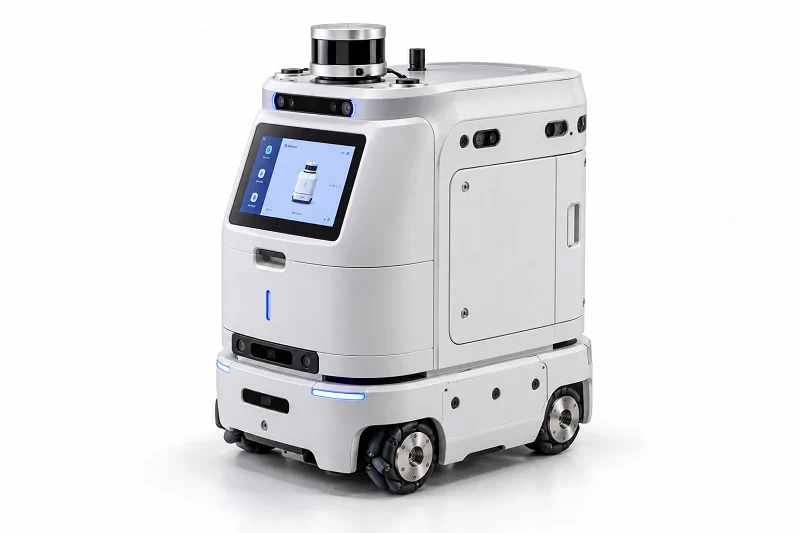
Precision, material choice, and consistent manufacturing are the most important things in service robot CNC machining. These three things directly affect safety, repeatable motion, weight limits, and long-term reliability. A robot arm that lifts patients or moves through warehouses cannot have loose tolerances or weak parts. Service robots need parts that hold up under constant motion and changing loads. That is why CNC machining is so important for making durable, accurate parts. This guide covers materials, precision needs, design challenges, machining processes, choosing a partner, and a real-world case example. You will get practical insights to help you make better choices for your next robotics project.
Precision and Consistency in Service Robot CNC Machining
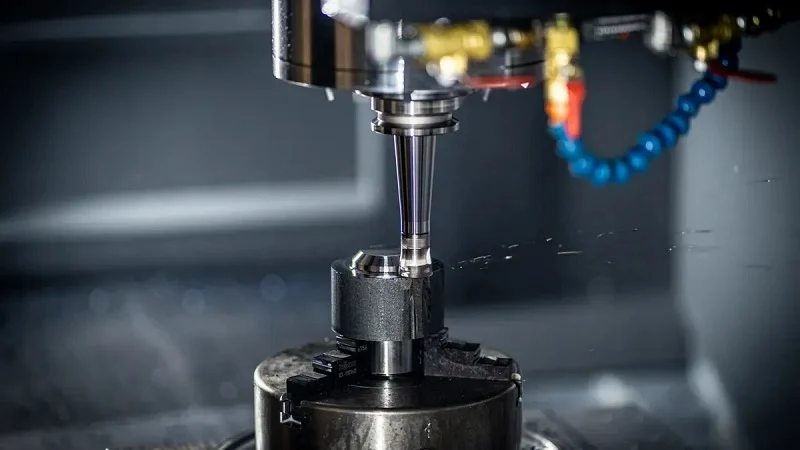
Building a service robot that works well means every part must fit correctly. Arm links, servo brackets, and gear housings all need tight tolerances. Even a tiny error in one component can break the whole system. That is why high-precision service robot CNC machining is so important here. You are designing for repeatable motion, and repeatable motion begins with accurate parts.
Tight Tolerances for Robot Performance
A robot works by moving the same way every time. That requires joints and actuators that line up perfectly. Precision service robot CNC machining is the only way to meet those specs.
Joint and Actuator Alignment
A servo motor bracket may seem like a simple part. But it does important work. If the mounting surface is not flat, or the holes are in the wrong spot, the motor shaft will not line up with the transmission. That causes vibration, noise, and coupling wear. For joint alignment, you need strict control over hole positions, flatness, and perpendicularity.
| Komponens / Funkció | Standard tolerancia | Precíziós tolerancia |
| Servo mounting planes | ±0.002 hüvelyk (±0.05 mm) | ±0.001 hüvelyk (±0.025 mm) |
| Bearing bores and joint interfaces | ±0.002 hüvelyk (±0.05 mm) | ±0.001 hüvelyk (±0.025 mm) |
| Linear dimensions — arm links (≤100 mm) | ±0.005 hüvelyk (±0.13 mm) | ±0.001 hüvelyk (±0.025 mm) |
| Angles — joint axes | ± 0.5 ° | ± 0.25 ° |
Precision tolerances affect robot repeatability, stiffness, and thermal stability. Tighter specs on these give you better performance.
Repeatability and Motion Accuracy
Motion-critical parts like harmonic drive housings need tolerances as tight as ±0.005 mm. That is finer than a human hair. These parts decide how well your robot can return to the same spot again and again. If the bearing bores and datum faces are not right, repeatability drops.
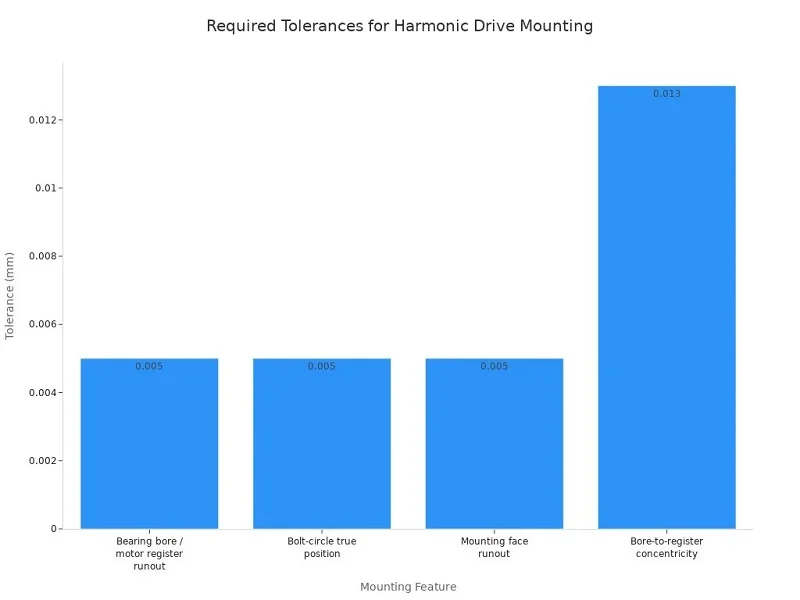
Bearing interfaces, mounting surfaces, and alignment features need concentricity within 0.013 mm and runout at 0.005 mm or less. That level of detail requires in-process inspection. You cannot just check parts after they are done and hope they are good.
Most robotic components require tolerances ranging from ±0.01 mm to ±0.005 mm, while critical motion-control features may require even tighter specifications. Critical parts such as harmonic drive housings, bearing seats, servo motor mounts, and end-effector assemblies frequently require tolerances ranging from ±0.01 mm to ±0.003 mm.
Manufacturing Consistency Across Runs
Getting one perfect part is hard. Getting a thousand identical parts is even harder.
Kötegenkénti variáció
When you go from prototyping to full production, every batch must match. A bracket from lot 100 needs to fit just like the one from lot 1. Tool wear, temperature changes, and material differences can all shift your tolerances. You need a CNC machining process that watches these factors and adjusts.
Minőség-ellenőrző rendszerek
Good quality control catches problems early. In-process inspection checks critical dimensions while the part is still on the machine. If something drifts, you fix it before making bad parts. This matters a lot for service robot CNC machining, since one out-of-spec part can cause a failure in the field.
Risks of Poor Precision
Skipping on precision saves money up front. But it costs more later.
Rezgés és zaj
Misaligned parts create vibration. That vibration creates noise. And noise in a service robot means something is wearing out faster than it should. Loose tolerances let parts wobble under load. That speeds up wear on bearings and gears.
Premature Wear and Failure
A robot running 24/7 with poor machining will not last long. Every extra micron of clearance adds friction and heat. Eventually, servo motors burn out and bearings seize. Proper CNC precision machining prevents these failures. It keeps everything aligned and within spec, so your robot runs reliably for years.
Design Considerations for Service Robot CNC Machining

Good design makes machining easier. Bad design makes it costly and slow. Precision service robot CNC machining depends on exact alignment and steady assembly. Every choice you make affects how well your robot works and how much it costs to build.
Komplex geometriák és organikus formák
Modern service robots often need parts with curved and natural shapes. These designs look good on a screen. But they can be very hard to machine.
Többtengelyes megmunkálási képességek
5-axis CNC machining lets you cut complex shapes in just one setup. The tool can reach the part from almost any angle. That means fewer setups, better accuracy, and faster production. For custom robotic parts with curved surfaces, this ability is critical.
Undercuts and Deep Cavities
Undercuts and deep pockets cause real issues. They add time and wear to the process. Sharp inside corners make things worse. Parts with many faces need extra setups or multi-axis paths, which raises costs. Problems with holding the part can cause bending when clamps open. Taking out too much material near key areas can warp the part as inner stresses let go. Good planning keeps these problems away.
Lightweight Design Without Strength Loss
Service robots need to move quickly and save power. Heavy parts make that harder.
Topológia optimalizálás
Topology optimization takes away material where it is not needed. The result is a strong and light part. But this makes thin walls and complex shapes. Thin walls can bend and twist, which is a big problem. You need good holding and tooling methods to keep the part from warping.
Anyagválasztás a súlycsökkentés érdekében
Aluminum alloys, such as 6061-T6, give a good balance of strength and weight. Titanium is stronger but heavier and tougher to machine. Engineering plastics like PEEK are lighter but may not take high loads. The best choice depends on what your robot does.
Felületkezelési követelmények
Surface finish changes how parts function and look.
Functional vs. Cosmetic Surfaces
Functional surfaces need a certain roughness for sealing or to resist wear. For sealing surfaces in robot joint housings, the usual surface roughness is Ra 0.2–0.4 μm (N5) for areas that touch rotating seals. This stops leaks and early seal wear. Cosmetic surfaces only need to look good.
Utófeldolgozási lehetőségek
Anodizing, passivation, and powder coating make parts last longer and look better. Anodizing gives aluminum protection from rust. Passivation cleans stainless steel. Powder coating gives a strong, colorful surface. Choose the right one for your use.
Common Materials Used for Service Robot CNC Machining
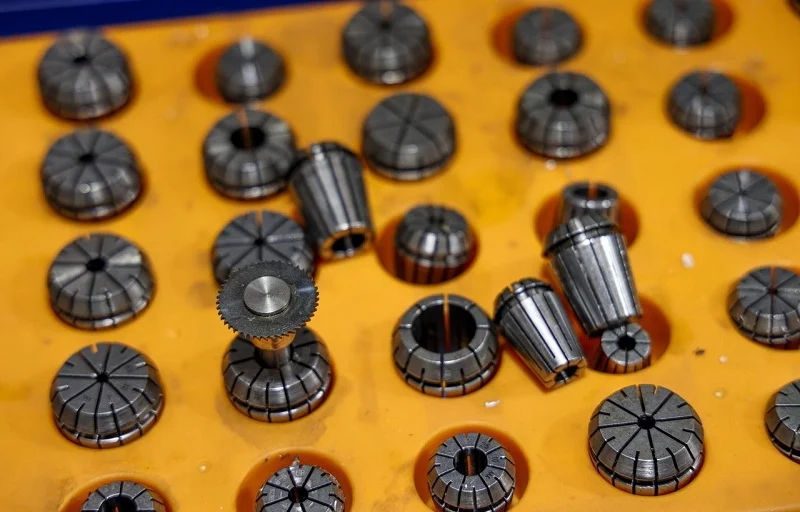
Choosing the right material is like finding a balance. You compare strength and weight. You compare cost and performance. If you choose wrong, your robot might not lift its own arm or cost too much to build. Robots need strong, stiff materials for steady movement and lifting. That’s the main trade-off in material selection in precision service robot CNC machining.
Alumínium ötvözetek
Aluminum is the go-to choice for robot frames and arms. It’s light, easy to machine, and resists rust. Two grades are talked about the most.
6061-T6 and 7075-T6 Properties
6061-T6 has a tensile strength of about 310 MPa (roughly 45,000 psi). That works for medium-strength jobs. 7075-T6 goes up to 572 MPa. That makes it about 1.85 times stronger. Here’s how they compare:
| Ötvözet | Szakítószilárdság | Folyáshatár |
| 6061-T6 | ~45,000 XNUMX psi | ~40,000 XNUMX psi |
| 7075-T6 | 74,000 78,000–XNUMX XNUMX psi | 63,000 69,000–XNUMX XNUMX psi |
Cost is important too. If 6061-T6 is the baseline of 1.0, 7075-T6 costs about 1.05 to 1.70 times that. So you pay more for that extra strength.
Applications in Robot Arms and Frames
6061-T6 is your main pick for structural frames, base plates, and brackets. It welds well and anodizes the same way each time. 7075-T6 works best in high-stress spots like arm links and joint housings where saving weight really matters. But there’s a problem. 7075-T6 is less consistent for cosmetic anodizing. Its higher zinc and copper content can cause color changes between batches. If your robot arm has visible decorative surfaces, 6061-T6 gives you more even finishing. For 7075-T6, you should approve a physical sample and set acceptable color variation before production.
Rozsdamentes acél és titán
When aluminum isn’t enough, you move to tougher metals.
304 and 316 Corrosion Resistance
304 stainless steel handles most environments well. It resists rust and holds up in humid or washdown settings. 316 goes further. It adds molybdenum, which boosts resistance to chlorides and harsh chemicals. That makes 316 the better pick for medical robots or food-processing units.
Medical and Harsh Environment Uses
Service robots in hospitals need parts that survive repeated cleaning. 316 stainless steel handles strong disinfectants without pitting. Titanium offers an even higher strength-to-weight ratio and excellent biocompatibility. It costs more and machines slower, but for surgical robots or sterile environments, it’s often worth it.
Engineering Plastics and Alloy Steel
Not every part should be metal. Plastics cut weight and reduce noise. Alloy steel handles the heaviest loads.
PEEK, POM, and Nylon
PEEK is the high-performance option. Unfilled PEEK has a continuous service temperature of 260 °C. It can handle short bursts up to 300 °C. That makes it great for gear parts, sliding elements, and grippers. PEEK gear wheels take high loads and offer good temperature resistance. POM and nylon are cheaper alternatives. They work well for lower-load applications like covers, bushings, and light-duty gears. They machine fast and keep costs down.
Alloy Steel for High-Load Components
For harmonic drive components, bearing races, and high-torque shafts, you need alloy steel. Grades like 4140 or 4340 offer the hardness and fatigue resistance that aluminum and plastics can’t match. These parts often go through heat treatment after service robot CNC machining to hit the required strength. The trade-off is weight. Alloy steel is dense, so you use it only where the load demands it.
From a practical perspective, the best material choice depends on your robot’s job. A warehouse robot might run mostly aluminum. A surgical robot needs stainless and titanium. A collaborative arm could mix all three categories. That’s the reality of common materials used for CNC machined robot parts. There’s no single answer. You match the material to the load, the environment, and the budget. And you verify your choice with real testing before you commit to production.
Machining Processes for Service Robot CNC Machining
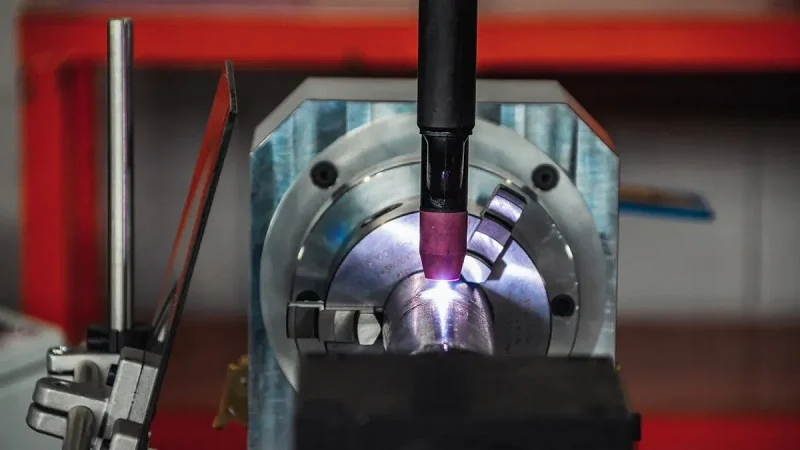
CNC machining is the main method used in service robot CNC machining. It makes the small, complex parts that let robots move. Gears, harmonic drive housings, precision bearing seats, servo motor mounts, and sensor brackets all need this kind of accuracy. You cannot mold or cast these parts and get the same results. The tolerances are too tight. The shapes are too complex. So you use CNC machining for robot parts that must work right every time.
Why Choose 5-Axis CNC Machining for Robot Parts
People often ask why choose 5-axis CNC machining for robot parts. The answer is easy. Complex parts need complex tool paths. A 3-axis machine can only cut from one direction. That means you flip the part, reset the fixture, and hope it lines up again. Every flip adds error. Every setup adds time.
Advantages for Complex Parts
Robot joints have curved surfaces, angled holes, and deep pockets. A 5-axis service robot CNC machining center reaches all of these in one pass. The tool tilts and turns to follow the shape. This is called 5-axis simultaneous machining. It lets you cut undercuts and organic shapes without special tools. For custom robotic parts with freeform surfaces, this skill is not a choice. It is a must.
Reduced Setup and Improved Accuracy
Here is where 5-axis really helps. It is worth noting that setup reduction is huge.
It’s not uncommon to go from five setups to one with 5-axis.
That change cuts labor, fixturing, and machine time all at once. Fewer setups mean less fixture prep. You also need fewer extra machines or workers. With 5-axis CNC machining, many faces get cut in a single setup. This cuts setup time and lowers human touch. The result is faster production and shorter delivery times. Accuracy gets better too. Every time you move a part to a new fixture, you risk losing alignment. One setup takes away that risk.
Esztergálás és marás
These are the two workhorses of service robot CNC machining. Each one has its own job.
Shafts, Housings, and Brackets
Turning makes round parts. Think motor shafts, bearing races, and cylindrical spacers. The material spins while a single-point tool cuts it. This process holds diameter tolerances very well. Milling makes everything else. Servo motor mounts, sensor brackets, and gearbox housings all start as milled parts. A machining center with multiple axes handles flats, slots, and holes in one program.
Mikor kell használni az egyes folyamatokat
Use turning when your part is mostly round. Use milling when your part has flat faces, pockets, or complex shapes. Many robot component machining jobs need both. A harmonic drive housing might start as a turned blank, then move to a mill for bolt patterns and mounting flanges. The best shops do both processes under one roof. That keeps tolerance stack-up low and lead times short.
Felületkezelés és kikészítés
A machined part is not done until it gets its surface treatment. These coatings protect against wear, corrosion, and environmental damage.
Anodizing, Passivation, and Powder Coating
Anodizing builds an oxide layer on aluminum. It comes in two main types. Type II is decorative and thin. Type III, also called hard anodizing, is thicker and much harder. It resists wear and abrasion. The MIL-PRF-8625 specification provides a table detailing thickness ranges for different types of anodizing coatings. For Type III hard anodizing, thickness ranges vary by application category. Here is how the ranges break down:
| Alkalmazás kategória | Thickness Range (microns) | Vastagság tartomány (mm) |
| Standard hard anodizing | 25-100 | 0.025-0.1 |
| Heavy-duty (aerospace/military) | 100–250 vagy több | 0.1–0.25 vagy több |
| Typical oxide film (general) | 25–150 (common: 50–80) | 0.025–0.15 (common: 0.05–0.08) |
Passivation cleans stainless steel. It removes free iron from the surface and boosts corrosion resistance. Powder coating adds a thick, strong layer. It works well for covers and frames that need color and impact protection.
Functional and Aesthetic Finishes
Some surfaces need to work. Seal grooves, bearing bores, and sliding surfaces need certain roughness. Hard anodizing helps here because it resists wear. Other surfaces just need to look good. A robot arm’s outer shell might get a cosmetic anodize in a brand color. From a practical view, you should list functional finishes first. Then pick aesthetic finishes for the rest. This keeps cost down and performance up. High-precision CNC machined parts for robotics often need both types on the same part. A 5-axis robotic arm machining job might need a hard-anodized joint face and a painted cover. The service robot CNC machining process for custom robotic parts must plan for both. Precision robot parts do not just come from the machine. They come from the full process, from raw stock to final finish.
Challenges and Solutions in Service Robot CNC Machining
Thin-wall distortion and holding sub-micron tolerances are the biggest problems in service robot CNC machining. Both issues get worse when parts are bigger and lighter. Here is how to deal with them.
Thin-Wall and Delicate Features
Thin walls shift when you cut them. The material springs back, and your finished part ends up out of spec.
Fixturing and Tooling Strategies
Support the part at its weakest points. Use custom soft jaws or vacuum fixtures that spread the clamping force. Light cuts with sharp tooling lower cutting pressure. From a practical view, plan the fixture before you plan the tool path.
Minimizing Deflection and Chatter
Chatter leaves marks and ruins the surface finish. Reduce tool overhang and choose a geometry that cuts smoothly. Climb milling also helps. If the wall still vibrates, slow the spindle and increase feed per tooth.
Tight Tolerances on Large Parts
Big parts drift when temperatures change. For example, a 500 mm 6061 feature measured at 25°C is about 0.059 mm larger than the ISO 1:2022 20°C reference. That is enough to ruin your stack-up.
Termikus kezelés
Control the shop environment and let parts soak before measuring. A 500 mm 6061 feature measured at 25°C reads about 0.059 mm larger than the ISO 1:2022 20°C reference. Here is how restraint level changes the picture:
| Korlátozási szint | Állapot | Implication for tolerance stack-up |
| Free expansion | Part slides or grows freely | Use ΔL = αL₀ΔT as a direct estimate |
| Partial restraint | Fasteners, slots, seals share movement | Simple equation is insufficient |
| Full restraint | Gradients, mixed materials, rigid bounds | Requires structural analysis or FEA |
Folyamatban lévő ellenőrzés
Check critical dimensions while the part is still on the machine. If a dimension returns to nominal after cooling, treat it as reversible expansion. If it shifts permanently, look for residual stress or fastener slip.
Cost and Lead Time Pressures
Everyone wants parts faster and cheaper. Good design and the right shop make that possible.
Tervezés a gyárthatóság érdekében
Add radii to internal corners. Relax tolerances on features that are not critical. Standardize dimensions. These steps cut cost by 20–30% and improve consistency.
Lead time is often overlooked when discussing design for manufacturability, but it has a direct financial impact. Complex parts usually need more programming, more setups, more inspection, and more processing steps. Each extra step stretches out production schedules.
A megfelelő partner kiválasztása
Pick a shop with multi-axis machines and in-house inspection. Look for experience in precision service robot CNC machining. A partner who understands high-precision CNC machining will catch problems early. That saves you money and keeps your schedule on track. Precision and tight tolerance control come from the whole process, not just one machine. Good precision service robot CNC machining partners also give DFM feedback before you cut metal. That is how you avoid costly surprises.
Case Example: Collaborative Robot Arm
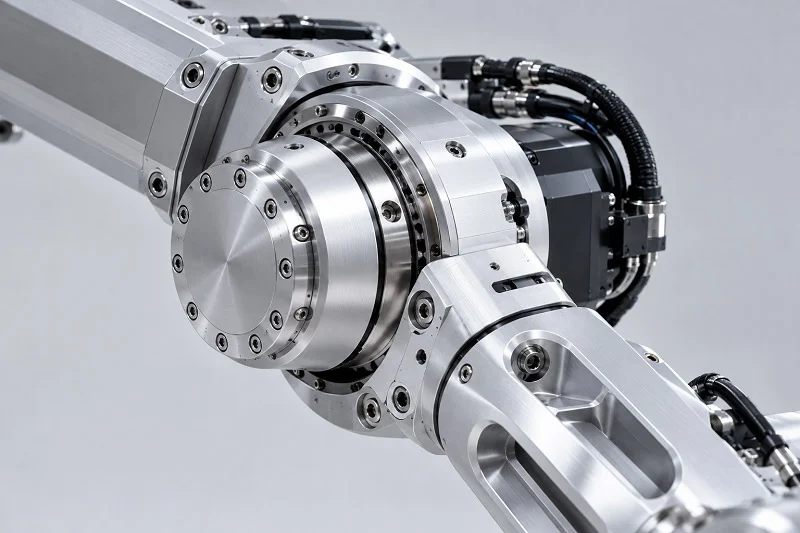
A robotics startup needed a robot arm for light assembly work that could work with people. The arm had to lift 5 kg, move without jerking, and fit into small spaces. Making the shoulder joint was the hardest part.
Project Overview and Requirements
The shoulder joint had to keep moving all the time without losing its position. Every part needed to line up just right with the parts next to it.
Material and Tolerance Specifications
The team picked 7075-T6 aluminum for the joint housing. This metal is very strong but does not add a lot of weight. The harmonic drive housing and servo motor mount needed extremely tight fit limits. Holes for bearings had to stay within ±0.001 inches (0.025 mm). Shaft surfaces needed the same tolerance. Flatness of mounting faces had to be tightly controlled. Roundness of bearing surfaces was critical and inspected. Surface finish on bearing surfaces needed to be below Ra 0.4 μm (approximately 16 microinches). The center lines of side-by-side bearing bores had to be precisely aligned, with concentricity typically held to within 0.013 mm (0.0005 in).
Termelési mennyiség és ütemterv
The startup needed 50 units for a first test run. Full production would follow at 500 units per year. The schedule was tight. They had 12 weeks from the final design to the first approved part.
Machining Approach and Challenges
The shop used 5-axis CNC machining for the joint housing. This method cut complex mounting features and inside pockets in one setup. Precision boring kept side-by-side bearing bores aligned. Gear cutting made the built-in pinion with exact tooth shapes. Thread milling put in mounting threads in the aluminum housing.
5-Axis Machining for Complex Joints
The shoulder joint had curved surfaces and holes at angles. A 3-axis machine would have needed five separate setups. The 5-axis robotic arm machining approach cut that down to one. This cut down on setup errors and kept alignment tight. The shop also used EDM for thin-wall features that milling could not reach safely.
Surface Finish for Wear Resistance
Bearing seats needed smooth surfaces to reduce rubbing. The shop used precision grinding after service robot CNC machining. This step hit the needed finish and final sizes. Hard anodizing added wear resistance on sliding surfaces.
Eredmények és tanulságok
The first approved part passed inspection on the first try. All critical sizes were within the allowed range.
Achieved Precision and Consistency
The shop held concentricity within 0.013 mm (0.0005 in) across all bearing spots. Runout was controlled to 0.005 mm (0.0002 in) or less. Parts from different batches stayed very close in size across the test run. The startup approved the process for full production.
Key Takeaways for Similar Projects
Start by getting DFM feedback before cutting any metal. Pick a partner who understands high-precision robot parts. Plan to check critical sizes while the part is still being made. Use 5-axis CNC machining to cut down on setups and improve accuracy. These steps make high-precision robot parts easier to produce in large numbers.
Choosing a Partner for Service Robot CNC Machining
Picking the right shop is important. You need more than a metal cutter. A good partner brings design skill and quality systems. They help you go from prototype to full production without constant rework.
Műszaki lehetőségek és felszereltség
Multi-Axis Machining and Inspection
Look for 5-axis CNC machines that can cut complex parts. They do everything in one setup. This lowers errors and keeps sizes exact. Such precision is hard to find. Checking parts during work is also key. Good shops measure key dimensions while the part is still on the machine. They fix problems before waste happens.
Each program needs official checks. This is called IQ/OQ/PQ. Written rules control tool wear and program changes. These records create the Device History Records that customers need.
Anyagi szakértelem
Different robots use different materials. Aluminum 6061 and 7075 are good for frames and arms. Stainless 304 and 316 work for medical and food tasks. PEEK and plastics lower weight and noise. A good partner knows how each material acts during CNC machining. They change cutting speed and feed to match.
Material certificates matter too. Mill test reports show the makeup. RoHS and REACH rules show they follow environmental laws. A shop that handles all this saves you time and trouble.
Quality Certifications and Processes
ISO 9001:2015 és ISO 13485:2016
Certifications show a promise of quality. ISO 9001:2015 is the basic standard for steady work. ISO 13485:2016 goes further. It is for medical devices. It asks for careful paperwork and risk planning.
ABS Machining says its quality work goes beyond its ISO 9001:2015 Registration. Quality experts work closely with each customer to meet all special needs.
For medical robots, ISO 13485 is the world standard. Suppliers must follow it. That is what you need for exact service robot CNC machining in sensitive uses.
Nyomon követhetőség és dokumentálás
Tracking starts with raw material. Each batch gets a unique ID. Material papers must come with every batch.
ISO 13485 requires several things:
- Track a finished part back to its original mill heat lot
- Mill test papers for every production batch
- Chemical makeup reports that match ASTM or ISO rules
- Mechanical traits like hardness and tensile strength
- Lot cross-referencing that links stock logs, CNC run sheets, and inspection records
- Digital lot tracking tied to original mill papers
Without these systems, you cannot show parts meet specs. That matters for safety-critical robot parts.
Full-Service Advantages
DFM Support and Prototyping
A partner who gives feedback on service robot CNC machining saves money. They look at your design and suggest changes. Add round corners to inside edges. Loosen limits on less important spots. These small fixes cut cost by 20 to 30 percent.
Making a first sample is just as key. A good shop moves fast from CAD to first part. They test fits and check function early. This finds problems before buying tools.
Összeszerelés és tesztelés
The best partners do more than cut metal. They also handle assembly and testing. They mount servo motors. They line up bearing seats. They check that everything fits before shipping.
This full-service way lowers your costs. One partner handles everything from design to final assembly. You get one contact and one quality system. That is the real benefit when you need CNC machining for robots from start to finish.
Why NOBLE for Service Robot CNC Machining
NOBLE is a top choice for metal and plastic machining for service robots. The company has modern equipment, certified processes, and a full-service approach. That mix is key when your robot parts must work right every time.
Fém- és műanyagmegmunkálási szakértelem
Aluminum, Stainless Steel, Titanium, and Plastics
NOBLE works with many materials for service robot CNC machining, including aluminum alloys (6061, 7075), stainless steel (304, 316), alloy steels (4140, 4340), titanium, and engineering plastics such as PEEK, POM, and Nylon. This range lets you match the material to your robot’s job without looking elsewhere.
Precíziós tűrések és felületkezelések
Tight tolerances are where NOBLE does its best work. The shop treats dimensional accuracy and surface finish as core quality metrics. For harmonic drive housings, bearing seats, and servo motor mounts, small errors add up fast. NOBLE uses CMM systems, bore gauges, and GD&T inspection to check critical dimensions. This ensures high first-pass yield and quality. Enterprise providers go above 98%, and world-class operations stay at 95% or higher. NOBLE aims for that top level.
Certified Quality and Full-Service Capabilities
ISO 9001:2015 és ISO 13485:2016
Certifications show that a shop follows the rules. NOBLE holds ISO 9001:2015 and ISO 13485:2016. The first covers general quality management. The second is for medical devices and requires strict documentation and risk planning. That matters for medical robots or any use where safety is critical. Traceability runs from raw material to finished part. Mill test reports, chemical makeup reports, and lot cross-referencing keep everything documented.
Design, Machining, Assembly, and Testing
NOBLE does more than cut metal. The team offers design support, machining, assembly, and testing all in one place. They give DFM feedback before you cut chips. They mount servo motors and align bearing seats. They check that everything fits before shipping. This full-service model lowers your costs and makes your supply chain simpler. One partner handles everything from design to final assembly.
Partnering with NOBLE
Gyors prototípusgyártás a gyártásig
Going from a prototype to full production is hard. NOBLE makes that switch smooth. The shop offers fast quoting and keeps quality the same from prototype to production. You get the same quality system whether you need 5 parts or 5,000. That consistency matters for service robot CNC machining, where batch-to-batch variation can hurt performance.
Dedikált mérnöki támogatás
You get a dedicated engineering contact at NOBLE. That person understands precision service robot CNC machining. They catch problems early and suggest fixes. They help you pick the right material and tolerance for each part. This support saves you money and keeps your schedule on track. From a practical view, that partnership is what sets a great shop apart from a good one.
Humanized Robotics: Structural frames, joint assemblies, actuator housings, and end-effector components for humanoid and collaborative robot OEMs. Fast quoting and prototype-to-production continuity.
NOBLE brings together material expertise, certified quality, and full-service capabilities. The shop handles 5-axis CNC machining, turning, milling, and finishing. It supports precision machining from prototype through production. For service robot CNC machining, that complete package is hard to beat.
Service robot CNC machining really comes down to four main things: precision, picking the right material, designing for manufacturability, and choosing a certified partner. Every part you make needs tight tolerances and the same quality across every batch. Without those, your robot won’t move the way it should or last very long. The guidelines in this guide give you a useful place to start. Use them on your next project. If you need a partner who gets these needs, NOBLE has the skills and certifications to help from prototype to production. Service robots are showing up more often each year in hospitals, warehouses, and homes. They will only work well if their parts are made with high-quality machining. The right approach now saves you trouble later.
FAQ of Service Robot CNC Machining
What tolerances can service robot CNC machining actually hold?
It depends on the part you are making. Normal precision parts are about ±0.002 inches. Key parts like harmonic drive housings can go as tight as ±0.005 mm. Bearing holes and mounting surfaces often need to be within 0.013 mm. In real life, you should tell the shop your hardest sizes early. That way they can set up their checks.
Which material works best for robot arms?
Aluminum 6061-T6 is the top pick for frames and brackets. It is light, welds well, and anodizes evenly. For high-stress spots like arm links, 7075-T6 gives you much more strength. It costs a little more and can be harder to finish well. Stainless steel and titanium are used for medical or harsh places.
Why is 5-axis machining so common for service robot CNC machining?
Robot joints have curved surfaces, angled holes, and deep pockets. A 3-axis machine needs several setups to reach them all. Each time you flip the part, you add error. A 5-axis device cuts most faces in one go. That means fewer setups, better alignment, and faster delivery. Cutting down setups alone can shorten lead times a lot.
Do I really need ISO 13485 for robot parts?
Only if your robot is used in medical or patient care. ISO 9001:2015 covers general quality management. ISO 13485:2016 adds strict paperwork and risk planning for medical devices. For surgical or hospital robots, that certification is often required. For warehouse or service robots, ISO 9001 is usually fine.
How do I keep thin walls from warping during machining?
Support the part at its weakest points. Use custom soft jaws or vacuum fixtures to spread the clamping force. Take light cuts with sharp tools to lower cutting pressure. Plan your fixture before you plan the tool path. If chatter happens, reduce tool overhang and try climb milling. Slow the spindle and increase feed per tooth if vibration continues.
Milyen felületkezelésre van szükség a csapágyülésekhez?
Bearing seats need smooth surfaces to reduce rubbing and wear. The article’s case example said bearing surfaces need surface finish below Ra 0.4 μm (approximately 16 microinches). Sealing surfaces in joint housings usually need Ra 0.2–0.4 μm. Hard anodizing can add wear resistance on sliding surfaces. Always list functional finishes first, then pick cosmetic ones for the rest.
Can one shop handle prototyping and full production?
Yes, and that is the best setup. A good partner gives DFM feedback before you cut metal. They keep the same quality system for 5 parts or 5,000. That consistency matters because changes between batches can hurt robot performance. Look for a shop with multi-axis machines and in-house inspection.
What’s the biggest mistake buyers make?
Skipping DFM feedback. A partner who looks at your design can suggest small changes. Add rounded corners to inside edges. Loosen tolerances on less important features. These fixes cut cost by 20–30% and improve consistency. Another mistake is picking a shop without robotics experience. Precision CNC machining for robots is not the same as general machining.