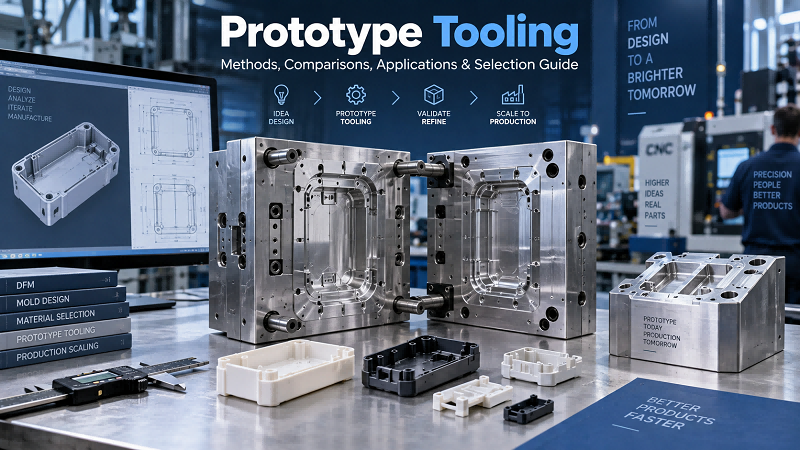
Prototype molds play a crucial role between early product development and full-scale production. They manufacture molded parts with processes and materials that are closer to actual production conditions.
के लिए इंजेक्शन-मोल्डेड products, prototype molds can help teams evaluate part design, material properties, assembly performance, surface quality, tolerances, and manufacturing feasibility before investing in expensive production molds.
Prototype molds can reduce the initial tool investment while providing sufficient functional components for testing, design verification, customer evaluation, trial production, and market validation.
This guide explains how prototyping tools work, how they differ from production tools, the distinctions between direct and indirect rapid tools, how soft tools adapt to the process, and when prototyping tools should be chosen over 3D मुद्रण or सीएनसी मशीनिंग.
1. क्या है प्रोटोटाइप टूलींग and Why Is It Used?
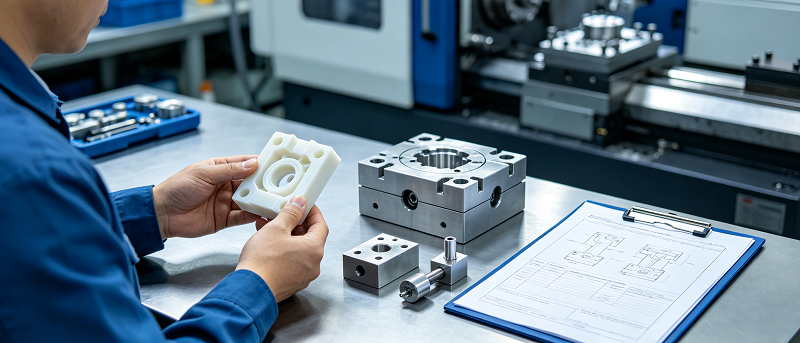
A prototype mold refers to a mold, die, fixture, or other manufacturing tool specifically manufactured for the production of prototypes or small-batch parts.
In the development of plastic products, it is usually associated with prototype injection molds made of aluminum, low-carbon steel, or other materials, which can be processed faster than traditional hardened production mold steel.
The main purpose of a prototype mold is to produce parts using a process very similar to the expected production method.
Engineers can not only evaluate the shape of components, but also test how the actual forming material flows, cools, shrinks, is sprayed, and is executed after manufacturing.
Therefore, prototype tools can be used for: design verification and engineering testing, functional prototyping, material performance evaluation, assembly and tolerance testing, injection molding process verification, market testing and customer sample certification or regulatory testing, experimental production, small-batch bridge frame production. Another important advantage is the flexibility of design.
Since prototype molds usually require less time and investment than complete production tools, engineers can make design modifications without taking the risk of higher costs associated with modifying complex production molds.
A typical prototype mold project begins after the CAD design has reached a relatively stable stage.
The manufacturer reviews the wall thickness, drawing Angle, notch, rib, boss, parting line, gate position, ejector position, tolerance and expected production quantity.
After DFM analysis, the mold can be processed, assembled, tested, and adjusted.
Then the test parts are inspected so that engineers can determine the dimensions or forming issues before the final production mold is manufactured.
Prototype tools are also manufacturing verification tools that help connect product design with scalable production.
2. Prototype Tooling vs. उत्पादन टूलींग: मुख्य अंतर
Prototype molds and production molds use many of the same basic forming principles, but they are designed for different purposes.
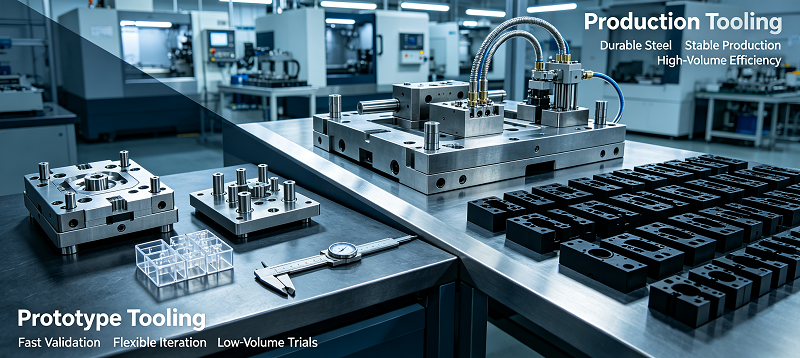
Prototyping tools prioritize speed, flexibility, and a lower initial investment. Production tools prioritize durability, repeatability, automation, and lower unit costs than mass production. One of the most obvious differences is the mold material.
Prototype molds are usually made of aluminium or softer grades of steel because these materials can be processed quickly.
When hundreds of thousands or millions of forming cycles are required, hardened tool steel is more likely to be used for production molds.
Therefore, the tool life varies.
A prototype mold may only need to manufacture dozens, hundreds, or thousands of parts.
Production tools must withstand longer working cycles and be repeatedly exposed to high injection pressure, high temperatures, abrasive materials and automated production cycles.
The complexity of the tools can also vary greatly.
Production molds may include multiple cavities, complex cooling channels, hot runner systems, automatic sliders, lifts, sensors, interchangeable inserts and highly optimized ejection systems.
When these features are not necessary for engineering verification, the prototype mold is usually simplified.
Delivery time is another important distinction.
Depending on the complexity of the parts, a prototype of an injection mold can be manufactured within a relatively short development time.
Production tools usually require a considerable amount of engineering, machining, finishing, verification, and optimization.
The cost also follows the same pattern.
Compared with direct prototyping, prototyping tools require upfront investment, but they are usually cheaper than hardening production tools.
However, the choice between them should not solely depend on the price of the mold.
If the product is still undergoing frequent design changes, immediately investing in production tools will generate unnecessary financial risks.
Prototype tools allow engineers to verify products before investing in more expensive manufacturing systems.
Once the geometric shape, material, tolerance, forming conditions, and market requirements are determined, production fixtures become a better solution for large-scale manufacturing.
Therefore, in many development projects, these two approaches are complementary rather than competing with each other.
Prototype tools verify the design and manufacturing processes, while production tools provide the durability and efficiency required for large-scale production.
3. Direct vs. Indirect रैपिड टूलिंग तरीके
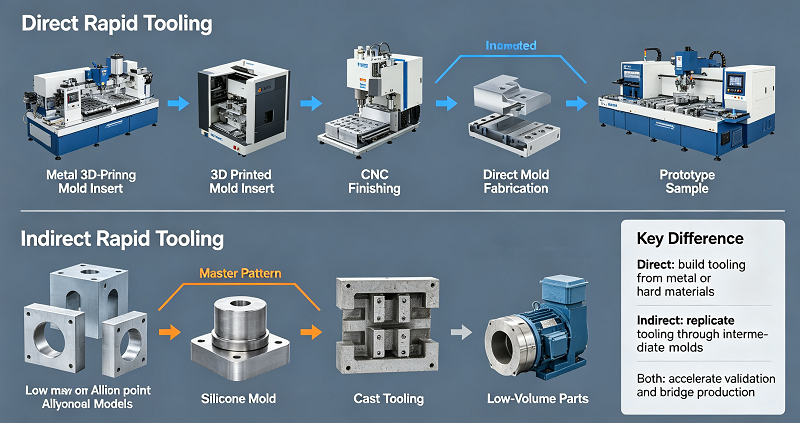
Rapid machining is generally divided into direct methods and indirect methods. Both of these methods aim to shorten the mold development time, but they create the final mold or mold components in different ways.
डायरेक्ट रैपिड टूलिंग
Direct rapid molds are created directly using technologies such as CNC machining, metal additive manufacturing, or other rapid manufacturing processes to produce molds, inserts, or tool assemblies.
Because fewer intermediate steps are required, direct tools can shorten the delivery time and simplify the development workflow.
अप्रत्यक्ष तीव्र टूलिंग
Indirect rapid molds start from the main model produced by CNC machining, 3D printing, or other prototyping technologies.
Then, use the master mold to create secondary molds or mold systems, such as silicone molds, casting molds, epoxy resin molds, or other replicated molds.
Choosing Between Direct and Indirect Tooling
When higher dimensional accuracy, stronger mold materials, or injection molding conditions are required, direct molds are usually more suitable.
Indirect tooling is attractive for projects that require very low production volumes, complex geometries or speeds, and lower tooling investment compared to longer mold life.
The correct method depends on the production quantity, the material of the parts, the dimensional requirements, the lifespan of the tooling, the surface finish, the complexity of the parts, and the manufacturing process that needs to be simulated.
For instance, when it is necessary to assess the actual thermoplastic performance, the company developing the plastic shell might use an aluminum prototype injection mold.
When only a small amount of polyurethane components are needed, another project may use silicone molds.
Understanding these differences helps engineers avoid choosing unnecessary, expensive, or tool processes that cannot reproduce the required production conditions.
4. Soft Tooling and Rapid Tooling: A Closer Look
Soft molds generally refer to molds made of materials that are easier and faster to process than quenched production tool steel.
Examples may include aluminum molds, silicone molds, polyurethane molds, epoxy resin molds, and certain low-hardness steel molds.
The main advantage of soft tooling is that it shortens the manufacturing time.
Softer materials can usually be processed, shaped, or cast more quickly, making them suitable for prototype production and small-batch manufacturing.
However, a decrease in hardness usually means a shortened tool life.
When the goal is to produce hundreds or thousands of components rather than hundreds of thousands, this trade-off is acceptable.
When the development team only needs 500 components for testing, investing in a mold designed for one million cycles offers almost no benefits.
Rapid machining is a broader concept that focuses on reducing the time required to manufacture functional tools.
Depending on the application, rapid molds can use a combination of soft mold materials, traditional CNC machining, additive manufacturing, rapid mold insertion, or other manufacturing methods.
Aluminum prototype molds are one of the most common examples.
Aluminum is easier to process than quenched tool steel and has good thermal conductivity.
During the prototype production process, faster heat transfer can sometimes reduce the molding cycle time.
However, aluminium is softer and may wear out more quickly when machining highly abrasive or glass-filled plastics.
When higher durability is required, steel prototype tools can be chosen.
Pre-hardened steel offers a useful compromise between machining efficiency and mold life, especially when prototype production may transition to bridge manufacturing.
When product requirements remain uncertain, soft fixtures are also very valuable.
Instead of immediately investing in expensive production tools, manufacturers can produce a limited quantity, assess customer responses, and make further improvements before increasing production capacity.
This makes fast and flexible tools particularly useful for new product introduction, medical device development, consumer electronics, automotive parts, robotic systems, industrial equipment, and other projects where engineering changes are frequently made in early production.
5. Comparison with Alternative Prototyping Methods: 3D Printing and CNC Machining
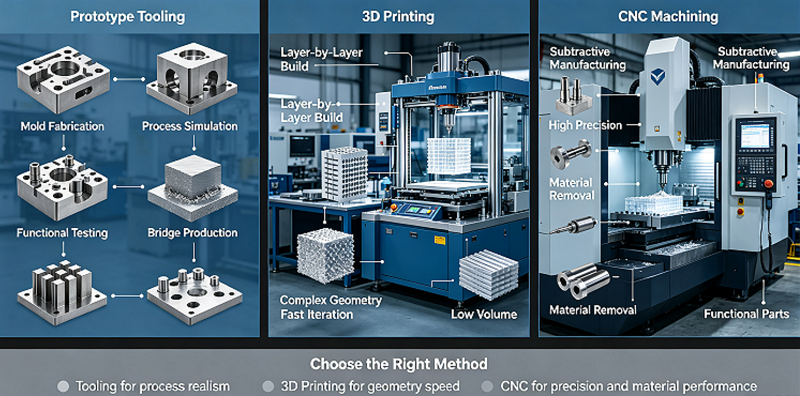
In the product development process, prototype molds are not always the first manufacturing method used. Engineers often compare it with direct prototyping technologies such as 3D printing and CNC machining. The right choice depends on whether the project only requires a few individual parts or needs molded components that closely represent the parts to be produced in the future.
3D मुद्रण
3D printing is an ideal choice for the rapid production of complex geometric shapes without the need for special tools. SLA, SLS, MJF, and FDM technologies enable engineers to evaluate shape, assembly, ergonomics, and basic functions during the early development period.
सीएनसी मशीनिंग
CNC machining directly produces precise prototypes from engineering plastics or metals.
It is particularly suitable for dimensional accuracy, mechanical properties, and functional testing of production-grade materials.
When the final component is used for molding, its limitations arise, as machining cannot reproduce the same material flow, shrinkage, gate marking, weld line or molding fiber direction.
When Prototype Tooling Makes More Sense
When engineers need to manufacture multiple identical components with the expected production resin, prototyping tools become more valuable.
For very early concept development, 3D printing is usually the fastest solution.
Designers can produce multiple versions without building molds and quickly compare different geometries.
CNC machining can be adopted when high-precision or production-grade engineering materials are required.
Production quantity is another important factor.
It is rarely economical to manufacture one or two parts with a dedicated injection mold.
Producing hundreds or thousands of the same plastic parts changes the calculation method, as the mold cost can be allocated to more parts.
The geometry of the parts should also be taken into consideration.
The plastic prototypes processed by cnc may need to change their geometries because the cutting tools need to physically access the material.
Injection molding can produce thin walls, ribs, bosses, clamps, integrated features, and complex internal structures, which may be difficult to process directly or be inefficient.
3D printing offers greater geometric freedom, but the printing materials and layer-based manufacturing processes may behave differently from the final formed polymers.
Therefore, prototyping tools fill the significant gap between individual prototypes and complete production.
It offers a greater sense of production reality without the full investment associated with high-volume tools.
6. How to Choose the Right Prototype Tooling Process
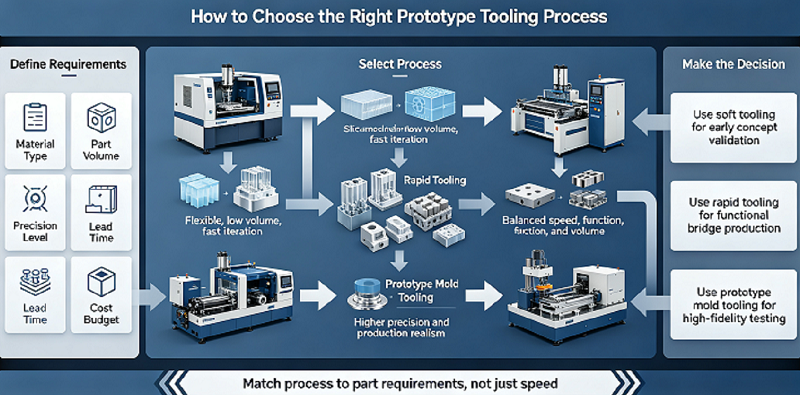
The selection of a prototype machining method should start from the machining technology itself.
Engineers should first determine what must be tested.
Visual prototypes, functional engineering prototypes, certification samples, trial production components, and market-formed parts all require different manufacturing solutions.
Production quantity is one of the most important considerations.
If only five parts are needed, CNC machining or 3D printing may offer better economic benefits.
If hundreds of injection-molded parts are needed, prototype molds become more attractive because the initial mold investment can be spread over the production quantity.
Material requirements should also be evaluated as early as possible.
If the project requires the actual production of thermoplastics such as ABS, PC, PP, PA, POM, PC/ABS, or glass-filled nylon, the prototype injection molding tool allows the selected polymer to be processed under actual molding conditions.
The complexity of parts can affect machining costs and delivery times.
Simple molds with direct parting lines and limited indentations can usually be manufactured more quickly.
Components that require multiple sliders, lifters, threaded insertions, complex closures, tight tolerances or complex cooling systems need additional engineering.
The expected tool life should also affect the selection of materials.
Aluminum may be suitable for short-term prototype runs, while pre-hardened steel may offer better value when thousands or tens of thousands of parts are expected.
The tolerance requirements must also be realistic.
Prototype molds can achieve precise formed components, but dimensional changes are affected by mold machining accuracy, polymer shrinkage rate, forming conditions, gate design, cooling, wall thickness, and part geometry.
Therefore, a successful project requires close collaboration among product designers, mold engineers, CNC machinists, and injection molding experts.
Manufacturability analysis and design should be completed before the start of mold production.
Engineers should review the drawing angles, uniform wall thickness, ribs, protrusions, notches, radius, parting line, gate, ejection position, shrinkage, and tolerance requirements.
If the project is likely to enter bridging or mass production, the decisions made during the prototype mold production process should support future manufacturing strategies.
The gate position, parting line selection, material properties, and forming parameters determined during the prototype production process can provide valuable information when designing the final production mold.
Therefore, costs should be evaluated together with risks.
The best prototyping tool strategy can achieve sufficient manufacturing realism to answer the engineering questions of the project without increasing unnecessary tool complexity.
7. N क्यों चुनें?ओबीएलई जैसे तुम्हारा प्रोटोटाइप टूलींग निर्माता
नोबल एक चीन-ब्रिटिश संयुक्त उद्यम है जिसे सरकार द्वारा "राष्ट्रीय उच्च-तकनीकी उद्यम" के रूप में सम्मानित किया गया है। हमारे दो प्रमुख व्यावसायिक क्षेत्र हैं: "स्मार्ट विनिर्माण" और "देखभाल उत्पाद"। "स्मार्ट विनिर्माण" व्यवसाय ग्राहकों को परियोजना-सहायक सेवाएं प्रदान करने में विशेषज्ञता रखता है, जिसमें पुर्जों की मशीनिंग और विनिर्माण शामिल हैं।
दस वर्षों से अधिक का पेशेवर विनिर्माण और रैपिड प्रोटोटाइपिंग का अनुभव। हमारी कुशल टीम आपकी नई परियोजनाओं को आपकी आवश्यकताओं के पूर्णतः पूरा करने के लिए सशक्त सहयोग प्रदान करती है; मानकीकृत प्रबंधन पुर्जों और उत्पादों की गुणवत्ता पर कड़ा नियंत्रण सुनिश्चित करता है; सुव्यवस्थित कार्यप्रवाह समान गुणवत्ता के साथ लागत को कम करता है।
वर्षों की कड़ी मेहनत और विकास के बाद, नोबल धीरे-धीरे सटीक पुर्जों की मशीनिंग और विनिर्माण करने वाली कंपनी से, संपूर्ण औद्योगिक श्रृंखला को समर्थन देने वाली सेवा क्षमताओं के साथ, एक सेवा-उन्मुख उद्यम में परिवर्तित हो गई है जो ग्राहकों की संपूर्ण परियोजनाओं के लिए पूर्ण समर्थन प्रदान करती है।
नोबल प्रोटोटाइप डिजाइन से लेकर उत्पादन तक, आपकी विश्वसनीय वन-स्टॉप कस्टम मैन्युफैक्चरिंग सॉल्यूशन है, जो विशाल विनिर्माण संसाधनों, उपयुक्त प्रौद्योगिकी, सुव्यवस्थित प्रक्रिया, विशेषज्ञ मार्गदर्शन और एक उत्तम गुणवत्ता निरीक्षण प्रक्रिया के माध्यम से आपके विचारों को वास्तविकता में बदल देती है।
NOBLE के पास निम्नलिखित योग्यता प्रमाण पत्र हैं:
आईएसओ 9001: 2015 – सामान्य विनिर्माण के लिए सुदृढ़ गुणवत्ता प्रबंधन। सुसंगत प्रक्रियाएं। दस्तावेजीकृत नियंत्रण। अनुरेखणीय निरीक्षण।
ISO 13485: 2016 – चिकित्सा उपकरण के पुर्जों के लिए सख्त गुणवत्ता मानक। कठोर प्रक्रिया सत्यापन। पूर्ण ट्रेसबिलिटी। प्रत्यारोपण योग्य और शल्य चिकित्सा पुर्जों के लिए अनिवार्य।
निष्कर्ष
Prototyping tools provide an effective bridge between early prototyping and full-scale manufacturing.
It enables engineers to test production materials, forming geometries, tolerances, assembly performance, and manufacturing feasibility before investing in mass production tools.
Compared with 3D printing and CNC machining, prototyping tools become particularly valuable when a project requires real formed parts or a large number of functional prototypes.
By choosing the right mold materials, manufacturing methods, mold complexity, and output, manufacturers can reduce development risks, enhance product verification, and achieve a smooth transition from prototype to production.
पूछे जाने वाले प्रश्न
1. What post-processing operations are compatible with prototype molded parts?
Common options include painting, laser marking, ultrasonic welding, and hot stamping; feasibility needs pre-verification according to mold material.
2. Can prototype tooling molds be modified later to become production-ready molds?
Partial modification is possible, but extensive rework often costs more than building a new formal mold.
3. What risks may occur when using glass-filled materials with aluminum prototype molds?
Severe mold abrasion will shorten mold life; pre-hardened steel molds are recommended for long-run needs.
4. How does environmental temperature affect prototype injection molding test results?
Ambient temperature influences part cooling speed and final shrinkage; the test environment should be kept stable.
5. Is surface texture replication achievable on soft prototype tooling?
Simple textures are available, but complex fine textures wear fast; hardened steel performs better.