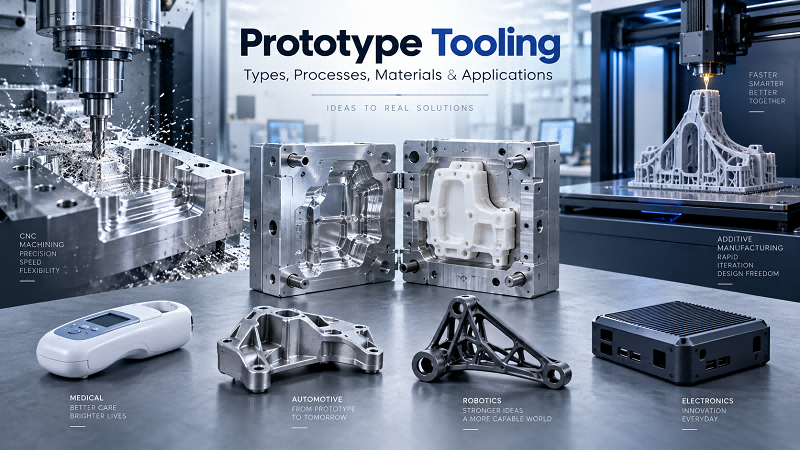
Rapid tooling technology offers manufacturers a faster way to produce molds, dies, fixtures, jigs, templates, and other manufacturing tools.
It is particularly suitable for prototype verification, bridging production, small-batch manufacturing, and early market testing.
However, depending on factors such as the required output, materials, and product design, other methods (such as rapid prototyping, traditional tools or soft tools) may produce more ideal results.
This guide outlines the concept of rapid mold technology and compares it with other manufacturing methods, aiming to assist engineers, designers, and purchasing teams in choosing the appropriate manufacturing strategy.
1. Co je Rychlé nástroje?
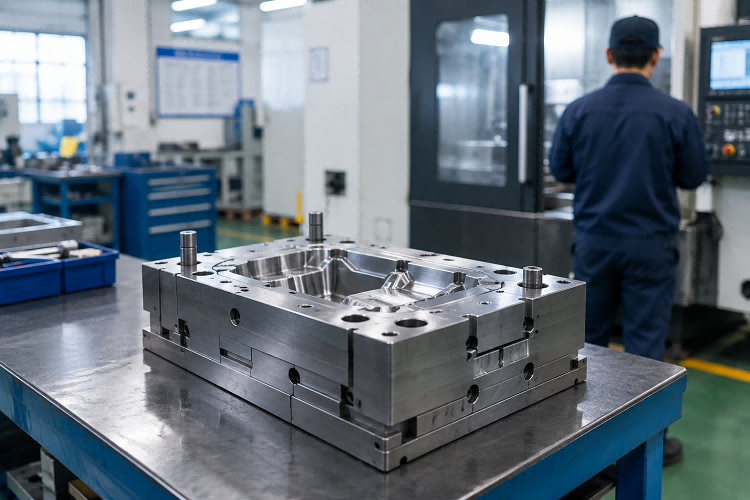
Rapid tooling refers to a set of manufacturing methods used to produce molds, dies, master patterns, fixtures, and other production tooling at speeds faster than traditional mold-making processes.
Rapid prototyping directly produces sample parts.
Rapid mold construction.
The factory uses these molds to manufacture finished parts.
Therefore, rapid mold construction supports prototyping and comprehensive mass production.
Manufacturers often use rapid mold injection molding, vacuum casting, thermoforming, compression molding, die casting and other processes that require custom molds.
Teams can quickly make tools using different materials or methods.
The choice depends on the project requirements:
- CNC obráběný hliník
- Předkalená ocel
- Silikonová guma
- Epoxidová pryskyřice
- polyuretan
- Kompozitní materiály
- 3D tištěné polymery
- Výroba kovových aditiv
People classify rapid processing into two main types: direct rapid processing and indirect rapid processing.
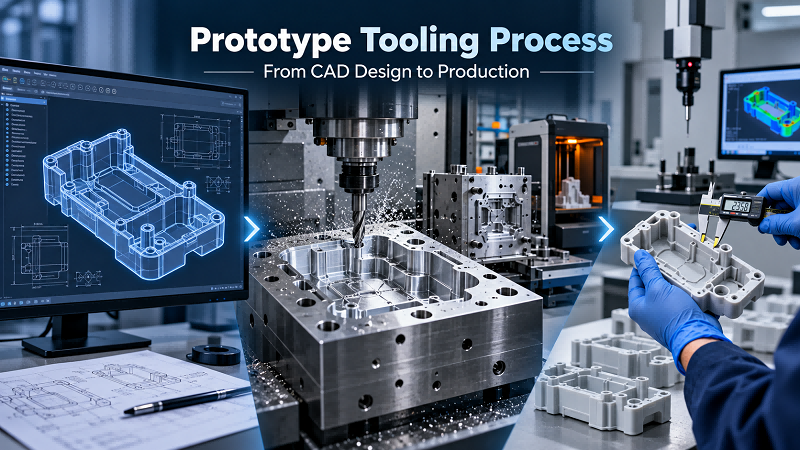
Direct rapid processing is carried out through CNC machining, additive manufacturing, or other methods.
These processes make the finished molds or tool parts directly.
The working mode of indirect rapid processing is different. The team first builds a master pattern or prototype. Then they use this pattern to make the final mold. Silicone molding and some casting methods are typical examples here. Rapid molds not only shorten the time for making molds. Its true benefit lies in linking prototype development with large-scale production.
2. Understanding Rapid Tooling Design
Good tool design is the key to the success of rapid prototyping. Rapid tooling focuses on rapid production. Even so, the mold must control material flow, cooling, part ejection, dimensional stability, surface finish, and consistent output. Poorly designed quick tools can produce many flaws. It can lead to flashes, dents, part warping, short shots, dimensional changes, long cycle times, or early mold damage.
Part Design and DFM Considerations
Design for Manufacturability, or DFM, should be performed before rapid tooling production begins.
Engineers typically evaluate:
- tloušťka stěny
- Úhly ponoru
- Podříznutí
- Žebra a výstupky
- Rohové poloměry
- Dělicí čáry
- Umístění bran
- Umístění vyhazovacích kolíků
- Srážení
- povrchová úprava
- Kritické tolerance
Complex features should be simplified where possible because every slide, lifter, insert, or undercut can increase tooling cost and manufacturing time.
A well-designed part therefore improves both tool manufacturing efficiency and final part quality.
Rapid Tooling Material Selection
The team selects tool materials based on the expected production operation, forming materials, working temperature, surface finish requirements, dimensional tolerances, and tool service life.
Aluminum is a common choice for rapid injection molds.
Workers process aluminium very quickly.
Steel has good wear resistance.
However, steel usually requires longer processing time and higher costs.
Polymer, resin, silicone, and composite material tools have further shortened the delivery time and cost.
However, these tools have relatively poor durability and heat resistance.
Balancing Speed, Cost, and Tool Life
Rapid mold design is all about finding the right balance.
Molds used for hundreds of test samples have very different structural requirements from those used for hundreds of thousands of production cycles.
Being too durable or having a structure that is too simple will both affect production.
The team must match the mold structure with the actual production goals.
This is the best rapid processing method.
3. Rapid Tooling vs. Rapid Prototyping
Co je Rapid Prototyping?
Rapid prototyping refers to technologies that use CAD data to quickly manufacture physical models or prototype parts.
Techniques used for rapid prototyping include:
- SLA 3D tisk
- SLS
- FDM
- MJF
- CNC obrábění
- Vakuové lití
- Other additive or subtractive manufacturing processes
Rapid prototyping is particularly useful during the early stages of product development.
Engineers can create prototypes, test their dimensions and functionality, identify design issues, modify CAD models, and quickly produce new versions.
Rychlé nástroje vs. rychlé prototypování
Nástrojové materiály
Rapid molds use aluminium, steel, silicone resin, epoxy resin, resin, composite materials, and printable tool polymers. Rapid prototyping of actual sample parts. It uses engineering plastics, photopolymers, powders, metals, processable plastics, or production-grade materials. The choice of materials depends on the selected process.
Objem formy
When you need many identical formed parts, rapid molds work better. Rapid prototyping is suitable for situations where only one or a few components are needed for design checks. Some rapid prototyping methods can also handle small-batch production.
Efektivita nákladů
Rapid prototyping bypasses the cost of building custom molds. It saves money for individual components and frequent design edits. Rapid processing requires an initial investment in molds. After you finish the mold, you can use it to make many parts. Therefore, as the total volume increases, the cost of each part will also decrease.
Účinnost výroby
Rapid prototyping can handle frequent design changes very well. Engineers directly create new parts from the updated CAD files. After the design is stable, rapid tooling can enhance production efficiency. A mold can repeatedly manufacture parts of consistent quality.
Under What Circumstances Should You Choose Rapid Tooling or Rapid Prototyping?
Vybrat Rychlé prototypování kdy:
- The product design is still changing frequently.
- Only one or several prototypes are required.
- You need quick form, fit, or functional testing.
- Production material validation is not yet essential.
- You want to avoid tooling investment.
Vybrat rychlé obrábění kdy:
- The design has reached a relatively stable stage.
- Multiple identical parts are required.
- Parts need to be manufactured using an actual molding process.
- Material performance must be validated.
- Pilot production or market testing is required.
In many development programs, the two technologies are complementary rather than competitive.
4. Conventional Tooling vs. Rapid Tooling
For decades, traditional tools have been driving large-scale manufacturing. It offers high precision, a long tool life, and a stable process. But it usually requires more time and cost than rapid processing.
What are traditional tools?
Traditional workwear encompasses traditional manufacturing methods.
Factories use these methods to manufacture production molds, dies, fixtures and similar tool components.
For injection molding work, manufacturers use hard tool steel to make traditional molds.
They design these molds for mass production.
Manufacturing may involve:
- CNC frézování
- CNC soustružení
- EDM
- Wire EDM
- broušení
- Vrtání
- Tepelné zpracování
- Leštění
- Mold fitting and assembly
These molds may include sophisticated cooling systems, slides, lifters, hot runners, replaceable inserts, and automated ejection systems.
Conventional Tooling vs. Rapid Tooling
Nástrojové materiály
Most traditional molds use tough tool steel and other wear-resistant materials. These materials can withstand long-term production. Rapid molds usually choose aluminum, pre-hardened steel, polymers or composite materials that are easy to process. These materials reduce the time required to manufacture tools.
Objem formy
Traditional molds are suitable for large-scale and long-term manufacturing work. Teams typically select rapid tools for prototypes, trial runs, bridging production, and medium and small batch production.
Efektivita nákladů
Traditional processing requires a large amount of upfront costs. However, the cost is spread across many components, thus making it cheaper in mass production. The start-up cost of rapid processing is usually low. This method is very effective when the total order is too small to cover the cost of the entire production mold.
Účinnost výroby
After production begins, a well-designed traditional tool can provide a stable cycle, automation support, and reliable long-term output. Quick tools can help projects proceed more quickly in the early stage. Builders can complete molds quickly and start production even faster.
Under What Circumstances Should You Choose Conventional Tooling or Rapid Tooling?
Vybrat conventional tooling kdy:
- Demand is stable and high.
- The design is finalized.
- Long tool life is required.
- Automated mass production is planned.
- Low unit cost at high volume is a priority.
Vybrat rychlé obrábění kdy:
- Doba uvedení na trh je kritická.
- Production quantity is limited.
- Design changes may still occur.
- Pilot production is required.
- The cost of a full production tool cannot yet be justified.
Rapid tooling is especially valuable as bridge tooling, allowing production to begin while long-life production molds are still being developed.
5. Soft Tooling vs. Rapid Tooling
Rapid tooling describes the objective of manufacturing tooling quickly. Soft tooling describes tools manufactured from relatively less durable or easier-to-process materials.
What Is Soft Tooling?
Soft tooling uses relatively flexible or less durable materials to manufacture molds and manufacturing aids quickly and economically.
Common soft tooling materials include:
- Silikonová guma
- polyuretan
- Epoxidová pryskyřice
- Fiberglass composites
- Certain aluminum alloys
- 3D tištěné polymery
Soft Tooling vs. Rapid Tooling
Nástrojové materiály
Soft molds mainly use silicone, resin, composite materials, and polymers. These materials are very easy to handle. Rapid molds can use these same materials. It is also applicable to aluminum or steel processed by cnc. Therefore, rapid molds cover a wider range of manufacturing options.
Objem formy
Soft molds are suitable for small-batch production. This tool wears out quickly. Metal rapid mold processing has more cycles. The exact quantity depends on the material, mold design, molding resin, part shape, temperature, and processing setup.
Efektivita nákladů
The upfront cost of soft tools is very low. The cost of rapid metal processing is relatively high at the initial stage. It becomes more cost-effective when you need extra parts.
Účinnost výroby
The team can produce soft tools very quickly. It is very effective for small-scale production operations. Aluminum or steel rapid molds take longer to build. But it offers better consistency, thermal performance, and higher production capacity.
Under What Circumstances Should You Choose Soft Tooling or Rapid Tooling?
Vybrat měkké nástroje kdy:
- Only a small batch is needed.
- Tooling budget is highly restricted.
- Product geometry may still change.
- Very fast tool production is required.
- Casting or prototype production is the primary objective.
Vybrat rapid tooling with metal molds kdy:
- Higher repeatability is required.
- More production cycles are expected.
- Actual injection molding materials need to be tested.
- Dimensional accuracy is important.
- Pilot or bridge production is planned.
6. Hard Tooling vs. Rapid Tooling
Hard molds focus on durability and stable long-term production. Rapid Tools prioritize rapid tool delivery and flexible product development.
What is hard Nástroje?
Hard tooling refers to sturdy molds, dies, fixtures, and production gears. Engineers design them for many production cycles over a long period of time. Commonly used materials include hardened steel, tool steel, nickel alloys, and other wear-resistant materials.
These tools handle repetitive mechanical forces, temperature changes, pressures, and material wear. Therefore, manufacturers need to carry out careful processing and surface treatment on them.
Hard Tooling vs. Rapid Tooling
Nástrojový materiál
Hard tooling predominantly uses durable metallic materials such as hardened tool steel.
Rapid tooling may use aluminum, pre-hardened steel, softer metals, polymers, resins, or composites.
Objem formy
Hard tooling is designed for sustained high-volume manufacturing.
Rapid tooling is commonly used for lower production volumes, engineering validation, pilot production, and bridge manufacturing.
Nákladová efektivita
Hard tooling requires greater upfront investment.
However, at sufficiently high production volumes, its longer service life can reduce tooling cost per part.
Rapid tooling has lower entry costs and reduces financial risk when future demand is uncertain.
Účinnost výroby
Hard tooling can deliver excellent production efficiency once mass production is established.
Rapid tooling provides greater efficiency during product introduction because manufacturing can begin sooner and tooling modifications are generally easier to implement.
Under What Circumstances Should You Choose Hard Tooling or Rapid Tooling?
Vybrat tvrdé nářadí kdy:
- The product will enter stable mass production.
- Very high production quantities are expected.
- Long mold life is essential.
- Tight process consistency is required.
- Tooling changes are unlikely.
Vybrat rychlé obrábění kdy:
- Demand is uncertain.
- Production must begin quickly.
- Engineering changes remain possible.
- A smaller investment is preferred.
- The project is moving from prototype to production.
7. 3D Tisk vs. Rapid Tooling
3D printing has transformed product development by allowing complex physical components to be manufactured directly from digital designs without dedicated tooling.
Co je 3D tisk?
3D printing, also called additive manufacturing, creates physical parts by adding material layer by layer according to a digital 3D model.
Mezi běžné procesy patří:
- FDM
- SLA
- SLS
- MJF
- DLP
- Svařování kovového práškového lože
Unlike injection molding, 3D printing normally does not require a mold. This allows engineers to move directly from CAD design to physical parts.
Complex internal channels, lightweight lattice structures, customized geometries, and low-volume components can therefore be produced without conventional tooling.
3D Printing vs. Rapid Tooling
Nástrojový materiál
3D printing typically manufactures the final component directly from polymer, resin, nylon, metal powder, or other printable materials.
Rapid tooling manufactures a mold or tool from aluminum, steel, resin, silicone, polymer, or composite materials. The mold is then used to produce the final parts.
Objem formy
3D printing is particularly attractive for individual components, customized products, prototypes, and small production quantities.
Rapid tooling becomes more attractive when larger numbers of identical parts are required.
Nákladová efektivita
3D printing eliminates the need for mold investment, which makes it economical at very low quantities.
However, individual printing time and material costs remain for every component.
Rapid tooling requires an initial mold investment, but once the tool is available, repeated molding can significantly reduce the cost per component as production quantity increases.
Účinnost výroby
3D printing allows immediate design changes because engineers simply update the digital model and print another part.
Rapid tooling requires mold modification when the design changes.
Under What Circumstances Should You Choose 3D Printing or Rapid Tooling?
Vybrat 3D tisk kdy:
- Only a few components are needed.
- Design changes occur frequently.
- Highly complex geometry is required.
- Customization is important.
- You want to avoid mold investment.
- Prototype speed is the main priority.
Vybrat rychlé obrábění kdy:
- Tens, hundreds, or more identical parts are required.
- Production-grade molding materials need to be evaluated.
- Surface finish and process repeatability are important.
- Injection molding characteristics need to be validated.
- Pilot manufacturing is beginning.
8. Proč zvolit N.OBLE jako tvůj rychlé obrábění výrobce
NOBLE je čínsko-britský společný podnik, kterému vláda udělila ocenění „Národní high-tech podnik“. Máme dva hlavní obchodní směry: „Inteligentní výroba“ a „Produkty péče“. Podnik „Inteligentní výroba“ se specializuje na poskytování produktů zákazníkům project support services, including parts machining and manufacturing.
Více než 10 let zkušeností s profesionální výrobou a rychlým prototypováním. Náš efektivní tým poskytuje silnou podporu vašim novým projektům, abyste na 100 % splnili své požadavky. Standardizované řízení přináší přísnou kontrolu kvality dílů a produktů. Rozumný pracovní postup dosahuje nižších nákladů při stejné kvalitě.
Po letech tvrdé práce a vývoje se společnost NOBLE postupně transformovala z podniku zabývajícího se obráběním a výrobou přesných dílů s kompletním průmyslovým řetězcem a servisními možnostmi na podnik orientovaný na služby, který poskytuje plnou podporu pro všechny projekty zákazníků.
NOBLE je vaše důvěryhodné komplexní řešení pro zakázkovou výrobu, od návrhu prototypu až po samotnou výrobu, a to prostřednictvím obrovských výrobních zdrojů, vhodné technologie, zefektivněného procesu, odborného poradenství a perfektního procesu kontroly kvality, které promění vaše nápady ve skutečnost.
NOBLE má následující kvalifikační certifikáty:
ISO 9001: 2015 – Robustní řízení kvality pro všeobecnou výrobu. Konzistentní procesy. Dokumentovaná kontrola. Sledovatelná kontrola.
ISO 13485: 2016 – Přísnější normy kvality pro součásti zdravotnických prostředků. Přísná validace procesu. Plná sledovatelnost. Požadováno pro implantabilní a chirurgické součásti.
9. Závěr
Rapid processing strikes a balance between speed, cost, and production capacity.
When compared with rapid prototyping, traditional tools, soft tools, hard tools, and 3D printing, rapid tools offer a practical option. The team uses it for prototype inspection, bridging production and medium- and small-batch production.
Your final choice depends on design stability, production quantity, budget, material requirements, and expected tool life. The manufacturer selects the correct mold plan for each development stage. This reduces costs, shortens delivery times, and enhances overall production efficiency.
10. FAQS
1. What key risks should be prevented when applying rapid tooling for medical-grade component production?
Risk of material incompatibility and unstable mold surface quality; verify medical material adaptability and perform strict mold surface inspection in advance.
2. Can rapid tooling molds be modified to switch between different product variants?
Partial modification is achievable, but large-scale structural changes are not cost-effective; insert-based design facilitates later adjustments.
3. How to judge whether a project is suitable for direct rapid tooling instead of iterative prototyping first?
Judge by design maturity, target batch size, and material requirements; pick rapid tooling if the core structure is locked and dozens to hundreds of parts are needed.
4. What post-processing work is necessary for parts produced by rapid tooling?
Deburring, surface polishing, and dimensional inspection; medical parts additionally need cleanliness and biocompatibility verification.
5. How does the lead time of rapid tooling change with part complexity?
Complex undercuts and sliding structures extend delivery cycles; simplify non-critical features to shorten tool-making time.