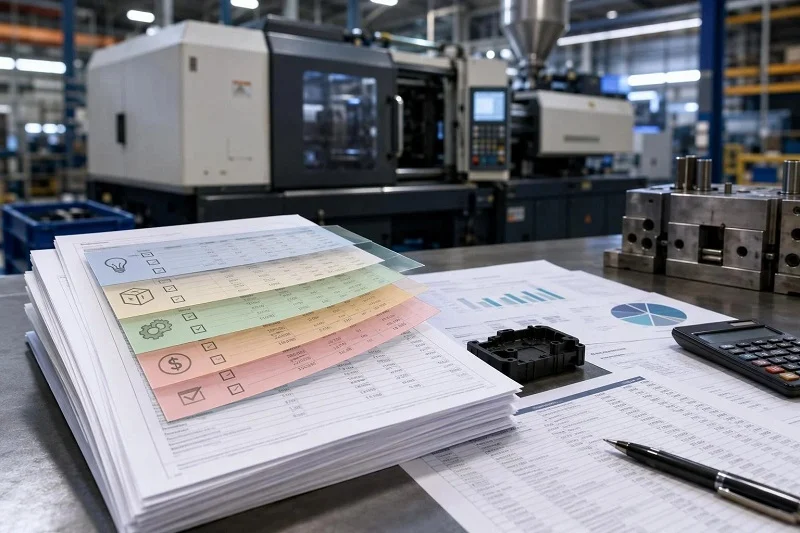
Cetakan injeksi cost is rarely a single number. It is a stack of decisions — wall thickness, cavity count, steel grade, runner type, trial rounds — and each one moves both the tooling line and the piece price. Most quote confusion comes from comparing totals that were never built on the same assumptions: one supplier prices a soft single-cavity tool with a high piece price, another prices a hardened multi-cavity tool with a low one, and the two figures look like a bargain and a rip-off when they are really two different programs.
This guide unpacks that stack in the order you will meet it. It starts with the anatomy of a quote — what material, machine time, tooling and program-level items actually pay for. It then covers the costs a low quote tends to leave out, a repeatable method for normalizing competing quotes onto equal assumptions, and a quick-reference view of how injection molding cost shifts across production volume bands. It closes with the design levers you control before you ever send an RFQ, and with the questions buyers ask most often.
Each section stands on its own if you need one answer quickly, but they share a vocabulary: once you know what a cavity count or an SPI class does to a total, the later sections read as consequences rather than new material.
What Actually Goes Into an Injection Molding Cost Quote
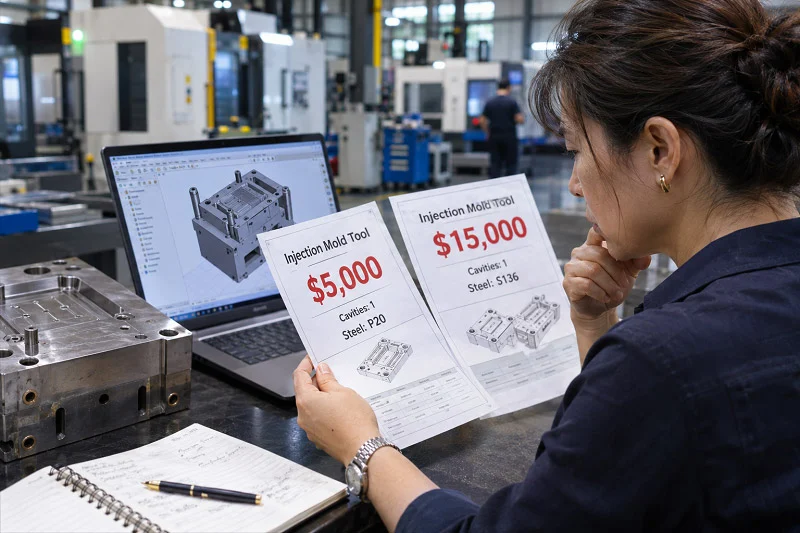
A quote is a model of your program, not a price tag. It contains three cost pillars that scale with the part and the run, plus a set of program-level items that sit outside them. Knowing which line belongs to which group tells you immediately whether a number will shrink, grow, or disappear as volume changes.
The Three Pillars: Material, Machine Time, and Tooling
Material cost is resin price multiplied by the material actually charged per part — part weight plus runner weight that cannot be reused, plus startup scrap and rejects. Machine cost per part is the machine hourly rate divided by 3,600, multiplied by cycle time, divided by cavities. Tooling cost per part is total mold cost divided by the smaller of production volume or (cavities × cavity life).
At production volumes, material is usually 20–40% of total part cost and machine time 30–50%, but those shares move with volume and part type: tooling dominates at low volume and fades toward negligible once amortized, while material share rises for commodity parts.
Wall thickness is the lever that surprises people. Cooling time scales with the square of wall thickness, so a 2 mm ABS wall cools in about 7 seconds while a 4 mm wall needs about 28. Cavity count works differently: it multiplies processing output — a 12-cavity mold can cut processing cost per piece by close to an order of magnitude — but it does not change material cost per part, and it raises both machine and mold cost.
Tooling Line Items: Steel Grade, Cavity Count, and Mold Class
The tooling number buys a specific build. Steel grade sets baseline durability: P20 comes pre-hardened to roughly 30–36 HRC and handles moderate volumes; H13 reaches about 48–52 HRC and suits long runs; S7 goes up to about 56 HRC, the highest hardness rating used in injection molding. Each step up extends tool life but adds machining time and cost.
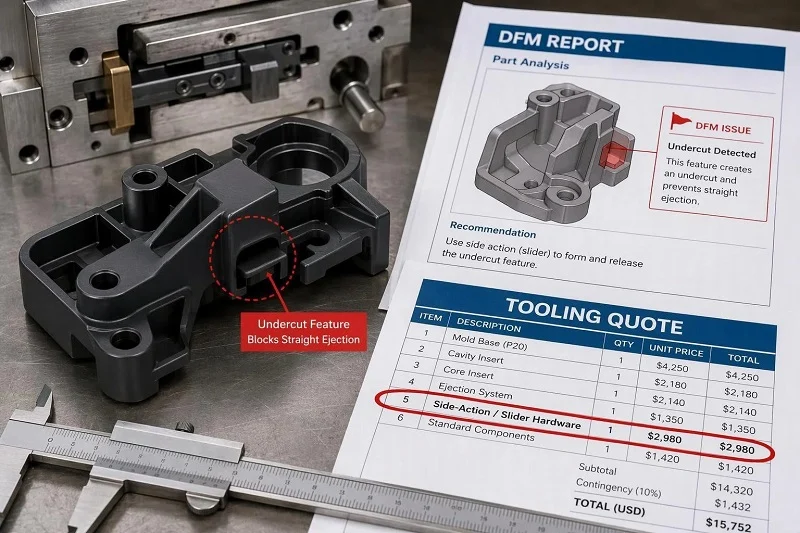
Cavity count raises tooling cost and lowers piece price. Side actions, lifters and unscrewing cores add mold-making hours — unscrewing cores for internal threads run roughly 200 to 300 mold-making hours each. Hot runners cost more upfront than cold runners but eliminate runner waste.
SPI classification is the industry shorthand for expected life: Class 101 for a million cycles or more, 102 up to a million, 103 under 500,000, 104 under 100,000, and 105 for prototypes under 500 cycles. The trap is that classes count cycles, not parts — a four-cavity mold makes four parts per cycle, so a Class 103 tool in four cavities is rated for up to two million parts.
Program-Level Line Items: NRE, Sampling, and Secondary Operations
Outside the three pillars sit the items that make a quote complete. NRE covers the design labor behind mold construction drawings, gate layout, cooling channel design and draft analysis; it typically runs $500–$3,000 for straightforward parts and considerably more for complex geometry, and the more useful question is whether it includes mold flow simulation and a formal DFM review.
Sampling rounds follow: T0 as an internal mold health check, T1 as the first real sample set, and T2 or T3 to verify fixes and stability. Trial rounds commonly cost $300–$1,500 each, covering machine time, test resin and inspection labor.
Then come first-article inspection, secondary operations such as degating, pad printing, ultrasonic welding and insert installation (roughly $0.10–$2.00 per part depending on complexity), packaging, and a scrap allowance — industry average 3–5% of shots. None of these is a red flag. Their absence from a quote is the thing to notice.
The Hidden Costs a Low Quote Leaves Out
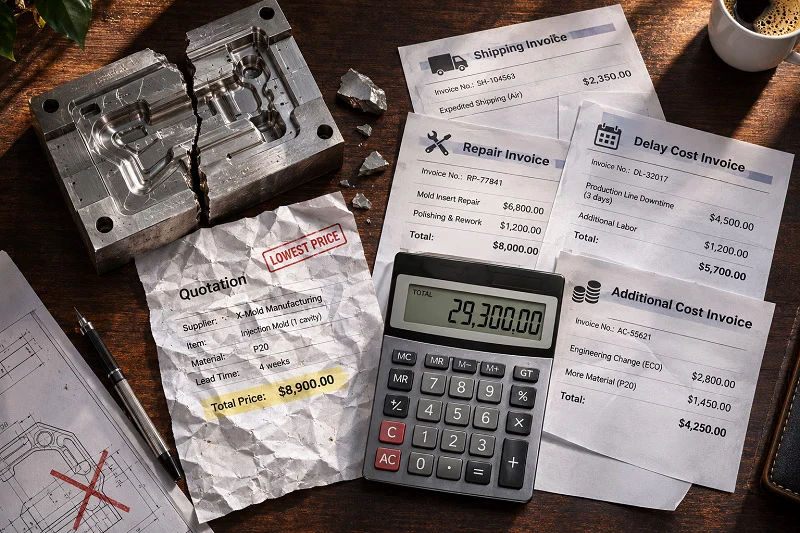
The lowest total is often not the lowest cost, and the reason is structural rather than sinister. A quote is built to be compared, so costs that are uncertain at quotation time — extra trial rounds, inspection fees, storage, engineering changes — tend to be deferred rather than estimated. They do not vanish. They reappear as invoices later, after the comparison has already been won. Reading a quote therefore means reading what is absent as carefully as what is printed.
The 10–15% Rule and Why Budgets Break
Experienced procurement teams recommend budgeting 10–15% above the stated quote total to cover predictable omissions. The mechanism is straightforward: when several suppliers bid the same part, the one who leaves out FAI, a second sampling round and mold maintenance presents the smaller number, and the comparison rewards that omission.
Treat the rule as a pattern to check for rather than an accusation. A quote that is 12% below its competitors and itemizes fewer line items is not necessarily cheaper — it may simply be showing you less of the program. The practical response is to ask which categories are included, not to assume the gap will stay closed.
Omissions That Resurface: Sampling Rounds, FAI, Storage, and ECOs
Four categories recur most often. T2 and T3 rounds become chargeable when design changes trigger them, even where T1 was included. First-article inspection, typically $500–$2,000 depending on complexity, is frequently absent and may bring PPAP documentation requirements with it in medical or automotive programs. Mold storage runs about $50–$200 per month when you own the tool but it lives at the molder. Engineering change orders carry their own cost whenever the part or tool changes after approval.
Secondary operations quoted as “needed” deserve the same scrutiny: a piece price that covers a raw molded part is not comparable to one covering a finished, assembled, tested and packaged unit. Confirm in writing which rounds are included, what triggers additional charges, what documentation ships with each round, and who pays for storage and transfer.
Tooling Built Too Light: The Rebuild Cost
A tool built too light for its program may need rebuilding mid-run, and a premature re-tool at several times the original mold cost erases every piece-price saving that justified the cheaper tool. A tool built too heavy ties up capital you did not need to spend. Both errors come from the same place: matching tooling to the purchase order rather than to the program.
Resin abrasiveness shifts the calculus. Glass-filled nylon and similar reinforced materials act like sandpaper on mold surfaces and can reduce mold life by 30–50% compared with unreinforced resins, so a tool that would comfortably serve an unfilled grade may need refurbishment far sooner in a glass-filled one. If the application requires reinforcement, plan for harder steel or more frequent maintenance from the start.
How to Compare Injection Molding Quotes
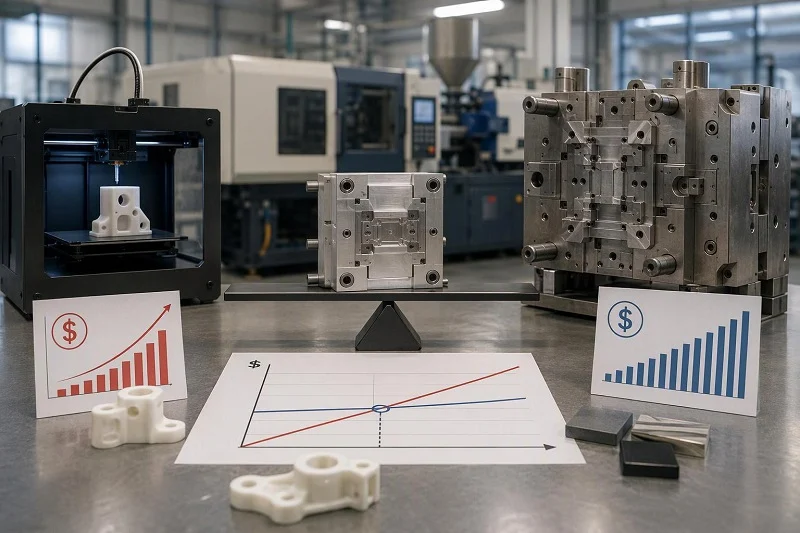
Comparing quotes is a normalization exercise before it is a pricing exercise. Two totals only mean something once they describe the same tool, the same part and the same batch terms. The method below takes a few minutes per quote and prevents the most expensive mistake in sourcing: choosing the smaller number for a program that was never priced on equal terms.
Lock the Four Assumptions Before You Compare
Four constraints must be identical across quotes for a comparison to hold: cavity count, SPI mold class and cavity steel, runner system (cold versus hot), and minimum production batch release.
Without them, the totals describe different programs. One supplier quotes a one-cavity soft tool with a high piece price; another quotes a multi-cavity hardened tool with a low one. The second may look cheaper per part and more expensive upfront, and neither figure tells you which is right for your volume until the assumptions are fixed. Put all four in the RFQ itself, so every bidder prices the same engineering baseline — including the batch release quantity, since small batches carry setup amortization that larger ones do not.
Normalize the Numbers: Total Cost of Ownership Math
Convert each quote to a common basis: total program cost equals tooling, plus piece price multiplied by volume, plus expected program-level costs — all calculated over the same volume and the same assumed tool life.
Two adjustments matter. First, if a quote bundles tooling into the piece price, isolate the tooling before comparing it with one that prices tooling separately. Second, cap the amortization at the tool’s realistic life: if volume exceeds cavities × rated cycles, the model needs a second tool, and the quote that ignored that will look artificially cheap.
For lifecycle decisions, compare repair cost per cycle with new tooling cost per cycle. If repair cost per cycle exceeds 150% of new tooling cost per cycle, replacement usually makes more financial sense than another rebuild.
Read the Trial and Quality Terms
“T1 included” does not mean the same thing at every supplier. Many shops call the first press run T1; many others call that internal run T0 and reserve T1 for the first official trial shared with the customer. One supplier’s T1 can therefore sit a full trial round ahead of another’s, which quietly changes what the quote covers and when you will actually hold parts.
Ask what each label includes and what comes before it. Confirm which rounds are chargeable and under what trigger. And specify the deliverables: a trial report recording material and key process settings, physical samples, and a dimensional report against your drawing. Samples without a report are close to wasted, because you cannot tell whether a measurement is a one-off or a trend.
Injection Molding Cost by Production Volume

The bands below are illustrative industry ranges, not quotes. Actual injection molding cost depends on part geometry, resin, tolerance, region and supplier, so use these to orient a program and to sanity-check a bid — not to replace one.
Prototipe dan Bridge Volumes (Under 10,000 Parts)
This band runs on aluminum or MUD tooling for non-abrasive materials. Prototipe tools typically produce fewer than 500 parts for design validation; low-run aluminum or MUD tools cover limited runs under roughly 10,000 parts annually. Bridge tooling — an aluminum prototype mold in the $3,000–$8,000 range — can produce the first 1,000–5,000 units to validate demand before steel investment.
At this band, tooling dominates total spend and piece price matters far less. A higher piece price on a $5,000 aluminum tool is usually the cheaper route than a hardened tool bought for a program that may never scale.
Mid Volume (10,000–100,000 Parts)
This is the genuinely ambiguous band. Pre-hardened steel such as P20 competes with aluminum depending on resin abrasiveness and demand trajectory. A program likely to keep climbing may be better served by steel from the start; a stable lower-volume part may run well on a more economical tool.
Tooling is still a visible share of total cost here, but piece price has begun to matter. This is the band where the cavity-count break-even calculation does the most work.
High Volume (100,000+ Parts)
Hardened steel (H13, S7), multi-cavity tools, hot runners and automation define this band. Tooling cost becomes negligible per part and cycle time becomes the dominant lever — one second saved is worth roughly $22,000 a year at a million parts, which is why cooling and cavitation decisions carry so much weight here.
A single-cavity tool quoted for 200,000 annual units is a signal worth questioning: the piece-price economics may not be optimized for your volume. At a million parts or more, multi-cavity hardened tools with hot runners and automation are the norm.
A Volume-Band Comparison Table
| Pita | Volume tahunan tipikal | Tooling material and class | Cavity tendency | Runner type | What dominates cost | Risiko utama |
| Prototype / bridge | Di bawah 10,000 | Aluminum or MUD, SPI Class 104–105 | Rongga tunggal | Dingin | Tooling | Tool wears out before demand is proven |
| Volume tengah | 10,000-100,000 | Pre-hardened P20, SPI Class 103–104 | 2–4 rongga | Dingin | Tooling amortization plus piece price | Wrong tool for the demand trajectory |
| Volume tinggi | 100,000 + | Hardened H13 or S7, SPI Class 101–102 | Rongga ganda | Cold through ~1 million; hot above | waktu siklus | Under-cavitation for stated volume |
Figures are illustrative industry ranges. Actual quotes depend on part geometry, resin grade and region.
Design Decisions That Move Injection Molding Cost
Long before a supplier’s rate card enters the conversation, the CAD file has already set most of the injection molding cost. Wall section, cavity count and gate layout determine cycle time, material consumption and tooling complexity — the three inputs every quote is built from. The levers below are the ones a design team can still pull before an RFQ goes out, and each one moves the number in a predictable direction.
Wall Thickness and Cooling Time
Cooling is governed by wall thickness squared, so doubling a wall quadruples cooling time: a 2 mm ABS wall cools in about 7 seconds, a 4 mm wall in about 28. That is one of the highest-leverage design levers available. Uniform walls also reduce warpage, which cuts both cycle time and the rework that follows it.
Cavity Count and the Break-Even Calculation
A four-cavity mold costs roughly 2.5 times a single-cavity tool but pays for itself above approximately 50,000 total units, where the lower piece price recovers the extra tooling spend. Cavity count is not free choice, though: mold dimensions, cooling capability and balanced fill across cavities all constrain how far you can go.
Gate Placement, Runner Design, and Scrap
Gates positioned to promote uniform cooling shorten the cycle, and internal gates can reduce material per shot by 5–15%. Runner systems typically equal about 5–37% of part weight, falling as part size grows; most runner material is reground, and only the portion above the allowable regrind percentage counts as scrap.
Conclusion: Turning an Injection Molding Cost Quote Into a Decision
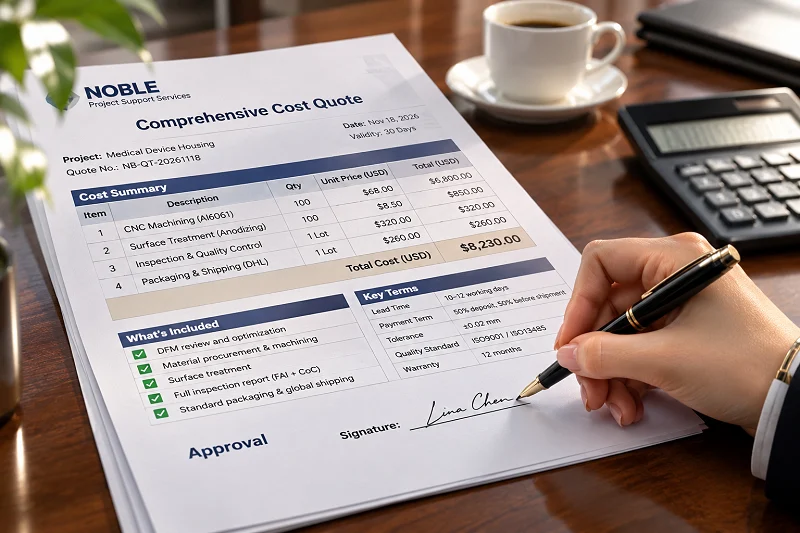
A quote is not a price. It is a map of the assumptions a supplier has made about your program — which cavity count, which mold class, which runner, which trial rounds, which operations are inside the number and which are waiting outside it. Two quotes can differ by a factor of two and both be honest, simply because they describe different programs.
Three habits close that gap. Read the line items rather than the total, because absence is information: a missing sampling round or inspection fee is an assumption, not a saving. Normalize before comparing, locking cavity count, mold class and steel, runner system and batch release so every total describes the same work. And match tooling to volume, so a soft tool is not asked to run a program that needs hardened steel and a hardened tool is not tying up capital on a short run.
That reframing changes what you do next. Instead of asking suppliers for a number, prepare an RFQ that already states the four assumptions, the resin grade, the annual volume and the program life. Quotes then arrive comparable, and the injection molding cost conversation becomes a technical one about cycle time, cavitation and tool life — which is where the real savings sit.
Mengapa Memilih NOBLE untuk Pencetakan Injeksi?
NOBLE is one of China’s outstanding machining and manufacturing companies, and our service capability and professional machining expertise help customers complete prototyping and volume production efficiently. Whether you are validating a design on a bridge tool or scaling into a hardened production mold, the same organization can carry the program through its stages rather than handing it between suppliers.
We are certified to ISO 9001:2015 and ISO 13485:2016. Those certifications apply to the quality system behind the work, which matters because documentation and inspection expectations attach to the program rather than to the quantity produced — a pilot build carries the same record logic as a full production run.
What distinguishes NOBLE is scope. We provide a full service from design to assembly — not production alone. That means the same team can support the design-for-manufacturability review before a tool is cut, the tooling and molding decisions that follow from your resin and run length, and the inspection and assembly steps after parts come off the press.
If you are preparing an injection molding project, bring us the part drawing, the resin grade, the quantity band and your documentation requirements. Our team can review the design against the tooling decision, advise on mold class and material for your resin and run length, and quote tooling and parts so that the comparison you run is a meaningful one.
FAQs about Injection Molding Cost
The questions below come up in almost every quote review. Each answer is short and points back to the section that develops it.
What is the biggest driver of injection molding cost?
It depends on volume. At low volume, tooling dominates. At high volume, machine time and cycle time take over, and material becomes a larger share for commodity parts once the mold is fully amortized.
Why is one quote half the price of another?
Usually because the two totals rest on different assumptions — cavity count, mold class and cavity steel, runner system, or batch release terms. Normalize all four before treating the numbers as comparable.
How accurate is a concept-stage cost estimate?
Roughly ±20–30% at concept stage, improving to ±10–15% once exact wall thickness, confirmed cavity count and regional machine rates are known.
When does a steel mold pay for itself over aluminum?
Steel is usually right at 100,000 or more parts a year, for abrasive resins, or when the part needs lifters, slides or multiple cavities. In the 10,000–100,000 band, the choice depends on the part, the resin and the expected demand growth.
Who owns the mold, and where is it stored?
Ownership and storage terms should be confirmed in writing before tooling begins. Storage charges are frequently omitted from an initial quote.