Prototype molds are an important stage in modern product development. Before investing in expensive production molds or large manufacturing systems, engineers need to confirm whether the design can be manufactured, assembled, and executed as expected in practical applications.
The prototype machining procedure provides a practical method for converting CAD models into physical prototype parts.
It can produce functional components that have similar materials, structures, and performance characteristics to the final product.
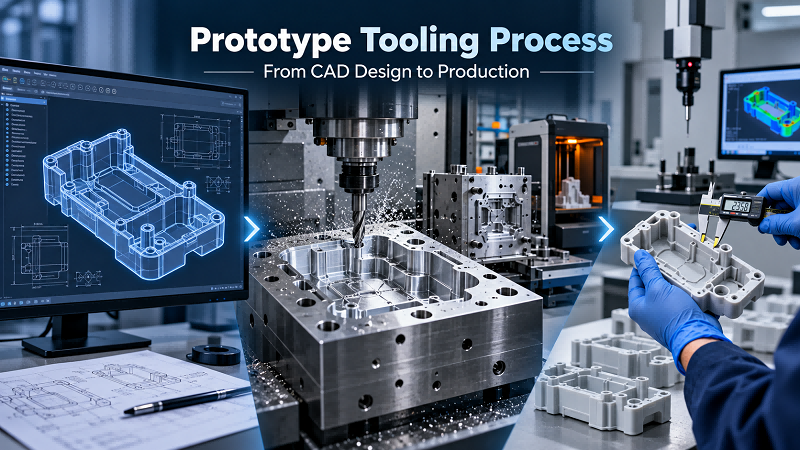
The workflow of a prototype mold involves multiple engineering stages, including CAD design analysis, design optimization, mold strategy selection, mold or mold manufacturing, prototype production, quality inspection, and production preparation.
Each step will affect the quality of the final product, development costs, and manufacturing efficiency.
With the development of CNC machining, rapid injection molding, additive manufacturing, and advanced mold technology, companies can now shorten the product development cycle while maintaining high precision and reliability.
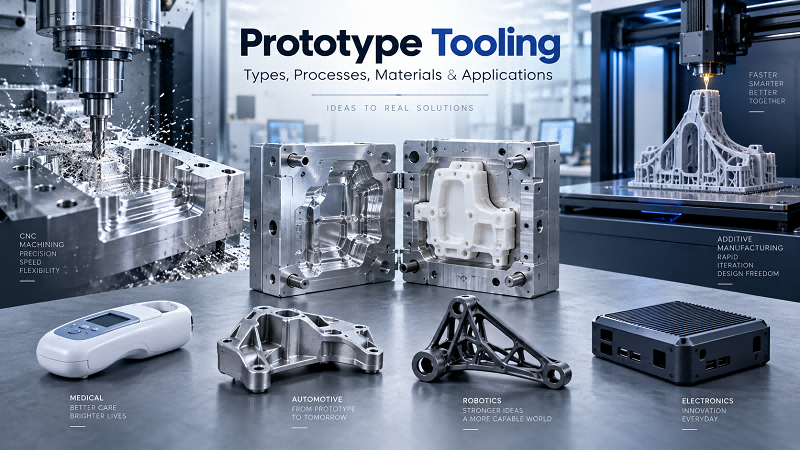
Prototype molds have been widely applied in industries such as automobiles, aerospace, medical equipment, consumer electronics, robotics, and industrial equipment.
This article explains the complete prototyping tool process from CAD design to production.
1. Understanding the Complete Prototype Tooling Process
Prototype machining is a systematic workflow that transforms digital product design into physical manufacturing solutions.
Although the ultimate goal is to create prototype components, the process involves more than simply producing molds.
The first stage begins with a digital CAD model created by a product designer or engineer.
This model defines the geometry, dimensions, tolerances, assembly features, and functional requirements of the components.
Before starting to make the prototype mold, engineers will carefully check the CAD data to determine whether the design is suitable for manufacturing.
At this stage, the engineering team analyzes factors such as part complexity, material requirements, production quantity, and expected test conditions.
Products designed for injection molding may require different considerations compared to those produced through CNC machining or silicone casting.
After design analysis, the engineer selects the appropriate prototype machining method.
This decision depends on several factors:
- Số lượng mẫu yêu cầu
- Required material properties
- Dimensional accuracy requirements
- Expected surface finish
- Lịch trình phát triển
- Available manufacturing budget
For instance, when a company needs to quickly injection mold parts at a lower mold cost, it usually opts for aluminum prototype molds.
When high precision and strong mechanical properties are required, cnc machining tools can be given priority.
For early proof-of-concept, tools based on additive manufacturing can provide faster results.
Once the tooling method is determined, the manufacturer creates the prototype tooling in accordance with the engineering specifications.
This stage includes machining, assembly, finishing, and inspection.
After the mold is completed, the manufacturer produces and evaluates the prototype parts.
The verification stage is of vital importance as it provides genuine manufacturing feedback.
Engineers can compare prototype parts with CAD models, test product performance, and determine improvement plans.
If modifications are needed, the CAD design or mold structure can be updated before going into production.
The ultimate goal of the prototype tool is a smooth transition from product development to manufacturing.
By addressing the challenges in design and production as early as possible, the company can reduce risks and improve efficiency during large-scale production.
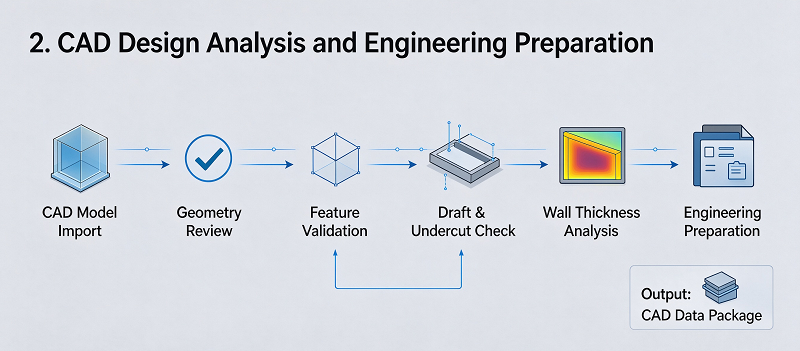
2. CAD Design Analysis and Engineering Preparation
CAD design is the foundation of the prototype machining procedure. Digital models provide necessary information for tool development, manufacturing planning, and quality inspection.
Before the production of prototype molds begins, engineers will conduct a design review to ensure that the parts can be successfully manufactured.
This stage helps identify potential problems before they become costly manufacturing issues.
Reviewing CAD Models and Product Requirements
The first step is to analyze the CAD model and understand the product requirements.
Engineers review the dimensions, tolerances, material specifications, assembly relationships, and functional requirements of the parts.
Important design factors include wall thickness, characteristic geometry, holes, ribs, bosses, mounting points, and moving parts.
These details directly affect the difficulty of mold design and manufacturing.
For injection molding prototypes, engineers evaluate the requirements related to the mold, such as the drawing Angle, parting line, and ejection method.
For CNC prototype molds, engineers focus on machining accessibility, tool movement, and fixture design.
A complete CAD review ensures that the prototype tool can accurately reproduce the expected product design.
Tối ưu hóa thiết kế cho sản xuất (DFM)
Manufacturing-oriented Design (DFM) analysis is one of the most important steps before the production of prototype molds.
DFM helps engineers modify product designs to enhance manufacturability while maintaining functional requirements.
During the DFM analysis process, engineers can adjust unnecessarily complex features, improve the wall thickness distribution, optimize the corner radius, or simplify the machining operation.
For formed parts, DFM considerations include reducing notches, improving the draft Angle, optimizing the gate position, and ensuring proper material flow.
For cnc machined components, engineers can modify the geometry to improve tool usage and reduce machining time.
Early DFM optimization can significantly reduce mold costs, shorten the manufacturing cycle, and prevent defects in the prototype production process.
Prototype Tooling Design Planning
After CAD analysis and DFM optimization, engineers began to plan the structure of the prototype mold.
This stage involves selecting the mold structure, determining the manufacturing process, and preparing detailed mold drawings.
Engineers consider the cavity design, insertion structure, machining method, cooling system, and assembly requirements.
The carefully planned mold design ensures the stability and repeatability of the prototype manufacturing process.
For complex components, engineers may use simulation tools to analyze potential manufacturing problems before the production of physical tools.
These simulations are helpful for predicting material flow, deformation risks, and possible quality issues.
The correct mold design and planning lay a solid foundation for the subsequent manufacturing stage.
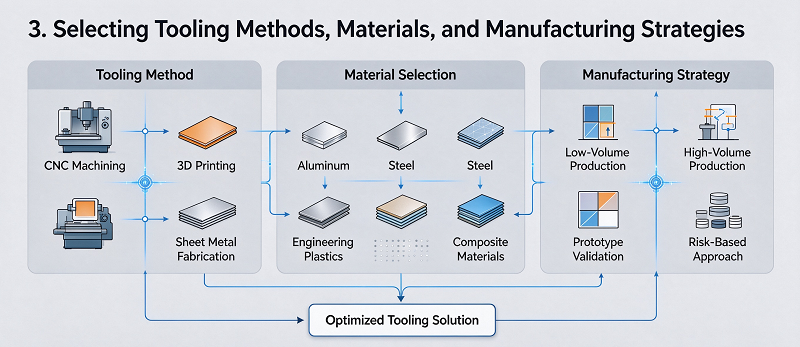
3. Selecting Tooling Methods, Materials, and Manufacturing Strategies
After the CAD analysis and design optimization are completed, the next important stage in the prototype mold process is to select the appropriate mold method, material, and manufacturing strategy.
The right choice directly affects the quality of the prototype, the development speed, the accuracy of testing, and the overall project cost.
Prototype tools focus on flexibility and efficiency.
Engineers need a manufacturing method that matches the current development stage and product verification requirements.
The first thing to consider is the expected number of prototypes.
If only a small number of functional samples are needed, engineers can choose cnc machining tools, soft tools, or additive manufacturing solutions.
These options offer faster production with a lower initial investment.
For projects that require hundreds or thousands of prototype parts, bridge frame molds or aluminum injection molds may be more suitable.
These methods provide parts similar to production while allowing companies to evaluate manufacturing performance before investing in full-scale molds.
Việc lựa chọn vật liệu cũng là một yếu tố quan trọng khác.
The prototype mold material must provide sufficient durability, dimensional stability, and compatibility with the predetermined manufacturing process.
For instance, aluminium is typically used in prototype molds because it is lightweight, easy to process, and can offer faster mold production compared to steel.
When higher durability, better wear resistance, or more demanding testing conditions are required, steel tools can be chosen.
Engineers will also take into account the final production materials when choosing the prototype mold method.
Prototypes made of materials similar to the final product can provide more accurate performance feedback.
This is particularly important for industries such as medical devices, automotive parts, and aerospace applications, as the material properties in these industries directly affect the reliability of the products.
The choice of manufacturing strategy also depends on the complexity of the parts.
Simple components can be quickly produced through CNC machining or 3D printing, while complex formed components may require carefully designed prototype molds.
A successful tooling strategy balances several factors:
- Product development stage
- Số lượng nguyên mẫu cần thiết
- Functional testing requirements
- Hiệu suất vật liệu
- Mong đợi về bề mặt hoàn thiện
- Giới hạn chi phí
- Mục tiêu sản xuất
Prototype Tooling Manufacturing Quy trình
Once the mold method and materials are selected, the project enters the manufacturing stage.
This stage transforms engineering design into physical tools that can produce prototype components.
The manufacturing of prototype molds requires close collaboration among designers, engineers, mechanics, and quality teams.
The accuracy at this stage is of vital importance because the precision of the mold directly affects the quality of the prototype parts.
Depending on the selected method, manufacturers can use CNC machining, electrical discharge machining, additive manufacturing, precision grinding, polishing, and other manufacturing technologies.
Cơ khí CNC and Tool Fabrication
Once the mold method and materials are selected, the project enters the manufacturing stage.
This stage transforms engineering design into physical tools that can produce prototype components.
The manufacturing of prototype molds requires close collaboration among designers, engineers, mechanics, and quality teams.
The accuracy at this stage is of vital importance because the precision of the mold directly affects the quality of the prototype parts.
Depending on the selected method, manufacturers can use CNC machining, electrical discharge machining, additive manufacturing, precision grinding, polishing, and other manufacturing technologies.
The machining process includes several important steps:
- Chuẩn bị nguyên liệu
- Lập trình CNC
- Gia công thô
- Bán hoàn thiện
- Hoàn thiện chính xác
- Kiểm tra kích thước
Each machining stage has an impact on the final tool accuracy and surface quality.
For injection molding prototype molds, additional operations may include cavity machining, core machining, insert manufacturing and mold component assembly.
High-precision machining ensures that the prototype mold can consistently produce parts that meet the requirements of the original CAD.
Khuôn Lắp ráp và hoàn thiện bề mặt
After machining is completed, the tooling components are assembled to prepare for the production of the prototype.
Mold assembly requires a precise fit among different components, including cavities, cores, inserts, sliders, ejection systems, and other mechanical components.
Correct assembly is indispensable because even a very small alignment error can affect the size of the parts, surface quality, and mold performance.
Surface treatment is another important step.
Depending on the product requirements, prototype tools may undergo different finishing treatments, including polishing, texturing, coating, or surface grinding.
The surface finish directly affects the appearance and performance of the prototype parts.
For consumer goods, high-quality surface treatment helps evaluate visual design.
For functional components, proper grooming can enhance durability and performance.
Before the prototype production begins, manufacturers usually conduct dimensional checks on key tool features to confirm that the tools comply with engineering specifications.
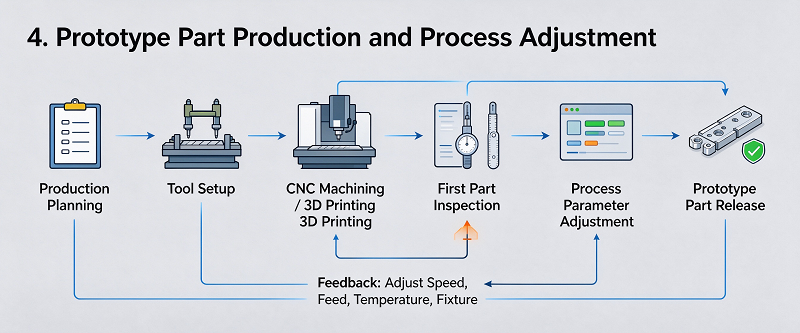
4. Prototype Part Production and Process Adjustment
After the tools are assembled and inspected, the manufacturer begins to produce prototype parts.
The first production run is usually regarded as a trial run because engineers need to verify whether the tools and manufacturing parameters are working correctly.
During this stage, manufacturing teams monitor important process conditions. For injection molding, these may include:
- Nhiệt độ tiêm
- Áp lực phun
- Thời gian làm mát
- Giữ áp lực
- Nhiệt độ khuôn
For CNC-based prototype production, engineers evaluate cutting parameters, tool selection, machining stability, and surface quality.
The first prototype part is carefully inspected to identify possible issues such as dimensional errors, surface defects, deformations, or assembly problems.
If problems are found, engineers can modify the mold structure, adjust manufacturing parameters, or update the product design.
This adjustment process is a key advantage of the prototype mold.
It enables companies to solve problems before entering expensive mass production.
Through multiple test cycles, prototype tools help create a stable manufacturing process and increase the possibility of successful production.
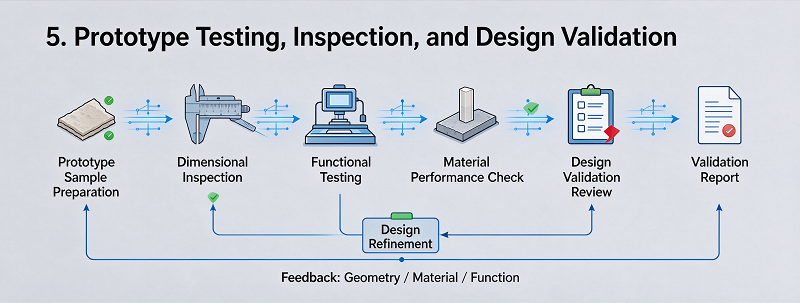
5. Prototype Testing, Inspection, and Design Validation
Prototype testing and verification is one of the most valuable stages in the prototype tool workflow.
The purpose of creating a prototype is not only to produce physical samples, but also to collect engineering data and confirm product performance.
After the prototype parts are manufactured, the engineering team assesses whether the design meets the functional, dimensional, and performance requirements.
Dimensional inspection is usually the first step of verification.
Advanced measuring equipment, such as coordinate measuring machines (CMM), optical inspection systems, and precision gauges, is used to compare prototype parts with CAD specifications.
Engineers inspect key dimensions, tolerances, hole positions, assembly interfaces, and geometric accuracy.
This information helps determine whether the tools and manufacturing processes can consistently produce acceptable parts.
Functional testing is another important part of verification.
Depending on different applications, prototypes may undergo mechanical testing, environmental testing, thermal testing, durability testing, or assembly evaluation.
For instance, automotive prototype components may require strength and vibration tests, while medical device components may need reliability and safety verification.
Prototyping tools also enable companies to evaluate user experience and product design.
Physical prototypes help designers review ergonomics, appearance, handling, and overall usability.
If problems are found during the testing process, engineers can go back to the early stage and make improvements.
They can modify CAD models, adjust tooling dimensions, replace materials, or optimize manufacturing parameters.
This iterative improvement process reduces product development risks and enhances the quality of the final product.
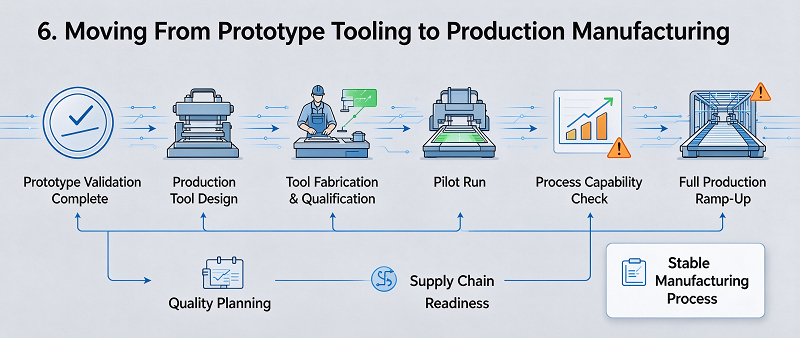
6. Di chuyển từ Công cụ nguyên mẫu to Production Manufacturing
The ultimate goal of a prototype mold is to create a reliable path for production and manufacturing.
After successful testing and verification, the company begins to prepare for large-scale production.
During this transitional stage, engineers analyze the prototype results and determine whether the design is ready for manufacturing expansion.
The collected data can help the team optimize production tools, manufacturing processes, quality control procedures and supply chain plans.
For some projects, prototype molds can directly support small-batch production or bridge manufacturing.
This method is particularly useful for products that require market testing, customer feedback, or a limited initial production quantity.
Bridging molds offer an economical and effective solution as companies can produce functional components without immediately investing in expensive production molds.
For products expected to achieve mass production, prototype molds provide valuable information for developing permanent mold solutions.
Engineers can improve production mold designs based on prototype feedback, reducing potential problems such as:
- Các khiếm khuyết sản xuất
- Excessive cycle times
- Chất thải vật liệu
- Khó khăn trong lắp ráp
- Sự thay đổi chất lượng
The successful transition from prototype tools to products requires collaboration among the engineering team, manufacturers, and the quality department.
Manufacturing partners should assess production scalability, tool durability, inspection requirements, and long-term cost efficiency.
Prototype tools create a controlled environment where companies can test, improve, and optimize their products before entering full-scale manufacturing.
7. Tại sao nên chọn NOBLE như bạn pbản mẫu tchảy máu nhà sản xuất
NOBLE là một liên doanh Anh-Trung được chính phủ trao tặng danh hiệu “Doanh nghiệp công nghệ cao quốc gia”. Chúng tôi có hai hướng kinh doanh chính: “Sản xuất thông minh” và “Sản phẩm chăm sóc”. Lĩnh vực “Sản xuất thông minh” chuyên cung cấp cho khách hàng các dịch vụ hỗ trợ dự án, bao gồm gia công và sản xuất linh kiện.
Với hơn 10 năm kinh nghiệm chuyên môn trong sản xuất và tạo mẫu nhanh, đội ngũ hiệu quả của chúng tôi hỗ trợ mạnh mẽ các dự án mới của bạn để đáp ứng 100% yêu cầu; quản lý tiêu chuẩn hóa đảm bảo kiểm soát chất lượng nghiêm ngặt đối với linh kiện và sản phẩm; quy trình làm việc hợp lý giúp giảm chi phí mà vẫn duy trì chất lượng tương đương.
Sau nhiều năm nỗ lực và phát triển, NOBLE đã dần chuyển mình từ một doanh nghiệp gia công và sản xuất linh kiện chính xác với khả năng hỗ trợ chuỗi công nghiệp hoàn chỉnh thành một doanh nghiệp hướng đến dịch vụ, cung cấp hỗ trợ toàn diện cho toàn bộ dự án của khách hàng.
NOBLE là giải pháp sản xuất theo yêu cầu trọn gói đáng tin cậy của bạn, từ thiết kế nguyên mẫu đến sản xuất hàng loạt, với nguồn lực sản xuất dồi dào, công nghệ phù hợp, quy trình tinh gọn, hướng dẫn chuyên nghiệp và quy trình kiểm tra chất lượng hoàn hảo để biến ý tưởng của bạn thành hiện thực.
NOBLE có các chứng chỉ đủ điều kiện sau:
ISO 9001: 2015 – Quản lý chất lượng mạnh mẽ cho sản xuất nói chung. Quy trình nhất quán. Kiểm soát được ghi chép lại. Kiểm tra có thể truy xuất nguồn gốc.
ISO 13485: 2016 – Tiêu chuẩn chất lượng nghiêm ngặt hơn cho các bộ phận thiết bị y tế. Quy trình thẩm định chặt chẽ. Khả năng truy xuất nguồn gốc đầy đủ. Bắt buộc đối với các bộ phận cấy ghép và phẫu thuật.
8. Kết luận
The prototype mold process from CAD design to production is a complete engineering workflow that transforms product concepts into reliable manufacturing solutions.
From the initial CAD analysis and DFM optimization to tool selection, manufacturing, testing, and production preparation, each stage plays a significant role in achieving successful product development.
A well-designed prototype machining procedure is not merely about creating sample parts.
It provides valuable engineering feedback, improves manufacturing strategies, and helps companies develop products with higher quality and reliability.
Whether the goal is functional testing, customer verification, bridging production, or preparing for large-scale production, prototyping tools provide a practical connection between design concepts and actual production.
By choosing the right tool strategy and collaborating with experienced manufacturing partners, companies can effectively transition from CAD design to production, while reducing costs, improving quality, and accelerating innovation.