In the field of medical device component manufacturing, stainless steel has become the mainstream metal material for surgical instruments, temporary implant components, and structural parts of diagnostic and therapeutic equipment, thanks to its excellent mechanical properties, outstanding corrosion resistance, mature machining technology, and cost advantages.
This article comprehensively interprets the key points of CNC machining for stainless steel medical parts from aspects such as material selection, machining advantages, machine difficulties, complete machining routes, post-treatment cleaning, and quality compliance control.
The commonly used stainless steel materials for ชิ้นส่วนทางการแพทย์ เครื่องจักรกล
In the medical field, CNC-machined stainless steel is mainly austenitic stainless steel. Different grades correspond to different medical application scenarios and are classified into implantable grade and in vitro device grade.
เครื่องจักรกล of 316L stainless steel medical parts
316L is a low-carbon austenitic stainless steel. For medical implant scenarios, 316LVM vacuum remelting grade is preferred. It complies with the ASTM F138 standard. Through vacuum arc remelting, it reduces internal inclusions, enhances material purity, fatigue resistance, and pitting corrosion resistance, and is mostly used for short-term human implant components.
Common 316L is mostly used in external-contact medical devices and can withstand high-temperature and high-pressure sterilization as well as repeated immersion and corrosion by disinfectants.
CNC machining of 304 stainless steel medical parts
304 stainless steel has basic corrosion resistance and is cheaper. However, it does not contain molybdenum and has relatively weak resistance to chloride ion corrosion. It is not recommended for use in human implant scenarios and is mainly used for medical equipment accessories that do not come into contact with the human body or have indirect contact with it.
If exposed to physiological saline or disinfectant reagents for a long time, 304 is prone to pitting corrosion and rusting. Therefore, in the medical industry, 304 is mostly used only for non-critical load-bearing components outside the body.
Other commonly used stainless steel grades for medical purposes
174PH precipitation-hardening stainless steel, after heat treatment, can achieve high hardness and is mostly used in surgical instruments such as surgical scissors and forceps that require edge strength;
420 martensitic stainless steel, with high hardness and wear resistance, is mainly used for cutting edge parts such as surgical knives and puncture needle tips.
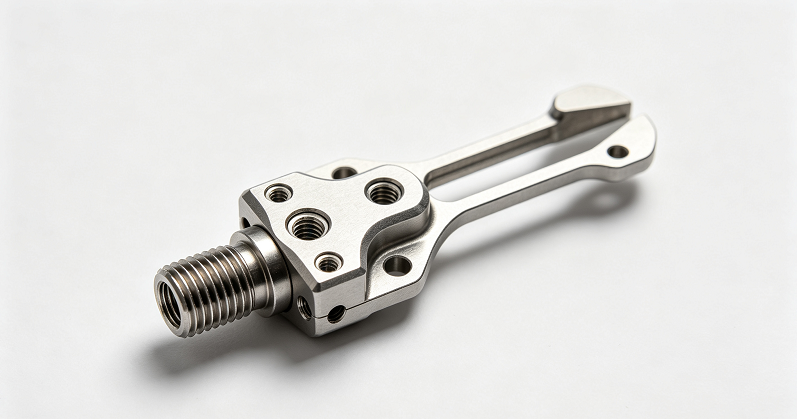
ข้อดีของการ เครื่องจักรซีเอ็นซี for stainless steel medical parts
First, the overall cost performance is outstanding. The procurement cost of stainless steel raw materials is much lower than that of medical TC4 titanium alloy. Meanwhile, its cutting performance is superior to that of titanium alloy, with less machining time and lower tool wear.
Second, it has excellent mechanical rigidity. Stainless steel has a high elastic modulus. After the parts are machined, they have strong resistance to deformation. When making thin-walled instrument shells and slender surgical operation rods, their resistance to bending deformation is better. It is suitable for surgical instruments that need to maintain high rigidity.
Third, it is resistant to corrosion by sterilizing media. Qualified medical stainless steel, after passivation treatment, can be adapted to mainstream medical sterilization methods such as high-temperature and high-pressure steam sterilization, ethylene oxide sterilization, and low-temperature plasma sterilization. It is not prone to rust after repeated disinfection and is suitable for reusable surgical instruments.
Fourth, the machining technology is mature. The stainless steel CNC machining is equipped with a complete set of tools, cutting fluids, and post-treatment polishing machine systems. Both the centerless machine and the การตัดเฉือนแบบ 5 แกน center can stably achieve the machining of micro-threads, micro-holes, and complex curved surfaces, making it easier to ensure the consistency of components.
Fifth, the grade system is well-developed. From in vitro devices to short-term implants, there are corresponding compliant grades. Implant-level materials such as 316LVM have a large amount of clinical application data, making it easier to complete the registration materials for medical devices and reducing the difficulty of registering Class II and Class III devices.
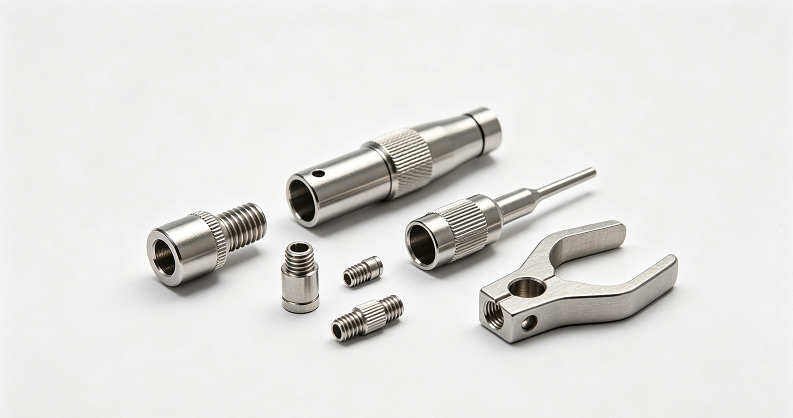
Why are 316L medical device parts often used in เครื่องจักรกลที่มีความเที่ยงตรง
Among medical stainless steel grades, 316L (316LVM) is the main material for medical precision CNC machining. A large number of minimally invasive instruments, temporary orthopedic implants, and precision tube parts all choose this grade. The reason behind this is that the material composition and performance are highly matched with the requirements of medical precision machining.
Firstly, molybdenum enhances resistance to chloride ion corrosion. Molybdenum is added to 316L, which can resist the erosion of chloride ions in human body fluids, physiological saline, and disinfectant reagents, reducing the risk of pitting. After the parts are machined, they undergo passivation treatment to form a stable chromium oxide film on the surface, reducing the precipitation of metal ions and ensuring biosafety when in short-term contact with the human body.
Secondly, low-carbon components inhibit intergranular corrosion. The “L” in the grade stands for ultra-low carbon, and it is less likely to cause intergranular corrosion after welding and high-temperature machining.
The 316LVM vacuum remelting version further reduces internal impurities, resulting in fewer internal defects in the material. When machining small thin-walled parts, it is less likely to experience cracking and failure caused by internal defects, meeting the fatigue usage requirements of precision small parts.
Furthermore, it is compatible with a variety of precision CNC machining equipment. Whether it is the through-spindle machine for machining small shafts and puncture tubes, or the five-axis machining center for machining irregular bone plates, 316L can stably achieve micron-level tolerances, capable of machining tiny inner holes and fine-thread precision threads, meeting the complex structural design requirements of minimally invasive medical components.
Finally, the compliance standards are complete. International standards such as ASTM F138 andISO5832-1 have clear regulations on 316LVM implant materials. The material traceability and biocompatibility test report system is mature. When medical device manufacturing enterprises register their products, it is easier for them to complete the material compliance verification.
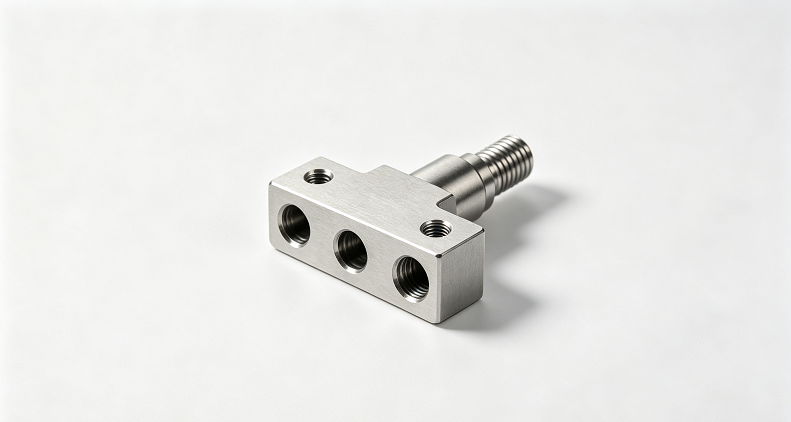
ความยากลำบากใน เครื่องจักรกลที่มีความเที่ยงตรง of stainless steel medical parts
First, severe work hardening phenomenon. During the machining of austenitic stainless steel, the tool tip squeezes the surface layer of the workpiece, causing lattice deformation of the surface metal and a significant increase in the hardness of the work-hardened layer. The depth of the hardened layer can reach 0.1- 0.3 mm.
If the tool wears out and the feed rate is too low, the hardened layer will continuously accumulate, accelerating tool wear. At the same time, a large amount of residual stress will accumulate inside the part, resulting in dimensional drift after finishing, which is particularly prominent in thin-walled parts.
Second, it has poor thermal conductivity, and the cutting tool wears out quickly. The thermal conductivity of stainless steel is only one third of that of ordinary carbon steel. A large amount of cutting heat accumulates in the tip area of the tool, causing the cutting temperature to rise rapidly. The cutting edge of the tool is prone to wear and chipping, and built-up edge may occur.
Built-up edge can tear the surface of workpieces, causing fine scratches. Fine scratches on the surface of medical parts can hide microorganisms, and subsequent cleaning and sterilization are difficult to completely remove them, posing a biosafety hazard.
Third, residual stress causes deformation. After rough machining removes a large amount of allowance, residual stress accumulates inside the parts. For thin-walled shell and thin-bone plate parts, the stress is released after the fixture is loosened after machining, resulting in springback deformation. The dimensions and flatness exceed the tolerances on the drawing. This is one of the main reasons for the scrapping of stainless steel medical parts.
CNC machining machine plan and machine route for stainless steel medical parts
Standard and complete machine flow
Raw material warehousing spectral re-inspection → blanking to prepare rough blanks → rough machining → stress relief annealing treatment → five-axis CNC semi-finishing → aging and static release of residual stress → Finishing, micro-hole and micro-thread machining → precision deburring → multi-stage ultrasonic cleaning → passivation/electrolytic polishing → final inspection in clean workshop → dust-free independent sealed packaging.
กลยุทธ์การเลือกเครื่องมือ
1. Fine-grained cemented carbide tools are preferred, combined with AlTiN and TiAlN series PVD coatings. The cutting edge is subjected to minor passivation treatment to prevent micro-chipping of the cutting edge.
Avoid using thick CVD-coated tools as they are prone to built-up edge.
2. When machining slender shafts and thin-walled parts, short tool holders should be selected to reduce tool overhang, suppress machining vibration, and minimize tool marks.
3. For the precision machining of micro-threads and micro-holes, positive rake Angle tools are selected to cut the material by shearing force, reducing the generation of burrs.
Cutting parameters and cooling schemes
The recommended linear speed for milling 316L medical parts is 7090m/min. It is recommended to perform layer-by-layer cutting and avoid large cutting depth at one time.
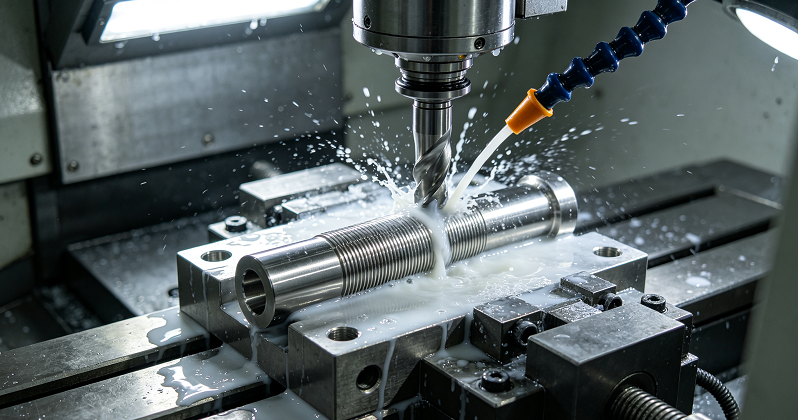
For cooling, it is recommended to use a special stainless steel extreme pressure cutting fluid free of chloride ions. The fluid should be cooled under high pressure and large flow rate, with a pressure of> 70 bar. It can quickly remove the cutting heat, promptly wash away the chips, and prevent the chips from re-scratching the workpiece surface.
Tooling clamping scheme, controlling clamping deformation
For thin-walled stainless steel medical parts, multi-point dispersed clamping, vacuum fixtures, and hydraulic expansion sleeve fixtures are preferred to disperse the clamping force.
During the rough machining stage, the clamping force can be relatively large. During the finish machining stage, the clamping pressure should be reduced to minimize the plastic deformation caused by clamping.
For complex and irregular-shaped parts, five-axis linkage machining centers are preferred. With a single clamping, all surfaces, holes, and threads can be machined, eliminating multiple clamping and positioning errors and improving dimensional consistency.
Key points for post-treatment, cleaning, and quality compliance control of stainless steel medical parts
Medical stainless steel CNC machining still needs to complete post-treatment, cleaning, passivation, inspection, and traceability.
การลบคมและการขัดเงา แมชชีนe
Microscopic burrs at cross holes, threaded holes, and step positions must be completely removed by the implant.
The micro-cross holes are preferentially deburred by electrochemical means to prevent mechanical grinding from damaging dimensional accuracy.
The polishing machine is selected based on the purpose of the parts:
- Friction motion surgical components: electrolytic polishing, Ra < 0.2- 0.4 μm, reducing bacterial adhesion and enhancing corrosion resistance;
- Grip part for handheld surgical instruments: Ra 0.8- 1.6 μm, which is both anti-slip and wear-resistant;
Temporarily implant the contact surface, control the reasonable roughness, and avoid excessive mirror polishing.
ที่สำคัญ เครื่อง for passivation treatment
After polishing is completed, passivation must be carried out. According to the ASTM A967 standard, nitric acid or citric acid passivation is adopted to remove the free iron elements on the surface, regenerate a dense chromium oxide protective layer, improve the resistance to fluid corrosion, and inhibit the precipitation of metal ions.
Multi-level cleaning control
Complete cleaning machine: degreasing cleaning → alkaline degreasing → multiple rinsing with high-purity water → ultrasonic cleaning → dust-free hot air drying.
It is recommended that all cleaning machines be operated in a clean workshop to thoroughly remove residual cutting fluid and metal micro-particles.
Implantable parts need to control bacterial endotoxins and comply with the ISO19227 medical device cleaning standard. After cleaning, they should be independently sealed and packaged in a dust-free manner to prevent secondary contamination.
Quality inspection and compliance control
1. Dimensional accuracy inspection: New products must undergo FAI first-piece full-size inspection;
The positional accuracy of complex curved surfaces and hole positions is measured using a three-coordinate CMM.
Special gauges are used for tiny threads and small holes.
The key dimensions monitor the Cp/Cpk machine capability, not just the random inspection of finished products, but also the stability of the machining machine.
2. Surface quality inspection: Examine the parts under a microscope to check for scratches, cracks, and residual burrs.
Metallographic examination should be conducted on the implant when necessary to confirm the machining deterioration layer.
3. Complete material machine traceability: Under the ISO13485 system, each batch of parts is fully retained with the raw material furnace number, heat treatment record, machining technology parameters, cleaning and passivation report, and a complete set of inspection reports, forming the equipment history record DHR. The medical device registration review will retrieve the complete set of materials. Parts without traceability documents cannot be used for the registration of Class II and Class III medical devices.
Sterilization compatibility verification: Qualified 316L stainless steel is compatible with mainstream medical sterilization methods. However, if the surface of the parts is not cleaned thoroughly, it will directly lead to sterilization failure. Verification needs to be conducted in combination with the actual sterilization machine.
เหตุใดจึงเลือก Nโอเบิล เป็นของคุณ medical pผู้ผลิตงานศิลปะ
NOBLE เป็นบริษัทร่วมทุนระหว่างจีนและอังกฤษที่ได้รับการรับรองจากรัฐบาลให้เป็น “วิสาหกิจไฮเทคแห่งชาติ” เรามีธุรกิจหลักสองด้าน ได้แก่ “การผลิตอัจฉริยะ” และ “ผลิตภัณฑ์ดูแลสุขภาพ” ธุรกิจ “การผลิตอัจฉริยะ” เชี่ยวชาญในการให้บริการสนับสนุนโครงการแก่ลูกค้า รวมถึงการกลึงและการผลิตชิ้นส่วน
More than 10 years of professional manufacturing and rapid prototyping experience. Our efficient team provides strong support for your new projects to 100% realize your requirements; Standardized management brings strict quality control of parts & products; a reasonable workflow achieves lower costs with the same quality.
หลังจากทำงานหนักและพัฒนามาหลายปี NOBLE ได้ค่อยๆ เปลี่ยนแปลงจากองค์กรผลิตและแปรรูปชิ้นส่วนที่มีความแม่นยำสูง พร้อมความสามารถในการให้บริการสนับสนุนตลอดห่วงโซ่อุตสาหกรรม ไปสู่องค์กรที่มุ่งเน้นการบริการ ซึ่งให้การสนับสนุนอย่างเต็มที่สำหรับโครงการทั้งหมดของลูกค้า
NOBLE คือผู้ให้บริการโซลูชั่นการผลิตแบบกำหนดเองครบวงจรที่คุณไว้วางใจได้ ตั้งแต่การออกแบบต้นแบบไปจนถึงการผลิต ด้วยทรัพยากรการผลิตขนาดใหญ่ เทคโนโลยีที่เหมาะสม กระบวนการที่คล่องตัว คำแนะนำจากผู้เชี่ยวชาญ และกระบวนการตรวจสอบคุณภาพที่สมบูรณ์แบบ เพื่อเปลี่ยนไอเดียของคุณให้กลายเป็นความจริง
NOBLE มีใบรับรองคุณวุฒิดังต่อไปนี้:
ISO 9001: 2015 – ระบบการจัดการคุณภาพที่แข็งแกร่งสำหรับการผลิตทั่วไป กระบวนการที่สม่ำเสมอ การควบคุมด้วยเอกสาร การตรวจสอบที่ตรวจสอบย้อนกลับได้
ISO 13485: 2016 – มาตรฐานคุณภาพที่เข้มงวดมากขึ้นสำหรับชิ้นส่วนอุปกรณ์ทางการแพทย์—การตรวจสอบความถูกต้องของกระบวนการอย่างเข้มงวด การตรวจสอบย้อนกลับอย่างครบถ้วน จำเป็นสำหรับชิ้นส่วนที่ฝังในร่างกายและชิ้นส่วนผ่าตัด

สรุป
Stainless steel is a very important metal material in the manufacturing of medical device components. Different grades such as 316LVM, 316L, and 304 are respectively suitable for various medical scenarios, including short-term implants, reusable surgical instruments, and in vitro diagnostic and therapeutic equipment.
The production of stainless steel medical parts cannot simply follow the common industrial stainless steel machining techniques. From the selection of raw material grades and CNC cutting machines to deburring, electrolytic polishing, passivation, and multi-stage cleaning, each machine must meet the compliance requirements of medical devices.
คำถามที่พบบ่อย
1. What surface defects should be avoided for stainless steel medical parts for ultrasonic cleaning?
Sharp burrs and deep crevices should be avoided, as they trap cleaning residues and endotoxins.
2. Can 316LVM stainless steel medical parts be welded after CNC machining?
Yes, but post-weld stress relief and repassivation are mandatory for medical compliance.
3. What risks will improper DFM design bring to stainless steel medical CNC parts?
It may cause excessive residual stress, higher reject rates, and failure in medical registration audits.
4. How to distinguish counterfeit 316LVM raw material from regular medical grade stock?
Verify the furnace batch certificate and perform spectral analysis; real material has low inclusion test data.
5. What is the shelf life limit for sealed, packaged finished stainless steel medical components?
Depends on packaging environment; normally 23 years under dust-free, low-humidity storage.