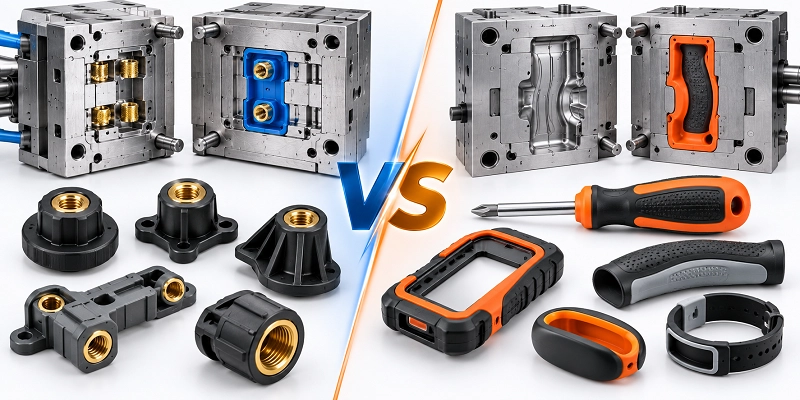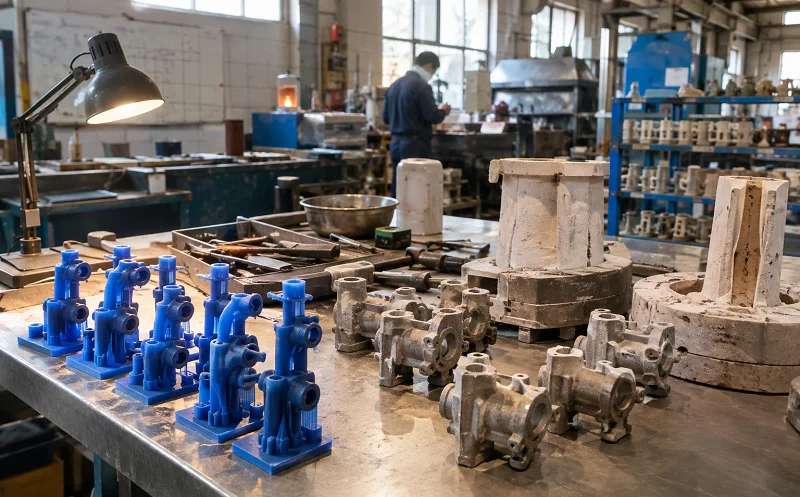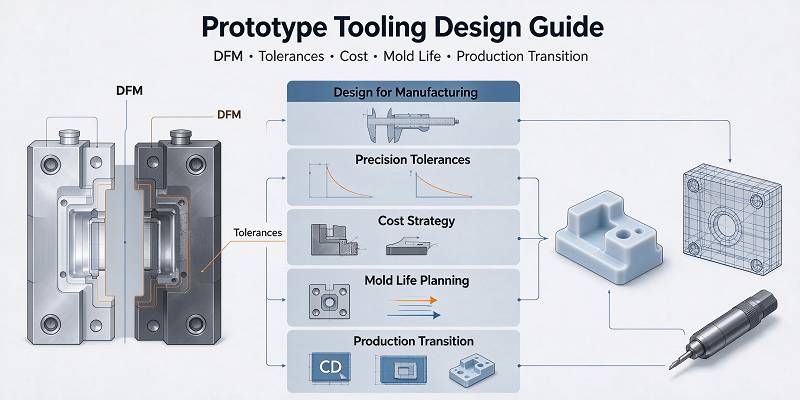
Prototype molds serve as a crucial bridge between product development and full-scale production.
They enable engineers to test product performance before manufacturing representative parts, identify design issues, and verify manufacturing feasibility before investing in expensive production tools.
The tool design required for prototype tools directly affects factors such as part quality, dimensional accuracy, and manufacturing costs.
Poorly designed prototyping tools may cause problems such as difficult demolding, inconsistent dimensions, and flashing.
A properly designed prototype tool should take into account production requirements such as the geometry of the part, tool material, production quantity, and tolerance.
This guide explains the key considerations for prototype mold design and demonstrates how manufacturers can balance cost, speed, precision, mold life, and production scalability.
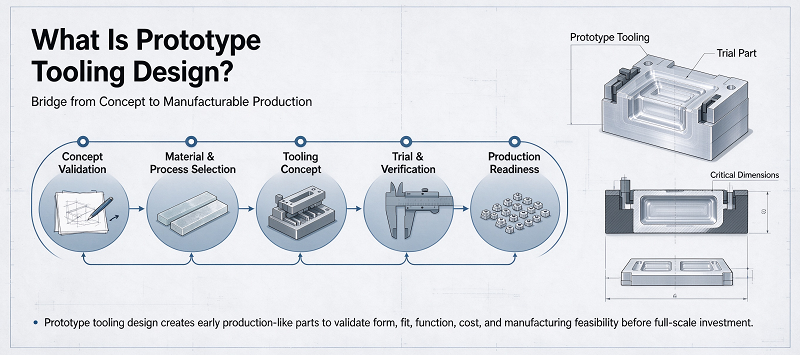
Mikä on Prototyyppityökalut Design?
Prototype mold design is the engineering process of developing molds, dies, inserts, jigs, and other tools for manufacturing prototypes or small-batch production parts.
Prototype tools focus on shorter delivery times, lower initial investment, easier modification, and sufficient durability for testing or limited production. Therefore, the prototype tool focuses on flexibility.
For instance, a prototype injection mold can use aluminium instead of hardened tool steel.
Complex automatic sliding vanes can be replaced by manual insertion. The cooling system can be simplified, and the standard mold base can replace the fully customized structure. These methods can reduce the cost of molds and manufacturing time.
However, simplified tools still need to follow basic engineering principles. The drawing Angle, wall thickness, shrinkage rate, gate position, ejector position, surface requirements, mold parting line, and dimensional tolerance will all affect the final prototype. Therefore, appropriate design depends on the purpose of the prototype.
The mold used for manufacturing 20 visual samples and the prototype tool for producing 5,000 functional components require very different design strategies.
Before the mold design begins, engineers should determine the expected production quantity, prototype material, functional requirements, dimensional tolerances, appearance requirements, expected tool life, required delivery time, future production processes, and expected design changes. Defining these requirements early can help manufacturers avoid overdesign while ensuring that the prototype tools produce meaningful engineering results.
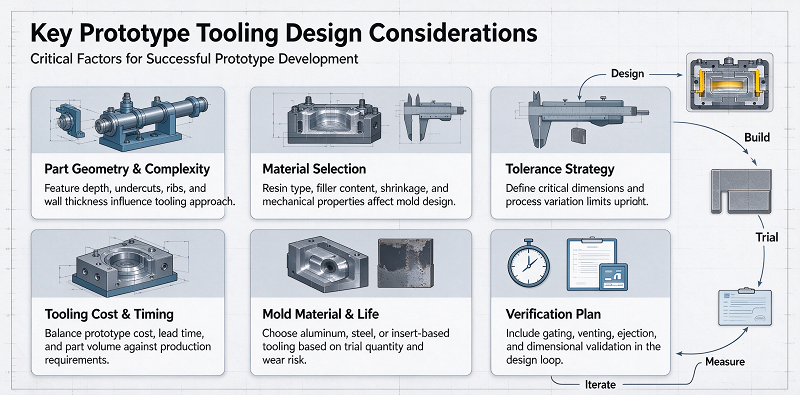
Key Prototype Tooling Design Considerations
Prototype mold design involves several engineering decisions that directly affect cost, quality, and manufacturing efficiency.
The geometry of the part, the material of the mold, and the structure of the mold are the three most important factors.
Part Geometry and Manufacturability
The geometry of the parts has a significant impact on the complexity of the prototype mold.
Simple components with a direct mold opening direction are usually manufactured faster and at a lower cost.
Parts with deep cavities, notches, internal threads, side holes, complex protruding ribs, thin walls, or irregular surfaces usually require more complex mold structures.
Some features can be simplified without affecting functional testing. The stretching Angle is particularly important in molded components.
If there is not enough ventilation during the injection process, the formed parts may stick to the cavity or core.
This may lead to scratches, deformations, dimensional issues, or mold damage. The wall thickness must also be taken into consideration.
Large variations in wall thickness may lead to uneven cooling, shrinkage, subsidence marks, warping, and internal stress. Where possible, engineers should maintain a relatively uniform wall thickness.
Selecting the Right Prototype Tooling Material
The material of the prototype mold affects the processing speed, mold cost, dimensional stability, surface finish, heat transfer, and mold life.
Aluminum is one of the most commonly used materials for making prototype molds.
Its excellent machinability enables manufacturers to produce mold cavities faster than many tool steels.
Aluminum also offers good thermal conductivity, which can help improve cooling performance in injection molding.
For these reasons, aluminum molds are usually suitable for: Small-volume injection molding, Engineering verification, Product development, the production of Bridges, Design verification, Short production cycles.
However, aluminium is softer than traditional die steel.
When producing grinding materials such as glass-filled plastics or when large-scale production is required, it may wear out more quickly.
Pre-hardened steels such as P20 offer greater wear resistance and durability. They are usually considered when prototype tools must support higher quantities, require higher materials, have higher forming pressures, or have longer production runs.
Mold Structure, Gates, Cooling, and Ejection
The structure of the prototype mold should be kept as simple as possible while still being able to produce reliable parts.
Single-cavity molds are typically used for prototype molds because they require less processing, are easier to modify, and reduce the initial mold cost.
When the production volume increases, multi-cavity molds may become attractive, but they require greater control over cavity balance, runner design, filling behavior, and dimensional consistency.
The design of the gate is another important consideration.
The position of the gate affects the way molten material enters and fills the mold cavity.
An inappropriate gate position may lead to weld lines, air traps, excessive pressure, incomplete filling, flow marks, or appearance problems.
The cooling system can also affect the quality of the prototype.
Although prototype molds sometimes use simplified cooling channels, insufficient cooling may cause inconsistent shrinkage, long cycle times, warpage, and dimensional changes.
The ejection system must also be carefully planned.
The top pin should be placed in a sufficiently solid area to withstand the top pin force without causing obvious marks or deformation.
Considering the gate, cooling, mold structure, and ejection can help manufacturers simplify the prototype mold without sacrificing the quality of the basic parts.
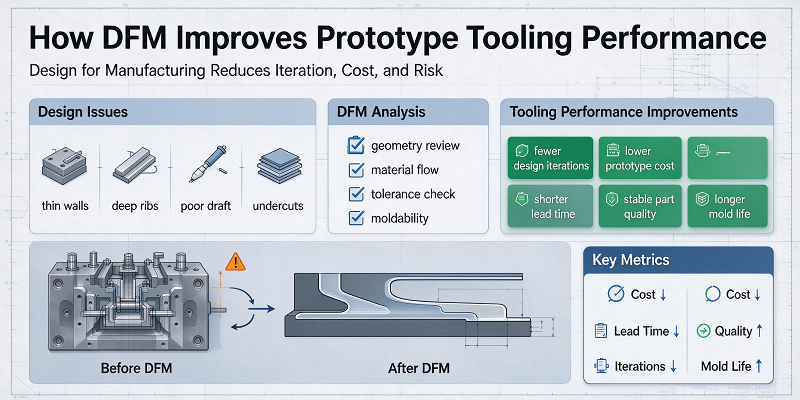
How DFM Improves Prototype Tooling Performance
Manufacturability design plays a crucial role in the development of prototype molds.
DFM assesses whether a component can be effectively manufactured using the selected tools and production processes.
The aim is to identify potential manufacturing problems before the production of tooling.
For prototype injection molding, DFM reviews typically assess: wall thickness, ejector pin position, material shrinkage, surface finish, mold flow, critical dimensions. The CAD model may seem correct, but the actual formed part may become difficult to pop out.
Increasing the appropriate drawing amount in the DFM stage can eliminate problems before mold processing.
Deep cavities may require longer cutting tools, which can lead to increased vibration, reduced cutting speed and prolonged processing time.
A very small inner corner radius requires smaller tools, which will also increase the manufacturing time.
In many cases, minor design modifications can simplify CNC machining without affecting the functionality of the parts.
Tolerance requirements should also be evaluated during DFM. Not every mold feature requires the same level of precision.
The sealing surface, assembly reference, optical mounting surface, or bearing position may require strict dimensional control. Non-functional outer surfaces cannot. Applying strict tolerances only to functional features helps to reduce processing and inspection costs. Therefore, DFM should start before the prototype mold is manufactured.
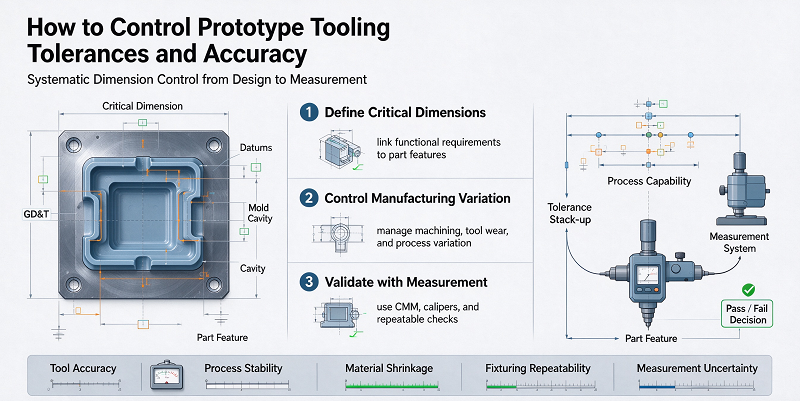
How to Control Prototype Tooling Tolerances and Accuracy
The prototype tool must produce components precise enough for meaningful testing.
Dimensional control starts from CAD models and engineering drawings. These may include assembly interface hole positions, sealing surfaces, bearing positions, optical interface reference surfaces, and precision installation features. Then, manufacturers can focus processing and inspection resources on areas of greatest functional importance.
Material shrinkage is another important consideration. Plastic materials shrink when cooled. The final shrinkage rate depends on several variables, including the type of polymer, part geometry, wall thickness, reinforcing material content, fiber orientation, mold temperature, injection pressure, and machining conditions.
The prototype mold cavity must compensate for this behavior. After the first part is formed, the manufacturer can inspect it and compare the actual measured values with the original CAD model. Minor modifications to the mold can be made when necessary. This is one advantage of the prototype tool.
Some tool materials, especially aluminium and machinable steel, are usually easier to modify than fully hardened production tools. The tolerance of the tooling should also be distinguished from that of the formed parts. Due to the introduction of additional manufacturing changes during the molding process, the mold cavity usually requires higher precision than the finished molded component.
Temperature control also affects dimensional accuracy. The mold material expands as the temperature rises, and uneven mold temperatures can cause inconsistent contractions in different areas of the part. Therefore, stable molding conditions and effective cooling directly contribute to dimensional consistency.
The inspection may include the following equipment: calipers, micron three-coordinate measuring machines, and surface roughness testers. Then, the measurement data of the prototype parts can be used to optimize product design and future production tools.
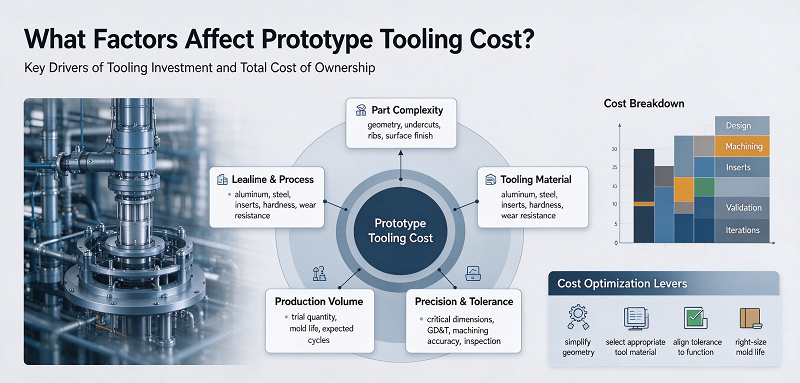
What Factors Affect Prototype Tooling Cost?
The cost of prototype molds is influenced by various engineering and manufacturing factors.
Tool size is only part of the calculation.
Geometric shape, mold material, processing difficulty, production quantity, tolerance, mold structure, and finishing requirements can all significantly change the final cost.
Tool Complexity and Machining Requirements
Tool complexity is one of the biggest cost drivers in prototype tools.
A simple opening and closing mold may require basic CNC-koneistus, standard pins, and traditional mold components.
More complex components may require: interchangeable inserts, manual inserts, electrical discharge machining, multiple CNC Settings, deep hole drilling, precision grinding, and a wide range of mold accessories. Each additional function will increase engineering, processing, assembly, and testing time.
Deep cavities also increase processing costs because longer tools are usually required. Long cutting tools generally require slower processing conditions to reduce vibration. A smaller inner radius can also increase the processing time because a smaller tool removes less material per pass. Therefore, simplifying these functions during DFM can reduce mold costs and delivery times.
Tooling Material and Production Quantity
The mold material must match the required production quantity.
Using hardened production-grade tool steel, only a few dozen prototype parts may incur unnecessary costs.
At the same time, for thousands of abrasive parts, using relatively soft mold materials may lead to rapid wear and repair costs.
Aluminum molds usually offer a good balance between processing speed and durability, and are used for small-batch manufacturing.
When the production volume increases, steel molds may become more economical.
Therefore, the decision should take into account the total cost of the project, not just the initial mold price.
If a slightly more expensive mold reduces maintenance, improves consistency, and can meet all the required production quantities, it may become more economical.
Tolerances, Surface Finish, and Secondary Operations
Dimensional tolerances have a significant impact on the cost of prototype molds. Standard machining tolerances can usually be effectively achieved.
Extremely strict tolerances may require slower cutting speeds, precision grinding, electrical discharge machining, specialized fixtures, or additional inspections. The requirements for surface finish also cause similar cost differences.
A functional engineering prototype may only require a standard cnc machining process to complete.
Secondary operations also increase the total cost of the project.
These include: thread insertion, installation, electroplating, laser marking, assembly, Post-machining, and special inspection. A practical cost control strategy is to only use high-quality finishes and strict tolerances where true functional or aesthetic value is provided.
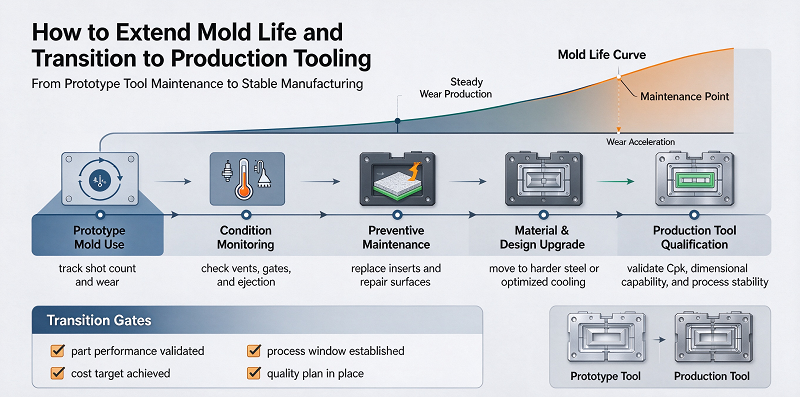
How to Extend Mold Life and Transition to Production Tooling
Prototype tools are designed for shorter production cycles, but durability remains important.
One approach is to select the tooling material based on the expected amount of wear.
For relatively small quantities, aluminium can offer sufficient durability.
For larger quantities or abrasive materials, pre-hardened steel may be more suitable.
Mixed mold construction can also be effective.
For instance, the main mold might be made of aluminium, while steel inserts are installed in high-wear areas such as gates, sliding surfaces, thread features or narrow cores.
This method can increase the tool life without the need for the entire mold to be made of steel.
Replaceable plugins are particularly valuable in the product development process.
If engineers expect a certain feature to change after testing, then this area can be designed as a removable insert.
Future modifications can be accomplished by replacing or processing inserts instead of rebuilding the entire mold.
Tool maintenance can also affect the lifespan of the prototype mold.
Tooling should be regularly inspected for wear, corrosion, damaged pins, blocked vents, contamination, and surface damage.
Proper storage is particularly important for steel molds, as moisture can cause corrosion.
The forming parameters should also be kept within a reasonable range.
Excessive injection pressure, clamping force, or mold temperature will all accelerate wear.
Once the prototype test is completed, the engineering team can use the information collected during the prototype manufacturing process to design production tools.
This transition should not simply involve replicating the prototype mold using stronger materials.
Prototyping usually reveals the following important information: dimensional stability, material shrinkage, bending, weld line indentation, performance of flashbang shooting, cooling behavior, cycle time. After functional testing, product design may also change.
The wall thickness may need to be adjusted, the assembly characteristics may need to be modified, the ribs may need to be reinforced, or certain tolerances may be proven unnecessary.
These changes should be completed before the production tools start.
Output may also require different mold structures.
A prototype mold can use a cavity, hand inserts, basic cooling, and simple ejection.
The production of molds may require multiple cavities, automatic sliding, advanced cooling channels, hot runners, sensors, automatic ejection, and hardening of mold materials.
Therefore, the prototype stage provides valuable engineering data for developing more reliable production tools.
Miksi valita NOBLE yrityksellesi? prototype tooling manufacturer
NOBLE on kiinalais-brittiläinen yhteisyritys, jolle hallitus on myöntänyt "kansallisena korkean teknologian yrityksenä" -statuksen. Meillä on kaksi pääliiketoiminta-aluetta: "älykäs valmistus" ja "hoitotuotteet". "Älykäs valmistus" -liiketoiminta on erikoistunut tarjoamaan asiakkaille projektitukipalveluita, mukaan lukien osien koneistus ja valmistus.
Yli 10 vuoden kokemus ammattimaisesta valmistuksesta ja nopeasta prototyyppien valmistuksesta. Tehokas tiimimme tarjoaa vahvaa tukea uusille projekteillesi vaatimustesi 100-prosenttiseksi saavuttamiseksi; standardoitu hallinta tuo mukanaan tiukan laadunvalvonnan osille ja tuotteille; järkevä työnkulku johtaa alhaisempiin kustannuksiin samalla laadulla.
Vuosien kovan työn ja kehitystyön jälkeen NOBLE on vähitellen muuttunut tarkkuusosien koneistus- ja valmistusyrityksestä, jolla on täydellinen teollisuusketjua tukeva palvelukyky, palvelukeskeiseksi yritykseksi, joka tarjoaa täyden tuen asiakkaiden koko projektille.
NOBLE is your trusted one-stop custom manufacturing solution, from prototype design to manufacturing, with extensive manufacturing resources, suitable technology, streamlined processes, expert guidance, and a perfect quality inspection process to turn your ideas into reality.
NOBLElla on seuraavat pätevyystodistukset:
ISO 9001: 2015 – Vankka laatujärjestelmä yleisvalmistukseen. Yhdenmukaiset prosessit. Dokumentoitu valvonta. Jäljitettävä tarkastus.
ISO 13485: 2016 – Tiukemmat laatustandardit lääkinnällisten laitteiden osille. Vaatimustenmukainen prosessin validointi. Täydellinen jäljitettävyys. Vaaditaan implantoitaville ja kirurgisille osille.
Yhteenveto
If the prototype tool is designed correctly, it will become an important engineering tool for verifying product design, manufacturing functional components, controlling development costs, and preparing for large-scale production.
A successful prototype mold design requires careful consideration of the part geometry, mold material, DFM, tolerance, mold structure, cooling, pouring, ejection, surface finish, production quantity, and the expected service life of the mold.
Simplifying unnecessary functions, choosing the right mold materials, applying tolerances only where needed, and using replaceable blades can reduce costs while maintaining reliable prototype quality.
DFM is particularly important because it can prevent many tool problems before CNC-koneistus or mold manufacturing begins.
Prototype production can also generate valuable manufacturing data.
Before investing in production tools, engineers can evaluate dimensional accuracy, shrinkage rate, cooling performance, molding defects, material behavior, and functional performance.
This information can be used to improve product design and optimize the final production mold.
For medical devices, robots, automotive parts, electronics, industrial equipment, and other precision products, an effective prototyping tool strategy can shorten the development cycle and reduce the risk of directly transitioning from CAD design to mass production.
By balancing speed, cost, precision, flexibility, and mold life, prototyping tools help transform product design into a manufacturing process that can be reliably produced.