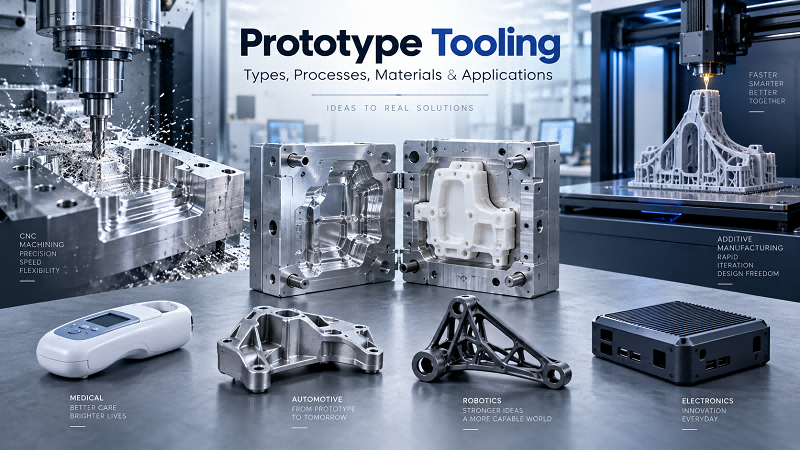
Prototype molds are an important stage in modern product development. Before investing in expensive production molds or large manufacturing systems, engineers need to confirm whether the design can be manufactured, assembled, and executed as expected in practical applications.
The prototype machining procedure provides a practical method for converting CAD models into physical prototype parts.
It can produce functional components that have similar materials, structures, and performance characteristics to the final product.
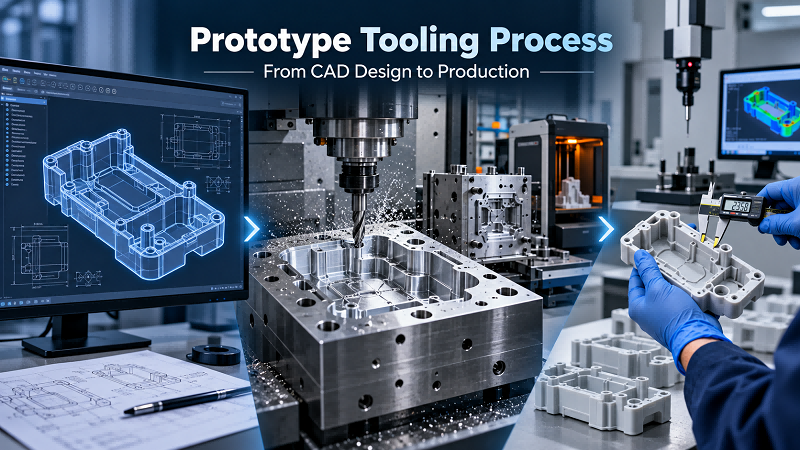
The workflow of a prototype mold involves multiple engineering stages, including CAD design analysis, design optimization, mold strategy selection, mold or mold manufacturing, prototype production, quality inspection, and production preparation.
Each step will affect the quality of the final product, development costs, and manufacturing efficiency.
With the development of CNC machining, rapid injection molding, additive manufacturing, and advanced mold technology, companies can now shorten the product development cycle while maintaining high precision and reliability.
Prototype molds have been widely applied in industries such as automobiles, aerospace, medical equipment, consumer electronics, robotics, and industrial equipment.
This article explains the complete prototyping tool process from CAD design to production.
1. Understanding the Complete Prototype Tooling Process
Prototype machining is a systematic workflow that transforms digital product design into physical manufacturing solutions.
Although the ultimate goal is to create prototype components, the process involves more than simply producing molds.
The first stage begins with a digital CAD model created by a product designer or engineer.
This model defines the geometry, dimensions, tolerances, assembly features, and functional requirements of the components.
Before starting to make the prototype mold, engineers will carefully check the CAD data to determine whether the design is suitable for manufacturing.
At this stage, the engineering team analyzes factors such as part complexity, material requirements, production quantity, and expected test conditions.
Products designed for injection molding may require different considerations compared to those produced through CNC machining or silicone casting.
After design analysis, the engineer selects the appropriate prototype machining method.
This decision depends on several factors:
- Απαιτούμενη ποσότητα δείγματος
- Required material properties
- Dimensional accuracy requirements
- Expected surface finish
- Χρονοδιάγραμμα Ανάπτυξης
- Available manufacturing budget
For instance, when a company needs to quickly injection mold parts at a lower mold cost, it usually opts for aluminum prototype molds.
When high precision and strong mechanical properties are required, cnc machining tools can be given priority.
For early proof-of-concept, tools based on additive manufacturing can provide faster results.
Once the tooling method is determined, the manufacturer creates the prototype tooling in accordance with the engineering specifications.
This stage includes machining, assembly, finishing, and inspection.
After the mold is completed, the manufacturer produces and evaluates the prototype parts.
The verification stage is of vital importance as it provides genuine manufacturing feedback.
Engineers can compare prototype parts with CAD models, test product performance, and determine improvement plans.
If modifications are needed, the CAD design or mold structure can be updated before going into production.
The ultimate goal of the prototype tool is a smooth transition from product development to manufacturing.
By addressing the challenges in design and production as early as possible, the company can reduce risks and improve efficiency during large-scale production.
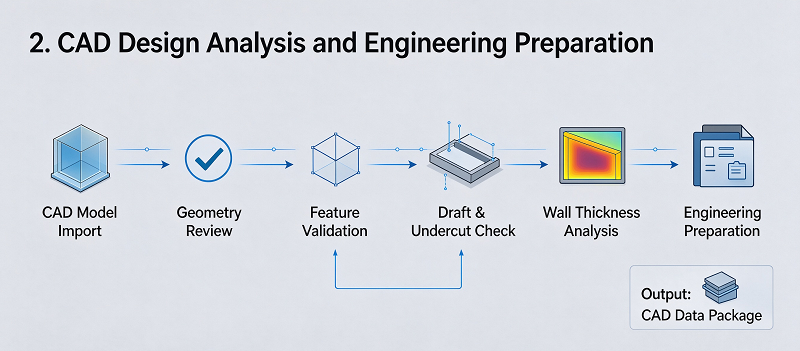
2. CAD Design Analysis and Engineering Preparation
CAD design is the foundation of the prototype machining procedure. Digital models provide necessary information for tool development, manufacturing planning, and quality inspection.
Before the production of prototype molds begins, engineers will conduct a design review to ensure that the parts can be successfully manufactured.
This stage helps identify potential problems before they become costly manufacturing issues.
Reviewing CAD Models and Product Requirements
The first step is to analyze the CAD model and understand the product requirements.
Engineers review the dimensions, tolerances, material specifications, assembly relationships, and functional requirements of the parts.
Important design factors include wall thickness, characteristic geometry, holes, ribs, bosses, mounting points, and moving parts.
These details directly affect the difficulty of mold design and manufacturing.
For injection molding prototypes, engineers evaluate the requirements related to the mold, such as the drawing Angle, parting line, and ejection method.
For CNC prototype molds, engineers focus on machining accessibility, tool movement, and fixture design.
A complete CAD review ensures that the prototype tool can accurately reproduce the expected product design.
Βελτιστοποίηση Σχεδιασμού για Κατασκευή (DFM)
Manufacturing-oriented Design (DFM) analysis is one of the most important steps before the production of prototype molds.
DFM helps engineers modify product designs to enhance manufacturability while maintaining functional requirements.
During the DFM analysis process, engineers can adjust unnecessarily complex features, improve the wall thickness distribution, optimize the corner radius, or simplify the machining operation.
For formed parts, DFM considerations include reducing notches, improving the draft Angle, optimizing the gate position, and ensuring proper material flow.
For cnc machined components, engineers can modify the geometry to improve tool usage and reduce machining time.
Early DFM optimization can significantly reduce mold costs, shorten the manufacturing cycle, and prevent defects in the prototype production process.
Prototype Tooling Design Planning
After CAD analysis and DFM optimization, engineers began to plan the structure of the prototype mold.
This stage involves selecting the mold structure, determining the manufacturing process, and preparing detailed mold drawings.
Engineers consider the cavity design, insertion structure, machining method, cooling system, and assembly requirements.
The carefully planned mold design ensures the stability and repeatability of the prototype manufacturing process.
For complex components, engineers may use simulation tools to analyze potential manufacturing problems before the production of physical tools.
These simulations are helpful for predicting material flow, deformation risks, and possible quality issues.
The correct mold design and planning lay a solid foundation for the subsequent manufacturing stage.
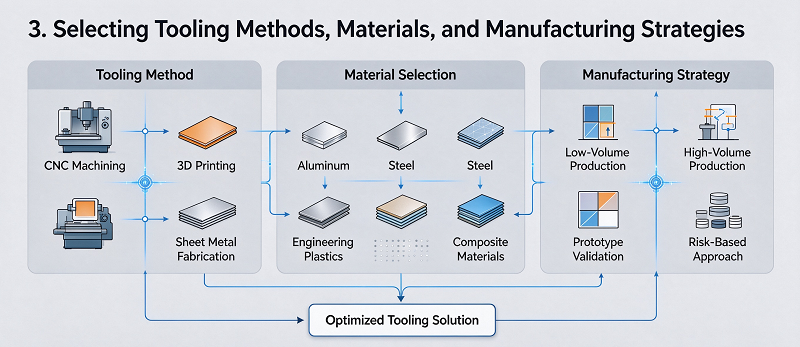
3. Selecting Tooling Methods, Materials, and Manufacturing Strategies
After the CAD analysis and design optimization are completed, the next important stage in the prototype mold process is to select the appropriate mold method, material, and manufacturing strategy.
The right choice directly affects the quality of the prototype, the development speed, the accuracy of testing, and the overall project cost.
Prototype tools focus on flexibility and efficiency.
Engineers need a manufacturing method that matches the current development stage and product verification requirements.
The first thing to consider is the expected number of prototypes.
If only a small number of functional samples are needed, engineers can choose cnc machining tools, soft tools, or additive manufacturing solutions.
These options offer faster production with a lower initial investment.
For projects that require hundreds or thousands of prototype parts, bridge frame molds or aluminum injection molds may be more suitable.
These methods provide parts similar to production while allowing companies to evaluate manufacturing performance before investing in full-scale molds.
Material selection is another important factor.
The prototype mold material must provide sufficient durability, dimensional stability, and compatibility with the predetermined manufacturing process.
For instance, aluminium is typically used in prototype molds because it is lightweight, easy to process, and can offer faster mold production compared to steel.
When higher durability, better wear resistance, or more demanding testing conditions are required, steel tools can be chosen.
Engineers will also take into account the final production materials when choosing the prototype mold method.
Prototypes made of materials similar to the final product can provide more accurate performance feedback.
This is particularly important for industries such as medical devices, automotive parts, and aerospace applications, as the material properties in these industries directly affect the reliability of the products.
The choice of manufacturing strategy also depends on the complexity of the parts.
Simple components can be quickly produced through CNC machining or 3D printing, while complex formed components may require carefully designed prototype molds.
A successful tooling strategy balances several factors:
- Product development stage
- Απαιτούμενη ποσότητα πρωτοτύπου
- Functional testing requirements
- Απόδοση υλικού
- Προσδοκίες για φινίρισμα επιφάνειας
- Περιορισμοί κόστους
- Στόχοι παραγωγής
Prototype Tooling Manufacturing Διαδικασία
Once the mold method and materials are selected, the project enters the manufacturing stage.
This stage transforms engineering design into physical tools that can produce prototype components.
The manufacturing of prototype molds requires close collaboration among designers, engineers, mechanics, and quality teams.
The accuracy at this stage is of vital importance because the precision of the mold directly affects the quality of the prototype parts.
Depending on the selected method, manufacturers can use CNC machining, electrical discharge machining, additive manufacturing, precision grinding, polishing, and other manufacturing technologies.
CNC μηχανική κατεργασία and Tool Fabrication
Once the mold method and materials are selected, the project enters the manufacturing stage.
This stage transforms engineering design into physical tools that can produce prototype components.
The manufacturing of prototype molds requires close collaboration among designers, engineers, mechanics, and quality teams.
The accuracy at this stage is of vital importance because the precision of the mold directly affects the quality of the prototype parts.
Depending on the selected method, manufacturers can use CNC machining, electrical discharge machining, additive manufacturing, precision grinding, polishing, and other manufacturing technologies.
The machining process includes several important steps:
- Παρασκευή πρώτων υλών
- Προγραμματισμός CNC
- Τραχιά κατεργασία
- Ημιτελική επεξεργασία
- Φινίρισμα ακριβείας
- Επιθεώρηση διαστάσεων
Each machining stage has an impact on the final tool accuracy and surface quality.
For injection molding prototype molds, additional operations may include cavity machining, core machining, insert manufacturing and mold component assembly.
High-precision machining ensures that the prototype mold can consistently produce parts that meet the requirements of the original CAD.
Μούχλα Συνέλευση και επιφάνεια φινιρίσματος
After machining is completed, the tooling components are assembled to prepare for the production of the prototype.
Mold assembly requires a precise fit among different components, including cavities, cores, inserts, sliders, ejection systems, and other mechanical components.
Correct assembly is indispensable because even a very small alignment error can affect the size of the parts, surface quality, and mold performance.
Surface treatment is another important step.
Depending on the product requirements, prototype tools may undergo different finishing treatments, including polishing, texturing, coating, or surface grinding.
The surface finish directly affects the appearance and performance of the prototype parts.
For consumer goods, high-quality surface treatment helps evaluate visual design.
For functional components, proper grooming can enhance durability and performance.
Before the prototype production begins, manufacturers usually conduct dimensional checks on key tool features to confirm that the tools comply with engineering specifications.
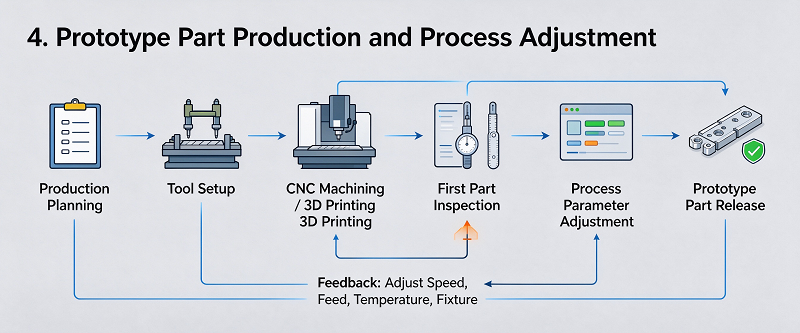
4. Prototype Part Production and Process Adjustment
After the tools are assembled and inspected, the manufacturer begins to produce prototype parts.
The first production run is usually regarded as a trial run because engineers need to verify whether the tools and manufacturing parameters are working correctly.
During this stage, manufacturing teams monitor important process conditions. For injection molding, these may include:
- Θερμοκρασία έγχυσης
- Πίεση έγχυσης
- Χρόνος ψύξης
- Κρατώντας πίεση
- Μορφή θερμοκρασίας
For CNC-based prototype production, engineers evaluate cutting parameters, tool selection, machining stability, and surface quality.
The first prototype part is carefully inspected to identify possible issues such as dimensional errors, surface defects, deformations, or assembly problems.
If problems are found, engineers can modify the mold structure, adjust manufacturing parameters, or update the product design.
This adjustment process is a key advantage of the prototype mold.
It enables companies to solve problems before entering expensive mass production.
Through multiple test cycles, prototype tools help create a stable manufacturing process and increase the possibility of successful production.
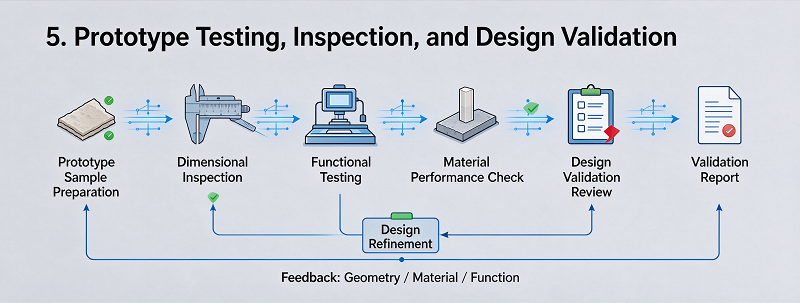
5. Prototype Testing, Inspection, and Design Validation
Prototype testing and verification is one of the most valuable stages in the prototype tool workflow.
The purpose of creating a prototype is not only to produce physical samples, but also to collect engineering data and confirm product performance.
After the prototype parts are manufactured, the engineering team assesses whether the design meets the functional, dimensional, and performance requirements.
Dimensional inspection is usually the first step of verification.
Advanced measuring equipment, such as coordinate measuring machines (CMM), optical inspection systems, and precision gauges, is used to compare prototype parts with CAD specifications.
Engineers inspect key dimensions, tolerances, hole positions, assembly interfaces, and geometric accuracy.
This information helps determine whether the tools and manufacturing processes can consistently produce acceptable parts.
Functional testing is another important part of verification.
Depending on different applications, prototypes may undergo mechanical testing, environmental testing, thermal testing, durability testing, or assembly evaluation.
For instance, automotive prototype components may require strength and vibration tests, while medical device components may need reliability and safety verification.
Prototyping tools also enable companies to evaluate user experience and product design.
Physical prototypes help designers review ergonomics, appearance, handling, and overall usability.
If problems are found during the testing process, engineers can go back to the early stage and make improvements.
They can modify CAD models, adjust tooling dimensions, replace materials, or optimize manufacturing parameters.
This iterative improvement process reduces product development risks and enhances the quality of the final product.
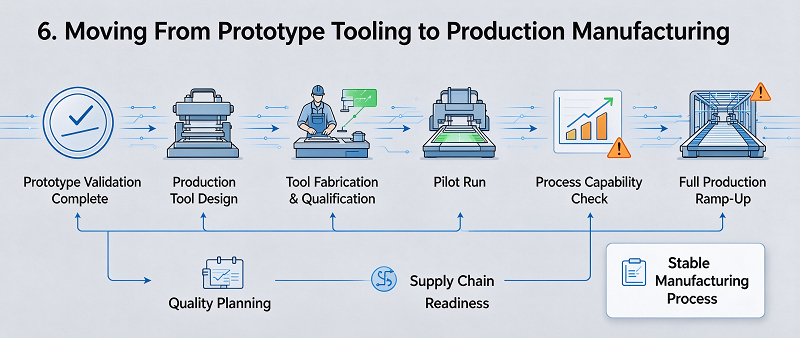
6. Moving From Prototype Tooling to Production Manufacturing
The ultimate goal of a prototype mold is to create a reliable path for production and manufacturing.
After successful testing and verification, the company begins to prepare for large-scale production.
During this transitional stage, engineers analyze the prototype results and determine whether the design is ready for manufacturing expansion.
The collected data can help the team optimize production tools, manufacturing processes, quality control procedures and supply chain plans.
For some projects, prototype molds can directly support small-batch production or bridge manufacturing.
This method is particularly useful for products that require market testing, customer feedback, or a limited initial production quantity.
Bridging molds offer an economical and effective solution as companies can produce functional components without immediately investing in expensive production molds.
For products expected to achieve mass production, prototype molds provide valuable information for developing permanent mold solutions.
Engineers can improve production mold designs based on prototype feedback, reducing potential problems such as:
- Κατασκευαστικά ελαττώματα
- Excessive cycle times
- Υλικά απόβλητα
- Δυσκολίες συναρμολόγησης
- Ποιοτική παραλλαγή
The successful transition from prototype tools to products requires collaboration among the engineering team, manufacturers, and the quality department.
Manufacturing partners should assess production scalability, tool durability, inspection requirements, and long-term cost efficiency.
Prototype tools create a controlled environment where companies can test, improve, and optimize their products before entering full-scale manufacturing.
7. Γιατί να επιλέξετε το ΝOBLE όπως το δικό σου pροτότυπο tάρωμα κατασκευαστής
Η NOBLE είναι μια σινο-βρετανική κοινοπραξία που έχει βραβευτεί από την κυβέρνηση ως «Εθνική Επιχείρηση Υψηλής Τεχνολογίας». Έχουμε δύο κύριες επιχειρηματικές κατευθύνσεις: την «Έξυπνη Κατασκευή» και τα «Προϊόντα Φροντίδας». Η επιχείρηση «Έξυπνης Κατασκευής» ειδικεύεται στην παροχή υπηρεσιών υποστήριξης έργων στους πελάτες, συμπεριλαμβανομένης της κατεργασίας και της κατασκευής εξαρτημάτων.
Πάνω από 10 χρόνια επαγγελματικής εμπειρίας στην κατασκευή και την ταχεία δημιουργία πρωτοτύπων. Η αποτελεσματική ομάδα μας παρέχει ισχυρή υποστήριξη για τα νέα σας έργα για την 100% υλοποίηση των απαιτήσεών σας. Η τυποποιημένη διαχείριση φέρνει αυστηρό ποιοτικό έλεγχο των εξαρτημάτων και των προϊόντων. Μια λογική ροή εργασίας επιτυγχάνει χαμηλότερο κόστος με την ίδια ποιότητα.
Μετά από χρόνια σκληρής δουλειάς και ανάπτυξης, η NOBLE έχει σταδιακά μετατραπεί από μια επιχείρηση κατεργασίας και κατασκευής ακριβών εξαρτημάτων με ολοκληρωμένες δυνατότητες υποστήριξης βιομηχανικής αλυσίδας σε μια επιχείρηση προσανατολισμένη στις υπηρεσίες που παρέχει πλήρη υποστήριξη για ολόκληρα τα έργα των πελατών.
Η NOBLE είναι η αξιόπιστη ολοκληρωμένη λύση κατασκευής, από τον σχεδιασμό πρωτοτύπων έως την κατασκευή, μέσω τεράστιων πόρων παραγωγής, κατάλληλης τεχνολογίας, βελτιστοποιημένων διαδικασιών, εξειδικευμένης καθοδήγησης και μιας άψογης διαδικασίας ελέγχου ποιότητας για να μετατρέψετε τις ιδέες σας σε πραγματικότητα.
Η NOBLE διαθέτει τα ακόλουθα πιστοποιητικά προσόντων:
ISO 9001: 2015 – Ισχυρή διαχείριση ποιότητας για γενική παραγωγή. Συνεπείς διαδικασίες. Τεκμηριωμένος έλεγχος. Ιχνηλασιμότητα στην επιθεώρηση.
ISO 13485: 2016 – Αυστηρότερα πρότυπα ποιότητας για εξαρτήματα ιατροτεχνολογικών προϊόντων. Αυστηρή επικύρωση διεργασιών. Πλήρης ιχνηλασιμότητα. Απαιτείται για εμφυτεύσιμα και χειρουργικά εξαρτήματα.
8. Συμπέρασμα
The prototype mold process from CAD design to production is a complete engineering workflow that transforms product concepts into reliable manufacturing solutions.
From the initial CAD analysis and DFM optimization to tool selection, manufacturing, testing, and production preparation, each stage plays a significant role in achieving successful product development.
A well-designed prototype machining procedure is not merely about creating sample parts.
It provides valuable engineering feedback, improves manufacturing strategies, and helps companies develop products with higher quality and reliability.
Whether the goal is functional testing, customer verification, bridging production, or preparing for large-scale production, prototyping tools provide a practical connection between design concepts and actual production.
By choosing the right tool strategy and collaborating with experienced manufacturing partners, companies can effectively transition from CAD design to production, while reducing costs, improving quality, and accelerating innovation.